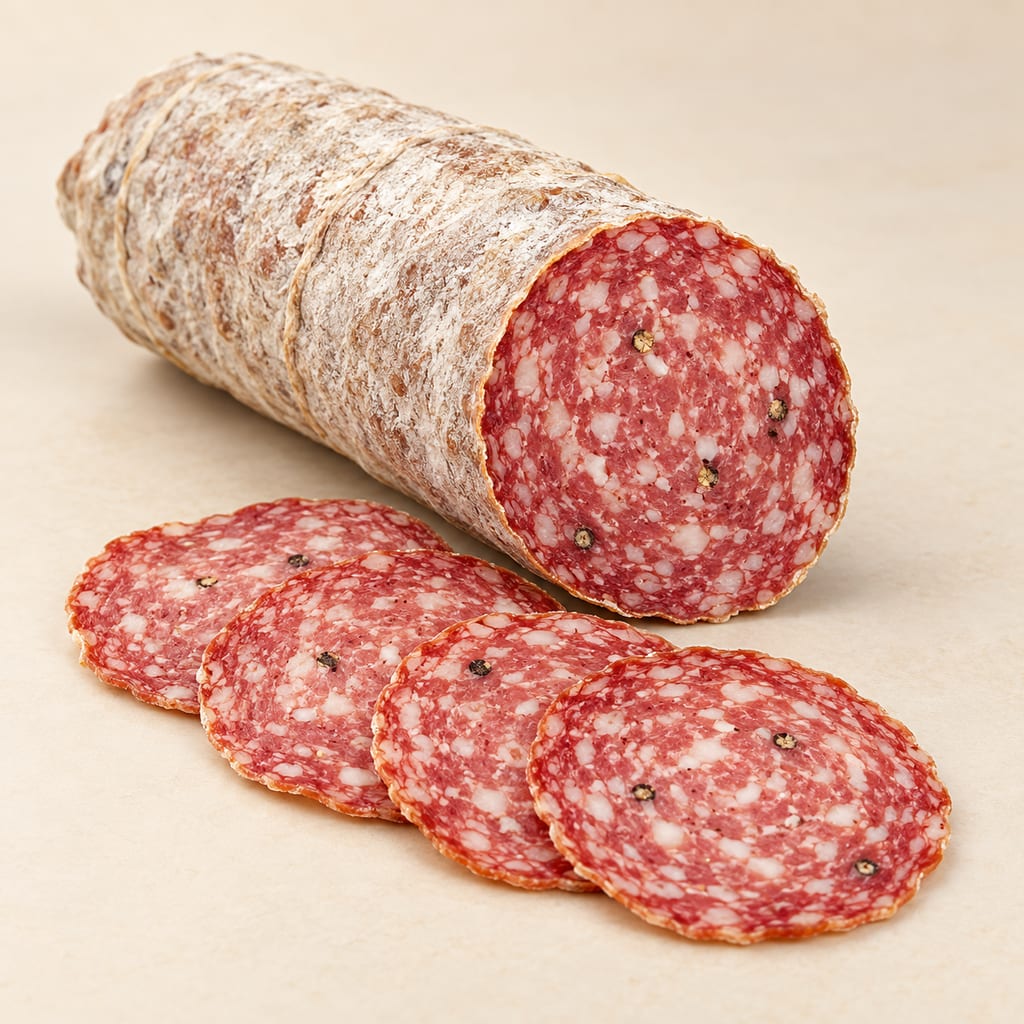
Genoa-style salami, red-wine method
Pork, beef and back fat ferment with a named starter, cure and red wine before the sausages dry in casings. This contemporary formula uses no wood-smoke stage.
 FermenteaWhere food goes to change
Spices and aromatics
Finely ground dried garlic used to distribute garlic flavour through foods, distinct from coarser dried grades and garlic salt.
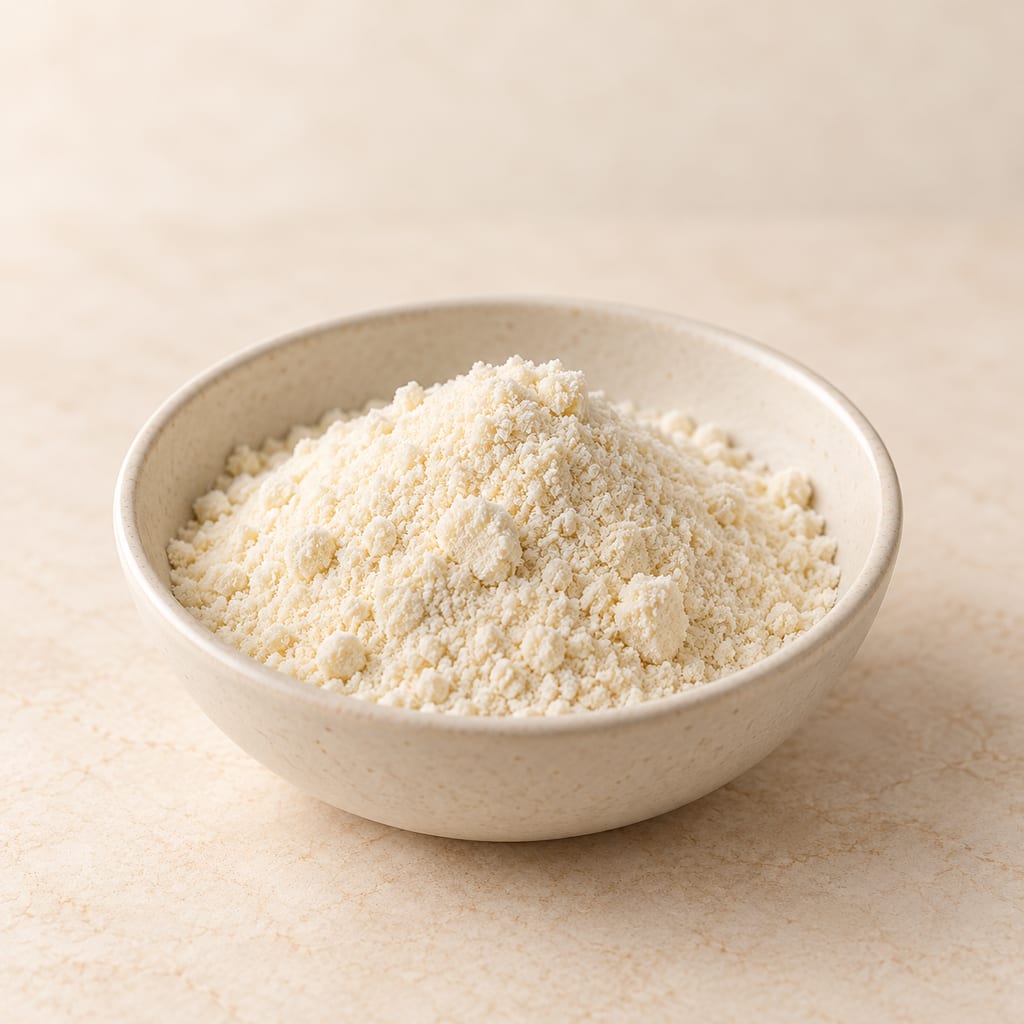
Garlic powder is dried garlic ground into fine particles. Its pale, sometimes softly clumped form carries garlic flavour into foods without leaving the larger pieces of minced or granulated garlic. The bulb has already been separated, dried and milled before the seasoning reaches the cook.
This makes it useful in mixtures where visible pieces are unwelcome or fresh cloves would require another preparation step. Fine powder, granules and flakes are different grades of dehydrated garlic. Garlic salt is a blend that adds salt as well as garlic; its ingredient declaration answers a different question from the size of the particles.
A plain product can contain garlic powder alone. McCormick's named powder, for example, declares that single ingredient and describes uses in soups, sauces, marinades, vegetables, bread dough and meat seasonings. Those uses place the powder both in foods cooked soon after mixing and in preparations whose later treatment is more elaborate. In either case, the cook is adding a processed form of the garlic plant, rather than a new fermentation culture.
Read the label when choosing between neighbouring jars. A seasoning blend may contain other ingredients even when garlic is prominent in its name. The declaration identifies the material entering the dish; a similar pale appearance cannot do that work.
The plant is Allium sativum, a bulbous member of the Amaryllidaceae family. A bulb provides cloves that can be separated for food or used to propagate another crop. The botanical name identifies the garlic plant; it does not specify a drying method, a powder grade or a manufacturer's blend.
Garlic also belongs to a genus that includes other familiar alliums. Plants called wild garlic in everyday speech are not necessarily Allium sativum. The name of a gathered relative should not be used to identify the crop from which an ordinary commercial garlic powder is made.
This distinction is particularly useful when moving from a whole plant to a milled food. Much of the crop's visible structure has disappeared by the time it becomes powder. Botanical identity and the manufacturer's ingredient declaration have to carry information that the intact bulb once displayed. A pale powder alone is a poor substitute for that provenance.
Garlic has travelled with cultivation over a long period. Its present native range and the history of people carrying cloves are related questions, but neither gives a simple birthplace for garlic powder. A crop can be grown far from its wild range, then dried and milled in another place again.
Philipp Simon's account of garlic origins describes collecting garlic and other alliums in Central Asia in 1989. The expedition encountered both hardneck and softneck forms. The account also emphasizes how little early writing reveals about the types grown in ancient kitchens: an old mention of garlic does not necessarily identify the kind of bulb a grower would recognize today.
That uncertainty prevents a tidy progression from one ancient variety to every modern spice jar. Garlic's long food history belongs to the crop. The commercial powder has additional histories of sourcing, processing and grading. A producer's country-of-origin declaration can identify its own supply, but it cannot locate the manufacture of every powder sold under the same ingredient name.
Much cultivated garlic has been propagated through cloves, bulbs or bulbils rather than through seed. Vegetative propagation allows a selected plant to be reproduced as a clone. A grower can retain a useful selection, while movement of planting material carries that selection into other gardens and farms.
This also complicates names. A collection can contain genetically similar material under different labels, or mixed selections under one name. Field appearance can be affected by growing conditions and disease, so a label and a single glance at the crop do not always settle identity. Work on genetic fingerprinting arose partly from the need to distinguish and track such material.
Vegetative reproduction also shapes how a crop can be improved. Keeping a useful clone preserves its combination of traits, but does not combine those traits with another clone through a cross. True seed offers breeders that additional route: offspring can carry new combinations from which another selection is made. Wild garlic collected in Central Asia included plants capable of prolific seed production. Such material connects conservation with the practical search for useful crops. Yield and storage behaviour are separate traits that a breeder may want to bring together, rather than qualities that must always improve at the same time. The eventual seasoning begins with those plant choices, long before a processor decides how finely to grind it.
For the spice, the point is variation before drying begins. Garlic reaches a processor as a crop with a particular selection and growing history, not as an identical chemical input every season. Milling can make the particles look more uniform without erasing those biological differences. The powder's form is standardized through processing; the plant behind it still has a history.
A bulb supplies separate cloves enclosed in papery coverings. In one documented production route, the bulbs are broken apart and the cloves lightly pressed or cut to open the covering and make drying easier. Solar or mechanical drying produces material that can remain as flakes or slices, or pass onward to milling.
The order matters. Cutting prepares the plant tissue for dehydration; drying removes much of its water; grinding reduces the dried tissue to smaller particles. Flakes and powder can therefore share an earlier stage of manufacture without being the same finished grade. The equipment changes as the material moves from bulb to clove, from moist tissue to dried pieces, and finally to a fine seasoning.
Processing also shapes more than appearance. Pretreatments and temperature history influence the colour and retained compounds in dried garlic. In controlled slice-drying comparisons, hotter pretreatments reduced allicin retention and adversely affected colour. The finding concerns the treatments tested, but it makes the manufacturing history relevant when two fine powders look broadly alike.
There is no need to turn that comparison into a drying schedule for a kitchen jar. The processor has to choose a route suited to the bulbs, equipment and desired product, while the buyer receives the result of those choices. Particle size describes the final form; the preceding work helps explain the ingredient's chemical and physical condition.
A freshly disrupted clove develops its characteristic chemistry through an enzyme reaction. Garlic contains alliin and the enzyme alliinase, also called alliin lyase. Breaking the tissue brings the reaction into play, leading to thiosulfinates, including allicin. The aroma of crushed garlic is therefore part of a changing system, rather than the release of one unaltered substance from storage.
Powder has already undergone disruption, dehydration and milling. Those operations can affect the enzyme and the compounds on which it acts. Drying does not necessarily remove all capacity for further thiosulfinate formation: carefully prepared powder produced amounts comparable with cloves under the controlled conditions used to compare them. Nor does that result make every powder chemically identical to a fresh clove. Different groups of thiosulfinates responded differently to drying and the acidity of their surroundings.
This explains why the choice cannot be reduced to a simple ranking in which fresh always contains everything useful and dried contains none of it. The material's treatment and the conditions in which its chemistry develops both matter. A culinary powder can still contain reactive garlic components while having a different history from the clove just cut on a board.
For food, the surrounding mixture adds another setting. A powder going into a sauce is being used as a seasoning in that sauce; one entering a salami is being distributed among meat, fat and the other ingredients of that formula. The laboratory comparison explains the ingredient's capacity for chemical change, while the particular preparation gives that change its culinary setting. It does not supply a fixed fresh-clove conversion for every dish.
The name allicin is also more precise than the general impression of garlic pungency. Alliin, allicin and the products formed as allicin changes can be separated analytically. High-performance liquid chromatography distinguishes and quantifies compounds within a mixture that the nose encounters together.
A strong smell is consequently useful as a sensory description, but cannot state the measured amount of one compound. A pale colour is similarly a description of the powder, rather than a chemical assay. Knowing what the label names, how the garlic was processed and what has actually been measured gives a clearer account than assigning a composition from aroma alone. None of these culinary observations establishes a medicinal effect or a pathogen-control role in a food.
Garlic powder can be added to a sauce, a rub, a vegetable dish or a meat mixture without peeling and chopping cloves at the point of use. Its fine form is particularly useful when the seasoning should be distributed without leaving obvious pieces. The other ingredients determine what that garlic flavour accompanies.
The linked Genoa-style salami, Spanish chorizo, Soppressata di Calabria and Ventricina formulas all name garlic powder. They place it among their seasonings, separately from starter cultures and curing ingredients. The powder is not the organism carrying out fermentation, and its presence does not validate the preservation process.
Those four formulas also place garlic within different combinations. The Genoa preparation includes red wine, while the Ventricina preparation includes white wine and fennel. The chorizo and Soppressata ingredient lists give their own pepper and spice settings. These combinations explain a shared ingredient's use without turning the foods into interchangeable versions of one recipe.
They are contemporary documented formulations. A regional sausage name can have a longer history than the particular powder-based formula shown here. The original links preserve what these makers used, while the crop's ancient food history remains a separate subject. Keep the recipe's own seasoning quantities and the complete meat-process controls with that preparation.
Garlic powder readily absorbs moisture and can clump when exposed. Packaging therefore continues the work after milling: it protects a fine, dry material whose condition can change in contact with the surrounding air. A sealed container and the manufacturer's storage directions belong to choosing and handling the particular product.
Drying, pretreatment and packaging can also interact. Garlic-powder research has compared treated and untreated cloves, several dehydration methods and different package materials, then assessed product quality and fungal counts during storage. The finished result reflects that sequence, rather than packaging being a decorative last step unrelated to the ingredient inside.
A finding about one combination of treatment and package is not a universal shelf life for every powder. The date and directions on a particular product are more useful for its handling than a storage period borrowed from a different formulation. Clumping describes a physical change; it cannot establish either the presence or absence of a pathogen.
Dry spices can enter the food chain contaminated. FDA's spice-safety assessment examines that problem and measures intended to reduce it. Buy from a documented food supply, follow recall information and handle the product as directed. Where garlic powder enters fermented meat, the complete meat preparation still needs its own supported controls. Drying the seasoning and obtaining a familiar garlic aroma do not establish the safety of the sausage.
The source documents a garlic-powder process but does not establish the origin of powder manufacture or this item’s supply. Garlic’s botanical native range is a separate claim.
Pork, beef and back fat ferment with a named starter, cure and red wine before the sausages dry in casings. This contemporary formula uses no wood-smoke stage.
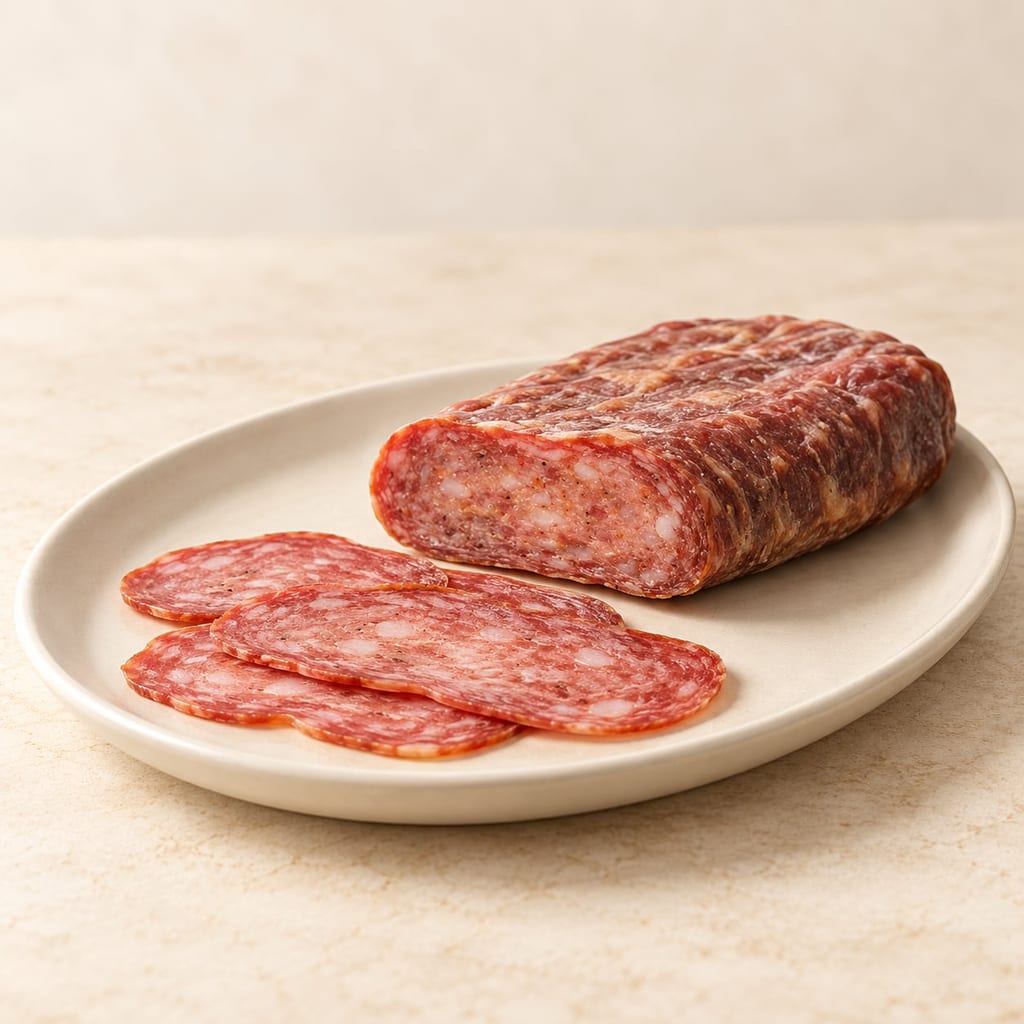
Calabrian soppressata is a flattened pork salami seasoned with pepper and wine. This entry documents a modern starter-cultured adaptation, not household instructions; the process lacks matched pathogen-reduction validation.
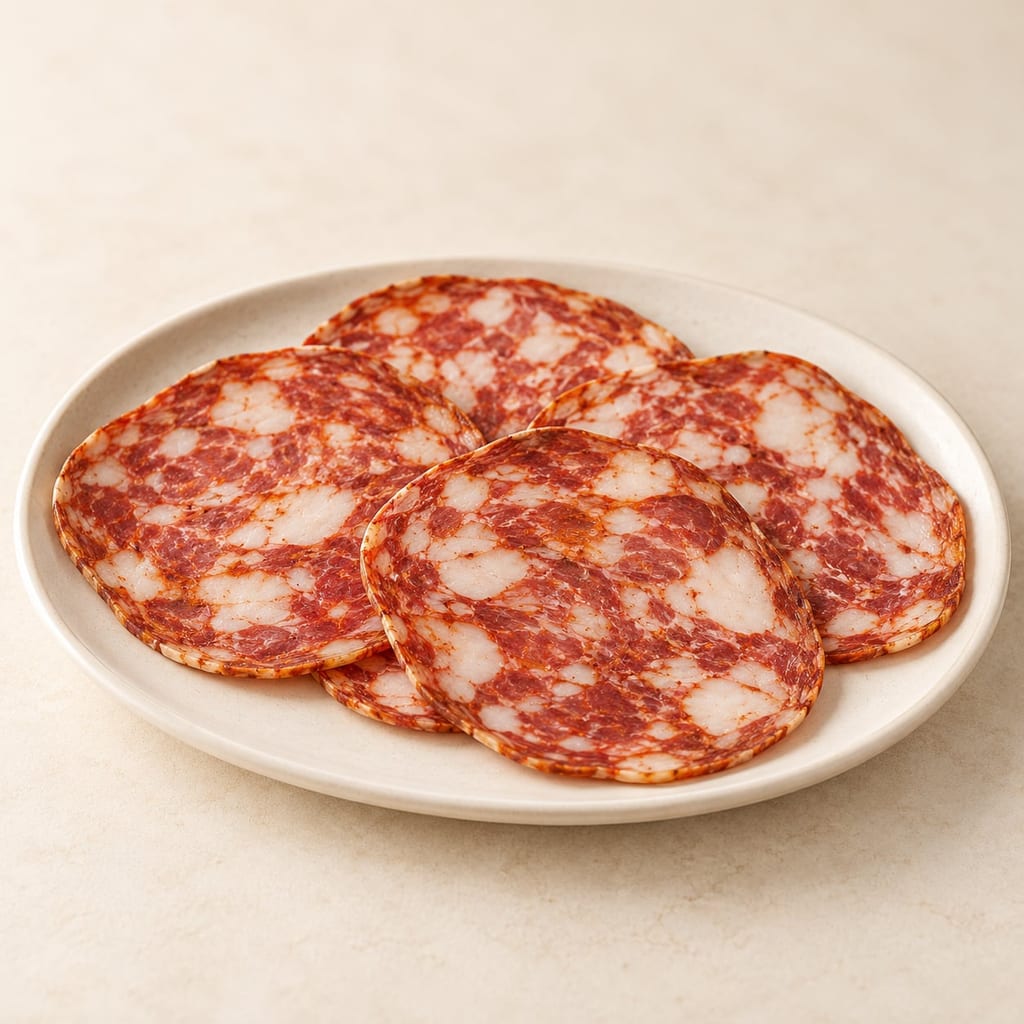
A documentary account of a modern ventricina-style salami source and its Abruzzese context. This page provides no preparation directions or validated home process.
No community contributions have been published for this entry yet.
Sign in to contribute. Published comments and photos are free to read.
Indian Council of Agricultural Research
Process Technology for Garlic Flakes and PowderBulbs are divided into cloves, lightly pressed or cut, dried by solar or mechanical means, and processed as flakes, slices or powder. Powder is hygroscopic and requires protective hermetic packaging.
Cited in: Garlic ready to distribute through a mixture; The processor turns cloves into a dry ingredient; Packaging protects what drying has produced
Occidental Foods
GarlicPowder, granulated and minced garlic are distinct dehydrated grades; garlic salt is a mixture with salt.
Cited in: Garlic ready to distribute through a mixture
Royal Botanic Gardens, Kew
Allium sativum L.Allium sativum L. is classified in Amaryllidaceae; native range is Central Asia to northeastern Iran. This botanical range does not establish powder manufacture origin.
Cited in: The crop behind the seasoning; An old crop without a precise powder birthplace
USDA Agricultural Research Service
Garlic OriginsPhilipp W. Simon describes the 1989 collecting expedition, vegetative propagation and clones, complications of names, field conditions and genetic fingerprinting.
Cited in: The crop behind the seasoning; An old crop without a precise powder birthplace; Cloves carried useful plant differences forward
Biochemical Journal 108(5), 725–730
Purification of the alliin lyase of garlic, Allium sativum L.Alliin lyase was purified from garlic and its activity and substrate response studied.
Cited in: The pungency develops through reactions in the garlic
Planta Medica 58(4), 345–350
Characterization of the formation of allicin and other thiosulfinates from garlicControlled comparison of thiosulfinate formation from garlic powder and cloves; conditions and compound groups matter, without a universal culinary conversion.
Cited in: The pungency develops through reactions in the garlic
Transactions of the ASABE 62(5), 1293–1298
Effect of Pretreatment on Allicin Degradation and Color Change in the Dehydration of GarlicPretreatment and dehydration affect allicin retention and color in the tested garlic slices.
Cited in: The processor turns cloves into a dry ingredient; The pungency develops through reactions in the garlic
McCormick
McCormick Garlic PowderOriginal product label lists garlic powder as the ingredient and describes culinary seasoning uses.
Cited in: Garlic ready to distribute through a mixture; Seasoning belongs to the particular formula
Planta Medica 56(3), 320–326
Quantitative Determination of Allicin and Alliin from Garlic by HPLCAnalytical separation and quantification of alliin, allicin and related products in garlic preparations.
Cited in: The pungency develops through reactions in the garlic
Indian Journal of Agricultural Sciences 92(5), 593–597
Effect of different drying techniques and packaging materials on garlic (Allium sativum) powderTested drying techniques and packaging materials influenced garlic powder quality and fungal counts during the studied storage.
Cited in: Packaging protects what drying has produced
U.S. Food and Drug Administration
Risk Profile: Pathogen and Filth in SpicesSpice contamination is a food-chain risk and risk controls are assessed.
Cited in: Packaging protects what drying has produced
Two Guys & A Cooler
Genoa SalamiThe Genoa formulation seasons pork, beef and pork fat with garlic powder, white pepper, whole peppercorns and red wine.
Cited in: Seasoning belongs to the particular formula
Two Guys & A Cooler
Spanish ChorizoThe Spanish chorizo formulation combines garlic powder with spicy paprika, sweet or smoked paprika and oregano in a pork-and-fat mixture.
Cited in: Seasoning belongs to the particular formula
Two Guys & A Cooler
Soppressata di Calabria: Step by Step Video TutorialThe Soppressata di Calabria formulation combines garlic powder with black pepper, whole peppercorns, Calabrian pepper flakes and powder, and red wine.
Cited in: Seasoning belongs to the particular formula
Two Guys & A Cooler
Ventricina SalamiThe Ventricina formulation combines garlic powder with black pepper, Calabrian pepper powder, cayenne, fennel seed and fennel pollen or powder, with white wine.
Cited in: Seasoning belongs to the particular formula