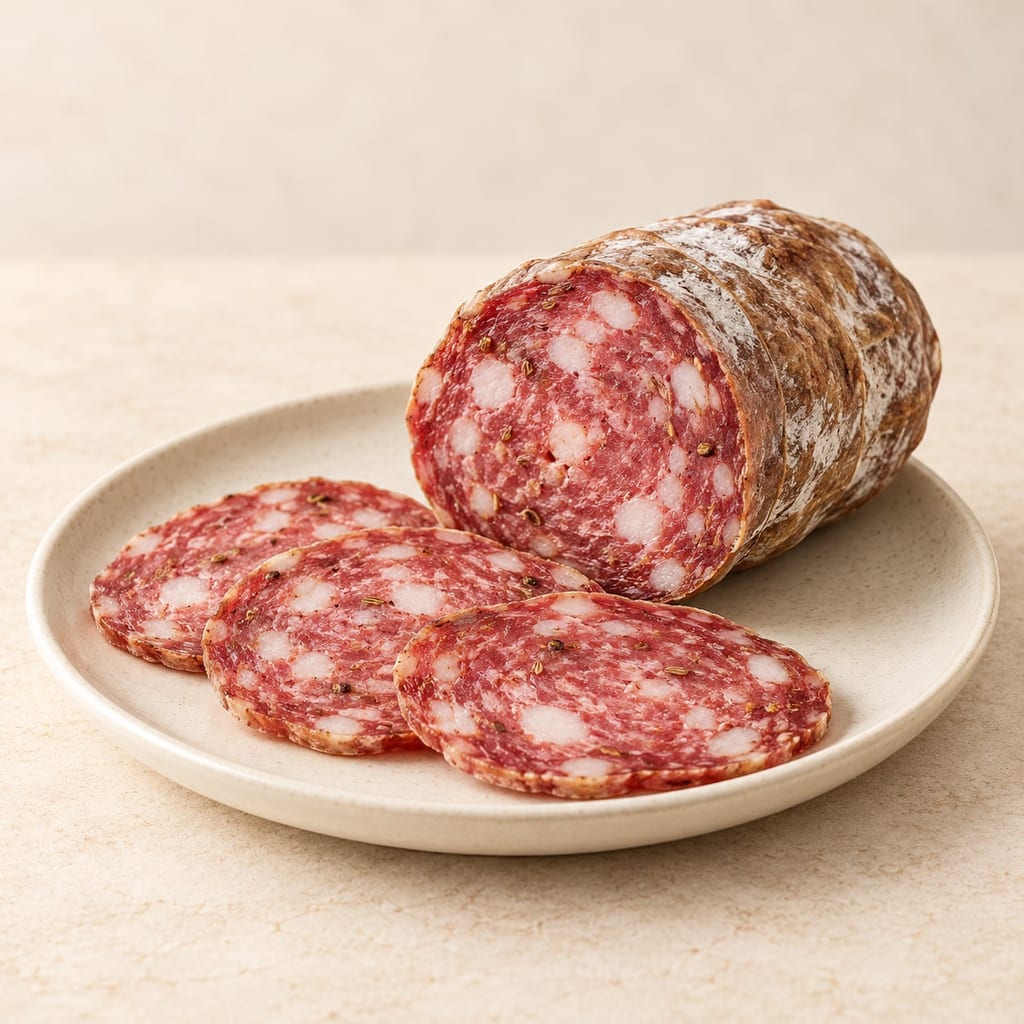
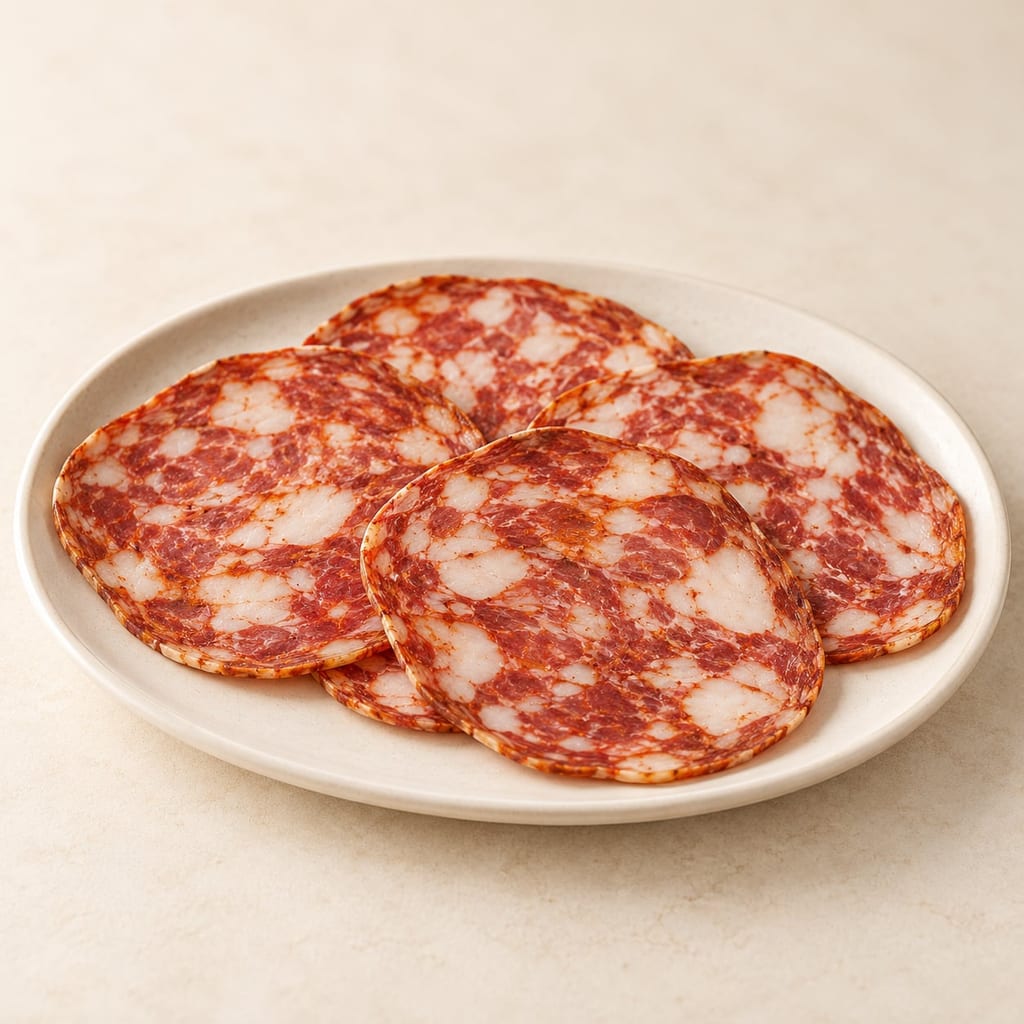
Finocchiona, starter-cultured
A Tuscan-style fennel salami made with pork and back fat. Toasted fennel, fennel pollen and Sambuca flavor this starter-cultured preparation.
 FermenteaWhere food goes to change
Cultures
Mold 600 is a freeze-dried Penicillium nalgiovense culture applied to dry sausage casings, where it develops a pale surface bloom and mushroom-like aroma.
Mold 600 is a freeze-dried culture of Penicillium nalgiovense used on the outside of dry fermented sausages. In the packet it is a ground powder, described as off-white to brownish. On a casing it becomes something visibly different: a short, dense covering of white to light-grey fungal growth, associated with a mushroom-like aroma. The ingredient and the surface it produces are different stages of the same deliberate inoculation.
Its place is outside the sausage. The bacterial starter mixed through the meat and the fungal culture applied to the casing have different habitats and functions. Lactic acid bacteria act within the filling; the mold establishes itself at the interface between casing and air. That distinction explains why a recipe may specify both a bacterial culture and Mold 600 without treating them as alternative ways to begin the same fermentation.
The visible bloom belongs to a wider tradition of mold-ripened meat. Some European sausages develop a relatively light covering, while others carry a denser one. Smoking, casing, recipe and drying conditions all influence that appearance. Choosing a surface culture introduces a selected organism into this setting, but the casing remains part of a working environment shared with air, equipment and other microorganisms.
The species has a history that reaches beyond meat. Penicillium nalgiovense was described by Laxa in 1932 from Ellischauer cheese. The preserved type culture is associated with that cheese, and its collection history passes through several mycologists and culture collections. A species now familiar on salami therefore carries a name linked with cheese research.
That history concerns the fungus as a named species. A commercial culture is a selected product, with its own production and quality requirements. The strain held as a taxonomic reference and the organism supplied in a packet cannot be equated simply because both bear the species name. Culture collections preserve reference material so that names can be investigated and compared; the product is supplied for a particular technological use.
Dry sausage surfaces were colonized before selected cultures became available. In-house organisms could give a characteristic bloom, but the results also varied with the room and its resident flora. Deliberate inoculation developed as a way to obtain more consistent coverage and character. The change was practical: a producer could introduce an intended culture instead of leaving the surface entirely to whatever organisms reached it first.
A mold grows differently from the bacteria dispersed through sausage meat. Its branching threads, called hyphae, extend over and through a suitable substrate. Together those threads form a mycelium. Spore-bearing structures allow the fungus to produce further propagules. The familiar powdery or velvety appearance is consequently a biological structure, rather than a layer of flour dusted onto a finished sausage.
Microscopy of mold-ripened salami has shown tubular fungal structures and branched, brush-like spore-bearing arrangements characteristic of Penicillium. Identifying the organism requires more than observing its colour. Investigators use morphology, growth characteristics and molecular evidence to distinguish closely related fungi. White growth alone is much less information than those combined methods provide.
The casing is also more than an inert support. Its moisture, material and contact with the filling affect the surface available for growth. Natural, collagen and cellulose casings differ in their behaviour during drying. The lean-to-fat balance and size of particles beneath them influence moisture movement as well. The surface culture therefore encounters a habitat partly made by the recipe and partly by the chamber around it.
Introducing a selected fungus can change which organisms dominate a sausage surface. On French dry fermented sausages examined during storage, deliberately inoculated casings carried less diverse fungal communities than naturally colonized ones. Penicillium nalgiovense and the yeast Debaryomyces hansenii were prominent together on the inoculated surfaces. The finding describes a community, rather than an isolated organism acting in an otherwise empty space.
This helps explain the purpose of applying the suspension evenly. The intended mold needs opportunities to establish across the casing, while unwanted organisms also arrive from ingredients, equipment and air. Competition depends on the environment and on the organisms already present. Selected inoculation changes that contest; it does not remove the surroundings or make every point on the casing biologically identical.
The commercial culture is chosen for a particular visual and aromatic direction. Other surface cultures can combine different organisms. A blend containing both Penicillium candidum and Penicillium nalgiovense is a different product from Mold 600, even when both produce pale coverage. Species composition, growth behaviour and aroma are meaningful distinctions within the wider category of meat-ripening molds.
Fungal activity can change molecules near the surface as well as create a visible covering. Proteases break proteins into smaller peptides and amino acids. Lipases act on fats, releasing products that can participate in further reactions. The smaller molecules provide different materials for aroma formation from the intact proteins and fats present at the beginning of ripening.
Penicillium isolates from Argentine salami have differed in growth and protein- and fat-degrading activity under controlled conditions. Temperature, salt and available water affected their performance. The ability to grow and the ability to produce a particular enzyme response were related questions, but not interchangeable measurements. An organism can be present without making every potential biochemical contribution to the same degree.
Greek sausage isolates likewise produced enzymes with different specificities. Activity measured against one fat substrate did not describe every possible fat, and protease measurements differed with the acidity of the assay. Those comparisons make the practical point clearer: a species name identifies a biological group, while the performance of a selected strain depends on both its capabilities and the material in which it is working.
Commercial M600 has been compared with newly isolated Korean Penicillium nalgiovense cultures, including a mudflat isolate named SJ02. Their differences were examined in laboratory enzyme assays and in sausages prepared with the selected cultures. M600 showed protein- and fat-degrading activity in the assays, while the new isolate performed more strongly in several comparisons.
The sausage comparison also showed why a single phrase such as “more flavour” is too simple. Instrumental aroma profiles differed between the cultures, while most measured texture and colour properties did not differ significantly in that experiment. Enzyme activity, volatile compounds, texture and taste are separate observations. A change in one does not require every other property to move in the same direction.
This kind of comparison is useful for understanding selection. A prospective culture is examined for growth, biochemical activity and performance in a food, rather than selected only because it forms an attractive colony. The commercial reference provides a point of comparison, while the new isolate remains a different organism with its own experimental record. Laboratory media and a particular trial sausage reveal capabilities under those conditions, not a universal ranking for every salami.
Water moves from the sausage interior toward the casing and then into the air. If the outside loses moisture too rapidly, a hardened rim can develop while the centre remains wetter. The outside may feel dry before the internal moisture has moved outward in a balanced way. Product diameter, casing permeability, air movement and humidity all influence this transfer.
A fungal covering changes the surface exposed to ventilation. The mycelial layer can moderate direct drying, contributing to a more even distribution of moisture. It acts within the drying system, alongside chamber management and the structure of the sausage. The culture’s intended benefit against a dry rim consequently belongs to a relationship between surface growth and moisture movement.
Surface metabolism can also change acidity during maturation. Mold 600 is associated with an increase in pH and a less sour character at this stage. This follows a different direction from the initial acidification by the bacterial starter. A sausage can therefore pass through acid production within the filling and later surface changes that soften the impression of sourness, while simultaneously becoming firmer through loss of water.
The dry culture is dispersed in water to make a working suspension. That suspension carries spores to the outside of the stuffed sausage. Dipping, spraying and showering are different ways of bringing the same general preparation into contact with the casing. The practical aim is distributed contact with the intended surface, rather than adding the mold to the mince as a seasoning.
Spores can settle, so the suspension needs stirring during use. Pieces of meat, string or other material entering a dipping bath can also affect distribution and application. Handling the suspension is therefore its own production stage, with equipment and cleanliness requirements separate from grinding and mixing. Keeping prepared material from one day to another risks growth of contaminating yeasts.
Application also affects the rest of the workspace. Airborne spores and contaminated equipment can spread a culture beyond the intended product. Industrial systems separate application areas and manage runoff and cleaning for that reason. A culture deliberately welcomed on one casing can be unwelcome elsewhere. Good distribution on the sausage and containment within the working area are complementary parts of using a surface inoculum.
Penicillium includes organisms with different biochemical capabilities. Work on French sausage fungi found differences between species and isolates in production of mycotoxins under the conditions examined. Selecting a food culture is consequently different from allowing an unidentified environmental mold to grow and judging it by resemblance to a desirable bloom.
Penicillium nalgiovense has also been investigated for antibiotic production. In examined Spanish cured-meat isolates, penicillin production extended to the casing and outer meat during early curing, while none was detected in the cured salami samples. Those isolates were not identified as Mold 600. The observation links metabolite production with stage and conditions; it does not describe a constant property of every finished product bearing the fungus.
These studies also distinguish genetic potential from measured food composition. Detecting a biosynthetic gene is different from measuring the compound in a finished sausage. A laboratory assay, an early curing sample and a mature food answer different questions. Culture identity, process control and product assessment remain separate tasks, even when the surface has developed the intended colour and aroma.
The name on the packet matters because surface cultures are formulated products. Mold 600 identifies the Penicillium nalgiovense preparation; a cheese-ripening culture, another numbered meat culture or an unidentified white mold is a different material. The ingredient list on the box also matters: the species name does not describe every carrier or other component in the supplied powder. A dated 2016 formulation lists sucrose, culture, silicon dioxide and manganese sulfate. That formulation is distinct from a strain accession or a certificate for a current lot.
The 22 March 2016 product information declares none of its listed common allergens present as ingredients, including cereals containing gluten, soybeans, and milk and products thereof, including lactose. That dated declaration does not establish current ingredients or absence of cross-contact. Check the current package and supplier documentation for the purchased lot.
The freeze-dried preparation requires dry frozen storage under its product instructions. Storage of the unopened culture, storage of a prepared suspension and storage of the finished sausage are three different questions. The dry powder is kept to preserve a viable inoculum; the suspension is a short-lived working preparation; the sausage is a food whose handling depends on its complete process.
Handling the dry culture also creates a different exposure from eating a finished sausage. Airborne powder can irritate the eyes and airways and may cause respiratory sensitization. Avoid raising or inhaling dust and follow the product’s handling precautions. These dust hazards are separate from the ingredient-allergen declaration for the food formulation.
At the table, the culture’s contribution is encountered as part of a larger food: a pale casing surface, mushroom-like aromatic notes and the combined texture of cured lean and fat beneath it. In the kitchen and curing room, however, it begins as a precisely named living ingredient. Understanding that passage from powder to surface growth gives the bloom its proper place within the sausage’s manufacture.
The 2016 ingredient and allergen declarations describe a dated formulation; the current package remains necessary for lot-specific information. Product strain identifiers and manufacturing origin are not established here. No exact photograph of the exposed culture powder was found. The species’ taxonomic history does not establish the origin or launch date of this commercial product.
The commercial culture’s manufacturing location and strain provenance are not established by the product sheet; cheese-isolate history is separate.
A Tuscan-style fennel salami made with pork and back fat. Toasted fennel, fennel pollen and Sambuca flavor this starter-cultured preparation.
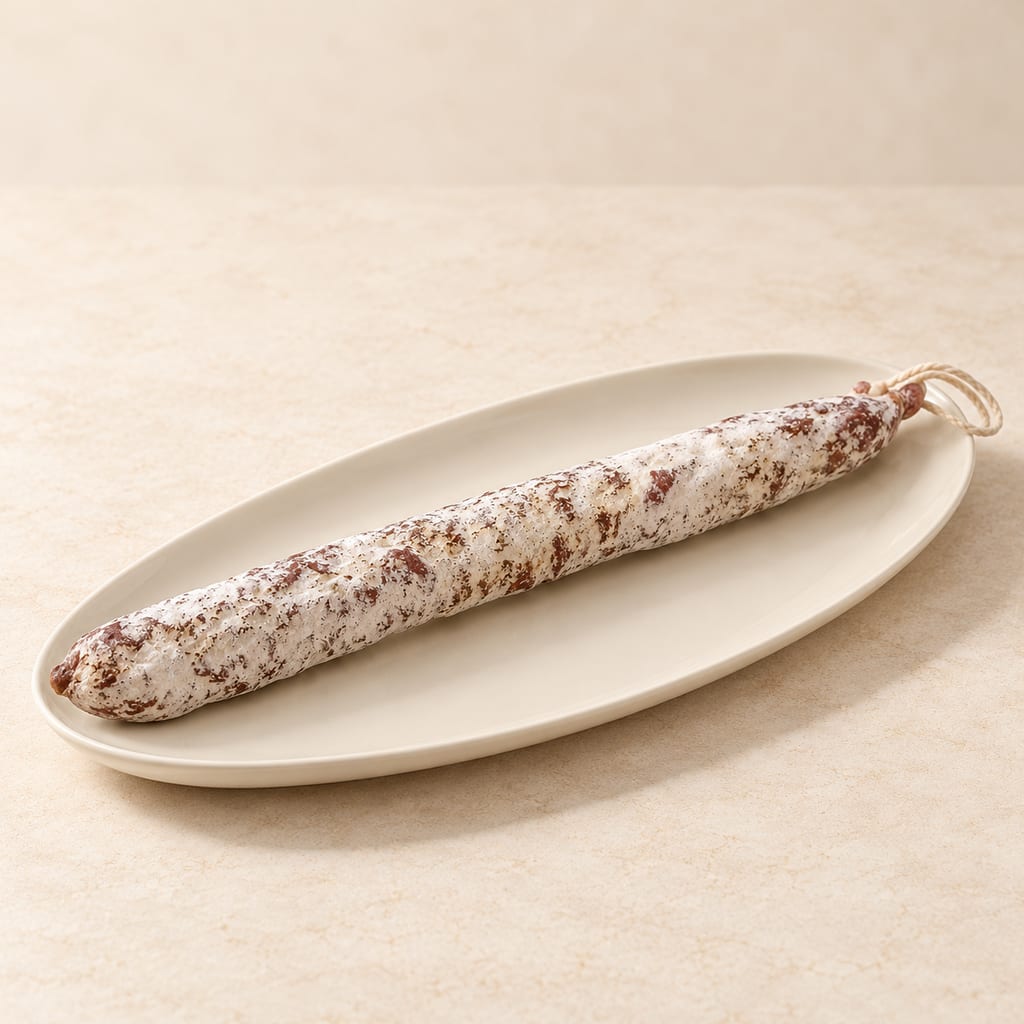
A documentary account of a modern starter-cultured Fuet formula and its place in Catalan sausage culture. The cited raw-pork process lacks matched safety validation, so this page does not present it as a household recipe.
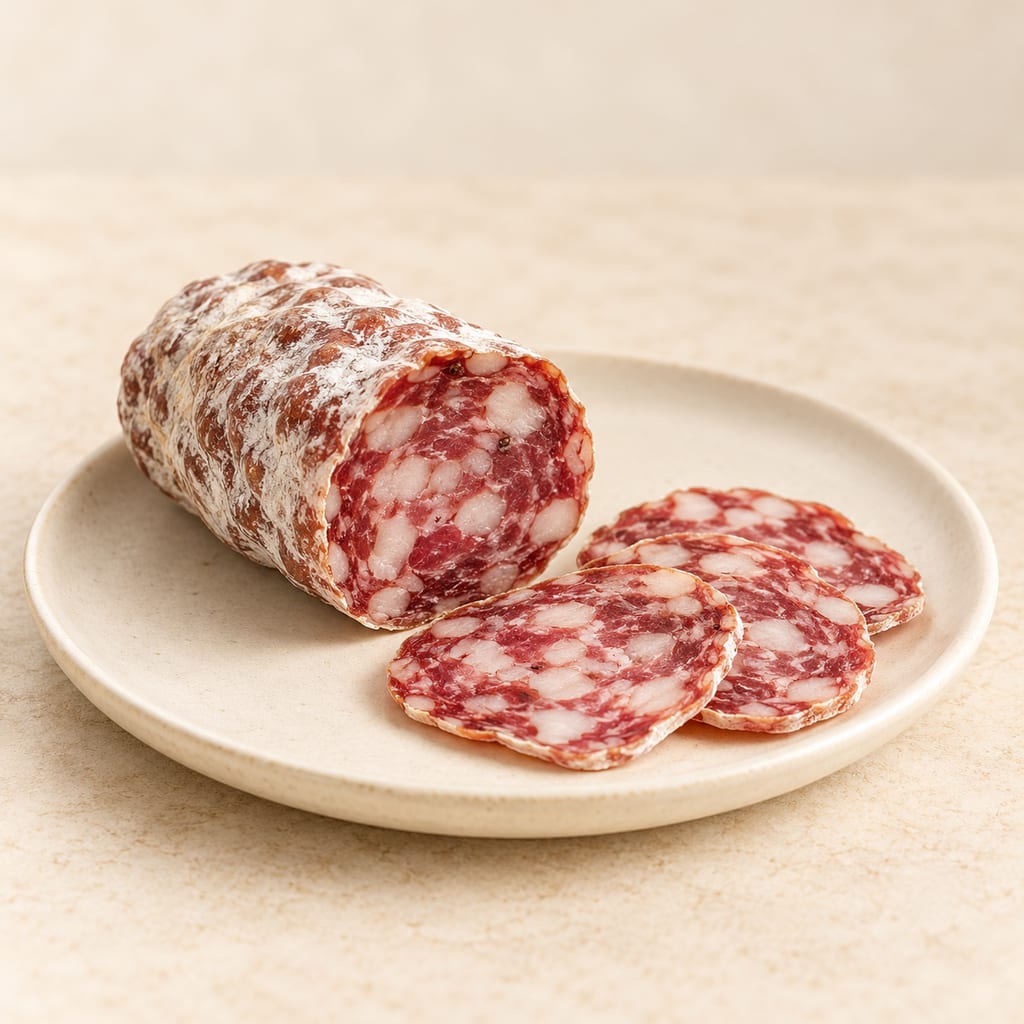
Saucisson sec is a French dry sausage of seasoned pork and fat. This version uses Flavor of Italy starter, white wine and an optional Mold 600 surface culture.
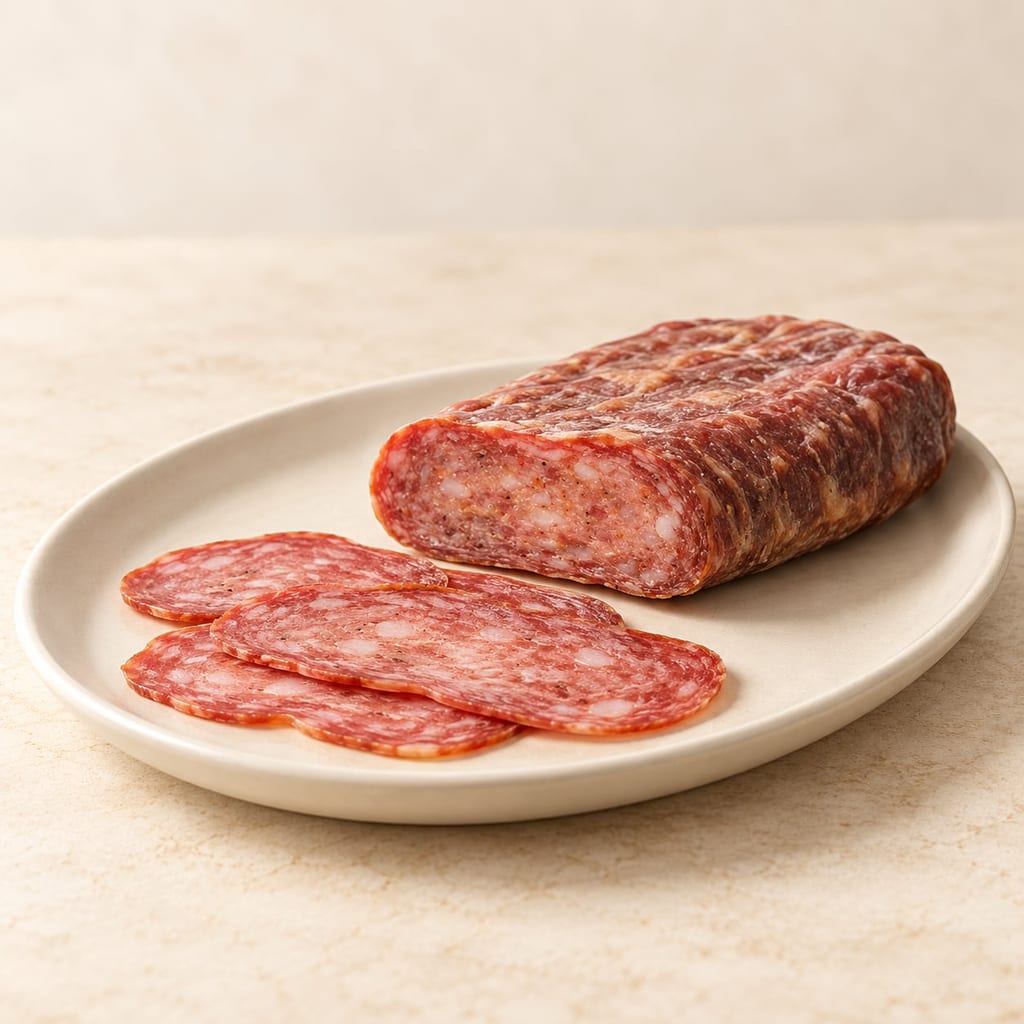
Calabrian soppressata is a flattened pork salami seasoned with pepper and wine. This entry documents a modern starter-cultured adaptation, not household instructions; the process lacks matched pathogen-reduction validation.
A documentary account of a modern ventricina-style salami source and its Abruzzese context. This page provides no preparation directions or validated home process.
No community contributions have been published for this entry yet.
Sign in to contribute. Published comments and photos are free to read.
Chr. Hansen A/SCulture identity · Handling · Method
MOLD-600 Product Information, version 3 PI-EU-EN, 28 August 2012Exact species, powder form, surface application, mushroom aroma, suspension handling, dry-rim and pH effects, dated label/storage/allergen scope.
Cited in: A powder that becomes a living surface; Drying is a physical process around a living cover; Preparing and applying a surface inoculum; Choosing the product and keeping it viable; Notes
Chr. Hansen A/SCulture identity · Handling · Method
Bactoferm Meat Manual vol. 2: Fermented sausages with Chr. Hansen surface cultures, second editionControlled inoculation history, culture distinctions, casing/environment effects, moisture transfer, application and workspace handling.
Cited in: A powder that becomes a living surface; A cheese isolate in the history of sausage cultures; Spores, threads and the casing habitat; What deliberate inoculation changes; Drying is a physical process around a living cover; Preparing and applying a surface inoculum
Antonie van LeeuwenhoekIdentity · Science · History
Taxonomy of Penicillium nalgiovense isolates from mould-fermented sausagesLaxa’s 1932 description concerned Ellischauer cheese; the species history does not establish the commercial product’s provenance.
Cited in: A cheese isolate in the history of sausage cultures
Leibniz Institute DSMZIdentity · Science · History
Penicillium nalgiovense DSM 897Type strain isolated from Ellischau cheese, collection chain, country of origin unknown.
Cited in: A cheese isolate in the history of sausage cultures
Food Technology and BiotechnologyIdentity · Science · History
Microbiological and Sensory Characteristics of Mould-Ripened Salami under Different Packaging ConditionsCanel et al. (2019), Food Technology and Biotechnology, DOI 10.17113/ftb.57.01.19.5803: fungal morphology and product-specific surface ecology.
Cited in: Spores, threads and the casing habitat
Frontiers in MicrobiologyIdentity · Science · History
Microbial Ecology of French Dry Fermented Sausages and Mycotoxin Risk Evaluation During StorageInoculated versus natural fungal communities, P.nalgiovense/D.hansenii findings, species/strain-specific mycotoxin observations.
Cited in: What deliberate inoculation changes; Species identity and secondary metabolites
Food Science of Animal ResourcesIdentity · Science · History
Evaluating the Potential of Korean Mudflat-Derived Penicillium nalgiovense SJ02 as a Fungal Starter for Manufacturing Fermented SausageLee et al.2024: commercial M600 comparator enzyme assays and sausage outcomes; strain/medium-specific effects, not recipe validation.
Cited in: Spores, threads and the casing habitat; Selecting for aroma and texture
International Journal of Food MicrobiologyIdentity · Science · History
Determination of growth characteristics and lipolytic and proteolytic activities of Penicillium strains isolated from Argentinean salamiPrimary abstract only: strain-dependent growth and enzyme responses to experimental conditions.
Cited in: Enzymes make ripening more than a change of colour
Applied Biochemistry and BiotechnologyIdentity · Science · History
An evaluation of the proteolytic and lipolytic potential of Penicillium spp. isolated from traditional Greek sausages in submerged fermentationThe abstract reports enzyme responses that depend on substrate and acidity; it does not characterize the exact commercial culture.
Cited in: Enzymes make ripening more than a change of colour
Applied and Environmental MicrobiologyIdentity · Science · History
Organization of the Gene Cluster for Biosynthesis of Penicillin in Penicillium nalgiovense and Antibiotic Production in Cured Dry SausagesThe abstract and introduction describe penicillin observations during early curing and none detected in the studied cured salami.
Cited in: Species identity and secondary metabolites
Chr. Hansen A/SCulture identity · Handling
Bactoferm MOLD 600 Product Information, Version 3 PI GLOB EN, 22 March 2016Dated composition includes sucrose, culture, silicon dioxide E551 and manganese sulfate; product appearance, physical form, storage and listed-allergen declaration. No current-lot or broad regulatory claim.
Cited in: A powder that becomes a living surface; Choosing the product and keeping it viable; Notes
Chr. Hansen A/SCulture identity · Handling
Safety Data Sheet MOLD-600, Version 3-EU/ENDust may irritate eyes/airways and cause inhalation sensitization; avoid generating/inhaling dust; distinct from food ingredient-allergen declarations.
Cited in: Preparing and applying a surface inoculum; Choosing the product and keeping it viable
New Zealand Organisms Register / Manaaki WhenuaCulture identity · Handling
Penicillium nalgiovense Laxa, NZOR name recordSpecies authority and citation of the 1932 publication relating to Ellischauer cheese; registry information rather than evidence from the original historical paper.
Cited in: A cheese isolate in the history of sausage cultures; Notes