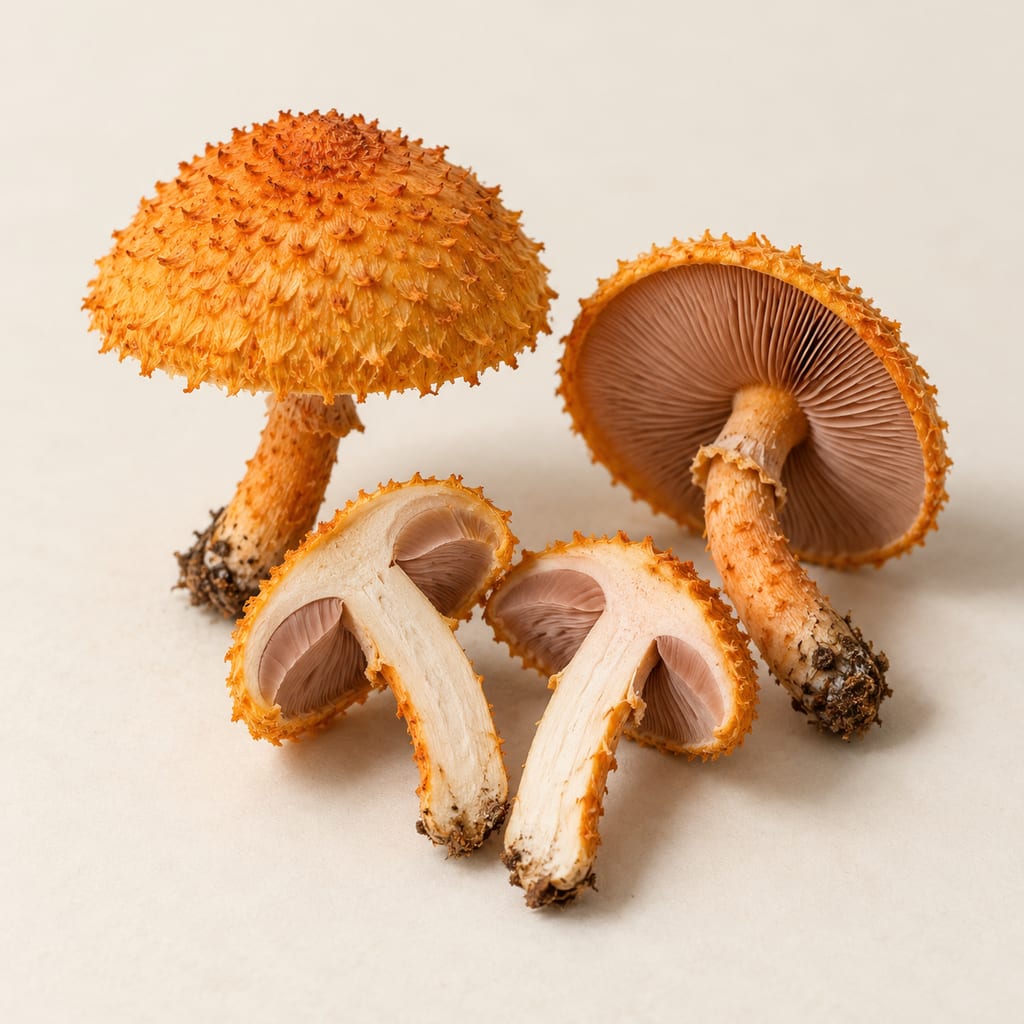
Agaricus crocopeplus
A forest mushroom of the genus Agaricus, recorded as a wild food in the Tshopo province of the Democratic Republic of the Congo in a voucher-backed ethnomycological survey.
 FermenteaWhere food goes to change
Mushrooms
Russula striatoviridis is a wild ectomycorrhizal mushroom recorded as locally eaten in Tshopo province, DR Congo. No preparation method or safety assessment is established for it.
Russula striatoviridis is the name under which the Tshopo study records this mushroom. The catalogue carries it as a research name only, with no common name and no validation against current taxonomic authorities, so the name should be read as a working identification rather than a confirmed one.
The Tshopo study classes the species as ectomycorrhizal, meaning it grows in partnership with the roots of trees, and it lists a voucher specimen, ADK5896, that supports the record.
Milenge Kamalebo and De Kesel's survey of wild edible ectomycorrhizal fungi in Tshopo province lists R. striatoviridis in its main table as a food species, with a frequency of mention of 52 and an EMCS score of 0.3. Informants of the Lokele, Ngando, Topoke and Turumbu communities described it as eaten, while Kumu and Ngelema informants did not. The paper gives no local name for the species.
The record is an interview-based food report. It shows that some local people named the fungus as food; it does not show how the fungus was prepared, how much was eaten, or how it compares with other Russula species in toxicity.
The discussion of the same study says that Russula, Amanita, Lactarius and Lactifluus, though common in the forests, do not seem to be harvested and consumed by local populations of Tshopo province. The authors also record that Kumu informants reject all edible Russula because of their vivid colours. The food classification and the discussion therefore pull in different directions, and the record should be kept with that conflict visible.
The catalogue's review label for this record is food, market and specialist evidence, and its caution is that the record is an ethnomycological food-use report, not an independent toxicological assessment. Nothing in the sources reviewed here establishes that the species can be identified in the field, that a preparation makes it safe, or that it is safe to eat in quantity.
No edibility verdict follows from this page. Identification of any Russula needs a specialist, and the sources cited here do not give identification features for this species.
A mushroom is a brittlegill, a Russula, only when several features line up. The cap is usually brightly coloured. The gills are brittle: they snap when you try to bend them, and the flesh breaks cleanly like chalk instead of tearing into fibres. The stem carries no ring and no cup or sack at its base, and there are no veil remnants on the cap. The gills are attached to the stem, and a spore print is white, cream or dark yellow.
Two checks separate Russula from its look-alikes. Break a gill or cut the flesh: a brittlegill gives no milky juice, while a milkcap (Lactarius or Lactifluus) weeps latex. Then look at the stem. A ring on the stem, a cup or a sack or bulb with torn remnants at its base, or flesh that tears in fibres points away from Russula and towards Amanita, a genus that includes the deadly death cap and many other poisonous species. A mushroom with a ring or a cup at the base is not a Russula, whatever colour its cap is.
Recognising the genus is much easier than naming the species. Cap colour varies widely inside one species, so experts rely on the colour of the spore print, the taste, colour changes in the flesh, how far the cap skin peels, chemical tests and the microscope. A collector who is sure of the genus but not of the species should treat the species as unidentified.
Foragers have long sorted brittlegills by taste. Break off a small piece of cap flesh or gill, chew it for several seconds and spit it out without swallowing; the burn of an acrid species can take half a minute to build. Brittlegills that taste mild are the traditional edibles. Those that taste hot, peppery or acrid, and many bitter ones, are left alone because they irritate the stomach and bowel and can cause vomiting and diarrhoea.
The method works only inside the genus. Use it once the mushroom is positively a Russula, never to decide whether an unknown mushroom is safe: the deadliest mushrooms do not taste unpleasant, and a mild taste says nothing about an Amanita, a Cortinarius or any other family. Within Russula it is a screen for rejecting species, not proof of safety. Some mild species are poor eating, rare species are poorly documented, and a few brittlegills have been linked with poisoning. Cook what you eat, start with a small portion, and identify to species where you can. This record is not a field guide.
Current taxonomic status of the name, confirmation of the voucher identity, the cooking or preparation methods used by the informants, and any toxicity data for this species are not established by the sources read. The next question for a specialist is whether the voucher ADK5896 can be matched to a currently accepted species name.
Interview-based food record from rainforest communities; it does not establish a species-wide food claim beyond the informant groups named.
A forest mushroom of the genus Agaricus, recorded as a wild food in the Tshopo province of the Democratic Republic of the Congo in a voucher-backed ethnomycological survey.
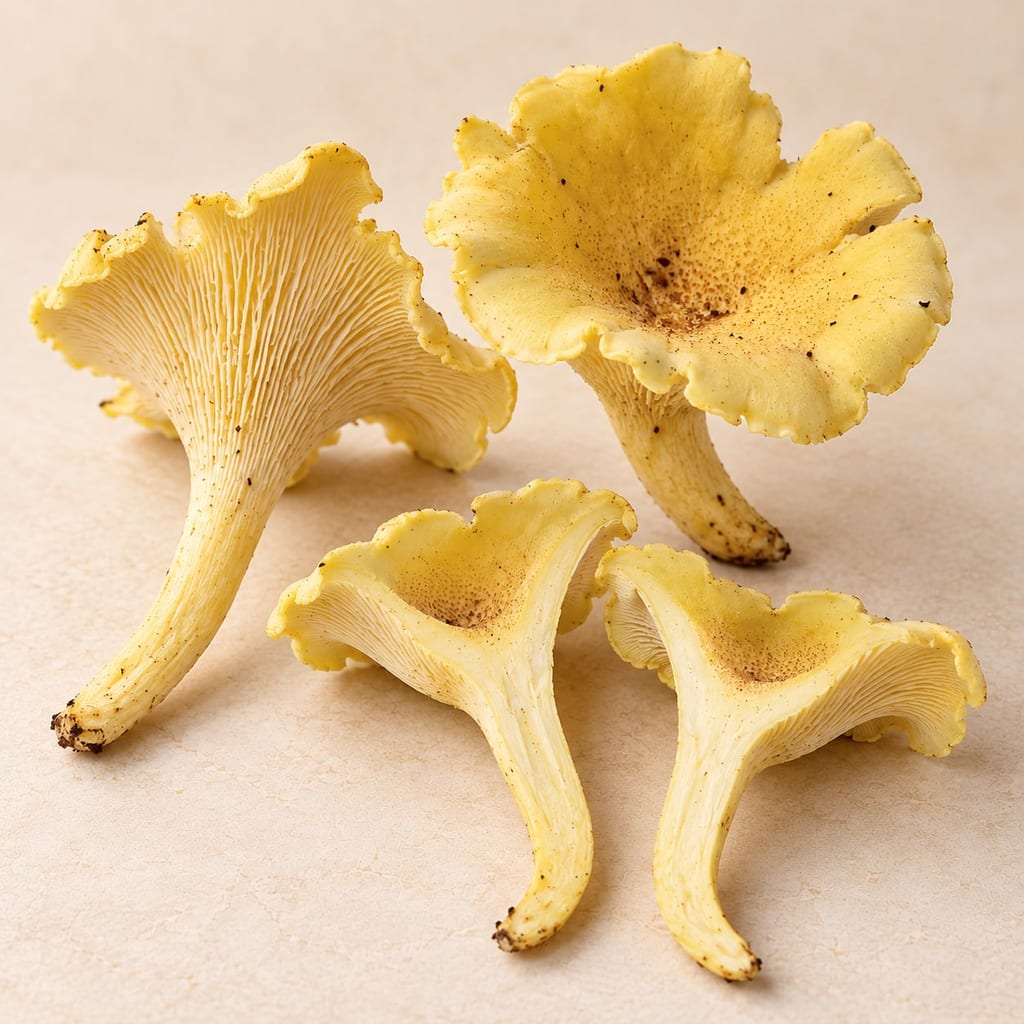
Cantharellus luteopunctatus is a wild ectomycorrhizal chanterelle of central African rainforest, recorded as eaten locally in Tshopo province, DR Congo. Its preparation is not documented.
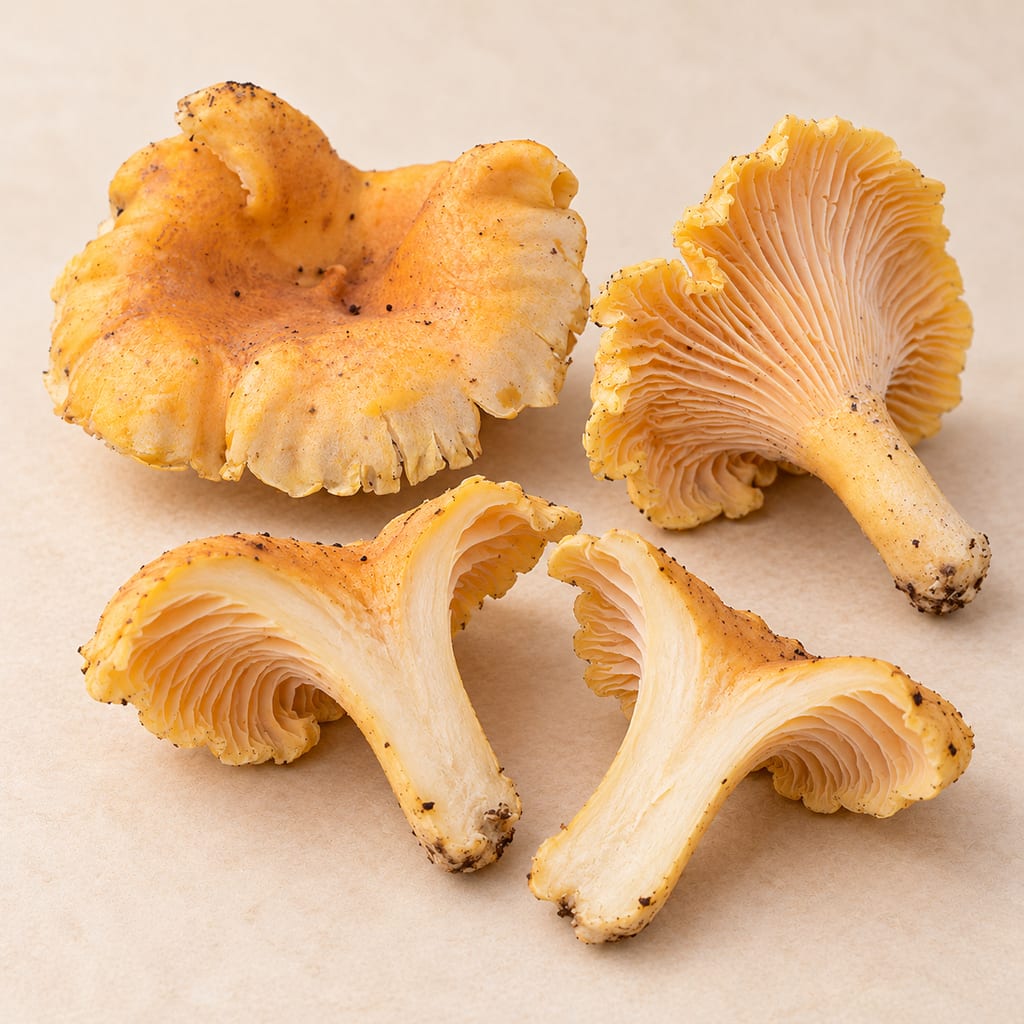
Cantharellus rufopunctatus is a rainforest chanterelle-group fungus that the catalogue records as eaten locally in Tshopo province, DR Congo, where no species-specific preparation has been established.
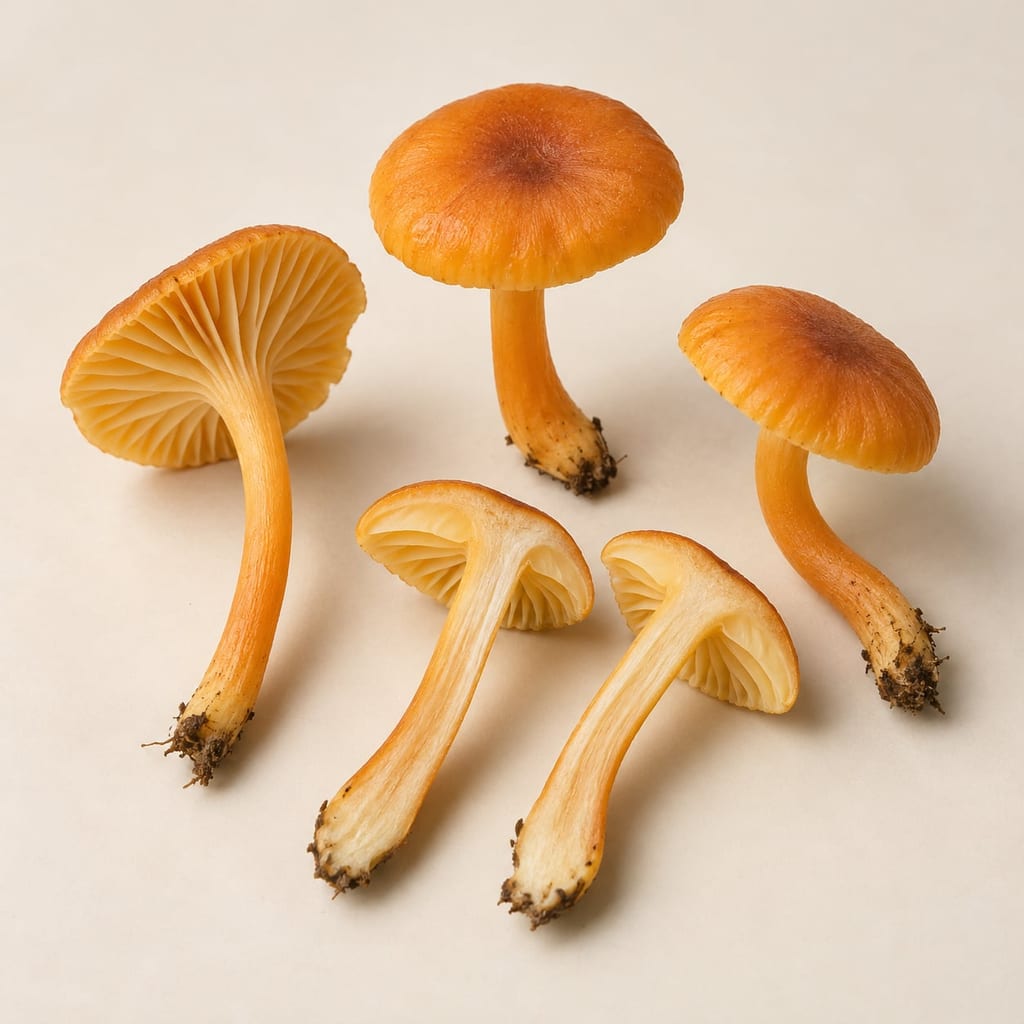
Hygrocybe cantharellus is a small orange waxy-cap agaric with a catalogued food record from Tshopo province, DR Congo, and a taxonomy that the sources read do not settle for that region.
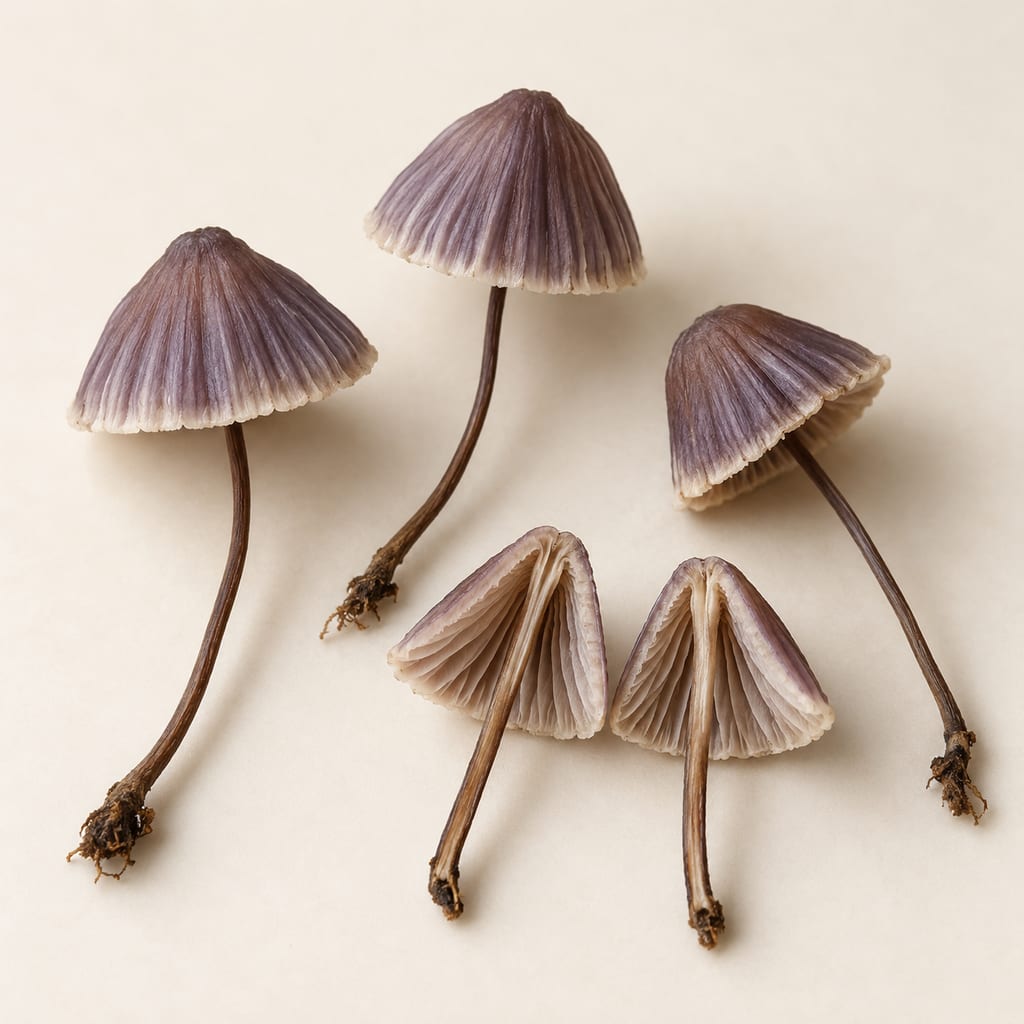
Marasmius bekolacongoli is a wild mushroom of Central African rainforest that field surveys in Cameroon, Gabon and the Democratic Republic of the Congo record as eaten by local people.
Pleurotus flabellatus is a wild forest oyster-type mushroom that grows on dead wood in the Congo Basin, recorded as eaten locally in Tshopo. Its name is entangled with P. djamor, so the record needs taxonomic care.
Russula sesemoindu is a wild ectomycorrhizal mushroom with a local name in Tshopo province, DR Congo. It is recorded as eaten by several informant groups, with no preparation or safety assessment.
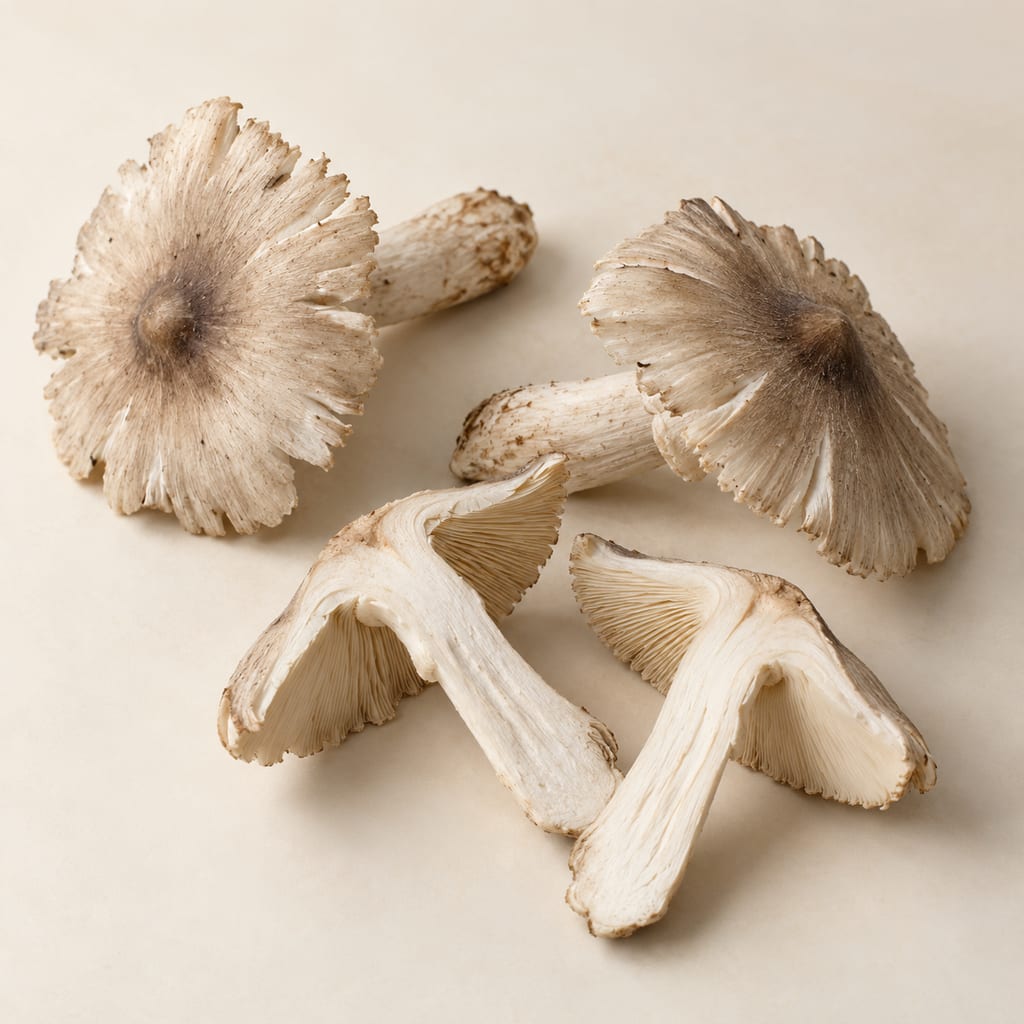
Termitomyces striatus is a wild termite mushroom that grows with fungus-growing termites in tropical Africa and Asia. Local food use is recorded, but its species-level preparation is not established.
No community contributions have been published for this entry yet.
Sign in to contribute. Published comments and photos are free to read.
Journal of Ethnobiology and EthnomedicineFood record · Ethnomycology · Caution
Wild edible ectomycorrhizal fungi: an underutilized food resource from the rainforests of Tshopo province (Democratic Republic of the Congo)Table 1 lists R. striatoviridis as food, ectomycorrhizal, frequency of mention 52, EMCS score 0.3, voucher ADK5896.
Table 2 records no local name for R. striatoviridis; reported as eaten by Lokele, Ngando, Topoke and Turumbu informants but not Kumu or Ngelema.
Discussion states edible ectomycorrhizal fungi including Russula do not seem to be harvested and consumed in Tshopo; Kumu reject edible Russula because of their colours.
The paper gives no cooking methods, preparation details or toxicity remarks for Russula.
Cited in: Identity and research name; Food record in Tshopo province; Conflicting signals in the same study; Identification and safety; Open questions
WikipediaIdentification · Food use
RussulaBrittle attached gills, no latex, no ring or volva; Lactarius weeps latex; taste (mild, bitter, acrid) as a diagnostic character; acrid species are toxic and mild species such as R. cyanoxantha and R. vesca are eaten; the genus is mostly free of deadly species.
Cited in: How to recognise a brittlegill; The taste test, and what it cannot tell you