
Vegetables
Barrels of winter: whole-head sour cabbage in the Balkans
In Futog and Ogulin, whole cabbage heads are soured for winter leaves and a glass of rasol. Their story runs through local seed, dark souring houses, hybrids and protected names.
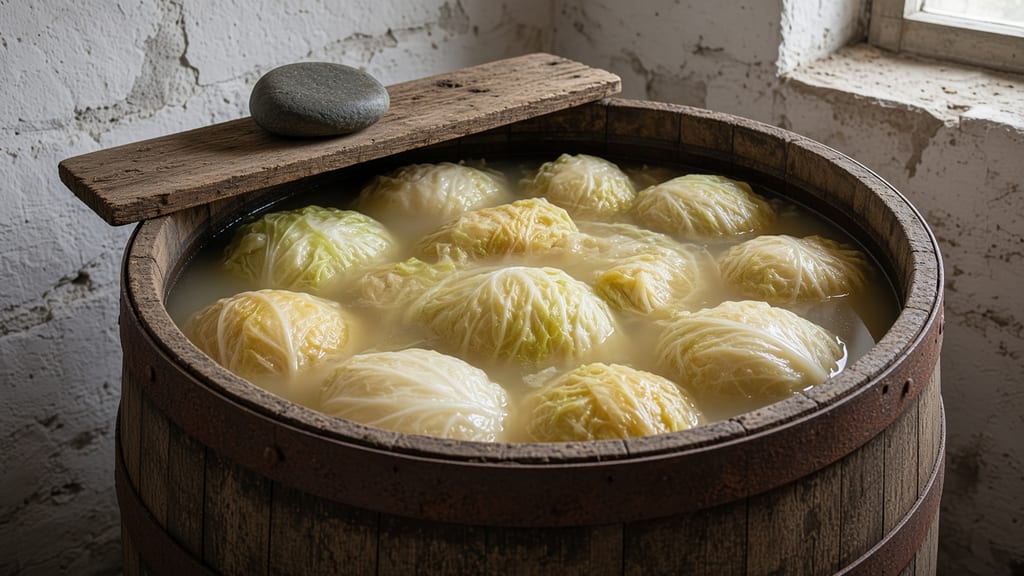
Whole sour cabbage heads packed under brine in a wooden barrel.
Two books for a cabbage
An Ogulin cabbage has two books. One follows the crop in the field. The other follows it through the souring house. Between them, the records account for the land, the variety, the harvest, the sugar in the incoming cabbage and the temperature of its fermentation. The winter barrel has paperwork.
The books belong to the production rules for Ogulinski kiseli kupus, also called Ogulinsko kiselo zelje. The cabbage can reach the customer as shreds or as an entire sour head. In the whole-head version, the leaves must remain thin and flexible. A cook still has to unfold them.
Across the Balkans, fermenting a cabbage whole keeps a future meal in a recognisable shape. A head can supply wrappers for sarma. Its liquid can supply a glass of rasol. November's work therefore concerns the meals still to come, and the room that must hold their ingredients until winter.
Ogulin in Croatia and Futog in Serbia give that work two distinct addresses. Both protect named cabbages. Their production documents record local varieties and finished leaves, but they also reveal a less picturesque story about selection, changing cultivars and packing lines. Behind the familiar winter barrel sits a continuing negotiation over what must stay the same.
The head has a job to do
The whole head survives because the kitchen needs the leaf. A shred can go into a salad or a pot, but it cannot enclose a filling. Sarma requires a sheet large enough to fold. Keeping that sheet through fermentation asks something of the original cabbage, and something of the person who handles it.
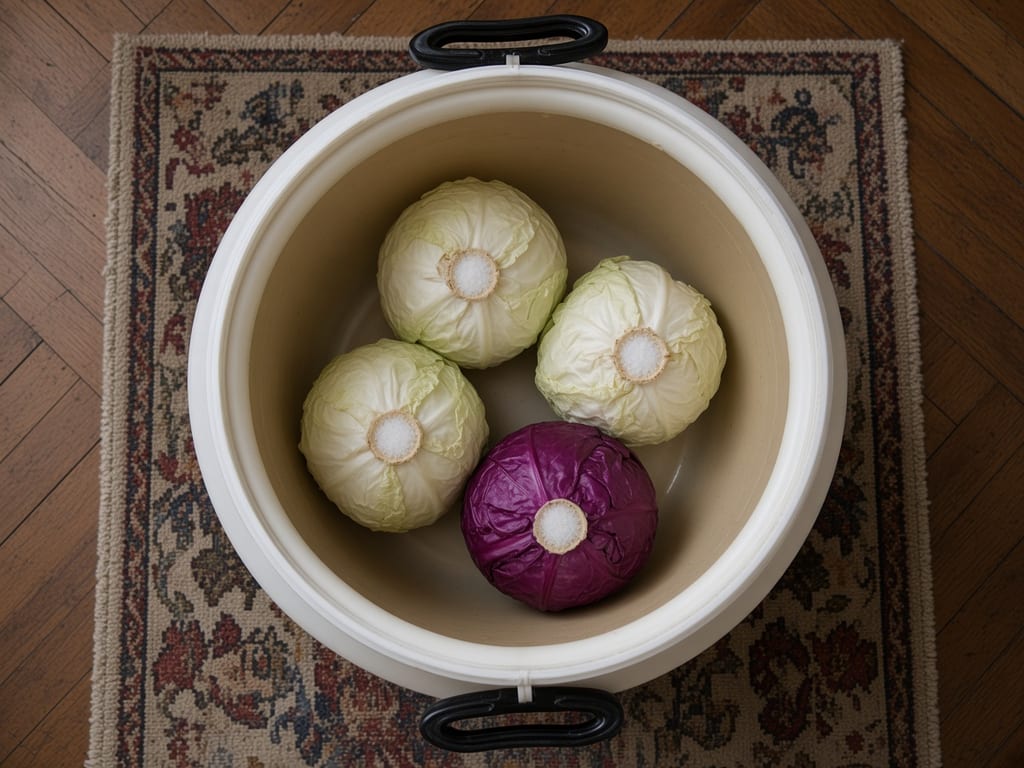
Ogulin's finished cabbage is yellow to golden yellow, with fine veins and leaves that approach transparency. The head has a rounded, flattened shape. It must be firm without toughness. These qualities describe a food at the point of sale, not an abstract preference for sourness. An intact leaf has to bend without losing its usefulness.
Futog's official description also begins with form. Its fresh cabbage comes from the local cabbage population and has thin leaves. The sour head is flattened, with overlapping leaves and an amber-yellow colour. Its taste is mildly sour and salty. The two descriptions overlap, but they refer to different named products with different places behind them.
The range of meals explains the care. Sour cabbage appears as salad, in soup and cooked dishes, and as the wrapping for sarma across the region. A whole head leaves those choices open. Once the knife has shredded it, the choice of a wrapper has gone.
November is a harvest date
Ogulin's production calendar reaches into November. Its late plantings supply cabbage for harvest in October and November, subject to the variety and the weather. That gives the winter barrel a practical date. The crop has to reach the souring house while its heads are suitable for the work.
Harvesting and sorting take place by hand. The grower checks the heads and makes a clean cut below the lowest enclosing leaf. Later, the processor separates heads for whole fermentation from cabbage destined for cutting. The cabbage has not all ripened to the same size. The worker has to decide what each head can become.
The distinction matters more than the picture of a pile of green vegetables suggests. A field supplies uneven raw material. The finished product requires recognisable qualities. Sorting connects the two. A damaged leaf or an unsuitable head is a production decision before it becomes a problem in a vat.
Balkan household accounts also place barrel-filling in the cooler autumn months. The timing survives in kitchens beyond a protected production area. It should not harden into a claim that every Balkan family fills a barrel on the same week, or that any November temperature will produce the same ferment. Ogulin's rules require attention to the room after the harvest is over.
A room made dark
The Ogulin souring house has an instruction for its windows and doors. Darken them. Fermentation takes place in a space with as little outside light as possible, and the vessels themselves should admit little light. The room has a job beyond storing containers.
The specification separates whole heads from shredded cabbage. The cut cabbage receives salt and pressure so that it releases juice. Whole heads receive a clear salt solution. The top of the vessel carries a food-industry polyethylene cover with an appropriate load. Pressure holds the cabbage in its liquid as the mass settles.
The dark room also needs warmth at the start. The first, active phase lasts about seven days, with an air temperature of at least 16 °C. After that phase the specification describes continued fermentation over the following six to eight weeks, depending on the heads' size and firmness. It gives further limits for the processing and storage environment.
Those are requirements within a defined production system. They are not a tested instruction for a new home barrel. Their interest here is what they reveal about the place. A cabbage cellar is an environment people manage. The worker must inspect the load after the cabbage settles, keep the vessel clean and follow the progress of the batch. Darkness alone does not make the cabbage sour.
Twenty days for a Futog head
In 2014 food technologists in Novi Sad put the question of the local cabbage to a test. They took whole heads of the Futoški population and of a hybrid called Bravo, stripped three or four outer leaves from each, and set them in salt solution at 1, 1.5 or 2 % salt. The heads were pressed tight and sealed under plastic film at 18–22 °C. For 80 days the researchers drew off brine and leaves and measured the acids.
The local cabbage won on speed. By the authors' reckoning, the Futoški heads had finished fermenting after 20 days. The Bravo heads took 50. Lactic acid in the Futoški brine reached about 12 g per litre and held steady from day 37 to day 80, while the Bravo brine was still gaining acid between day 55 and day 80. The authors explained the gap by the hybrid's tighter heads, into which salt moved more slowly, and suggested that compact hybrid heads might need more salt.
That result sits awkwardly beside Ogulin's cultivar list. Ogulin admitted hybrids for their disease resistance and yield, and the Novi Sad paper found the old Serbian population better suited to souring as a whole head. The two documents answer different questions. A grower wants a crop that survives the field, and a souring house wants a head that takes salt evenly.
The study is a laboratory trial with one set of batches. It does not give a household schedule, and its 20 days is not a safety endpoint. What it does give is a measured reason why people who sour whole heads care which cabbage goes into the barrel.
The weather outside the souring house
Ogulin's production area lies where continental conditions give way to a mountain climate. The specification places it at the approach to Gorski kotar and Lika. This is a different account of place from a claim that a cellar has a secret ingredient. The raw cabbage grows under local conditions before it enters a room where people manage the ferment.
The document gives soil and climate their own sections. It describes low, relatively level growing ground, with deep cultivated soils, and connects the crop to the area's moisture. Those details belong to the argument for a protected origin. They explain why the production rules follow the cabbage back to the land.
The room does not reproduce the weather outside without intervention. At the start of fermentation, the minimum required air temperature matters. Afterwards, workers check the settling cabbage and its load. The document's agricultural description and processing instructions address successive parts of the food's production. Autumn supplies a harvest, but it does not remove the need to manage the vessel.
That distinction keeps the November story honest. A date on a calendar cannot tell a processor whether a particular head is ready to pick. A cold night cannot tell a home cook whether an unknown ferment is complete. Both the field and the vessel require decisions about an actual food in an actual place.
What the salt water becomes
At the beginning, water and salt make a solution. At the end, the cabbage sits in a salty, acidic liquid. Fermentation connects the two. Calling both liquids brine can conceal the change that gives the finished drink its identity.
Salamura is a general name for a salt solution in regional usage. A Croatian technical dictionary pairs it with rasol and defines salt dissolved in water, in an entry about fish processing. That broader meaning is a useful warning against treating the word itself as proof of fermentation. Here, rasol means the finished liquid from sour cabbage. The food supplies the context that the word brine leaves open.
The Ogulin specification makes the difference between forms explicit. Whole heads remain in an added salty, sour covering liquid. Shredded cabbage remains in its own salty, sour juice. The same broad food family therefore contains liquids with different starting points. One cannot infer the contents of a glass simply from the word sauerkraut.
The production rules describe lactic acid as a product of fermentation under low-oxygen conditions. They also set separate chemical limits for the finished cabbage. Salt and acid are different measurements. A cabbage can taste salty before fermentation has done its work, and a sour taste cannot tell the whole history of a batch.
For the drink, the useful distinction is simple. Rasol comes from finished fermented cabbage liquid. A fresh mixture of salt and water is not a substitute. Nor does taking liquid from a vessel of uncertain origin establish that it is fit to drink. The identity of the food includes the process that produced it.
Futog keeps the seed
Futog's official geographical description is brief. The cabbage comes from the local population, and both the fresh and sour products belong to the village's production area. The entry protects a cabbage before fermentation as well as the sour food afterwards. The field remains part of the name.
The fresh head is light green outside and white to whitish yellow at the cut. The sour head becomes amber yellow, with overlapping leaves. The written description leaves no need for an invented tour of a cellar. Colour and leaf structure provide enough to recognise the food that producers are trying to preserve.
The producers' account gives the seed a central place. It describes a local effort to maintain the Futog population and an association of growers and processors formed around it. A protected name has value only if the underlying cabbage remains available. Seed-saving is therefore part of the winter food's production, even when the customer meets it as a sealed bag.
The account also describes sour cabbage sold as heads, shreds and leaves under vacuum. That range answers several kitchen needs. It allows the intact head to survive beyond the household barrel while making individual leaves available to a cook. The preservation practice continues through packaging as well as through fermentation.
Ogulin changes the cultivar list
Ogulin's protected cabbage contains a complication for a tidy story about an unchanged local variety. The March 2022 specification allows the local Ogulinski variety and a named list of hybrids. It permits one of those varieties or a mixture. The legal description of tradition has room for agricultural change.
Disease resistance helps explain the change. The specification describes growers' move towards hybrids with better resistance and higher yields. It retains the qualities required of the finished cabbage. The consumer still receives a flattened head with thin, flexible leaves, but the route to that head can include a different cultivar.
The named hybrids are not a general permission to use any cabbage. A defined list replaces the claim that only the local variety can qualify. Origin still matters. The March 2022 document describes a production area that includes Ogulin and the municipalities of Josipdol, Plaški, Tounj and Saborsko. Growing the raw cabbage and processing it belong within that defined area.
The change is useful because it makes a protected name less simple and more exact. A familiar food can retain a market identity while its producers respond to disease and yield. The decision is visible in the specification, where the permitted plants have names. The phrase traditional cabbage cannot carry all that detail by itself.
The barrel and the vacuum bag
The modern packet belongs in the story. Ogulin's specification records vacuum-packed sour heads on the market in 1975 and their later appearances at fairs. It also describes the expansion of fresh and sour cabbage production in the 1960s and 1970s. Those dates concern commercial production and packaging. They do not date the invention of fermented cabbage.
A household barrel and a vacuum-packed head answer different problems. The barrel holds a winter supply at one address. The packet allows a head or a portion of leaves to leave the souring house and reach another kitchen. Neither form removes the need to handle and store the food appropriately.
Ogulin's name entered the European Union register as a protected designation of origin under a regulation adopted on 10 August 2015. Futog's official Serbian entry describes an appellation of origin. Those are not interchangeable labels. The shared importance of place does not turn the Serbian cabbage into an EU PDO.
The distinction matters when a name travels. A home cook can make sour cabbage outside either production area. A successful ferment does not acquire either protected origin. The name records a relationship between production and place, alongside the qualities of the food. It is more specific than praise for a good barrel.
A leaf crosses borders
The dishes travel more freely than the protected names. Sarma belongs to winter tables in several Balkan countries, with fillings and seasonings that change between kitchens. Adrijana Alački, who leads North Macedonia's national cooks' organisation, describes a filling of rice, minced meat and spices, or spiced rice alone for meatless days. She says that North Macedonia smells of sarma in December and January.
The numbers can be large. In December 2008, for the feast of Saint Nicholas, 160 cooks in Prilep made 80,191 meatless sarmas in six hours and entered the Guinness record book. The same sour leaf can hold a filling for a fast day or a richer mixture for a feast. The work of preserving cabbage comes first.
Sour cabbage also travels through other dishes. In Slavonia it appears in salads and podvarak. In Serbia the favourite is cooked sour cabbage, svadbarac, and the Kupusijada festival in Mrčajevci draws several thousand visitors each autumn. The resemblance between meals does not erase their local names, but neither does a name prove that a dish belongs to only one nation.
The food-heritage researcher Tamara Ognjević goes further. She told Radio Free Europe that people north of the Balkans mostly sour cabbage shredded, and that souring whole heads belongs to this region alone. That is her claim, made in an interview. It explains why cooks here prize the whole head, but it is not a survey of every European cellar.
The second serving is liquid
The glass is the barrel's other serving. The Ogulin specification uses the word rasol for the liquid in its vats, and after fermentation it keeps the cabbage in a dark room with the rasol at no more than 22 °C. A review of European fermented drinks puts Serbian rasol beside German Sauerkrautsaft and Romanian moare.
Its winter reputation includes the morning after a heavy meal or a night of drinking. Serbian food writing treats cabbage brine with affection and credits it with restoring the drinker. That is evidence of a custom and a belief. The same review found that research on sauerkraut juice and health came from laboratory and animal studies, which cannot show that a glass of rasol treats a hangover.
Factories treat the liquid differently. In a Latvian study, the juice from shredded sauerkraut made up about 30 % of the cabbage's weight. The producer drew it off at packing and counted it as a by-product. It averaged pH 3.7, and the authors note that its short shelf life and strong aroma limit its commercial use.
Salt matters too. A food can be traditional and still add a good deal to the day's salt, and the NHS advises adults to keep below 6 g a day. The home recipe that goes with this piece keeps the glass small and draws it from finished, tested sauerkraut or a juice sold ready to drink.
The home kitchen has a different contract
A protected production specification and home food-preservation guidance answer different questions. One defines a named commercial food, its origin and its production. The other gives a home cook a method for a particular preparation. They should not be joined into a new recipe whose safety neither document establishes.
The National Center for Home Food Preservation's sauerkraut method begins with shredded cabbage. It specifies the salt, the packing and the liquid that must cover the cabbage. It also gives fermentation temperatures and times. The instructions do not validate a barrel of whole heads simply because both foods are called sauerkraut.
Keeping that boundary does not make the regional practice disappear. It allows the history of whole heads to stand beside a defined modern home method without confusing the two. The same boundary applies to the juice. Taking liquid out of a ferment can leave cabbage without its covering liquid. Changing the salt to make the drink less salty changes the original preparation.
The home recipe takes the liquid from sauerkraut that has finished fermenting by the tested method and keeps the cabbage covered, or it uses a bottled juice sold ready to drink. Storage, the date after opening and the declared salt content then belong to that jar or that bottle. No account of an Ogulin souring house can replace them.
What the books can tell us
The production records establish some things with precision and leave others open. They can tell a buyer what qualifies as Ogulin cabbage. They can record a batch's raw material and processing temperature. They cannot supply a complete history of every household that preserved cabbage before those records existed.
The specification also reaches back. It says cabbage has been grown around Ogulin since the fifteenth century. A cabbage crop in a district does not by itself show a fifteenth-century sour-cabbage method, and a date for a processing plant does not make the food a twentieth-century invention. A careful history has to keep those distinctions even when a single ancient origin would make an easier story.
The household accounts are more particular. Zvonko Horvat, a journalist from Virovitica, remembers his family souring cabbage in large vats and his own job as a boy, treading it down. Alački describes rows of heads and salt, a wooden lid and a heavy stone, and then water poured over the top. These are accounts of particular kitchens, not a census of Balkan practice.
Read together, the records and recollections describe continuing work. There is the plant in the field, the choice of a head, the vessel in the dark room and the meal that needs a leaf. Each has a different witness. No single number of centuries can replace them.
The head leaves the room
When Ogulin cabbage leaves the fermentation vessel, the worker handles it again. The specification describes heads taken out by hand and packed for sale. The head has to retain the qualities that the grower and processor selected for: the flattened form, the fine veins and the flexible leaves.
This is where the two books meet the food. The field record follows the cabbage that entered the souring house. The processing record follows what happened there. At the far end is something a cook can lift from a packet and separate leaf by leaf.
Futog's packed heads and leaves also leave the local vessel. The old kitchen purpose remains legible in the new package. The leaf must still fold.
The barrel holds the leaves until they are needed. When the cook takes them out, there is liquid left for a glass.
Related
Discussed in this article
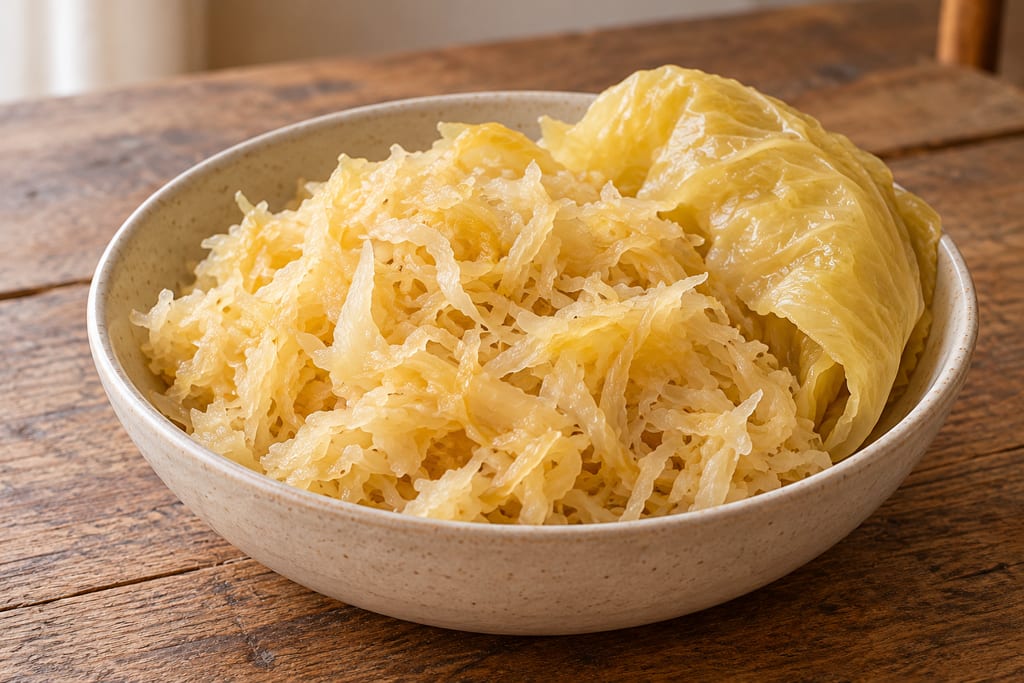
Futoški kupus (Futog sour cabbage)
Serbian sour cabbage from the Futog area, made from the autochthonous Futoški cabbage population and registered as a protected product in 2008. It is a subset of general Serbian kiseli kupus.
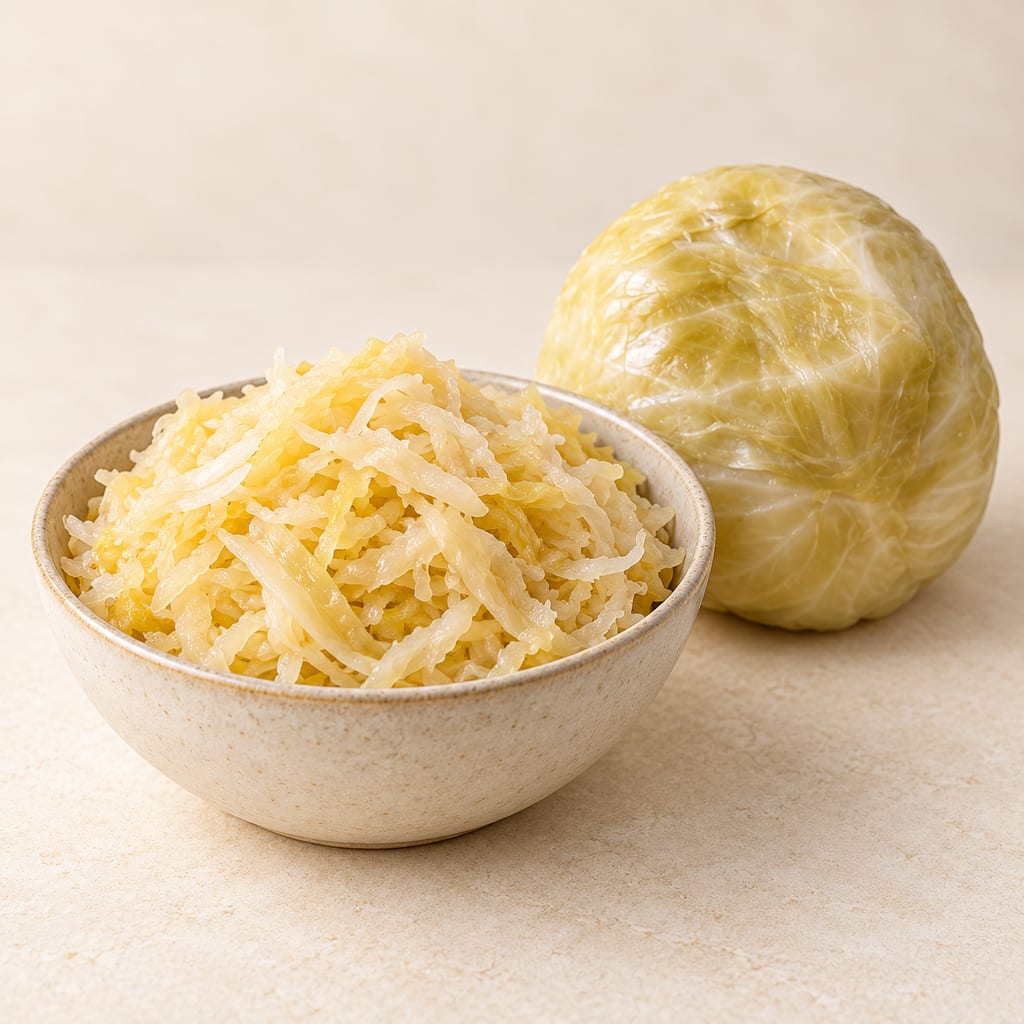
Ogulinsko kiselo zelje (Ogulin sauerkraut)
Protected Croatian sauerkraut from the Ogulin area: fresh white cabbage naturally lactic-fermented without preservatives, sold whole or shredded, from registered establishments.
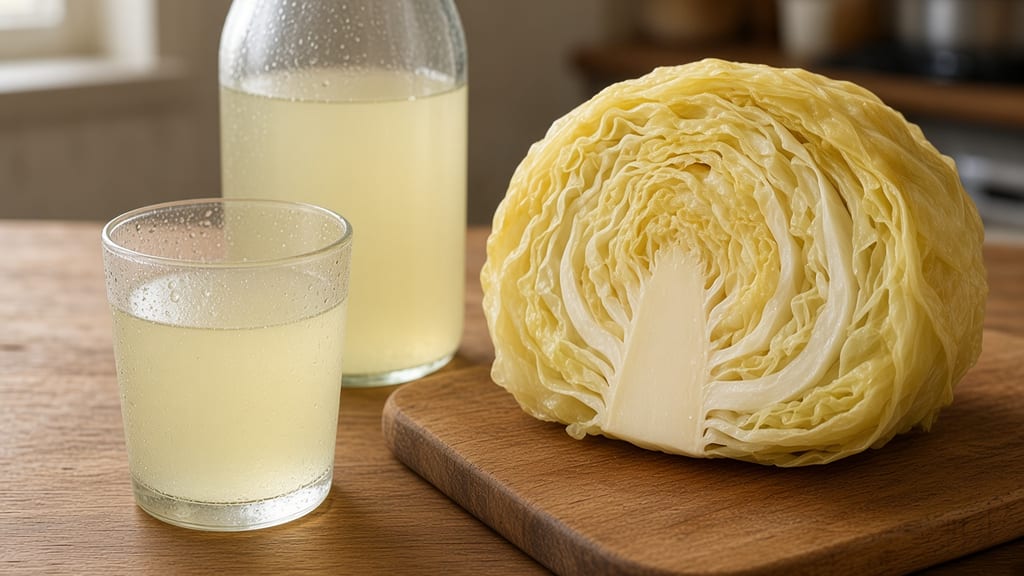
Rasol
Rasol is the sour, salty liquid of fermented cabbage, drunk cold in a small glass across the Balkans. Here it comes from finished, tested sauerkraut or a ready-to-drink juice.
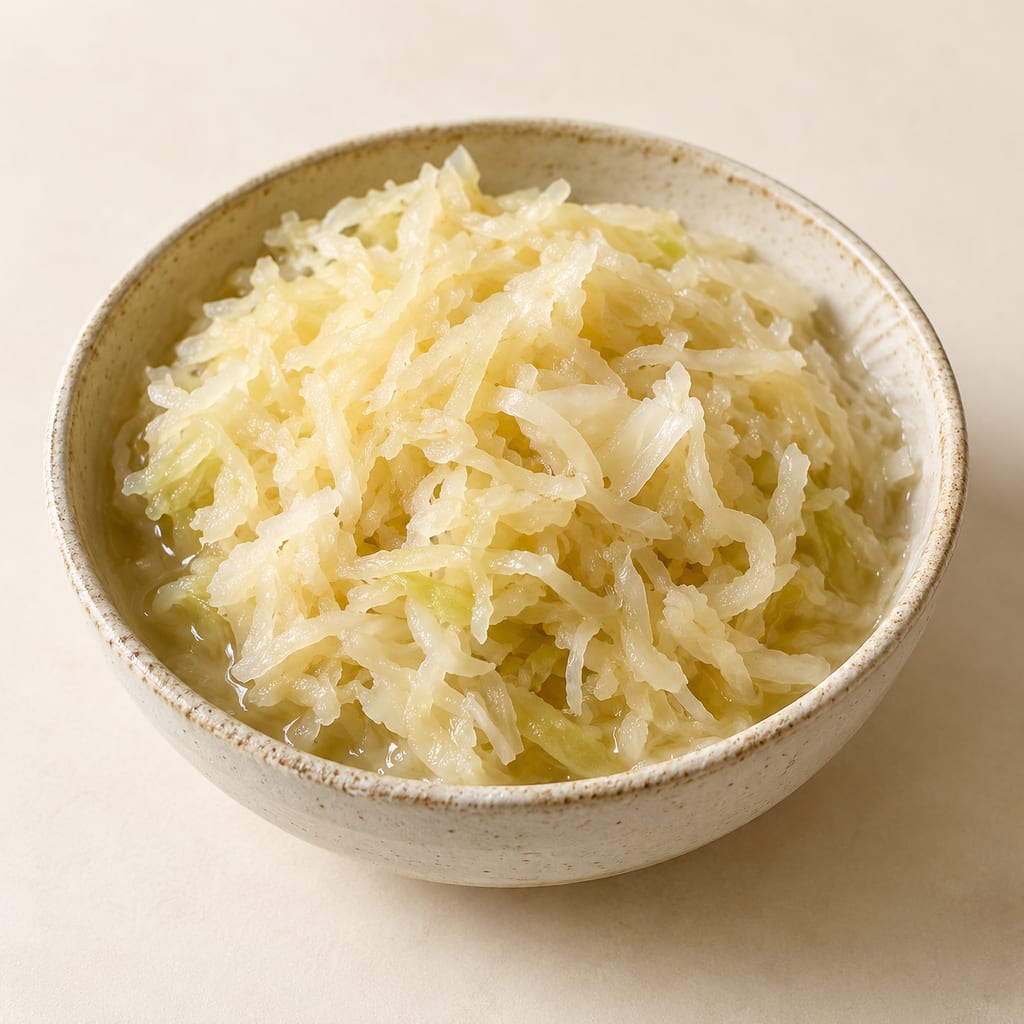
White cabbage sauerkraut
A Penn State Extension crock method mixes 5 lb of shredded cabbage with 3 tablespoons of canning or pickling salt, packs it under its own brine and ferments it in a covered container.
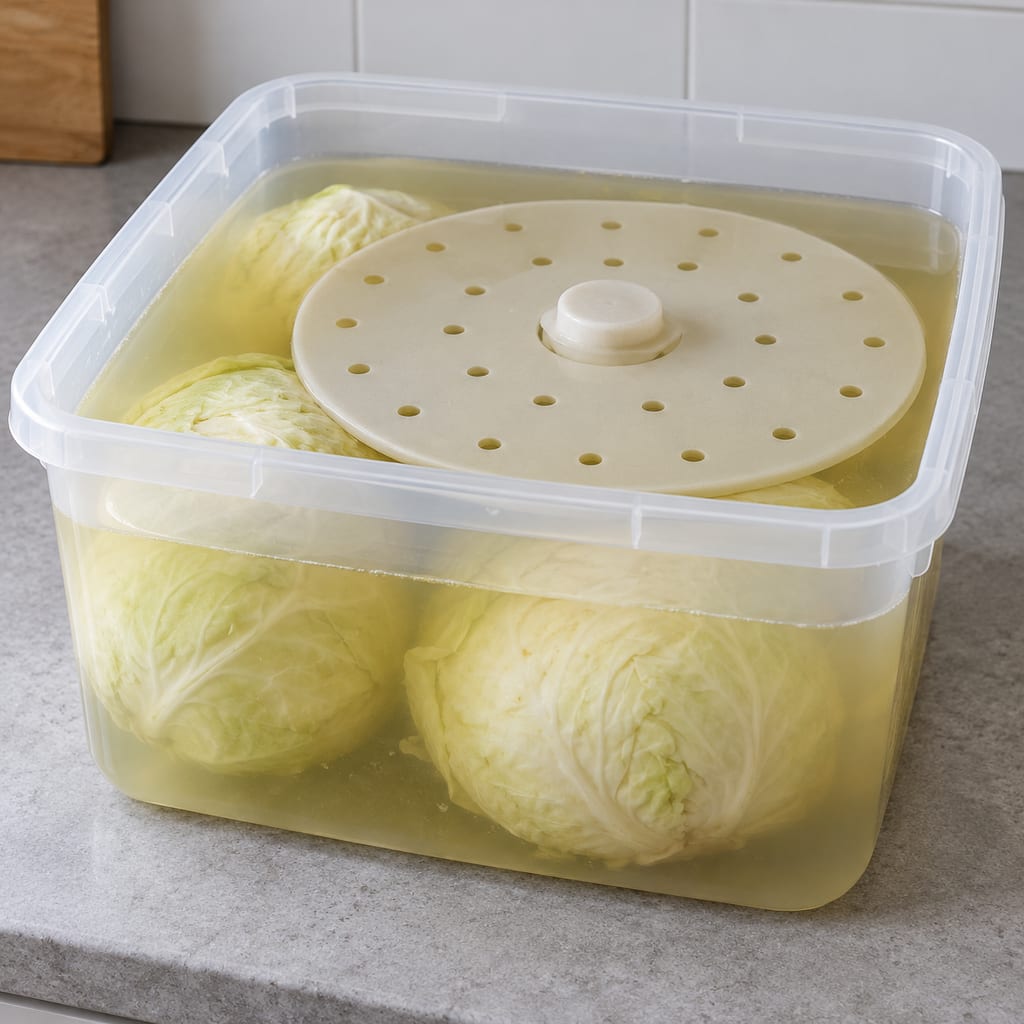
Whole-head brined sauerkraut
Cored cabbage heads ferment intact or halved under measured brine, with repeated surface checks over six weeks.
Community
No community contributions have been published for this entry yet.
Share what you made
Sign in to contribute. Published comments and photos are free to read.
Sources
Udruga proizvođača i prerađivača ogulinskog kupusa, March 2022; Croatian Ministry of Agriculture
Ogulinski kiseli kupus / Ogulinsko kiselo zelje: Specifikacija proizvodaCited in: Two books for a cabbage; The head has a job to do; November is a harvest date; A room made dark; Twenty days for a Futog head; The weather outside the souring house; What the salt water becomes; Ogulin changes the cultivar list; The barrel and the vacuum bag; The second serving is liquid; The home kitchen has a different contract; What the books can tell us; The head leaves the room
European Commission, 2015
Commission Implementing Regulation (EU) 2015/1413 of 10 August 2015Cited in: The barrel and the vacuum bag
Intellectual Property Office of the Republic of Serbia, undated
Reg. no 50: Appellation of origin: Fresh sour cabbage from FutogCited in: The head has a job to do; Futog keeps the seed; What the books can tell us
Futoški Kupus Ćulum, undated
Geographic originCited in: Futog keeps the seed; The barrel and the vacuum bag; The head leaves the room
Radio Slobodna Evropa, 9 January 2020
Kiseli kupus kao gastronomsko nasleđe BalkanaCited in: The head has a job to do; A leaf crosses borders; What the books can tell us
Air Serbia, Elevate, December 2017, p. 65
Sarma – queen of the tableCited in: The second serving is liquid
National Center for Home Food Preservation; adapted from USDA Complete Guide to Home Canning, revised 2015
SauerkrautCited in: What the salt water becomes; The home kitchen has a different contract
NHS, reviewed 17 April 2023
Salt in your dietCited in: The second serving is liquid; The home kitchen has a different contract
Balkan Lunch Box, Aida, updated 11 February 2024
Fermented Cabbage Heads (Homemade Sauerkraut Heads, Kiseli Kupus)Cited in: November is a harvest date
Leksikografski zavod Miroslav Krleža, Pomorski leksikon, 1990; online edition 2026
SalamuraCited in: What the salt water becomes
Journal on Processing and Energy in Agriculture 18(2), 2014, pp. 88–90
Chemometric approach to optimization of white cabbage fermentationCited in: Twenty days for a Futog head
Foods 12(1):19, 2022
Evaluation of chemical and sensory characteristics of sauerkraut juice powder and its application in foodCited in: The second serving is liquid
Nutrition Research Reviews 30(1), 2017
Traditional low-alcoholic and non-alcoholic fermented beverages consumed in European countries: a neglected food groupCited in: The second serving is liquid
Gaps
- The earliest whole-head cabbage fermentation and the first use of rasol as a drink are undated.
- No tested household method exists for drawing a drink from a barrel of whole heads.
- The current list of authorised Futog producers is unverified.
Updated 2026-11-09