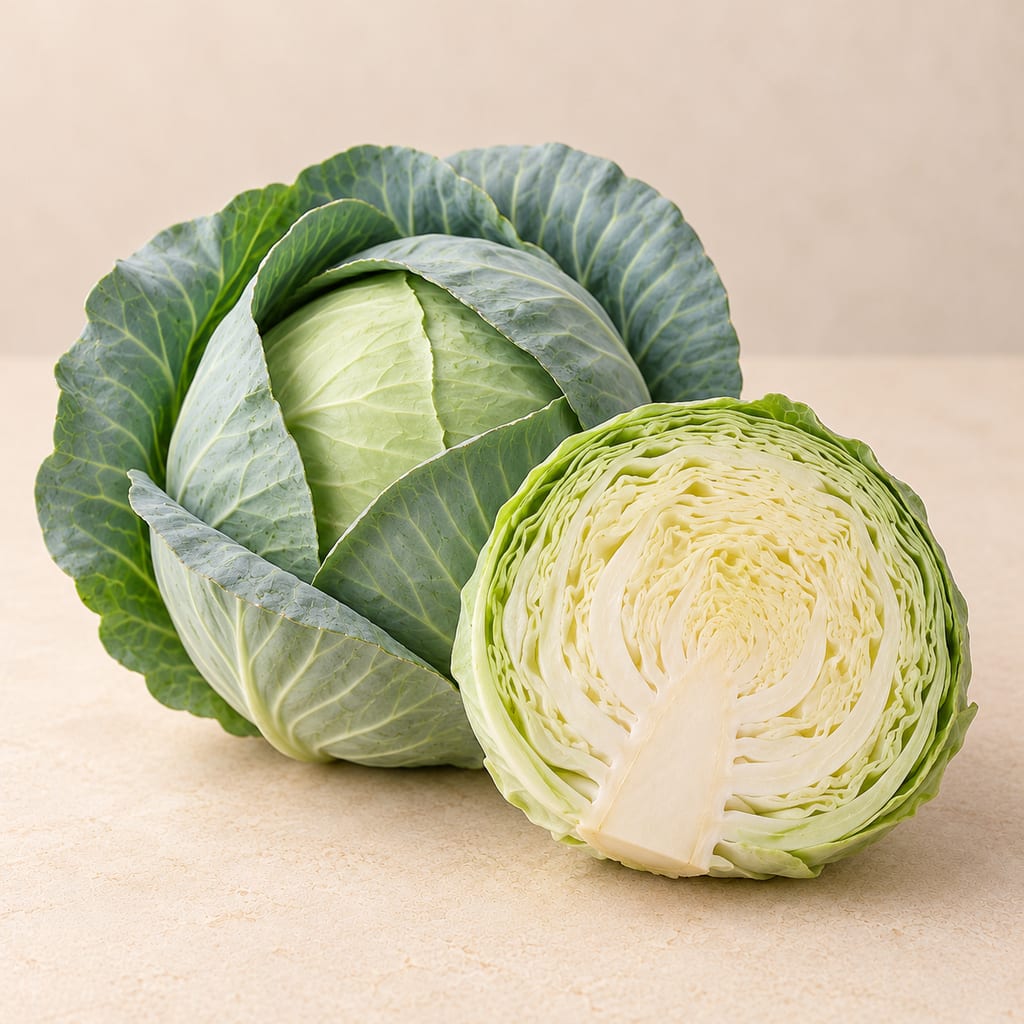
Cabbage
Cabbage is the dense leafy head of Brassica oleracea, a European vegetable that keeps for months and is the classic raw material for sauerkraut, with napa cabbage the base of kimchi.
 FermenteaWhere food goes to change
Modern method
Whole sauerkraut
Cored cabbage heads ferment intact or halved under measured brine, with repeated surface checks over six weeks.
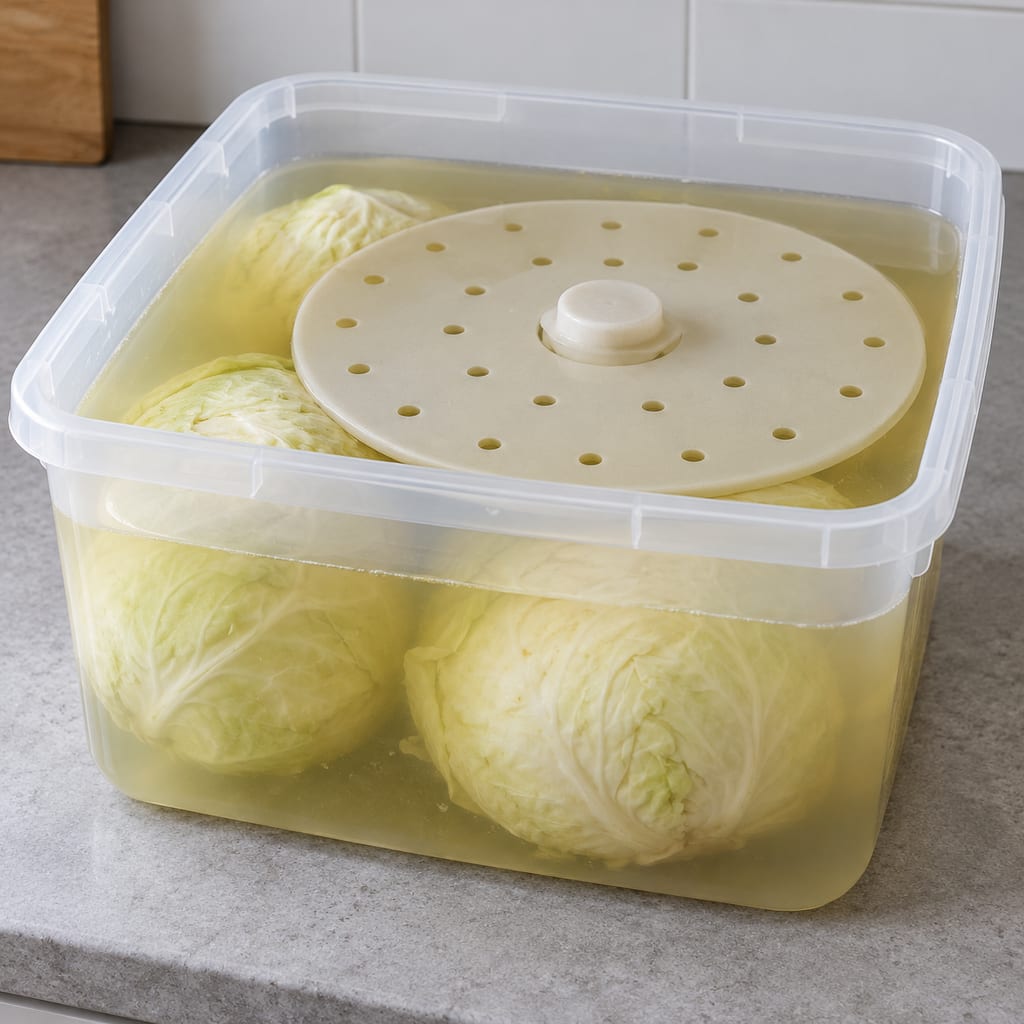
Whole-head brined sauerkraut is a preparation in which entire cabbage heads, or large halves, are fermented beneath a salt solution.
It differs from the shredded cabbage more commonly associated with German-style sauerkraut.
Instead of shredding the leaves and rubbing them with salt to release their own juices, this method packs whole heads into a vessel and covers them with a separately prepared brine.
The source procedure uses 50 g salt per litre of water.
The cabbage heads are graded by size, cleaned and cored before being packed.
The larger heads may be halved.
The fermentation is monitored over approximately six weeks, with repeated checks of the liquid surface and the position of the cabbage beneath the brine.
Whole fermented cabbage is especially useful for cooking dishes that require intact leaves.
In much of the Balkans, fermented cabbage leaves are used to wrap meat, rice or other fillings in dishes commonly called sarma.
The present FAO procedure does not assign its particular flowchart to one country.
It should therefore be treated as a documented family-, farm- and community-scale production method rather than claimed as an exact recipe originating in Serbia, Croatia, Romania or another individual region.
The vegetable is the cultivated heading cabbage, Brassica oleracea var. capitata.
The German term Sauerkraut refers broadly to sour cabbage.
In Serbian and Croatian, kiseli kupus means sour cabbage, and whole-head versions are common.
In Romanian, varză murată refers to fermented or pickled cabbage.
Bulgarian names include кисело зеле, and related expressions occur throughout southeastern Europe.
These terms reflect overlapping food traditions but do not necessarily describe an identical brine formulation.
Some methods use whole cabbages specifically to preserve intact leaves.
Others use chopped cabbage or combine both forms in the same container.
The exact salt concentration, seasonings, handling and fermentation period vary.
The FAO whole-head method is a practical way to preserve large cabbage heads under measured brine.
Fermented cabbage has a long history in Europe, though precise invention dates for individual forms are difficult to establish.
Cabbage preservation became particularly important in regions where fresh vegetables were scarce during winter.
Lactic-acid fermentation allowed autumn harvests to be consumed during colder months.
Whole-head fermentation has an additional culinary function because it preserves large leaves suitable for stuffing.
In southeastern European cooking, stuffed cabbage dishes are strongly associated with winter meals, celebrations and family cooking.
An ethnobotanical study of sarma traditions across Turkey and the Balkans documents considerable diversity in the leaves used for wrapping.
Fresh and fermented cabbage are among the relevant materials.
The source confirms a broad culinary context rather than one universal recipe.
The particular FAO flowchart belongs to a technical food-processing publication aimed at small-scale production.
It specifies practical operations that are sometimes omitted from brief household recipes: size grading, repeated washing, core removal, maintaining a substantial brine layer and scheduled surface inspection.
Whole cabbages present a different fermentation problem from shredded leaves.
The outer leaves and internal core do not exchange liquid at the same rate.
A large head has a relatively long distance between its surface and interior.
Fermentation can therefore progress unevenly if heads vary greatly in size.
The FAO method separates the harvest into three groups, describing heads around 700 g, heads below 1.2 kg, and heads above 1.2 kg.
The wording of the first two categories overlaps and should not be treated as a mathematically rigorous grading standard.
The practical point is that differently sized cabbages are processed separately.
Very large heads are cut in half.
Removing the core also changes the geometry and allows brine better access to the interior.
This is an important technical advantage over simply submerging completely intact unprepared heads.
The first stage is inspection.
Damaged outer leaves may harbor dirt or undesirable microorganisms.
The method removes visible damage and then washes the cabbage.
A further two to three outer leaves are discarded.
The heads are then graded by size and washed again.
The core is removed from each cabbage.
For the largest size category, the heads are halved.
These steps are more labor-intensive than shredding cabbage, but they help produce relatively consistent whole or half heads.
The original method does not specify a particular coring tool or the exact diameter of the removed core.
Those dimensions should not be invented.
The source specifies a 5% salt solution, expressed as 500 g salt in 10 litres water, or 50 g per litre.
Salt should dissolve completely before the solution is used.
The method then filters it through clean cheesecloth.
Filtering removes undissolved particles or visible impurities.
It does not sterilize the liquid.
Salt is a major element of microbial selection in the fermentation.
The brine must contact the exterior surfaces and gradually penetrate the leaves.
An uneven or unmeasured salt solution can alter fermentation behavior.
The amount of brine should be sufficient to maintain complete coverage.
Use a large clean food-grade fermentation vessel suitable for whole cabbages.
The original source describes separate receptacles for different size groups.
A clean weight or fitted cover holds the vegetables below the liquid.
Wooden pieces are identified in the historical process, with fitted covers containing holes presented as an alternative.
Any material used today must be appropriate for food contact and resistant to the acidic, salty environment.
A large vessel should be positioned where it can be inspected and cleaned without contamination from dust, insects or animals.
A thermometer and pH meter are useful for modern monitoring, although the FAO method does not prescribe numerical readings.
Inspect the cabbage heads. Reject badly damaged or deteriorated vegetables.
Remove defective leaves. Wash the heads to remove soil and other foreign material.
Remove additional outer leaves. Discard two to three outer leaves from each head.
This exposes cleaner, more suitable leaf surfaces.
Grade the cabbages by size. Separate smaller, medium and larger heads.
Process different size groups in separate vessels where practical.
Approximate weights around 700 g and 1.2 kg serve as grading references.
Wash again and remove cores. Rewash the prepared heads.
Remove the cores. Cut the largest cabbages in half.
Prepare the brine. Dissolve 50 g salt in 1 litre water, or use the equivalent source ratio of 500 g in 10 litres.
Stir until the salt is dissolved. Filter through clean cheesecloth as specified.
Pack the vessels. Arrange the cored cabbage heads or halves in clean receptacles.
Keep the different size categories separate. The source does not specify a maximum packing weight or particular vessel volume.
Add the salt solution. Pour brine over the vegetables.
The source specifies approximately 10 cm of brine above the cabbage level.
This extra depth helps maintain coverage despite movement or settling.
Secure beneath the liquid. Fit suitable clean weights or covers to prevent the cabbage from floating above the brine.
Floating leaves are more exposed to oxygen and possible surface contamination.
Position the fermentation vessels. Place them in a moderately cold, ventilated location away from direct sunlight, heat, dust and insects.
Cover with appropriate clean material. No numerical fermentation temperature is specified.
Inspect during the first week. Check the surface approximately every two days.
The source instructs removal of surface scum with a clean spoon.
Modern safety assessment must distinguish minor harmless surface material from mold or other significant contamination; it is not appropriate to assume all scum can simply be removed safely.
Continue monitoring. For the following five weeks, repeat inspection approximately every four days.
Maintain complete submersion. Restore the intended brine condition using an appropriately controlled process if necessary.
Assess the finished cabbage. At the end of the source's six-week sequence, evaluate the cabbage with suitable acidity and microbiological controls.
The source does not provide a universal final pH, measured salt penetration or validated storage life.
Lactic acid bacteria metabolize carbohydrates present in cabbage.
They produce organic acids, particularly lactic acid.
As those acids accumulate, the pH falls.
Salt influences which microorganisms can grow and how quickly the process proceeds.
Some species are better adapted to the early, relatively mild environment, while others become more important as acid levels rise.
Because the cabbage remains in large pieces, the fermentation environment differs inside and outside the head.
Soluble compounds must move through the leaf tissues and into the surrounding brine.
The brine can also carry metabolites from one part of the vessel to another.
The rate of these processes depends on cabbage size, core removal, temperature and the actual salt distribution.
The FAO process therefore includes size grading and halving large heads.
Those operations are not simply presentation choices.
They influence how consistently the cabbage can ferment.
Salt initially occupies the surrounding water.
Over time, it diffuses into cabbage tissues.
Water and dissolved compounds can move in the opposite direction.
The final equilibrium depends on the vegetable mass and brine volume.
The concentration of the brine may therefore change after cabbage is added.
A prepared 5% solution does not establish that the interior of every cabbage head immediately contains 5% salt.
The depth of liquid above the cabbage is also important.
A shallow surface layer is easier to disturb, exposing leaves to oxygen.
Maintaining approximately 10 cm of brine above the vegetable mass offers a practical buffer against floating and settling.
It does not independently establish anaerobic conditions in every internal region of every head.
Whole-head cabbage fermentation is particularly familiar in southeastern European food traditions.
Serbian, Croatian, Bosnian, Bulgarian and Romanian households prepare fermented cabbage for winter cooking.
Some versions use only cabbage, salt and water.
Others may incorporate additional flavoring ingredients or different methods of core removal.
The degree of sourness and preferred leaf texture vary.
A cabbage intended for sarma needs leaves that remain sufficiently intact to wrap around a filling.
A product intended to be chopped into soup may tolerate a different texture.
The FAO method does not document all these regional variations.
They should be described as related practices rather than modifications secretly inserted into the measured source process.
The most distinctive use is stuffed cabbage.
Leaves are removed from the fermented head and used as wrappers.
Depending on the regional dish, fillings may include meat, rice, grains, vegetables and seasonings.
The filled parcels are cooked in a pot, sometimes with smoked meat or other rich ingredients.
The fermented cabbage contributes acidity and saltiness.
Its flavor contrasts with fatty fillings and helps give the final dish its characteristic taste.
Fermented cabbage can also be shredded and used in soups or stews.
The brine itself is sometimes valued as a strongly flavored liquid in regional food cultures, but consumption and storage practices vary.
The FAO method does not provide a specific recipe for using the brine as a beverage.
A satisfactory fermented cabbage should develop sourness and a texture appropriate to its intended use.
The leaves become less crisp than fresh cabbage but should remain recognizable.
Color may change from vivid green to paler yellow-green.
Some cloudiness and gas production may occur.
However, smell, color and bubbling are not validated safety tests.
Mold growth, putrefaction, extensive slime or loss of brine coverage are concerns.
The original instruction to remove surface scum should not be treated as permission to continue using a significantly contaminated ferment.
A modern processor must assess the nature and extent of contamination and reject unsafe batches.
The FAO flowchart specifies the brine ratio and monitoring schedule but not a validated final product acidity or water activity.
A source process lasting six weeks does not automatically establish safety for every cabbage size and storage temperature.
General vegetable-fermentation guidance emphasizes sound produce, clean equipment, proper submersion and acidification.
The final product should be handled and stored in accordance with a verified process.
Whole heads present special challenges because their interiors may not acidify at the same rate as the surrounding liquid.
Measuring the brine alone may therefore be insufficient for commercial validation.
The method is a valuable record of traditional processing, but it should not be represented as a certified ambient-storage recipe without further testing.
FAO presents this as a simplified whole-sauerkraut process for family, farm and community settings, without assigning a single regional origin.
Scaling: source batch only
Poor brine coverage or contaminated equipment can compromise vegetable fermentation; this recipe has not been professionally validated.
Hazard sourceUse clean food-grade equipment, keep produce submerged where the method uses brine, and follow established acidity-monitoring guidance. No recipe-specific validated endpoint is supplied.
Control sourceUnknown documented preparation location. FAO presents a family/farm/community process without assigning it to a country or region.
Cabbage is the dense leafy head of Brassica oleracea, a European vegetable that keeps for months and is the classic raw material for sauerkraut, with napa cabbage the base of kimchi.
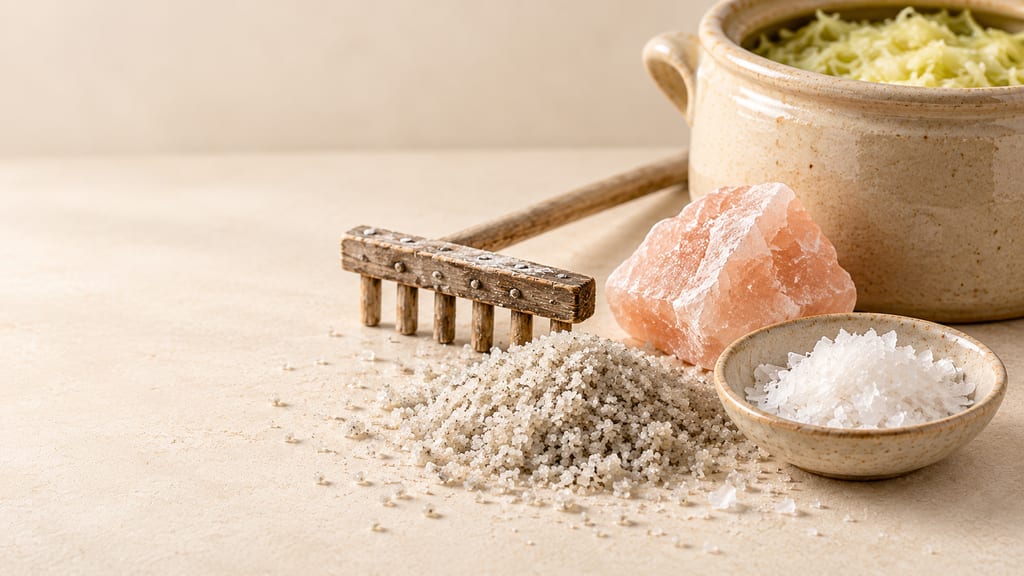
Salt seasons a meal, shapes fermentation and preserves food. Its history follows the people who mine, harvest, trade and transform it, and the choices hidden inside an ordinary packet.
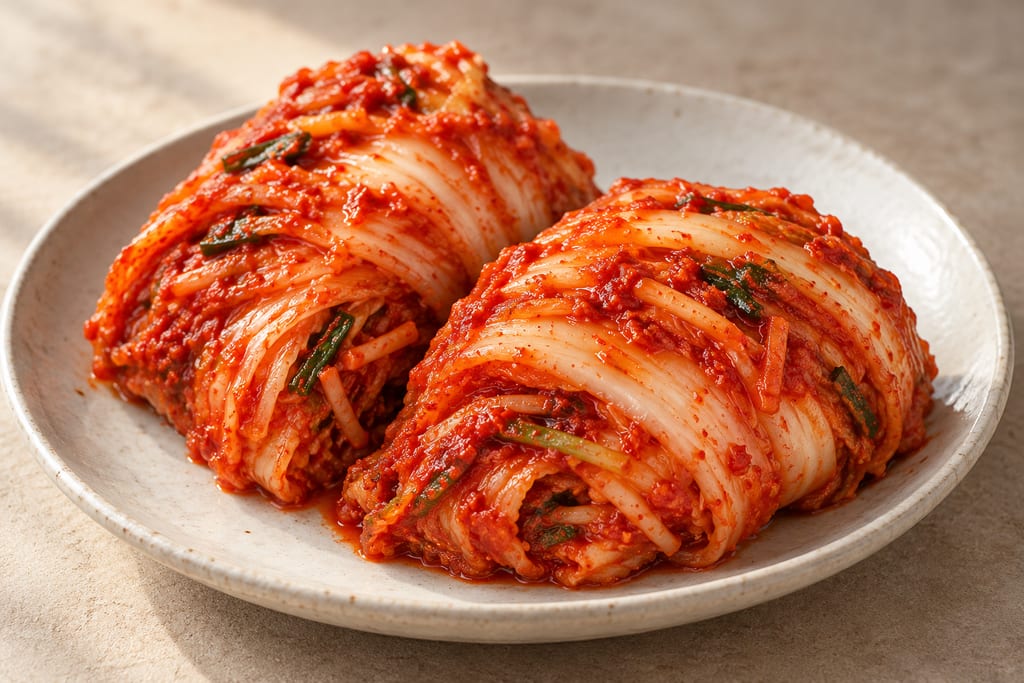
Napa cabbage salted, seasoned with a paste of gochugaru, garlic, ginger and salted seafood, and left to sour through lactic fermentation; Korea's everyday winter preserve.
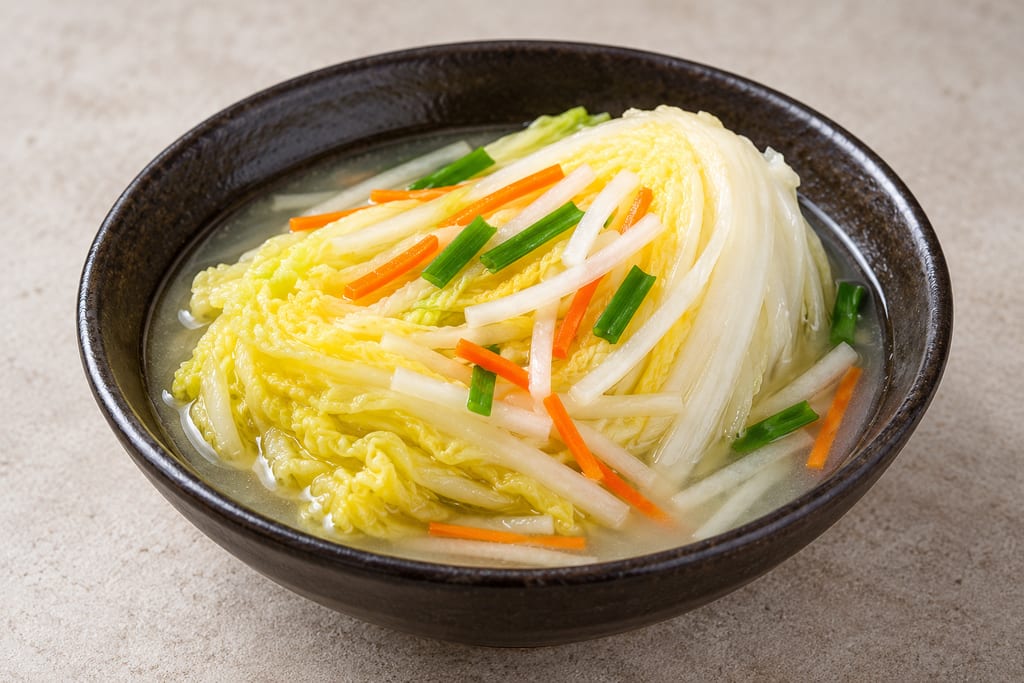
Napa cabbage is brined and filled with pear, radish, alliums, chives and fruit; this Korean kimchi omits red pepper flakes.
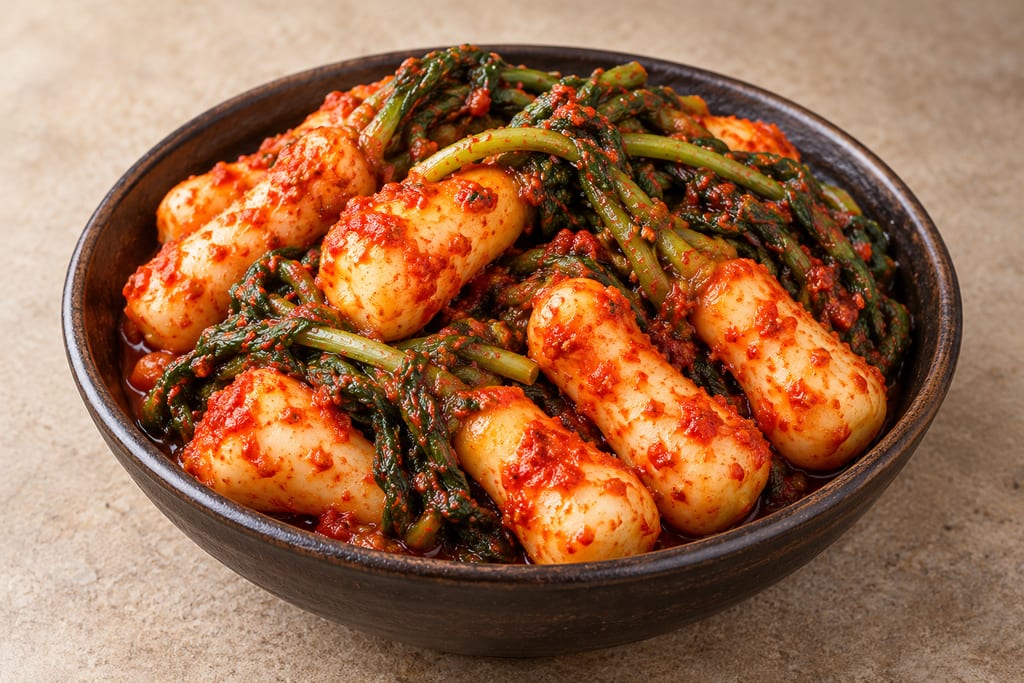
Small ponytail radishes keep their greens attached and ferment in a flour-and-chile seasoning paste.
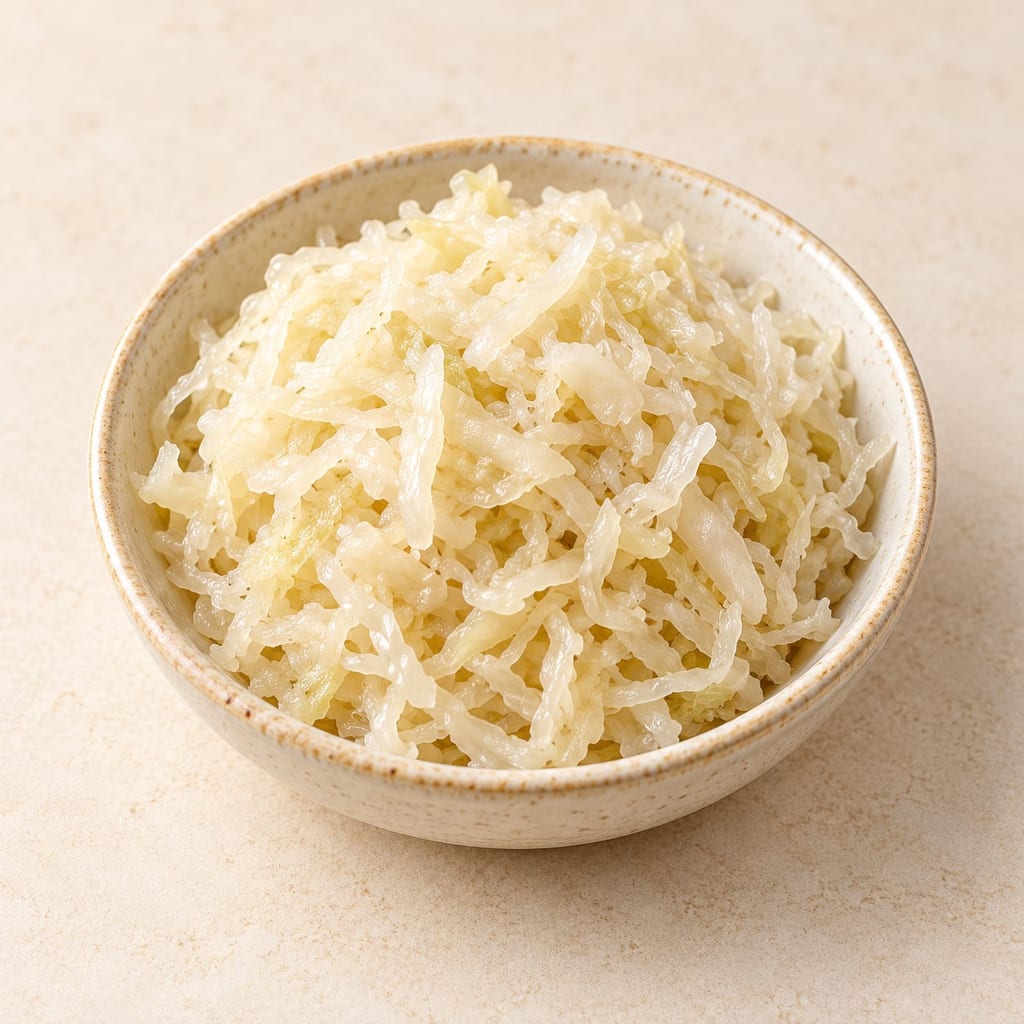
Finely cut cabbage fermented with salt in vats by natural lactic fermentation, a protected Alsatian product sold raw or cooked after fermentation.
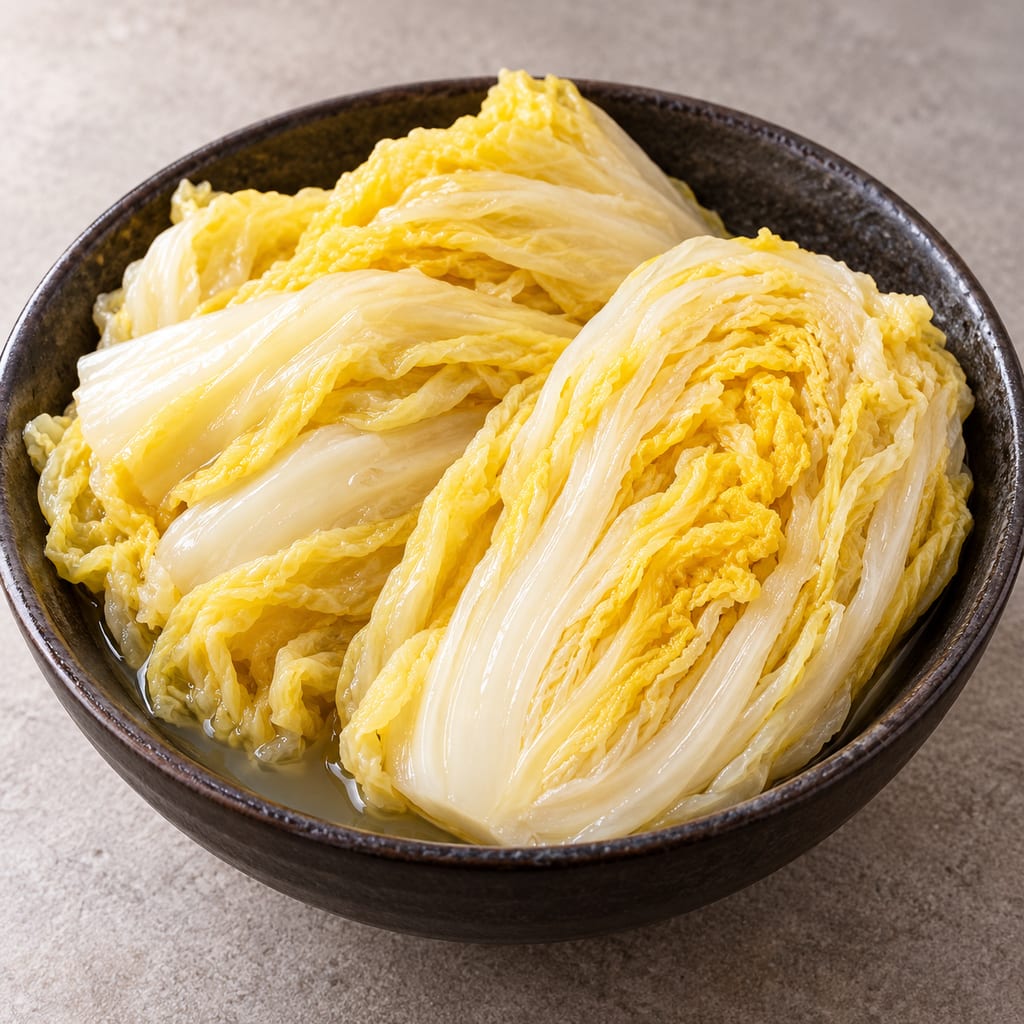
Napa cabbage fermented in a salt brine in Northeast China, traditionally in large ceramic or glass jars, until it turns sour.
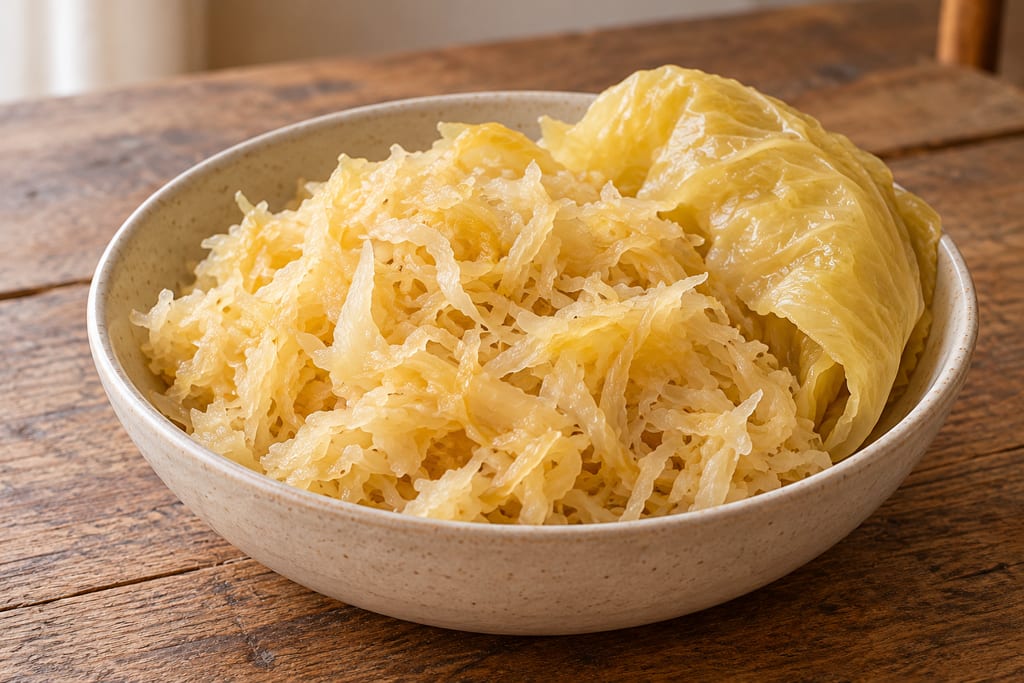
Serbian sour cabbage from the Futog area, made from the autochthonous Futoški cabbage population and registered as a protected product in 2008. It is a subset of general Serbian kiseli kupus.
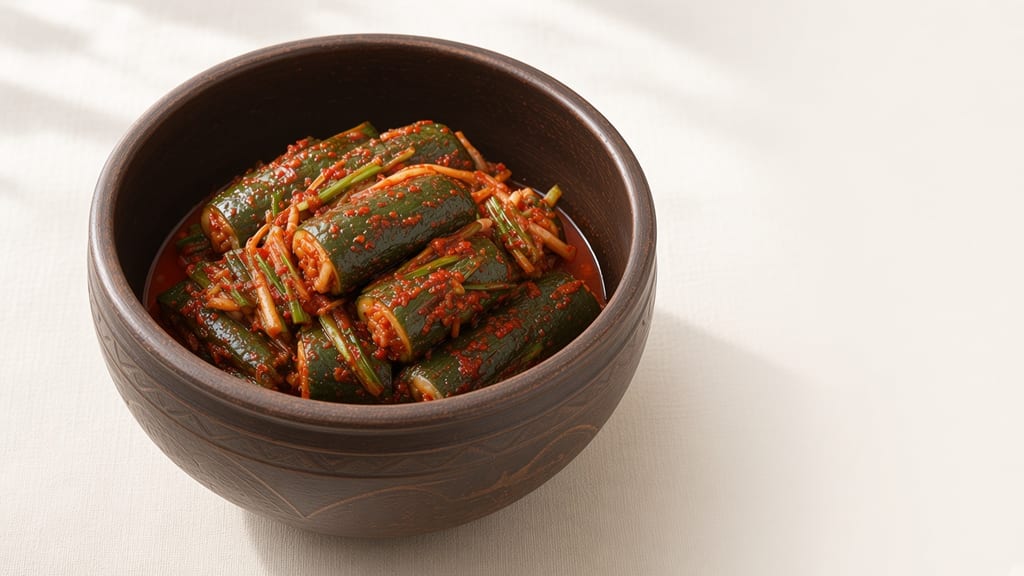
Hwanggwa damjeo is a cucumber kimchi from Yu Jung-rim's Jeungbo sallim gyeongje of 1766. Slit cucumbers are packed with chilli powder and garlic, scalded with hot salted water and sealed overnight.
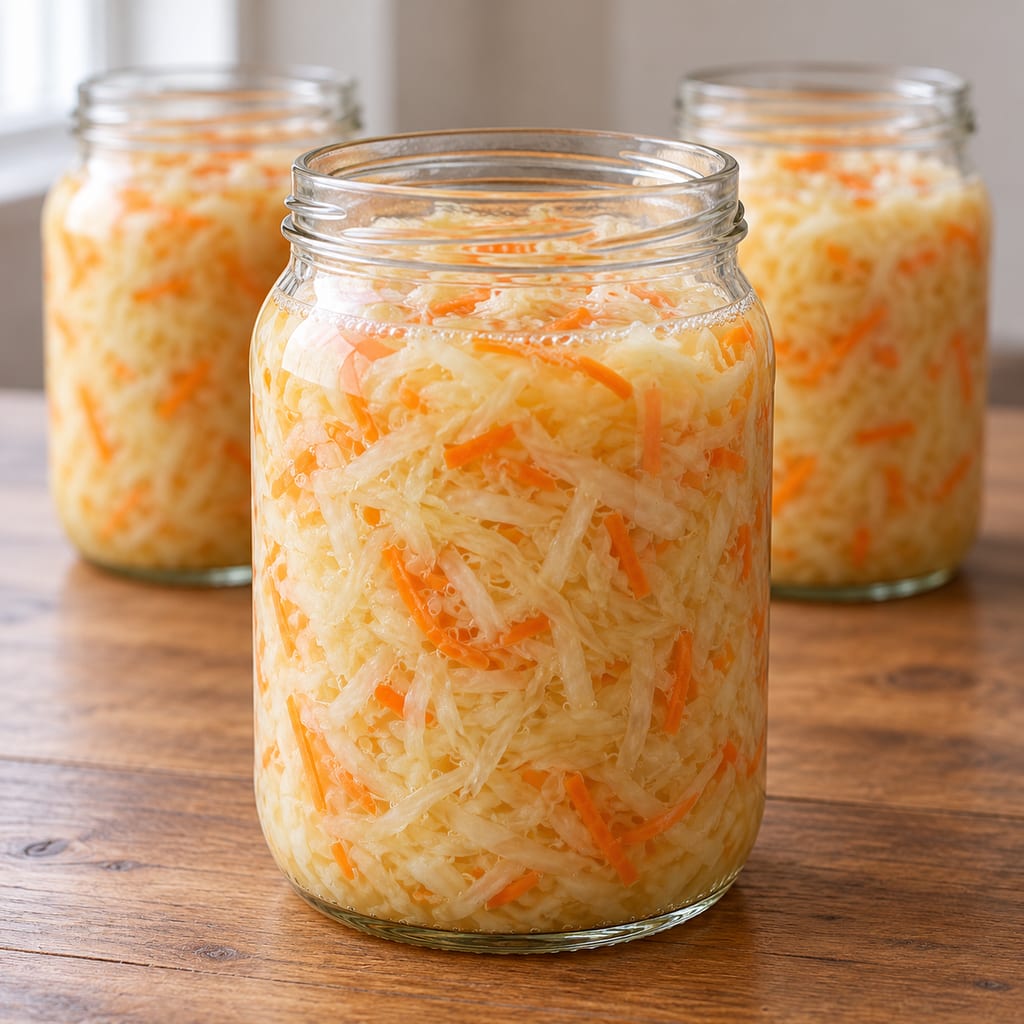
Shredded cabbage and grated carrot are salted to 20 g/kg, rested, packed into three jars and monitored during a creator-reported eight-day fermentation; measured temperature is not given.
No community contributions have been published for this entry yet.
Sign in to contribute. Published comments and photos are free to read.
Food and Agriculture Organization of the United NationsInspiration
Fruit and vegetable processing: Chapter 9, vegetable-specific processing technologiesWhole cabbage preparation, 5% brine, submersion, storage location and six-week maintenance schedule.
Cited in: Cabbage preserved without shredding; Names and botanical identity; Historical background; Why size grading is important; Preparing the cabbage; Making the brine; Equipment; Method; What happens during fermentation?; Diffusion and the importance of brine depth; Regional differences; How whole fermented cabbage is eaten; Recognizing good and problematic results
University of Minnesota ExtensionSafety
Preserving food at home: FermentationGeneral guidance for vegetable fermentation, submersion and acidity monitoring; not validation of this recipe.
Cited in: Safety and storage
FAOMicrobiology background
FAO — Fermented Fruits and Vegetables: A Global PerspectiveLactic-acid fermentation background.
Cited in: Names and botanical identity; Historical background; What happens during fermentation?; Diffusion and the importance of brine depth; Regional differences
pmc.ncbi.nlm.nih.govMicrobiology background
Ethnobotany of Sarma in Turkey and the BalkansComparative regional culinary use.
Cited in: Names and botanical identity; Historical background; What happens during fermentation?; Diffusion and the importance of brine depth; Regional differences