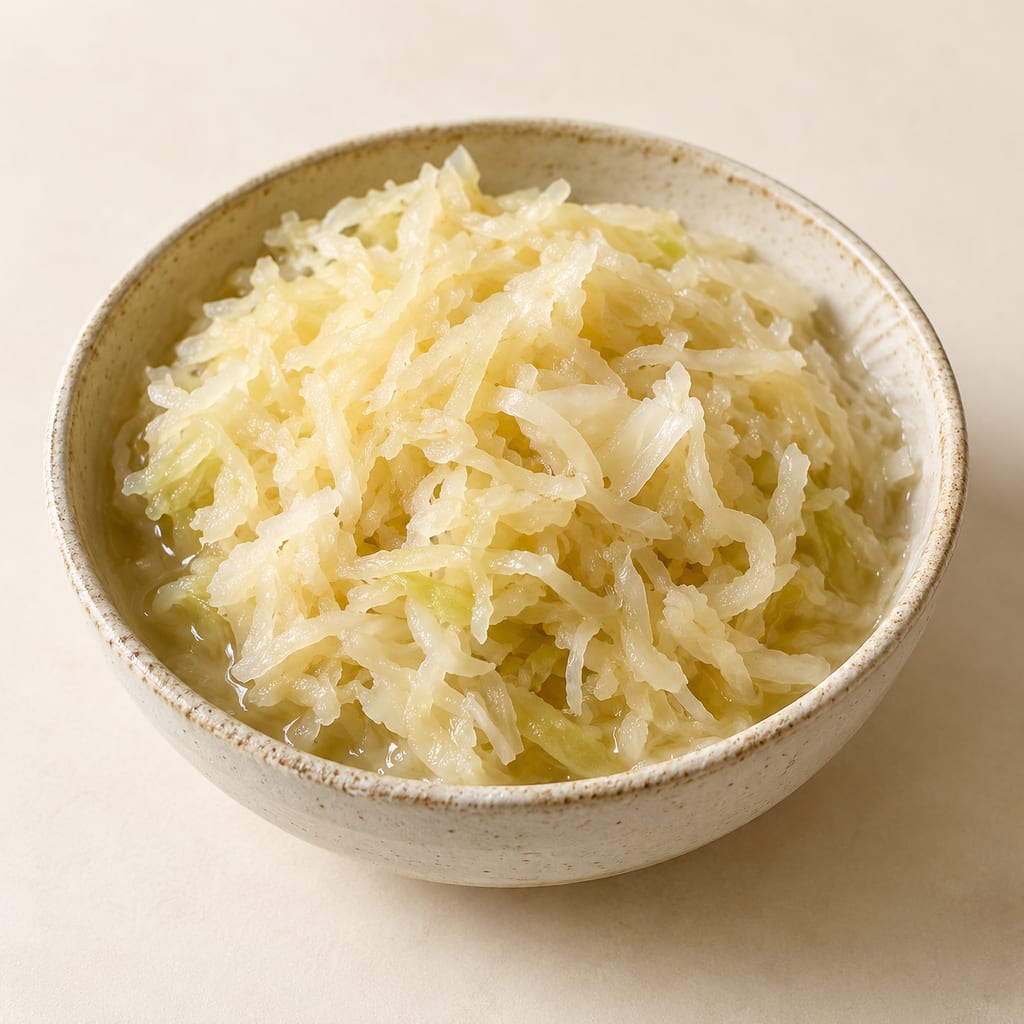
White cabbage sauerkraut
A Penn State Extension crock method mixes 5 lb of shredded cabbage with 3 tablespoons of canning or pickling salt, packs it under its own brine and ferments it in a covered container.
 FermenteaWhere food goes to change
rasol · Sauerkraut juice · Sauerkrautsaft · moare · rassol · sour-cabbage brine
Rasol is the sour, salty liquid of fermented cabbage, drunk cold in a small glass across the Balkans. Here it comes from finished, tested sauerkraut or a ready-to-drink juice.
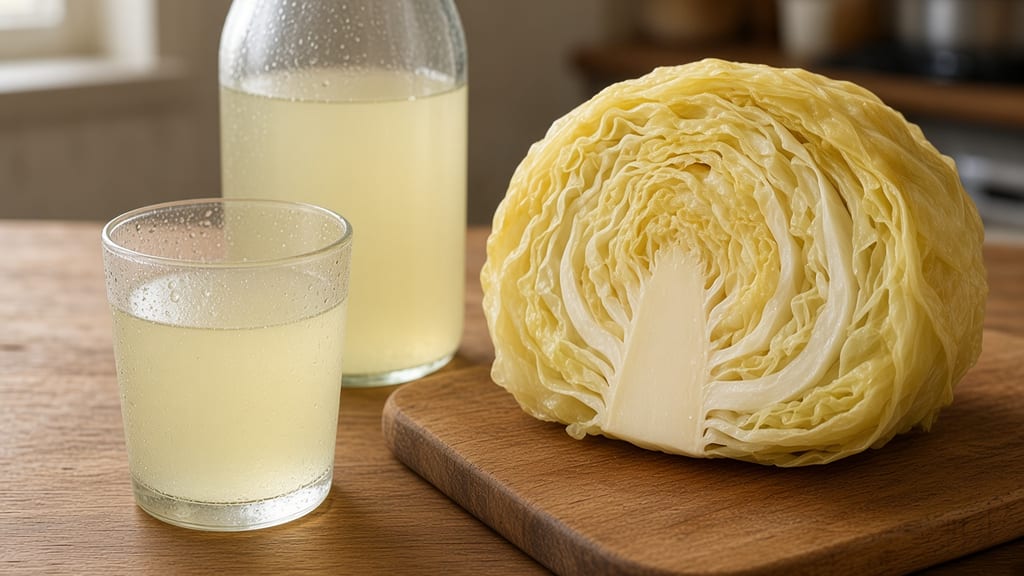
Rasol is the sour, salty liquid that surrounds fermented cabbage. In Serbian and Croatian kitchens it is the water of the cabbage barrel, and people drink it cold from a glass. A review of traditional European fermented drinks groups it with German Sauerkrautsaft and Romanian moare, and lists Ukraine and other Black Sea regions among the places where fermented cabbage juice is widely consumed.
The word has a working meaning before it has a drinking one. The 2022 production specification for Ogulin sour cabbage uses rasol for the liquid in the vat: after fermentation the cabbage is kept in a dark room with the rasol at no more than 22 °C. A Croatian maritime dictionary pairs rasol with salamura and defines both as salt dissolved in water. So the same word can name a fresh salt solution at the start of the job and the finished sour liquid at the end.
This page is about the finished liquid. A glass of rasol is cabbage liquid that has been through a full lactic fermentation with the cabbage. Fresh salt water poured over raw heads is the starting material, and it is not the drink.
Rasol belongs to the whole-head cabbage barrel. In the Balkans cabbage is often soured as entire heads, so that the leaves stay large enough to wrap sarma. Adrijana Alački, who leads North Macedonia's national cooks' organisation, described the household method to Radio Free Europe in 2020. Cooks lay a row of heads in the bottom of a vat or large barrel, scatter salt over them, and repeat until the vessel is full. A wooden lid goes on top with a heavy stone to press the heads down. Then the vessel is filled with water and closed.
The Croatian journalist Zvonko Horvat told the same reporter that his family soured cabbage in large vats for as long as he could remember. His job as a boy was to tread on it. The recipe then and now, he said, was cabbage, salt and water.
The protected Ogulin product gives the same idea in production terms. Heads to be soured whole receive a clear solution of 5–6 % table salt. Shredded cabbage gets 2–3 % salt and is pressed until it releases its own juice. The first, vigorous phase lasts about seven days with the air in the souring room at no less than 16 °C. Fermentation then continues for six to eight weeks, depending on the size and firmness of the heads.
In Ogulin the liquid has a paper trail. Each souring house keeps a book that records, for every vat, the origin, amount and variety of the cabbage, whether it went in shredded or as heads, its sugar content measured with a refractometer, the date souring began and the temperature during fermentation.
Those two routes produce two kinds of liquid. Shredded sauerkraut sits in juice drawn out of the cabbage by salt. Whole heads sit in a salt solution that the heads slowly turn sour. Both can end up in a glass.
A study from the Institute for Food Technology in Novi Sad followed whole heads of the local Futoški cabbage and the hybrid Bravo through fermentation. The researchers removed three or four outer leaves, covered the heads with salt solution at 1, 1.5 or 2 % salt, pressed them tightly and sealed the surface with plastic film. They held the batches between 18 °C and 22 °C and sampled the brine on days 3, 6, 10, 15, 22, 37, 55 and 80.
The brine changed far more than its colour. In the Futoški brine, lactic acid reached about 12 g per litre and stayed level from day 37 to day 80. Acetic acid reached about 1 g per litre by day 37. The Bravo brine kept gaining lactic acid between day 55 and day 80. The authors judged that Futoški heads finished fermenting after 20 days and Bravo heads after 50, and they put the difference down to salt moving more slowly into the tighter hybrid heads.
A Latvian study gives figures for the shredded route. Its sauerkraut juice came from a producer that ferments shredded cabbage with 1.7 % salt, 1 % grated carrot and 0.2 % caraway for 14 days. The juice made up about 30 % of the cabbage's weight. It averaged pH 3.7 and 7.6–8.5 °Brix of soluble solids. At packing the producer drew it off and treated it as a by-product. The authors note that its short shelf life and strong aroma limit its commercial use.
These numbers describe particular batches in particular studies. They are not targets for a home barrel or a substitute for a tested method. They do show why rasol tastes sour as well as salty: the acid in the glass is made by the cabbage during fermentation.
Rasol has a reputation at the winter table. An Air Serbia magazine feature on sarma describes a glass of cold rasol after a heavy night as a household habit. Serbian food writing treats the brine with affection and credits it with restoring the drinker.
That is a record of a custom and a belief. It is not evidence that rasol treats a hangover. The 2017 review of European fermented drinks found that research on the health effects of sauerkraut juice came from laboratory and animal studies. Those studies looked at antioxidant activity and at enzymes in rat livers and kidneys. They do not show an effect in people who drink a glass of rasol, so this page makes no health claim for it.
The custom still says something useful about the drink. It is served plain and cold, in a small glass, at the moment someone wants something sharp and salty rather than sweet.
Home sauerkraut guidance shows the difference between fresh and finished liquid clearly. The National Center for Home Food Preservation's sauerkraut method salts shredded cabbage and packs it until the salt draws out the juice. If the juice does not cover the cabbage, the cook adds boiled and cooled brine made with 1½ tablespoons of salt per quart of water.
That top-up is fresh salt water. It has not fermented and it is not rasol. It joins the cabbage juice in the crock and only becomes part of a finished ferment after the batch has fermented. The same holds for the clear salt solution poured over Ogulin heads. At the start it is salt and water. At the end of the fermentation it is rasol.
For the glass, use only liquid from cabbage that has finished fermenting. Smell, cloudiness and a sour taste vary from batch to batch. None of them shows that an unknown batch fermented safely, and none of them can turn fresh brine into a finished drink.
This page uses two sources of rasol. The first is sauerkraut made by the tested home method on this site, fully fermented and kept tightly covered in the refrigerator. The second is a commercial fermented cabbage juice sold ready to drink.
The home source follows the National Center for Home Food Preservation. Its method ferments shredded cabbage at 70–75 °F (21–24 °C) for about three to four weeks, or at 60–65 °F (16–18 °C) for five to six weeks. It warns that kraut may not ferment below 60 °F (16 °C) and may become soft above 75 °F (24 °C). Fully fermented kraut can then be kept tightly covered in the refrigerator for several months. The rasol in this recipe is the liquid in that finished, refrigerated kraut.
A whole-head barrel is a different case. This site's whole-head recipes and the protected Futog and Ogulin cabbages describe how those foods are made. None of them is a tested home method for drawing a drink from a household barrel of heads. A reader without a tested batch should use the commercial juice and follow its label.
Sauerkraut keeps in its liquid. When the tested method packs finished kraut raw into jars, it fills them firmly with kraut and covers it with juice. Draining a jar for a drink would leave the cabbage above its liquid.
So take only the surplus that stands above the cabbage once it is pressed down. If a jar has little spare liquid, leave it alone and use the commercial juice instead. Do not top up a finished jar with fresh salt water to make more to drink. That adds a liquid that has not fermented and dilutes the one that has.
Pour each serving into its own clean glass. Do not pour a tasted serving back into the jar or the bottle, and do not keep a decanted glass for later. The serving is not a preserved product. The kraut and the bottle keep under their own instructions.
Rasol is salty, and the reviewers of European fermented drinks say sauerkraut juice typically contains a lot of salt. The NHS advises adults to eat no more than 6 g of salt a day in total, counting the salt already in food.
A label that gives salt per 100 ml makes the arithmetic simple: multiply that figure by the millilitres poured and divide by 100. For example, a juice with 1 g of salt per 100 ml would give 0.5 g in a 50 ml glass. That is an illustration, not a measured value for rasol. Home kraut has no label, and its liquid's salt content is unknown.
The Ogulin specification sets 1.5–4 % sodium chloride and 0.5–2.5 % lactic acid for the finished cabbage. Those limits describe a protected product on sale. They are not a nutrition label for a glass of liquid. People who need to limit salt should follow their clinician's advice before drinking it.
Adding water to the glass makes the taste milder but leaves the same amount of salt in the serving. A small, plain portion keeps the salt down.
Rasol comes out of the same barrel as the leaves for sarma. Tamara Ognjević, a food-heritage researcher, told Radio Free Europe that sour cabbage is eaten as salad, cooked into soups and other dishes, chopped as a filling for pies, and used whole to wrap sarma. Alački described sarma made in sour cabbage leaves with rice, minced meat and spices, or with spiced rice alone for meatless days.
Sarma also shows the scale of the barrel's work. In December 2008, for the feast of Saint Nicholas, 160 cooks in Prilep in North Macedonia made 80,191 meatless sarmas in six hours for a Guinness world record.
The leaves and the liquid go to different parts of the meal. The cook lifts the heads out for the pot. What is left in the barrel can be poured into a glass.
On this site, Futoški kupus and Ogulinsko kiselo zelje describe two protected whole-head cabbages, and whole-head brined sauerkraut describes a separate head method. White cabbage sauerkraut is the tested shredded method that supplies the home version of this drink.
Rasol is the liquid of fermented cabbage in Serbian and Croatian kitchens, a relative of German Sauerkrautsaft and Romanian moare. It comes from the whole-head cabbage barrel, where heads and salt are layered, weighted and covered with water, and the Ogulin specification uses the word for the liquid in its fermentation vats. Serbian food writing describes a cold glass after a heavy night as a household custom. The first dated use of the liquid as a drink is unknown.
Yield 1 glass of about 50 ml · Scaling: scale linear
Fresh salt water is a starting brine, not rasol, and the look, smell or sourness of a batch does not show it fermented safely.
Hazard sourceFinished kraut is stored covered by its juices; draining it for a drink leaves cabbage above its liquid.
Hazard sourceSauerkraut juice typically contains a lot of salt, and adults should keep total salt under 6 g a day.
Hazard sourceUse only liquid from sauerkraut fermented by the tested method and kept tightly covered in the refrigerator, or a commercial juice sold ready to drink
Control sourceTake only surplus liquid and keep the kraut covered by its juice
Control sourceKeep the serving small and count it in the day's salt
Control sourceNo health or hangover benefit is established for rasol; research on sauerkraut juice comes from laboratory and animal studies.
Do not drink liquid from a household whole-head barrel of unknown history.
Senses never prove safety.
Rasol named as the Serbian fermented cabbage juice; cold rasol custom from Serbian food writing.
Protected whole-head sour cabbage whose specification calls the vat liquid rasol.
Moare, the Romanian name for fermented cabbage juice.
Sauerkrautsaft, the German name for fermented cabbage juice.
A Penn State Extension crock method mixes 5 lb of shredded cabbage with 3 tablespoons of canning or pickling salt, packs it under its own brine and ferments it in a covered container.
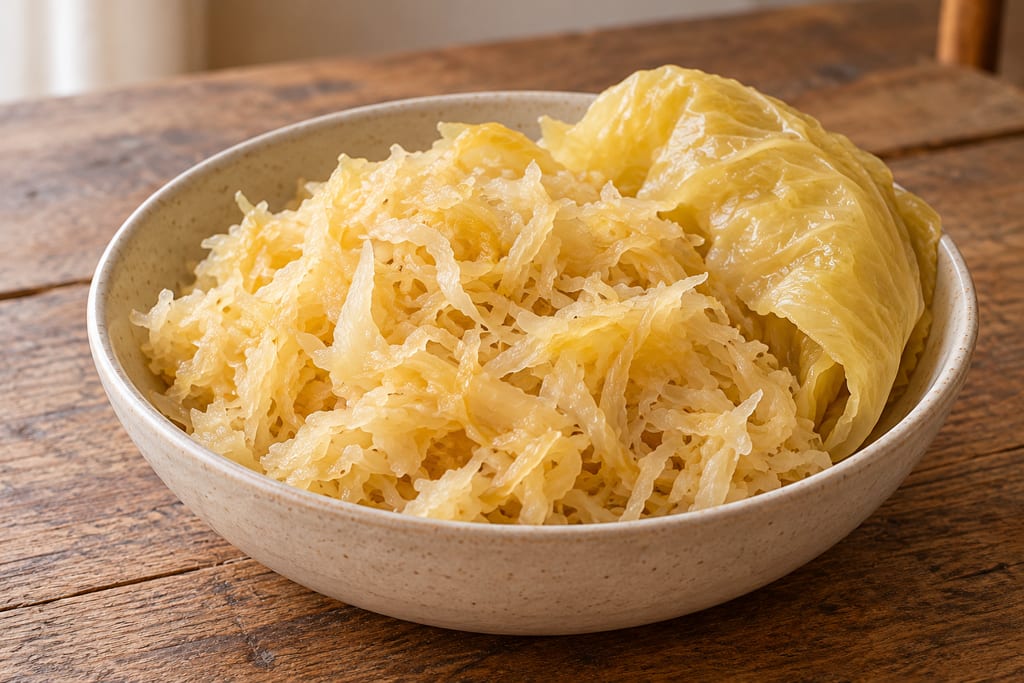
Serbian sour cabbage from the Futog area, made from the autochthonous Futoški cabbage population and registered as a protected product in 2008. It is a subset of general Serbian kiseli kupus.
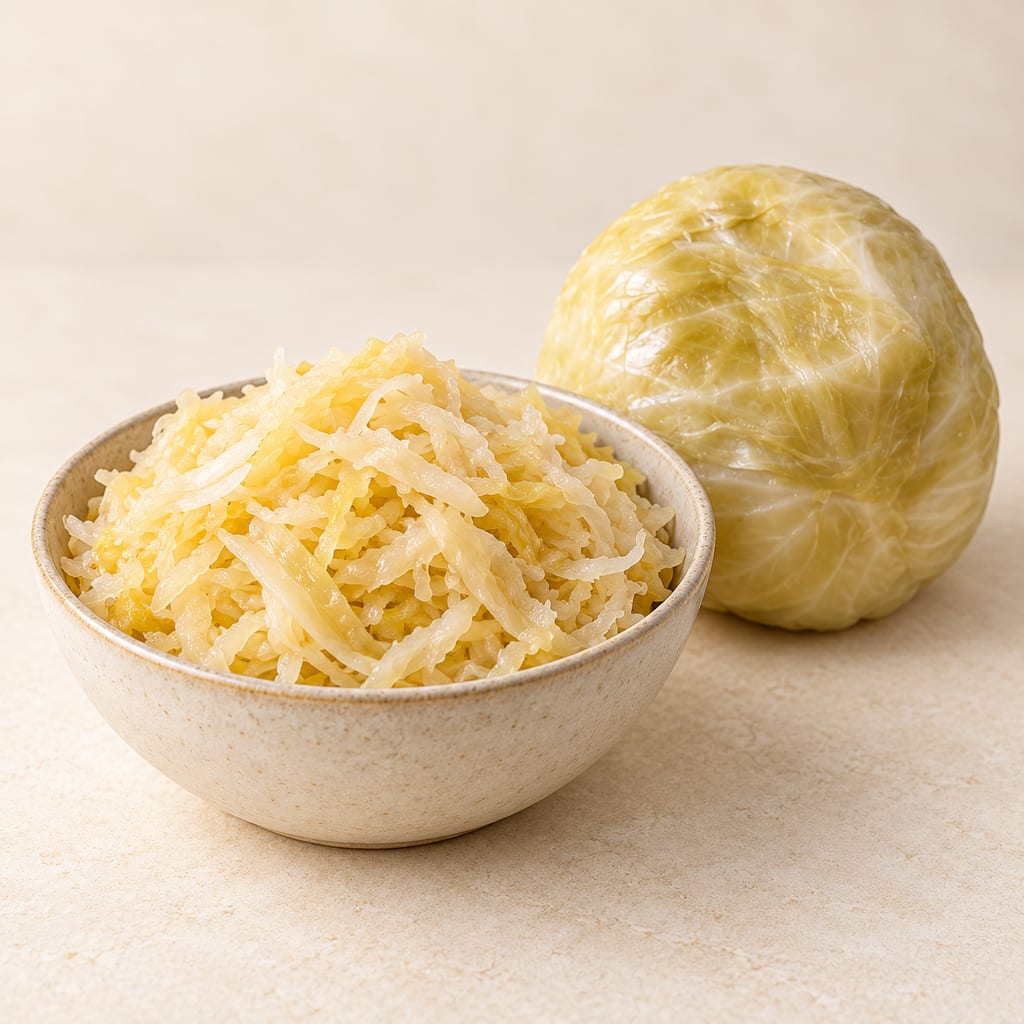
Protected Croatian sauerkraut from the Ogulin area: fresh white cabbage naturally lactic-fermented without preservatives, sold whole or shredded, from registered establishments.
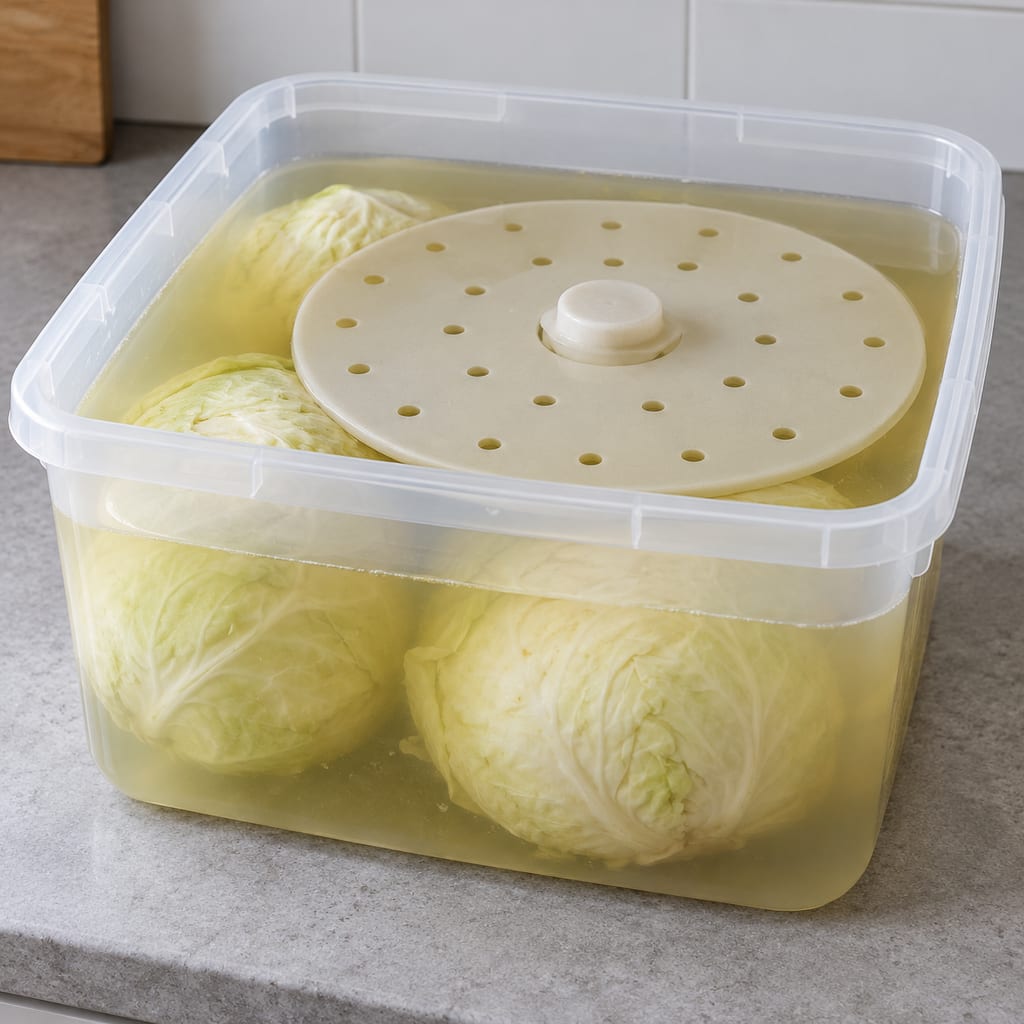
Cored cabbage heads ferment intact or halved under measured brine, with repeated surface checks over six weeks.
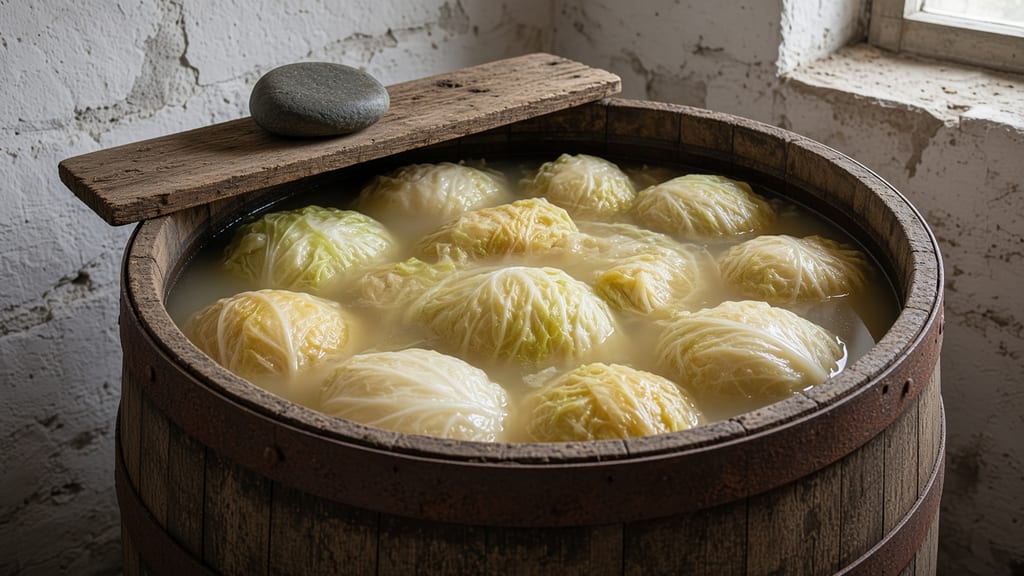
In Futog and Ogulin, whole cabbage heads are soured for winter leaves and a glass of rasol. Their story runs through local seed, dark souring houses, hybrids and protected names.

Ajvar is a cooked Balkan pepper preserve built around roasted red peppers, peeled, drained, ground and slowly fried with oil and seasoning. Leskovac’s protected version is a pepper specialty; regional versions vary.
A Balkan relish of cooked peppers, tomatoes, aubergine and garlic in oil, sometimes made hot, served cold and named for its spiciness.
A Balkan relish of roasted red peppers and tomatoes, often with aubergine and garlic, cooked down into a spread for the winter store.
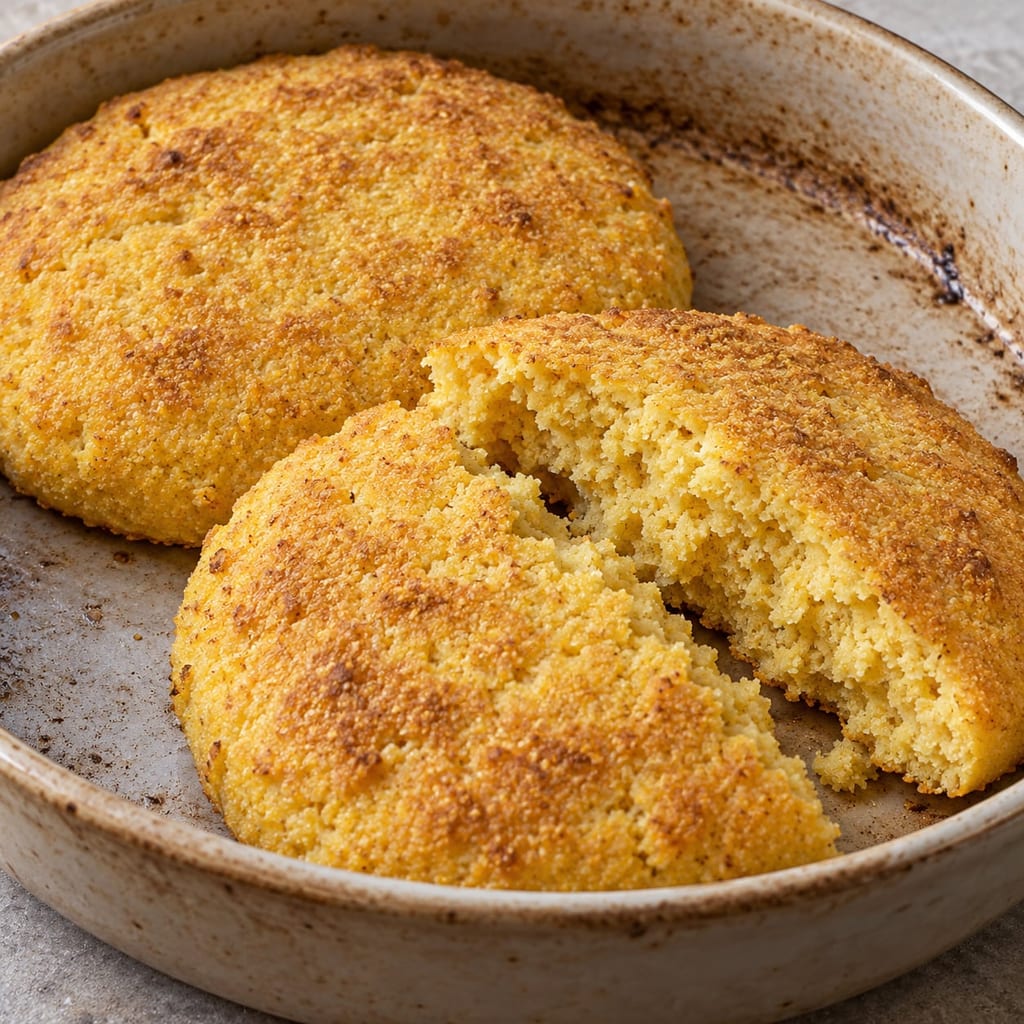
A plain Serbian cornmeal bread made with heated water and salt, shaped into low rounds and baked in a preheated shallow dish. This home method keeps the simple cornmeal form separate from richer dairy-filled projara.
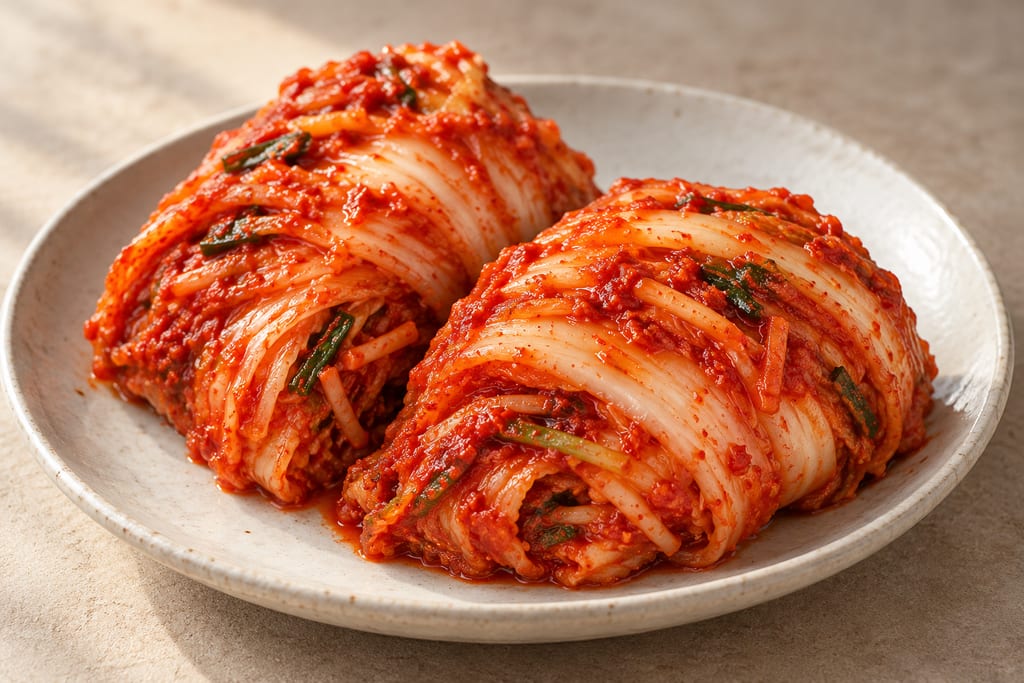
Napa cabbage salted, seasoned with a paste of gochugaru, garlic, ginger and salted seafood, and left to sour through lactic fermentation; Korea's everyday winter preserve.

Napa cabbage is brined and filled with pear, radish, alliums, chives and fruit; this Korean kimchi omits red pepper flakes.
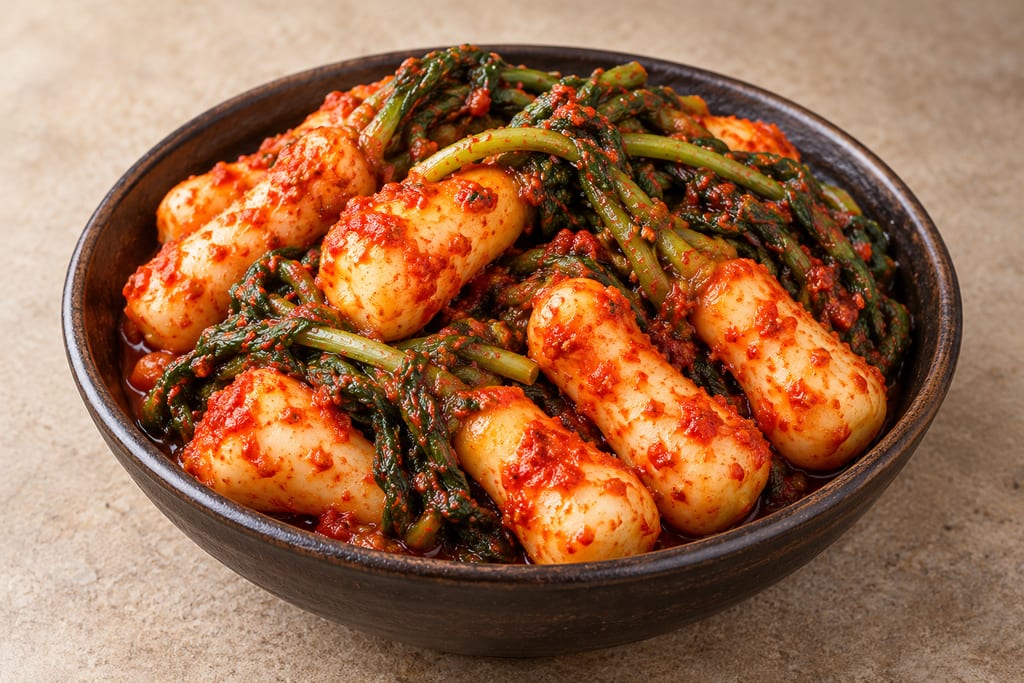
Small ponytail radishes keep their greens attached and ferment in a flour-and-chile seasoning paste.
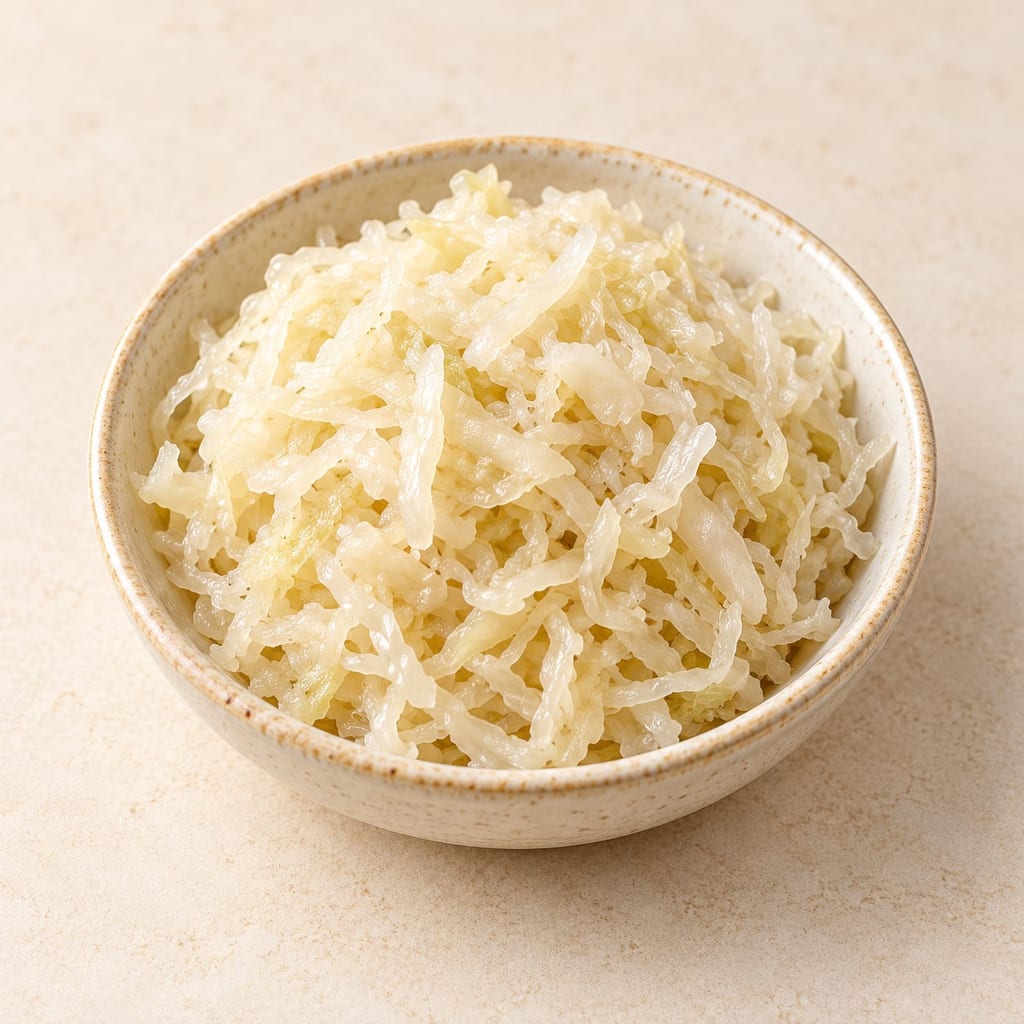
Finely cut cabbage fermented with salt in vats by natural lactic fermentation, a protected Alsatian product sold raw or cooked after fermentation.
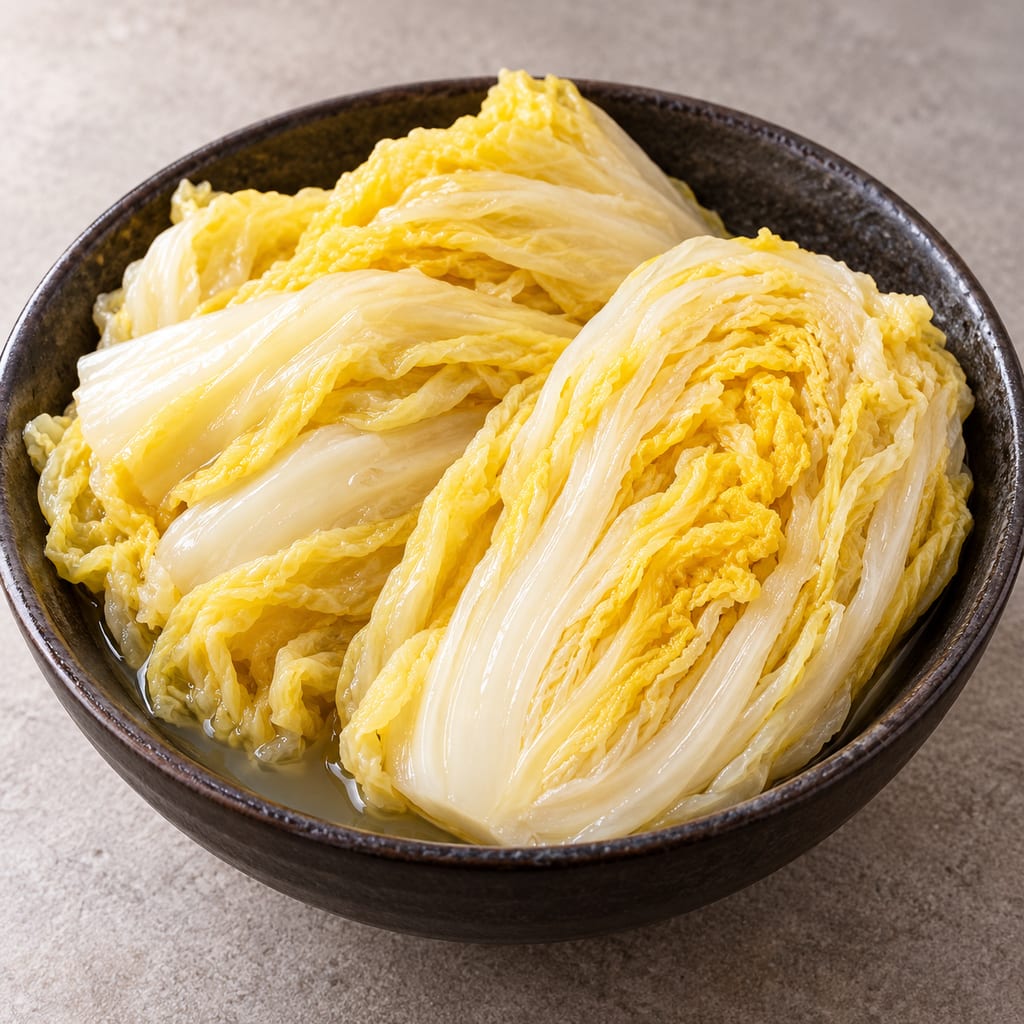
Napa cabbage fermented in a salt brine in Northeast China, traditionally in large ceramic or glass jars, until it turns sour.
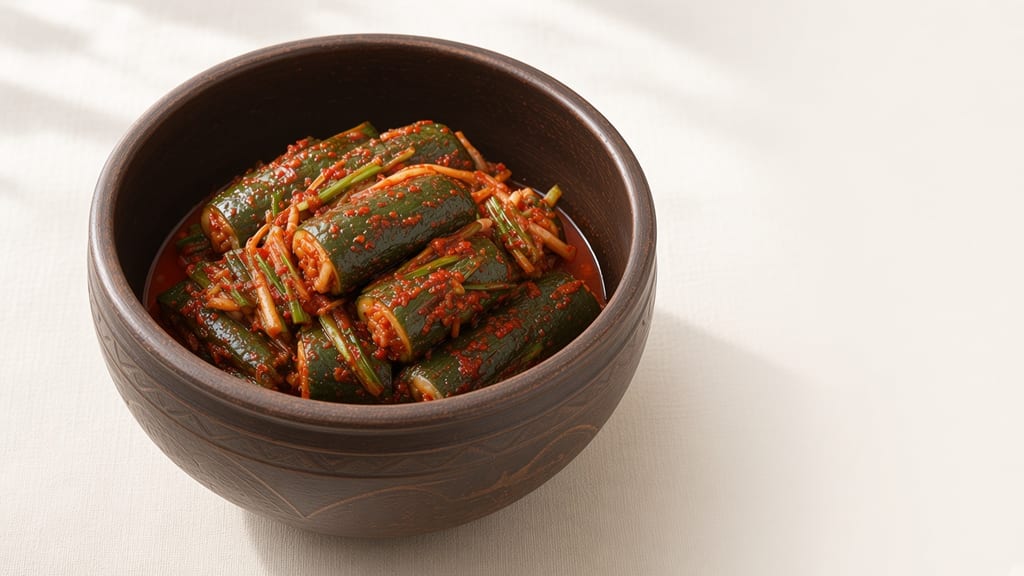
Hwanggwa damjeo is a cucumber kimchi from Yu Jung-rim's Jeungbo sallim gyeongje of 1766. Slit cucumbers are packed with chilli powder and garlic, scalded with hot salted water and sealed overnight.
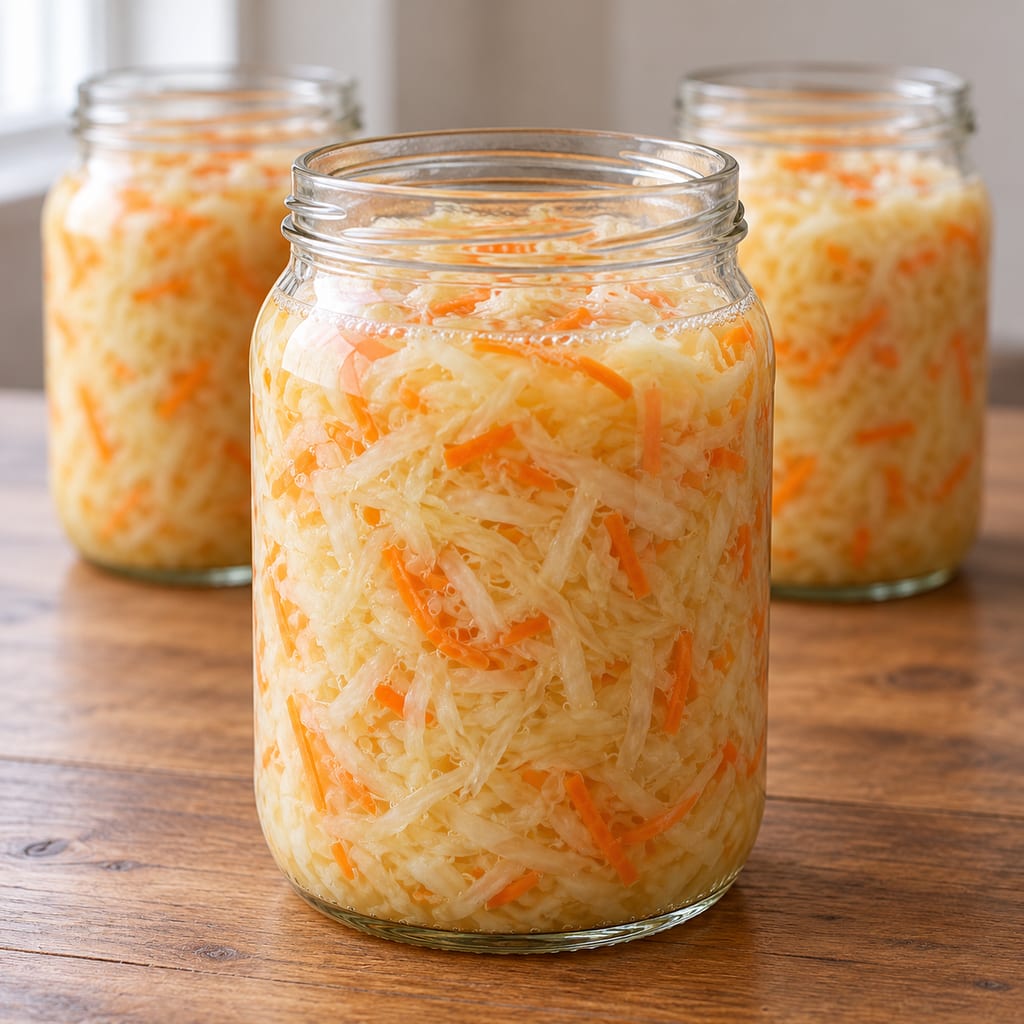
Shredded cabbage and grated carrot are salted to 20 g/kg, rested, packed into three jars and monitored during a creator-reported eight-day fermentation; measured temperature is not given.
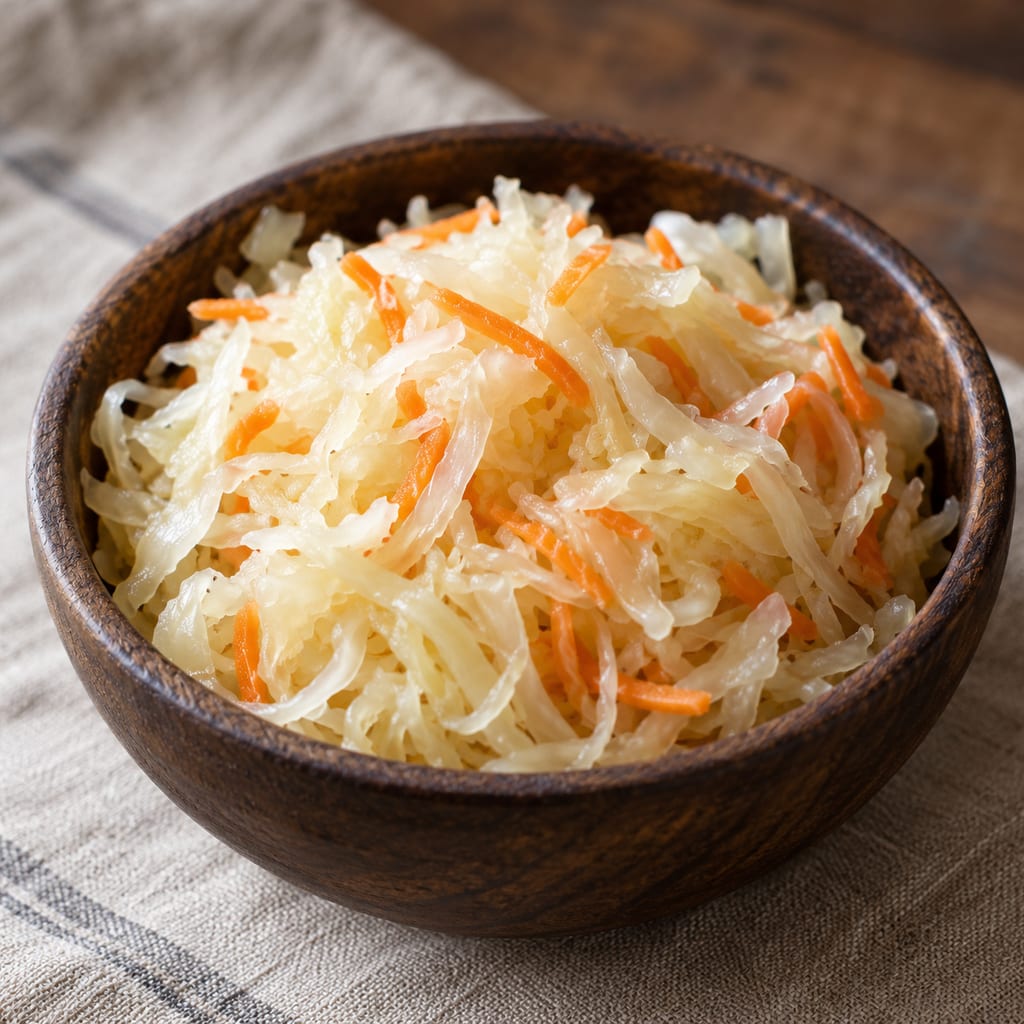
Kapusta kiszona z beczki is barrel-fermented cabbage from the Kołobrzeg area, entered on Poland’s List of Traditional Products in 2008. It is salted and fermented, with raw grated carrot added after souring.

Soft, spreadable Calabrian pork sausage made with a great deal of red chilli and fatty pork, stuffed into natural casings, sometimes smoked and matured while staying soft.

A way to add independent temperature logging to an existing food dehydrator without changing its built-in controls or protections. It is a monitoring method, not a rewiring plan.

Pleurotus cystidiosus is the abalone mushroom, a cultivated oyster-type fungus with dark brown caps that grows more slowly and is more demanding than other Pleurotus species.

A dark, balanced vinegar from Emilia-Romagna made by combining cooked or concentrated grape must with wine vinegar, then acetifying and refining it in wood under a protected specification.

A living dairy inoculum that starts controlled cream fermentation, developing acidity and aroma before sour cream or cultured butter is finished.

A small electric incubator holds jars at a selected temperature for yogurt and other documented warm food preparations. Controls, capacity and vessel arrangement vary by model.

Adygean salt is a seasoned table salt associated with Adygea and the wider North Caucasian culinary tradition. Salt is blended with garlic and a variable selection of herbs and spices; the exact mix depends on the named style and maker.

The African Caesar-group mushroom, Amanita masasiensis, is a wild ectomycorrhizal species of central and southern African woodlands, eaten locally. The genus contains deadly poisonous species, so identification needs care.
No community contributions have been published for this entry yet.
Sign in to contribute. Published comments and photos are free to read.
Nutrition Research Reviews 30(1), 2017History · Safety
Traditional low-alcoholic and non-alcoholic fermented beverages consumed in European countries: a neglected food groupFermented cabbage juice widely consumed in Germany (Sauerkrautsaft), Ukraine, Romania (moare), Serbia (rasol) and other Black Sea regions
Cabbage is fermented and the juice pressed out; final product typically contains a lot of salt
Health research on sauerkraut juice limited to a few in vitro and animal studies
Cited in: What rasol is; A cold glass after a long night; Salt in a small glass
Udruga proizvođača i prerađivača ogulinskog kupusa; Ministarstvo poljoprivrede, March 2022History · Method
Ogulinski kiseli kupus / Ogulinsko kiselo zelje: Specifikacija proizvodaWhole heads receive a clear 5–6 % table-salt solution; shredded cabbage 2–3 % salt, pressed to release juice
First phase about seven days at air temperature at least 16 °C; then six to eight weeks
Finished cabbage kept in a dark room at a rasol temperature up to 22 °C
Knjiga kiseljare records origin, quantity, sugar content, variety, form, start date and fermentation temperature per vat
Finished cabbage NaCl 1.5–4 % and lactic acid 0.5–2.5 %
Cited in: What rasol is; The barrel it comes from; Fresh brine is a different liquid; Where the liquid for this glass comes from; Salt in a small glass
Journal on Processing and Energy in Agriculture 18(2), 2014, pp. 88–90Method
Chemometric approach to optimization of white cabbage fermentationWhole Futoški and Bravo heads, 3–4 outer leaves removed, NaCl solution 1, 1.5 or 2 % w/w, pressed and covered with plastic film, 18–22 °C
Brine sampled on days 3, 6, 10, 15, 22, 37, 55 and 80
Futoški brine lactic acid about 12 g/L, unchanged from day 37 to 80; acetic about 1 g/L by day 37
Futoški heads finished after 20 days, Bravo after 50; salt diffuses more slowly into compact hybrid heads
Cited in: What fermentation does to the liquid
Foods 12(1):19, 2022Method
Evaluation of chemical and sensory characteristics of sauerkraut juice powder and its application in foodShredded cabbage fermented with 1.7 % NaCl, 1 % carrot, 0.2 % caraway for 14 days
Juice about 30 % of cabbage weight, removed at packing as a by-product
Juice averaged 7.6–8.5 °Brix and pH 3.7
Short shelf life and specific aroma limit applications
Cited in: What fermentation does to the liquid
Radio Slobodna Evropa, 9 January 2020History
Kiseli kupus kao gastronomsko nasleđe BalkanaAlački: heads and salt layered in vats and barrels, wooden lid and heavy stone, then water
Horvat: family soured cabbage in large vats; his job was to tread on it; cabbage, salt and water
Ognjević: sour cabbage as salad, soup, pie filling and sarma wrapper
Prilep, December 2008: 160 cooks, 80,191 meatless sarmas in six hours
Cited in: The barrel it comes from; Rasol beside sarma
Air Serbia, Elevate, December 2017, p. 65History
Sarma – queen of the tableCold rasol after a heavy night as a household custom and belief
Cited in: A cold glass after a long night
Leksikografski zavod Miroslav Krleža, Pomorski leksikon, 1990History
SalamuraSalamura (rasol) defined as a solution of salt in water
Cited in: What rasol is
National Center for Home Food Preservation, University of Georgia; adapted from USDA Complete Guide to Home Canning, revised 2015Method · Safety
SauerkrautTop-up brine is boiled and cooled, 1½ tablespoons salt per quart water
70–75 °F about 3–4 weeks; 60–65 °F 5–6 weeks; below 60 °F may not ferment; above 75 °F may soften
Fully fermented kraut kept tightly covered in the refrigerator for several months
Raw pack: fill jars firmly with kraut and cover with juices
Cited in: Fresh brine is a different liquid; Where the liquid for this glass comes from; Keep the cabbage covered
NHS, 2023Safety
Salt in your dietAdults should eat no more than 6 g of salt a day
Cited in: Salt in a small glass