
Home equipment crafts
Drying and freeze-drying at home
A dehydrator turns fruit purée into leather and steamed sweet potato into hoshiimo without sun or wind; a freeze dryer works differently. Both stop microbes growing by removing water, and neither replaces a step that kills them.
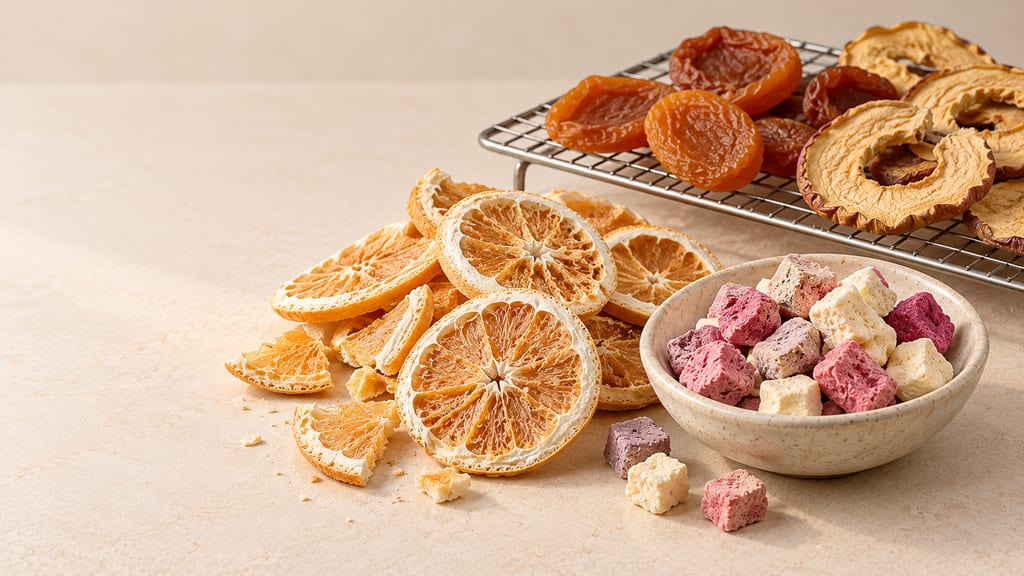
Freeze-dried orange slices and yoghurt crisps beside sun-dried fruit: two ways of taking the water out.
Water that microbes can use
Drying keeps food by taking away enough water that bacteria, yeasts and moulds cannot grow. The measure that matters is not how much water a food contains but how much of it is free to move, which food scientists call water activity.
Water activity is the ratio between the vapour pressure of a food and that of distilled water under the same conditions. It equals the relative humidity of the air that settles above a food sample in a closed container, divided by 100. Most foods sit above 0.95, where bacteria, yeasts and moulds can all grow. The minimum for Clostridium botulinum is about 0.93, and can be as high as 0.96 in some products; in the United States, 0.85 or below in a finished food is a regulatory threshold for certain rules.
Two consequences follow for anyone drying at home. The humidity reading on a cabinet describes moving air, not the food; water activity is measured on a sample sealed in a small chamber, and it takes several hours to reach equilibrium. And different foods hold water differently. Tested home guidance expects dried fruit to keep about 20 % moisture and vegetables about 10 %, brittle enough that some shatter when struck. Those are working targets for those foods, not a universal number.
Air, heat and the skin that forms too soon
A dehydrator is a heater, a fan and a set of trays. Four things decide the result: time, temperature, air circulation and how the food is prepared. Hotter is not simply faster. Too much heat causes case hardening: the surface dries into a leathery skin that blocks water still trying to leave the centre.
The physics behind that is evaporation. Water leaves only from the surface, so drying is limited by how fast water can travel from the middle of a slice to its outside. Thin, even slices dry faster and more evenly, so slices are cut to the same thickness. A dehydrator can evaporate surface water quickly, but the total time depends on how long the interior water takes to reach the surface, and a setting that is too hot forms a skin that slows drying.
Evaporation also cools. Excalibur says food on its trays typically runs about 20 degrees cooler than the air, and that its dial is calibrated to the food: set to 41 °C, the air can reach 51 °C (41 and 51 °C). Brød & Taylor says wet food may run up to 20 °C below the setting, or as much as 25 °C at the start, rising to the setting only as evaporation stops, and offers a two-stage timer to control food temperature through the cycle. Either way, a dial reading is not a food temperature.
Airflow direction matters for mixed loads. In dehydrators with horizontal flow, the fan and heater sit at the side: every tray heats alike, flavours mix less and juices do not drip into the heating element. With vertical flow, both sit at the base, flavours mix and liquids drip down. A typical thermostat runs from 29 to 71 °C, and dehydrators are designed to dry food fast at 60 °C.
Room conditions still count. The humidity of the room, the quantity of food, its moisture and the altitude all change drying time; humid air slows evaporation.
What sun and wind did
Before dehydrators, weather did this work, and it still does for some foods. Fruit can be dried outdoors because its sugar and acid protect it; low-acid vegetables and protein-rich meat spoil when heat and humidity cannot be controlled, so they are dried indoors. Outdoor drying needs hot, dry, breezy days, at least 29 °C and humidity below about 60 %, takes several days, and has to be covered or brought in at night, because cool night air condenses moisture back onto the food. California's raisins are dried in the warm, dry, breezy San Joaquin Valley; rain while the grapes dry can destroy the whole supply.
Sun also changes food beyond drying it. Herbs dried in the sun lose flavour and colour. Japan's hoshiimo, dried sweet potato, is dried by wind as much as sun: potatoes drying under the eaves of houses are a familiar winter scene, and the Ibaraki industry dries them in strong sea breezes.
A cabinet gives independence from weather. It does not reproduce sunlight's chemistry or the day-and-night cycle of an outdoor rack, so a machine-dried version of a sun-dried food is a related product, not a copy. The starkest example, sour cassava starch that rises only after sun drying, is taken up in the article What an appliance cannot reproduce.
Fruit leathers on a lined tray
Fruit leather is purée spread thin and dried into a flexible sheet. The standard home method uses ripe or slightly overripe fruit, washed, peeled, seeded and puréed. Two cups of fruit make one 13 by 15 inch leather. Light-coloured fruit gets 2 teaspoons of lemon juice or an eighth of a teaspoon (375 mg) of ascorbic acid per 2 cups to stop it darkening. Sweetening is optional: a quarter to half a cup of corn syrup, honey or sugar, with corn syrup or honey better for longer storage because they do not crystallise. Applesauce can stretch any fruit and make the leather smoother and more pliable.
The purée goes onto a lined tray about an eighth of an inch thick, kept back from the edges, and dries at 60 °C: roughly 6 to 8 hours in a dehydrator, up to 18 in an oven, one to two days in the sun. Leather dries from the edge inward, so the test is at the centre: touch it, and no dent should remain. It is peeled while warm, rolled and wrapped, and keeps up to a month at room temperature or a year in the freezer.
Mango leather is more specific. Four cups of purée from about four large, unripe mangoes are passed through a food mill or sieve to remove fibre and mixed with a cup of clover honey and small amounts of cinnamon, nutmeg and cloves. Spread a quarter of an inch thick on two lightly oiled roll-up liners, it dries for about 10 hours at a steady 60 °C, with the air temperature checked by thermometer and the time depending heavily on the room's humidity. An oven will do only if it holds 60 to 63 °C, with the door open 2 to 6 inches.
The liner is a piece of equipment in its own right. Waxed paper and aluminium foil are out; purpose-made dehydrator sheets, plastic wrap or food-safe silicone mats are used instead. A solid liner holds liquid that would fall through a mesh tray, but it also stops air passing under the purée, so the sheet dries mainly from its upper surface; that is one reason thickness matters so much for leathers. Other inserts widen what a cabinet can do: fine mesh for herbs, removable trays to make room for hanging products, and small individual sample trays for side-by-side comparisons. Covering every tray with an impermeable sheet blocks circulation through the whole stack.
Tklapi and pestil: cooked fruit sheets
Georgia and Türkiye have their own fruit sheets, and both differ from the leathers above. Tklapi is a sheet of boiled and dried fruit purée, sold in Tbilisi's Deserters' Bazaar, the city's largest agricultural market, beside churchkhela, spices and the cherry or plum sauce tkemali. It is made both as sour sheets used in cooking and as sweet ones eaten as snacks, and the two are kept distinct. A dehydrator version follows the leather method: cooked purée blended smooth and dried on a lined tray into a controlled sheet, with the thickness and a still-flexible endpoint worked out for the chosen fruit.
Pestil is a cooked, starch-thickened sheet. Fruit is boiled briefly at about 95 °C and puréed, seeds and peel are strained out, and the purée is concentrated at 100–110 °C to a target soluble-solids content, traditionally around 40 °Brix. Flour or starch, about 5 to 15 g per 100 g of dry matter, is stirred in during the concentration, and the thick, gelatinised mixture, called herle, is spread thin and dried. Pestil made from boiled grape juice with starch has been studied as a material, for how readily water vapour passes through the sheet.
At home, a pan or cooker prepares the grape-juice and starch mixture and a dehydrator dries it in measured sheets. The cooking and setting carry the recipe, and the composition and final texture differ from a plain fruit leather.
Hoshiimo: steamed, peeled, sliced and dried
Hoshiimo is dried sweet potato, soft and naturally sweet, made without sugar or additives. Its traditional story runs like this. Sweet potatoes reached Shizuoka after a village official, Osawa Gonemon, rescued a ship in distress from Satsuma; a local man, Kuribayashi Shozo, then devised the method of boiling the potatoes, slicing them thin with a knife and drying the slices. It spread to the Kanto region because the potatoes could be kept and eaten at any time. In Ibaraki, production surged after Yuasa Toshichi and Koike Kihei, who ran a rice-cracker shop in Nakaminato, began processing and selling them. Ibaraki now leads Japan's production, centred on Hitachinaka, Tokai and Naka, with volcanic-ash soil, wide temperature swings, salty sea breezes and long sunny winter days; the crop ships mainly from November to mid-March.
The method is short: steam the potatoes, peel, cut and dry. Because the process is so plain, the quality of the potato and the skill of the processing show directly in the flavour. Shapes range from whole potatoes to flat slices, sticks and cubes.
A dehydrator removes the dependence on winter wind and sun, but it replaces the eaves and the sea breeze, not the method, and its chewy result is best compared with the traditional product. Trays need slices of even thickness, and the end is judged by texture. Low-acid vegetables are dried indoors under controlled conditions. Dried fruit is often conditioned: the cooled pieces are packed loosely in sealed jars for 7 to 10 days, shaken daily and returned to the dryer if condensation appears, so that moist pieces share their water with drier ones. Hoshiimo is eaten soft rather than brittle.
Herbs, mushrooms and chilli
Herbs show what low heat protects, and a dehydrator is particularly useful for them in humid climates, where air drying is slow; the aim is to keep aroma and colour rather than to apply the most heat the machine allows. A dehydrator is preheated to 35–46 °C, or up to 52 °C in humid regions; rinsed and shaken herbs go in a single layer and dry for 1 to 4 hours, until the leaves crumble and the stems snap. Excalibur's own chart is a little lower, 35–41 °C. Sturdy herbs such as rosemary, sage and thyme can hang in bundles; tender herbs such as basil, oregano, tarragon, lemon balm and mint hold so much water that they mould if not dried quickly. Small amounts can go in a microwave, following its maker's instructions. Dried herbs go into airtight containers in a cool, dry, dark place and are three to four times as strong as fresh.
Mushrooms change more than their water content. When six varieties of dried shiitake were soaked and heated, free amino acids, 5'-nucleotides and lentinic acid rose, by different amounts in different varieties, and the varieties absorbed water and browned at different rates. Much of the flavour develops in the soak and the pot, and depends on the mushroom chosen. Drying is therefore a flavour-making step as well as a way of removing water, and species identity and the intended cooking still matter. A dehydrator followed by a grinder makes mushroom seasoning; keeping a separate sample whole allows rehydration tests.
Chilli powder has its place in the kimjang year: in Korea, red chillies are dried and ground into powder in late summer, before the autumn kimchi season. A dehydrator followed by a grinder with controlled particle size is the modern route, with Excalibur's vegetable range of 46–54 °C as one maker's starting point; the cultivar, the proportion of seeds and the heat remain recipe-specific.
Tarhana: ferment first, then dry
Tarhana is a Turkish soup base of flour, yoghurt and vegetables, fermented as a dough and then dried and crumbled. It is made at home and commercially, with relatives across a wide area: trahanas in Greece, kishk in Syria, Palestine, Jordan, Lebanon and Egypt, and kushuk in Iraq and Iran. Traditionally the dough is dried in the sun and ground, and the dried crumbs are cooked into soup.
A laboratory batch gives a full recipe: 1,000 g of white wheat flour, 700 g of full-fat yoghurt, 85 g of tomato paste, 78 g of chopped onion, 35 g of red pepper, 17 g of green pepper, 12 g of salt and 4.5 g of mint, kneaded together. The dough fermented in a glass jar at 35 °C for seven days, then dried in a convection oven at 55 °C for 72 hours and was ground. During the week, acidity rose from 1.10 to 3.25 %, the pH fell from 5.22 to 4.13, and lactic acid bacteria and yeasts multiplied. The dried tarhana held 9.55 % moisture.
The two stages need two environments. The fermentation is a warm, closed-jar job of the kind a proofer does; the drying wants moving warm air, which a dehydrator supplies.
One detail needs care. Mould counts in the dough rose from about 16 to about 24,500 colony-forming units per gram during fermentation, although no mould growth was seen. That means no visible mould alongside a measurable mould population, a reason not to treat tarhana dough as self-protecting. At its low pH and moisture, the dried product is a poor medium for pathogens; the study counted indicator organisms, not pathogens.
Jameed and aaruul: dense dried dairy
Jameed, Jordan's dried fermented dairy, shows the limit of surface drying. It is shaped into stone-hard balls or other forms: heated buttermilk is strained in cloth bags, the paste is salted by kneading, shaped and dried in the sun. It is broken up and reconstituted to make mansaf, lamb cooked in jameed sauce and served on rice, Jordan's national dish. When solar-dried and freeze-dried jameed with added carrageenan were compared, the freeze-dried samples generally carried higher microbial counts than the sun-dried ones.
A ball of paste dries from the outside in, like the leathers above, so its surface can be hard while the middle is still moist. Solar- and freeze-drying research gives real technical precedent for drying it under control, but large dense balls need more than a dry surface. A modern route separates the cultured-milk preparation, the draining and pressing, and a controlled drying stage. Smaller, even pieces would dry more predictably, but would make a different product.
Aaruul is Mongolia's dried curd, a traditional dairy food that still carries living lactic acid bacteria: eight aaruul samples were among the Mongolian dairy products from which those bacteria were isolated and tested for probiotic traits. A development route makes the curd separately and then runs drying trials on pieces of uniform shape.
Meat is a different job
Jerky is where drying and safety come apart most clearly. Raw meat can carry disease-causing bacteria, and the risk from home-dried jerky falls if the meat's inside reaches 71 °C, done in a way that avoids case hardening. There are two routes: boil the strips in their marinade for 5 minutes before drying, or heat dried strips cut a quarter of an inch thick or less for 10 minutes in an oven at 135 °C. Drying itself is at 60 °C, until a test piece cracks without breaking; properly dried jerky keeps two weeks at room temperature in a sealed container. The USDA's home method makes the same separation, heating meat to 71 °C, or poultry to 74 °C, before dehydration. The heating step does the killing and the dryer does the drying.
Brød & Taylor tells Sahara owners to dry meat at a setting of at least 71 °C, noting that some studies recommend heating meat before drying, because contaminants can become more heat-resistant once dry. Biltong, southern Africa's dried meat, belongs in a purpose-designed drying box with monitored temperature and airflow and is kept distinct from cooked jerky: equivalent safety cannot be inferred from a drier-looking surface, and it needs its own validation. Meat curing and lethality are the subject of the article What an appliance cannot reproduce.
Cool, pack and check: what dry means afterwards
Drying is not finished when the trays come out. Dried food is cooled completely first, because warm food sweats inside a container and the moisture can be enough for mould. It then goes into clean, dry, insect-proof jars, freezer boxes or bags, packed in amounts used at once, since every opening lets in moist air. Vacuum packing is acceptable for food that is already dry.
Dried foods keep 4 months to a year, less in warmth: most dried fruits last a year at 16 °C and six months at 27 °C, and vegetables about half as long. Food that seemed bone dry can take up moisture in storage; glass jars show condensation early. Moist but unspoiled food is used at once or dried again; mouldy food is discarded. Water activity remains the honest measure, and few homes can measure it.
A freeze dryer is a different machine
A home freeze dryer does not blow warm air. It works in three stages: freezing the food solid, usually below −18 °C; primary drying, in which raised temperature under vacuum turns ice directly into vapour; and secondary drying, in which more heat removes the last bound water. Because the structure is frozen in place while the water leaves, the food keeps its shape, flavour and nutrients better than in a dehydrator, at a higher cost in energy and time.
Its limits are specific. Proper freeze-drying brings water activity to about 0.3 or below, often 0.08–0.33, where microbes cannot grow, but it does not kill them: they stay viable, and laboratories use freeze-drying to keep cultures alive for decades. Foods normally cooked before eating, such as meat, seafood and eggs, are cooked before freeze-drying or after rehydration; raw meat, raw eggs and raw milk products are unsuitable. Pasteurised dairy, cooked starches, fruit, blanched vegetables and finished sauces work; fat and sugar slow drying and fatty foods go rancid. The jameed comparison above points the same way.
The process asks for thin pieces, ideally no more than half an inch, pre-frozen and in one layer; thick foods can take more than two days. Finished food goes straight into moisture- and oxygen-proof packaging, best 5–7 mil Mylar bags without windows, with oxygen absorbers. Machines work best in rooms at 7–27 °C, and typical batches take 20 to 40 hours. Well-packed food is cited as keeping 10 to 15 years, sometimes 25, but home freeze-dried products are best not eaten more than 5 to 10 years after processing. A machine's cycle is not a shelf-life test.
Freezing is not freeze-drying. A block of tofu frozen at home is still wet food; the article Soy milk, tofu and yuba explains the difference from dried kōri-dōfu.
Related
Discussed in this article
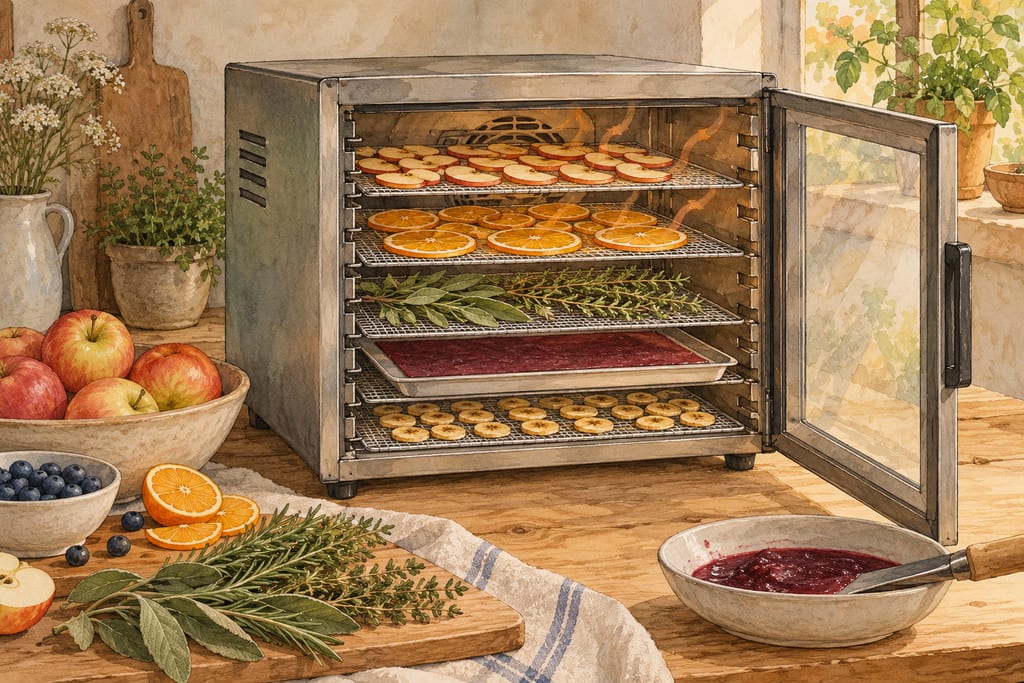
Drying cabinet with lined trays
A dehydrator or drying box set up with mesh trays for slices and herbs and solid liners for purées, drying by warm moving air to a recipe's own endpoint.
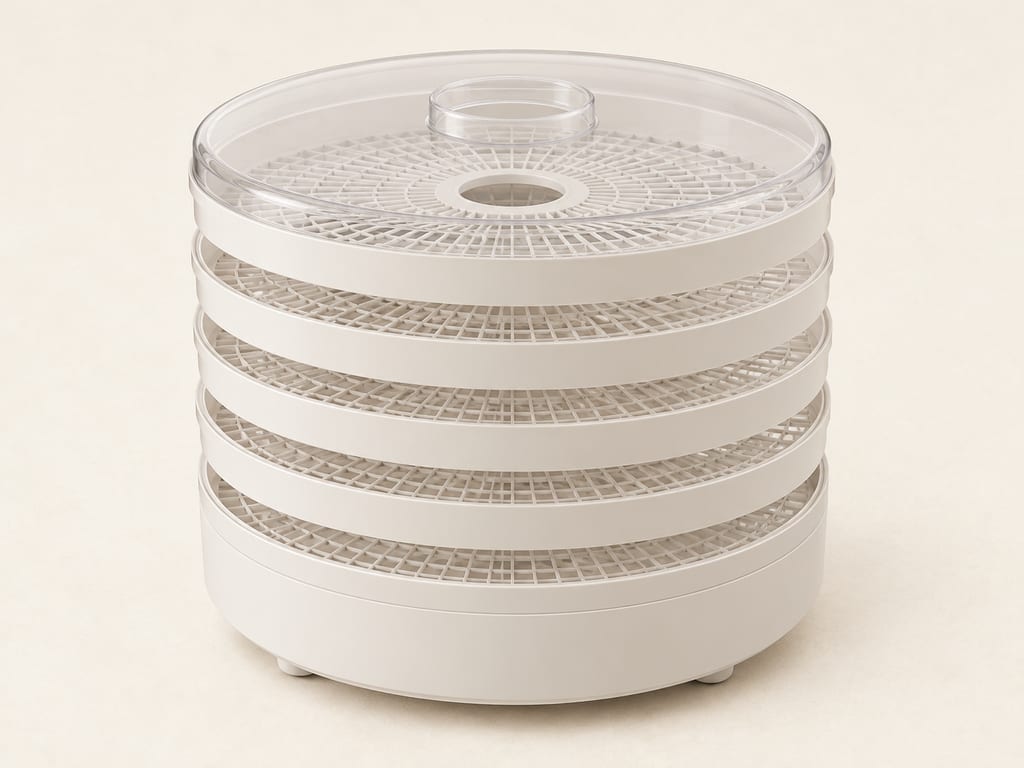
Food dehydrator
A countertop electric appliance circulates warmed air across food on open trays to remove moisture. Round stackable and rectangular cabinet designs use different airflow paths; materials, capacity and controls vary by model.
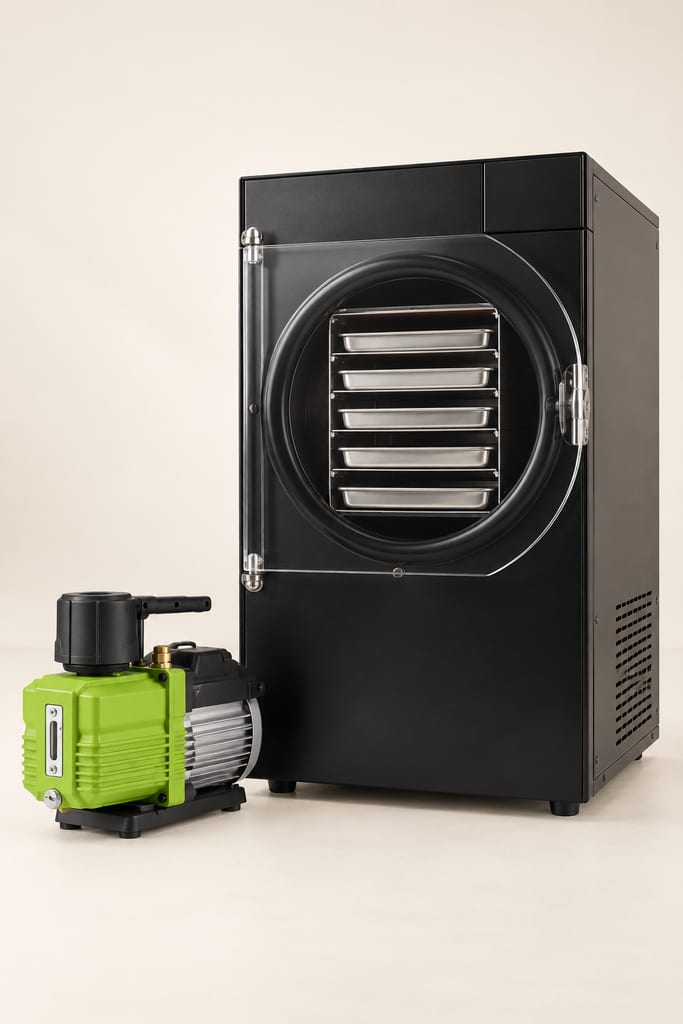
Home freeze dryer
A home freeze dryer freezes food and then removes ice under vacuum by sublimation, followed by drying to reduce residual moisture. It is a contemporary electric preservation appliance, not a freezer alone or a microbial kill step.

Jameed
A documentary account of jameed, a traditional dried cultured-milk food. The cited sources do not provide a complete validated home process or a measurable endpoint for making it shelf-stable.
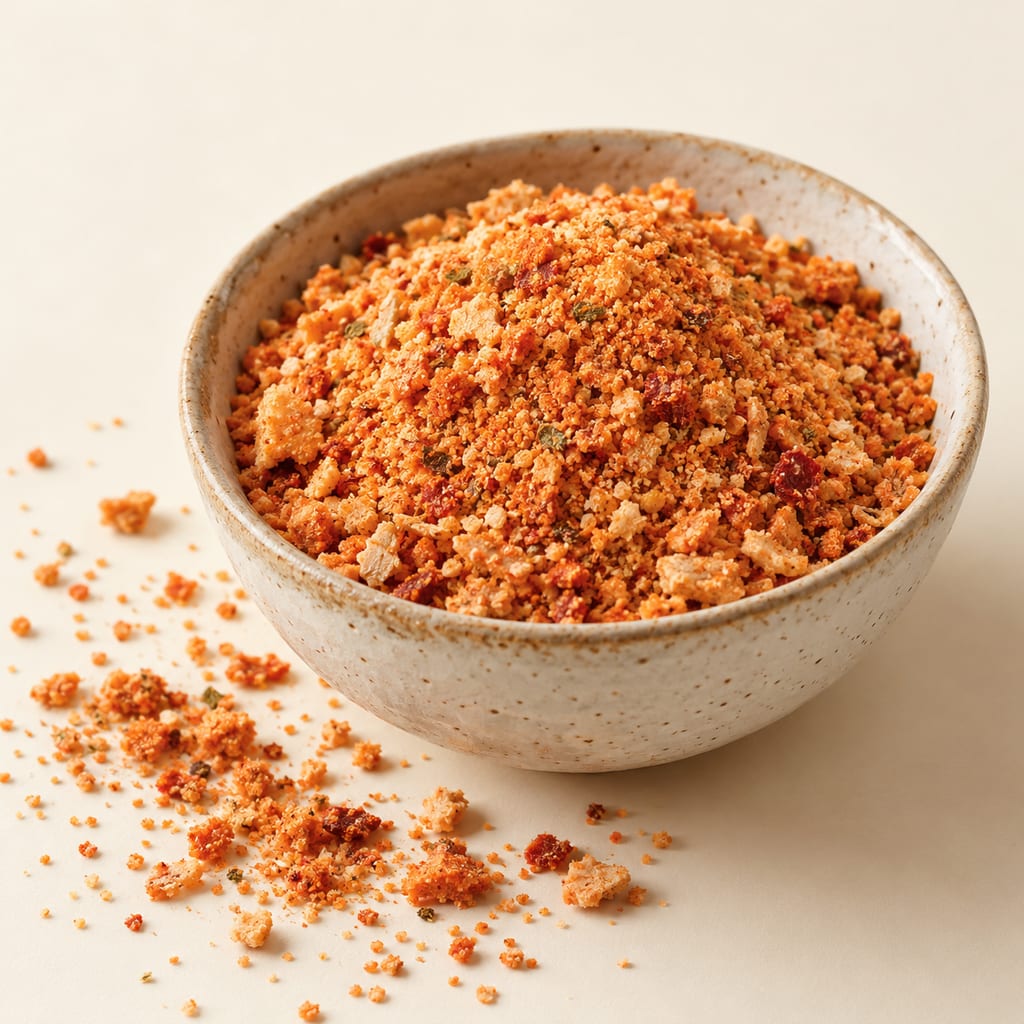
Tarhana and related dried fermented soup bases
Tarhana is a Turkish soup base: yoghurt, flour or semolina and usually onion, tomato and red pepper, fermented as a dough for days, rubbed into grains and dried.
Community
No community contributions have been published for this entry yet.
Share what you made
Sign in to contribute. Published comments and photos are free to read.
Sources
Brød & Taylor
Support (product specifications and FAQ: Folding Proofer & Slow Cooker, Sourdough Home, Sahara Folding Dehydrator)Cited in: Water that microbes can use; Air, heat and the skin that forms too soon; Fruit leathers on a lined tray; Meat is a different job
U.S. Food and Drug Administration
Water Activity (aw) in FoodsCited in: Water that microbes can use; Meat is a different job; Cool, pack and check: what dry means afterwards
National Center for Home Food Preservation (University of Georgia)
Packaging and Storing Dried FoodsCited in: Water that microbes can use; Hoshiimo: steamed, peeled, sliced and dried; Cool, pack and check: what dry means afterwards
Excalibur Dehydrator
Intro to DehydratingCited in: Air, heat and the skin that forms too soon; Fruit leathers on a lined tray; Herbs, mushrooms and chilli
National Center for Home Food Preservation (University of Georgia)
Food DehydratorsCited in: Air, heat and the skin that forms too soon
National Center for Home Food Preservation (University of Georgia)
Sun DryingCited in: What sun and wind did
National Center for Home Food Preservation (from So Easy to Preserve, 6th ed., Bulletin 989)
HerbsCited in: What sun and wind did; Herbs, mushrooms and chilli
Ministry of Agriculture, Forestry and Fisheries, Japan
Hoshiimo | Traditional Foods in JapanCited in: What sun and wind did; Hoshiimo: steamed, peeled, sliced and dried
National Center for Home Food Preservation (from So Easy to Preserve, 6th ed., Bulletin 989)
Fruit LeathersCited in: Fruit leathers on a lined tray; Tklapi and pestil: cooked fruit sheets
National Center for Home Food Preservation (University of Georgia)
Mango LeatherCited in: Fruit leathers on a lined tray
Georgian National Tourism Administration (georgia.travel)
Deserters' BazaarCited in: Tklapi and pestil: cooked fruit sheets
Foods (MDPI), open access, PMC12111520
Production of Red Beetroot (Beta vulgaris L.) Pestil as an Alternative Healthy Snack (Foods 14(10): 1784, 2025)Cited in: Tklapi and pestil: cooked fruit sheets
Journal of Food Engineering
Water vapor permeability of pestil (a fruit leather) made from boiled grape juice with starch (Journal of Food Engineering 57: 295–299, 2003)Cited in: Tklapi and pestil: cooked fruit sheets
J-STAGE (Japanese Society for Food Science and Technology)
The Behavior of Different Varieties of Dried Shiitake Mushrooms (Lentinus edodes) in Rehydration (Nippon Shokuhin Kagaku Kogaku Kaishi 47: 347–354, 2000)Cited in: Herbs, mushrooms and chilli
UNESCO Intangible Cultural Heritage
Kimjang, making and sharing kimchi in the Republic of KoreaCited in: Herbs, mushrooms and chilli
Food Science and Technology, SciELO
A functional food: a traditional Tarhana fermentation (Food Science and Technology (Campinas) 37(2), 2017)Cited in: Tarhana: ferment first, then dry
Pakistan Journal of Nutrition
Microbiological Analysis of Solar and Freeze-Dried Jameed Produced from Cow and Sheep Milk with the Addition of Carrageenan Mix to the Jameed Paste (Pakistan Journal of Nutrition 7: 726–729, 2008)Cited in: Jameed and aaruul: dense dried dairy; A freeze dryer is a different machine
Animal Science Journal
The investigation of probiotic potential of lactic acid bacteria isolated from traditional Mongolian dairy products (Animal Science Journal 82: 571–579, 2011)Cited in: Jameed and aaruul: dense dried dairy
Food and Agriculture Organization of the United Nations
FAO Digital Media Hub: Mongolian aaruul photographic record (2026)Cited in: Jameed and aaruul: dense dried dairy
National Center for Home Food Preservation (from So Easy to Preserve, 6th ed., Bulletin 989)
JerkyCited in: Meat is a different job
Utah State University Extension
Can I Freeze-Dry That? A Practical Guide to Safe and Effective Freeze-DryingCited in: A freeze dryer is a different machine
Utah State University Extension
Buying a Home Freeze-Dryer: What to Know Before You GoCited in: A freeze dryer is a different machine
Gaps
- No slice thickness, drying temperature or endpoint is published for hoshiimo, and whether fruit-style conditioning suits a soft dried sweet potato is unknown.
- No tested home method exists for tklapi, pestil, jameed or aaruul, and no safe modern home drying method for aaruul has been established.
- No home drying temperature is published for shiitake or for chillies for gochugaru.
- The tarhana study reports rising mould counts while stating that no mould growth was observed.
- Water activity, the measure that would settle most questions about dried foods, is rarely measurable in a home kitchen.
Updated 2026-10-27