
Breads
The long loaf: how France made the baguette
From 1920 price lists and Favrais's 1904 manual to the 1993 Décret Pain and UNESCO 2022: how long French breads, night-work law, Calvel and three ferments shaped the baguette.
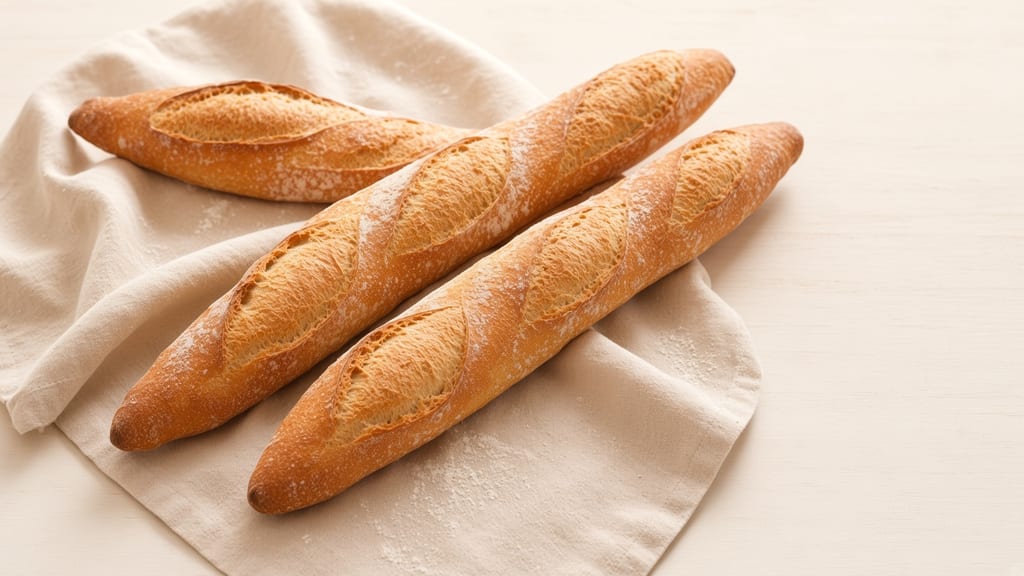
Three scored baguettes on ivory linen with a light flour dust.
Eighty grams and a morning clock
In July 1920 the Bulletin de la Statistique générale de la France listed, among the pains de fantaisie, a baguette of 80 g priced at 0.30 franc. The same summer Le Figaro wrote of "exquises baguettes" still warm in the hands of workers leaving for the six-o'clock shift. The loaf that would become a national shorthand for French bread was already small enough to price by the piece and light enough to eat on the way to work.
That bureaucratic line does not invent the baguette. It records a name that had only recently settled. The French Ministry of Culture's inventory for UNESCO traces long breads in Paris back through eighteenth-century flûtes and nineteenth-century flûtes crevées, then finds the word baguette for a scored long loaf in Favrais's 1904 baker's manual. The story is a pile of shapes, laws, ovens and microbes, not a single inventor.
What follows is that pile: Viennese steam, the night-work statutes of 1919, the postwar industrial loaf, Raymond Calvel's fight for flavour, the 1993 Décret Pain, the Paris Grand Prix, and the 2022 UNESCO listing. Alongside it sit three fermentation routes that bakers still use: poolish, levain, and pâte fermentée.
Why the long loaf matters
A baguette is not only a shape. UNESCO's 2022 inscription names the craft and the culture around it: weighing and mixing flour, water, salt and leaven or yeast; kneading; fermentation; dividing; resting; hand shaping; a second fermentation; shallow cuts that act as the baker's signature; baking in small batches through the day. Temperature and humidity change the loaf, so two bakers with the same four ingredients do not make the same bread.
The sensory claim in the heritage file is specific: a crisp crust and a chewy crumb. The social claim is specific too: the daily visit to the bakery, the racks cut to the length of the loaf, the apprenticeship that mixes school courses with time at the bench. A history that stops at the silhouette misses the fermentation and the labour that give the silhouette its meaning.
Long breads before the name
French bakers were already drawing dough into long forms when the word baguette still meant a stick, a wand or a conductor's baton. Olivier de Serres, writing in 1600, listed breads that differed in body, figure, colour, quality and price, some long, some round. Paul-Jacques Malouin's 1767 professional treatise, whose plates later entered Diderot and d'Alembert's Encyclopédie, places elongated loaves in the ordinary Paris range.
In the eighteenth century the Paris term for many of those loaves was flûte: tapered ends, often 120–250 g, treated as a luxury because they stale quickly. By 1808 Grimod de La Reynière was praising the flûtes of Battu on the rue Saint-Denis. Mid-nineteenth-century writers describe flûtes crevées marked by incisions. The baker's slash that opens into a grigne is already there. Frédéric Le Play weighed some of those crevées at about 175 g, with smaller ones down to 85 g. Around 1880 lengths ran from a 48 cm jocko to an 80 cm long fendu and a metre-long boulot long. Husson wrote in 1874 that the Paris consumer wanted "le luxe du pain allongé ou plat", more crust for the weight.
The Ministry inventory is careful: these are successive traits of long fancy breads, not proof that a modern 250–300 g baguette stood on every counter in 1850. The name arrives later.
Cheval's source survey adds texture to the same arc. Nineteenth-century visitors to Paris keep noticing long narrow loaves baked free of contact so steam and heat can finish them quickly. An American baker's guide from 1884 praises French and Vienna breads made as narrow loaves and mentions Paris lengths of six feet with a diameter of about four inches. Those reports are travel and trade talk, not a legal standard, but they show that extreme length was already a Paris habit before the baguette name locked in.
What the fancy long loaf offered was crust. Round miches of a kilo or more kept well for households that bought bread infrequently. Urban customers who could afford several small purchases a day preferred a higher crust-to-crumb ratio and a loaf that would be stale by evening. That preference is the economic ground under the later baguette, whether or not any single baker claimed the invention.
August Zang, steam, and what he did not invent
In 1839 the Austrian August Zang opened a Viennese bakery in Paris. He is widely credited with bringing steam-oven baking and Viennese soft rolls into French pastry practice, and the croissant story often starts in his shop. Steam keeps the surface of dough moist in the first minutes of the bake so the loaf can expand before the crust sets. French bakers later used that principle for the thin, blistered crust of long wheat breads.
What the sources do not support is a clean line from Zang's counter to the twentieth-century baguette. Nineteenth-century pains viennois are repeatedly described as petits pains, often elliptical, sometimes milk-enriched, closer to rolls than to a metre of lean dough. Jim Cheval's documentary inquiry into baguette origins treats the Zang-as-inventor claim as overstated: steam technology travelled; the scored lean baguette as later known does not appear, fully formed, in the Zang years. Steven Kaplan, interviewed for France Culture, puts the baguette firmly in the twentieth century as a product of urban demand for fresh crust several times a day, not of a single Austrian patent.
When the word baguette sticks
Favrais's 1904 Manuel du boulanger lists a "baguette" (also called noël or richelieu) on which the baker multiplies the coups de lame. Four years earlier the baronne Staffe had mentioned petits pains-baguettes. The Ministry inventory reads those lines as the moment the term settles on an elongated, scored, yeast-raised white loaf in Paris.
By 1920 the statistical bulletin can price an 80 g baguette without gloss. A 1921 trade poster mentions a 300 g baguette. After the Second World War the form spreads in the provinces. In 1957 the Revue politique et parlementaire notes that INSEE has taken the 300 g baguette, not the old gros pain pesé, into the consumer price index. Even the statisticians had switched symbols.
The 1919 night-work law
On 28 March 1919 France passed a law forbidding the employment of bakery workers on bread and pastry between 10 p.m. and 4 a.m. It took effect on 1 October 1920. A later Assemblée nationale answer dates the same prohibition to 26 March 1919; both point to the same postwar labour measure. Prefectoral exemptions later hollowed it out, and the ban on night work for bakery workers was repealed in the December 1993 employment law.
Popular histories often say the law invented the baguette: bakers, denied a full night, switched from slow levain miches to fast yeast and thin loaves that bake in about twenty minutes. The timeline overlaps. Commercial yeast was already in use; long fancy breads already existed; the baguette name was already in manuals. Steven Kaplan and the Ministry inventory treat the law as one pressure among others, not as a founding charter. L'Histoire notes that enforcement was uneven. The safer claim is narrower: shorter overnight windows favoured schedules and shapes that could be mixed, fermented and baked after four in the morning, and the baguette fitted that urban rhythm.
Oral histories collected by Isabelle Bertaux-Wiame from bakers who apprenticed in the 1920s and 1930s, cited in Cheval's inquiry, show shops still talking in baguettes and bâtards as daily units of work. The law did not empty the night of labour forever. Exemptions and later practice put bakers back on early-morning shifts. What persisted was the product mix: smaller, faster loaves for customers who wanted bread still crackling after dawn.
Marx's image of bakers as "white miners," repeated in Kaplan's interviews, belongs to the older overnight miche culture. The political answer in 1919 was a clock limit. The technical answer, already underway, was yeast, stronger flour and shapes that baked in a short oven cycle. The baguette rode that convergence.
Levain, levure, poolish
For centuries French country bread leaned on levain: a refreshed flour-and-water culture of lactic acid bacteria and wild yeasts. The 1765 Encyclopédie entry on LEVAIN already treats it as a living dough. Commercial baker's yeast, Saccharomyces cerevisiae grown as a product, shortened schedules and made lean white doughs more predictable. The 1993 decree still allows either agent, or both, for pain de tradition française.
Poolish sits between them. It is a commercial-yeast preferment, usually near equal weights of flour and water, mixed for one bake and used up in that dough. King Arthur Baking's professional reference repeats a Polish-origin story for the name; Matthew Baerman's linguistic note finds 1865 Central European spellings such as Pohlisch and pollisch and leaves the inventor unresolved. What matters for the baker is the schedule: a wet, yeasted sponge that ripens overnight, then disappears into the final mix. Pâte fermentée is different again: a piece of salted, yeasted dough held back from an earlier batch, already gluten-developed, then cut into a new dough. French bakers used all three routes in baguettes and related long breads.
The Muséum national d'Histoire naturelle's public explainer draws the same bright line: levure de boulanger is a selected yeast strain sold as a product; levain is a community refreshed by the baker. UNESCO's baguette file allows "leaven and/or yeast" among the four ingredients. The fermentation choice is part of the craft the heritage listing protects, not a side note.
Postwar white and the Calvel quarrel
After 1945 France wanted white bread again. Roller mills, high-yielding wheat, dough improvers, fresh compressed yeast and two-speed mixers produced tall, pale, fast loaves. Intensive mixing oxidised carotenoid pigments in the flour, bleached the crumb and shortened fermentation. By the 1970s and 1980s critics were calling industrial baguettes bloated and hollow. Le Cordon Bleu's account of the boulangerie renaissance describes refined flour "corrected" with improvers and the slow loss of levain skill across tens of thousands of shops.
Raymond Calvel (1913–2005), trained first as a rural baker in the Tarn and later at the École de Boulangerie of the Grands Moulins de Paris, spent decades teaching and consulting against that drift. He advised Japanese bakers from 1954 onward, taught the bread chapter of Mastering the Art of French Cooking Volume 2, and in 1974 formalised the autolyse: a rest of flour and water before salt and yeast are added, so gluten can hydrate with less mechanical work. King Arthur Baking summarises his complaint: aggressive mixing made bread "very white and high in volume" at the cost of aroma and keeping quality. Calvel's The Taste of Bread (Le goût du pain) became the handbook of the quality reaction.
Calvel's own path matters for the tone of the revival. After a rural apprenticeship he learned Paris baguette work with a four-hour pointage and careful coups de lame at the Grands Moulins school, then spent the war in captivity and returned to publish on wartime flour substitutes with M. Nuret in 1948. He consulted for biscotte factories and tunnel ovens even as he attacked lipoxygenase from bean and soya flours in the crumb. The AIPF Calvel association quotes his 1983 plea: keep both of those flours out of the dough. The 1993 decree's tiny allowances for bean and soya flour sit in the shadow of that fight.
By the late 1980s the cultural press had turned. A Nouvel Observateur line remembered in later baking essays called the common baguette "horribly disgusting," bloated and dead white. Calvel joked that the best baguette might soon be made in Tokyo, where he had taught for decades. The joke was a warning to French bakers: technique travels, and shame can follow.
Décret Pain, 13 September 1993
Décret n° 93-1074 of 13 September 1993, issued under the 1905 frauds law, is the legal hinge of modern French bread talk. Article 1 reserves pain maison for loaves fully mixed, shaped and baked at the point of sale. Article 2 reserves pain de tradition française, pain traditionnel français and related names for breads that have never been frozen during making, contain no additives, and come from a dough of wheat bread flours, drinking water and culinary salt, fermented with baker's yeast and/or levain as defined in the decree. Bean flour up to 2%, soya flour up to 0.5% and wheat malt flour up to 0.3% of the flour weight are the only optional extras listed.
Article 3 sets a separate label pain au levain, with a crumb pH of at most 4.3 and at least 900 ppm endogenous acetic acid. Article 4 defines levain as a naturally acidifying dough of wheat and/or rye flour and water, optionally salted, whose flora is mainly lactic bacteria and yeasts; a late addition of baker's yeast is capped at 0.2% of flour at the final mix. The Confédération Nationale de la Boulangerie-Pâtisserie Française presents the decree as a professional initiative to protect French panification during European additive harmonisation. Weight and price are not fixed. Shape is not fixed either: the decree covers breads "quelle que soit leur forme". A baguette can qualify; so can a boule. What the decree blocks is the frozen, additive-laden loaf sold under a traditional name.
Read cold, the decree is a labelling statute, not a romance. It does not require a baguette shape, a minimum fermentation time or a wood-fired oven. It does require that anything sold under the tradition names skip the freezer and the additive cabinet. Ascorbic acid as a dough strengthener, a common industrial shortcut, falls outside that cabinet for the tradition label. Bakers who want the name have to find strength in flour choice, preferment and time instead.
Home bakers outside France are not bound by the decree. The text still helps as a reading guide: if a formula lists emulsifiers, multiple enzymes or a freeze step, it is solving a different problem from the tradition loaf the Paris contest judges.
A gold coin in the middle: four thousand euros and the Élysée
In January 1994 the Conseil de Paris created the Grand Prix de la baguette de tradition française de la Ville de Paris. A 2022 City deliberation still funds a 4,000-euro prize for the winning bakery or bakeries, organised with the national bakers' confederation, the Grand Paris bakers and the Chambre de Métiers. The jury mixes professionals, journalists and, in recent years, Parisians drawn by lot. Competition rules used in coverage of the contest call for loaves about 55–65 cm long, 250–300 g, with salt near 18 g per kilogram of flour. Winning has a concrete perk: the bakery becomes a supplier to the Élysée Palace for a year.
That prize is theatre and policy at once. It keeps the 1993 definition in public view. It also turns fermentation choices into a scored tasting: crust, crumb, aroma, flavour, appearance. The contest does not invent good bread. It makes a yearly argument that the tradition loaf is still a craft product, not a supermarket afterthought.
UNESCO, 2022
On 30 November 2022 UNESCO inscribed "Artisanal know-how and culture of baguette bread" on the Representative List of the Intangible Cultural Heritage of Humanity (decision 17.COM 7.b.8, nomination 01883). The French Ministry of Culture's press release the same day stressed the whole filière: millers, cereal farmers, employees and apprentices, in mainland France and overseas. The ministers framed the daily bakery visit as a cultural act, not only a purchase.
Steven Kaplan, quoted in L'Histoire, regretted that the inscription named the baguette de pain rather than the baguette de tradition. The nuance matters to bakers who live inside the 1993 decree. UNESCO's own summary stays with process and social practice: four ingredients, hand work, small batches, apprenticeship. It does not freeze a single formula. That openness is useful. It also leaves room for industrial loaves to borrow the silhouette while skipping the craft the file describes.
Three ferments, three home routes
The recipes published with this article stay inside fermentation, not enrichment. The overnight poolish baguette already on Fermentea follows King Arthur Baking's Classic Baguettes: a wet yeast sponge for about 14 hours, then a lean final dough shaped into three loaves and baked with steam. Poolish is a one-bake preferment; it is not a maintained mother.
The baguette au levain uses ripe sourdough starter in the preferment path, closer in spirit to the decree's levain option, with long fermentation and lean dough. The baguette with pâte fermentée builds on Fermentea's existing old-dough preferment: salted yeasted dough held overnight, then cut into a new lean dough and shaped as baguettes. None of these home batches is a Paris contest loaf. They are ways to feel the schedule differences the history turned on: wet sponge, living levain, leftover dough.
Steam remains the shared baking trick across all three. A pan of boiling water in a home oven is a rough stand-in for Zang's Viennese steam chamber and for the injection steam of a modern deck oven. It does not recreate a bakery. It does keep the skin of the dough wet long enough for the cuts to open.
What remains unsettled
No primary source gives a single inventor or a first morning when a baker decided the modern baguette was finished. The Zang story explains steam more than shape. The 1919 law explains labour time more than naming. Favrais and the 1920 statistics explain when the word was common enough to print. Kaplan's urban-demand account explains why a small, crusty, several-times-a-day loaf won in Paris before it won in the provinces.
Microbiology is clearer than genealogy. Levain and commercial yeast leave different acid and aroma profiles. Poolish and pâte fermentée change dough strength and floor time in ways professional bakers can taste. The decree draws a legal line around additives and freezing. UNESCO draws a cultural line around craft and habit. Between those lines, bakers keep arguing with mixers, benches and the clock.
Back to the eighty-gram line
The 1920 bulletin did not know it was writing heritage. It was pricing a fancy bread. A century later the same thin loaf carries a decree, a city prize and a UNESCO file. The crust still wants steam. The crumb still wants time. The name still fits in one hand on a morning walk.
What changed is the argument around it: whether the loaf is a product or a practice. The bakers who mix flour, water, salt and a ferment, then slash and load the oven in small batches, keep answering that question in dough.
Related
Discussed in this article
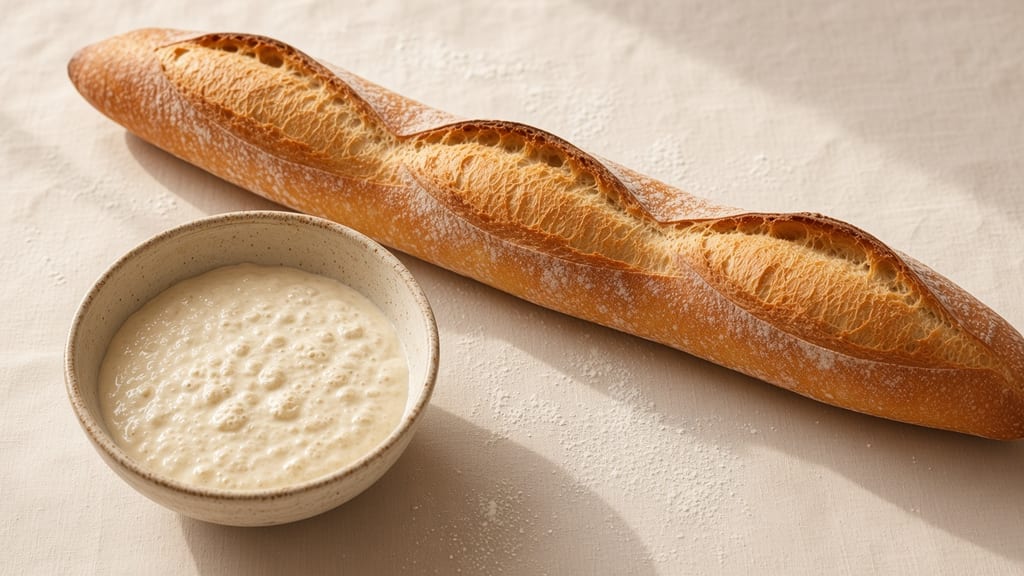
Baguette au levain
Three lean baguettes using 25 g ripe starter in an overnight sponge, then yeasted final dough, shaped and steam-baked like a classic baguette.

Baguette with overnight poolish
Three long crusty wheat baguettes from an overnight yeast poolish, shaped by hand and baked with steam for a deep golden crust.
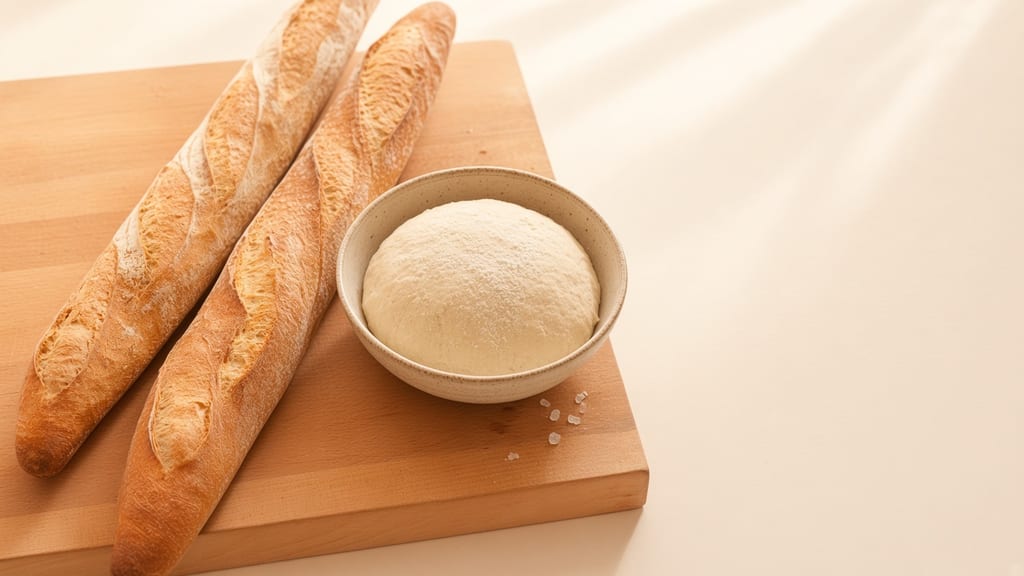
Baguette with pâte fermentée
Lean baguettes built with 105 g cold pâte fermentée in the dough, then shaped and steam-baked like a classic long loaf.
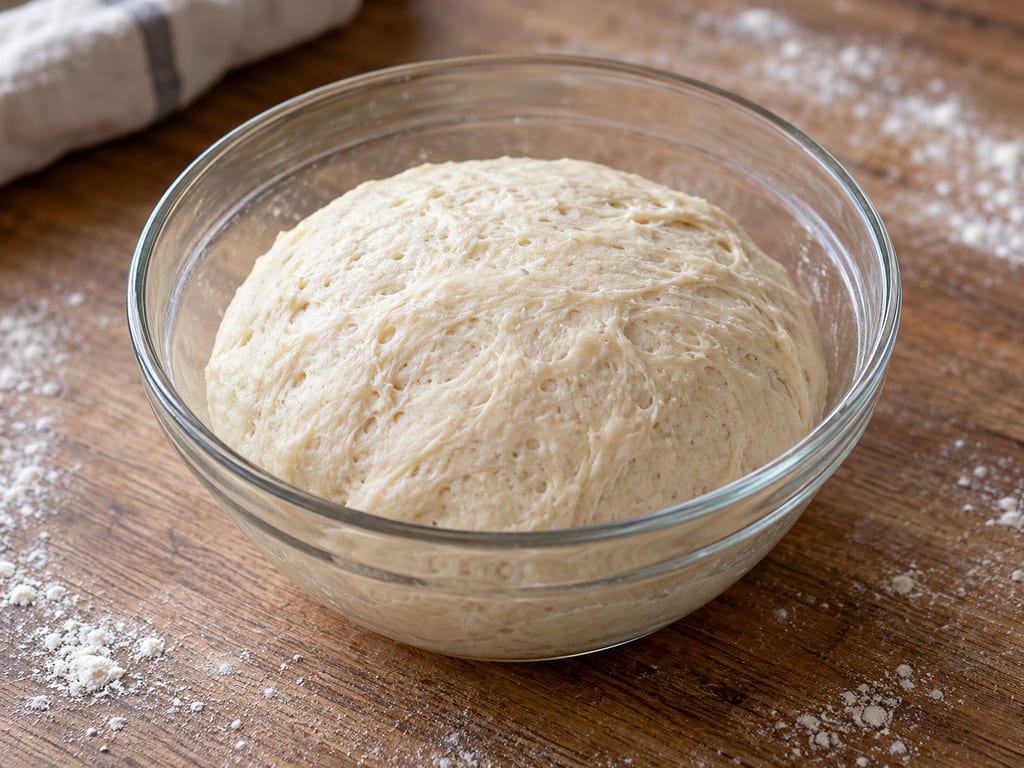
Pâte fermentée
Pâte fermentée is a bread preferment made from salted, yeasted dough set aside to ferment and mixed into a later batch, carrying developed dough and fermentation products with it.
Poolish
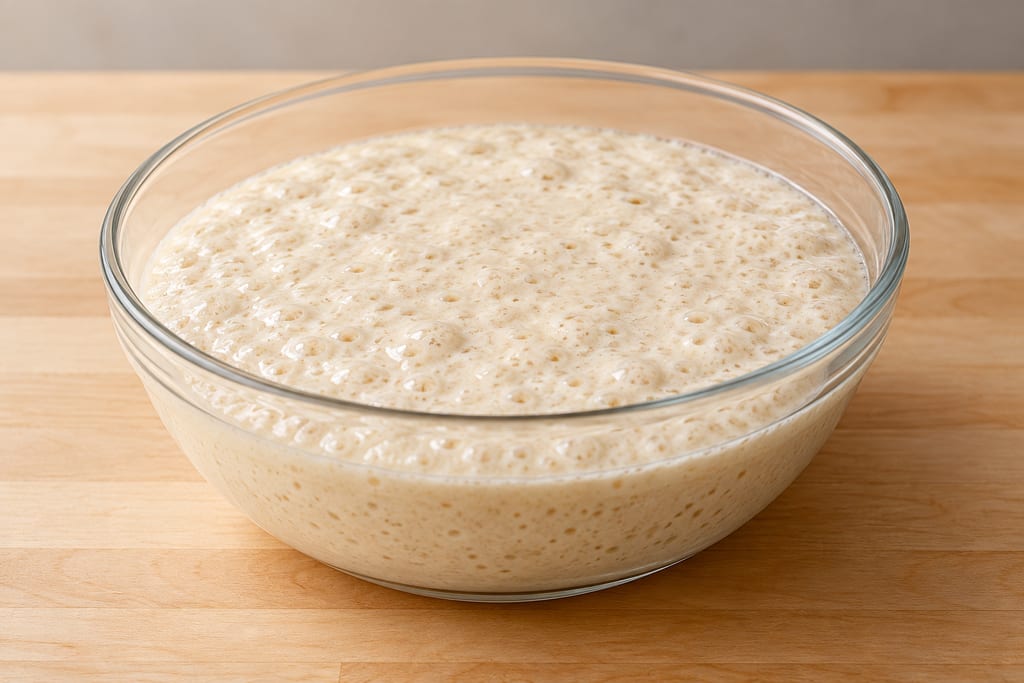
Poolish is a loose, unsalted bread preferment of roughly equal weights of wheat flour and water with a pinch of baker's yeast, left to ripen before it goes into the final dough.
Community
No community contributions have been published for this entry yet.
Share what you made
Sign in to contribute. Published comments and photos are free to read.
Sources
UNESCO Intangible Cultural Heritage
Artisanal know-how and culture of baguette breadCited in: Eighty grams and a morning clock; Why the long loaf matters; UNESCO, 2022; Three ferments, three home routes; What remains unsettled; Back to the eighty-gram line
Ministère de la Culture
Inscription des savoir-faire artisanaux et la culture de la baguette de painCited in: Eighty grams and a morning clock; Why the long loaf matters; UNESCO, 2022; Back to the eighty-gram line
Ministère de la Culture
Les savoir-faire artisanaux et la culture de la baguette de painCited in: Eighty grams and a morning clock; Long breads before the name; When the word baguette sticks; Back to the eighty-gram line
Légifrance
Décret n° 93-1074 du 13 septembre 1993Cited in: Levain, levure, poolish; Décret Pain, 13 September 1993; What remains unsettled
Confédération Nationale de la Boulangerie-Pâtisserie Française
Pain de tradition françaiseCited in: Décret Pain, 13 September 1993
Jim Cheval / Chez Jim
About the Baguette: an inquiry into the origin of the baguetteCited in: August Zang, steam, and what he did not invent; The 1919 night-work law; Three ferments, three home routes; What remains unsettled
France Culture / Radio France
La vraie histoire de la baguette de pain, au-delà de la légendeCited in: August Zang, steam, and what he did not invent; The 1919 night-work law; What remains unsettled
L'Histoire
La civilisation de la baguetteCited in: August Zang, steam, and what he did not invent; The 1919 night-work law; UNESCO, 2022
Le Cordon Bleu
The renaissance of French boulangerie (1990-2019)Cited in: Postwar white and the Calvel quarrel
Ville de Paris
Grand Prix de la baguette de tradition française de la Ville de Paris (2022 deliberation annex)Cited in: A gold coin in the middle: four thousand euros and the Élysée
paris.fr
Et si vous deveniez juré du Grand Prix de la baguetteCited in: A gold coin in the middle: four thousand euros and the Élysée
Wikipedia
Concours de la meilleure baguette de ParisCited in: A gold coin in the middle: four thousand euros and the Élysée
Muséum national d'Histoire naturelle
Quelle est la différence entre levure et levain ?Cited in: Levain, levure, poolish
Ministère de la Culture
Les savoir-faire artisanaux et la culture de la baguette de pain (inventory citing Bulletin de la Statistique générale, July 1920)Cited in: Eighty grams and a morning clock
Gaps
- The July 1920 Bulletin de la Statistique générale entry for the 80 g baguette is cited through the Ministry inventory rather than a direct scan of the bulletin pages.
- Exact first-use dating of steam ovens in Paris baguette baking after Zang remains inferred from secondary baking histories, not a single oven invoice.
- Grand Prix dimensional rules (55–65 cm, 250–300 g) are taken from secondary contest coverage pending a current official rule PDF.
Updated 2026-11-09