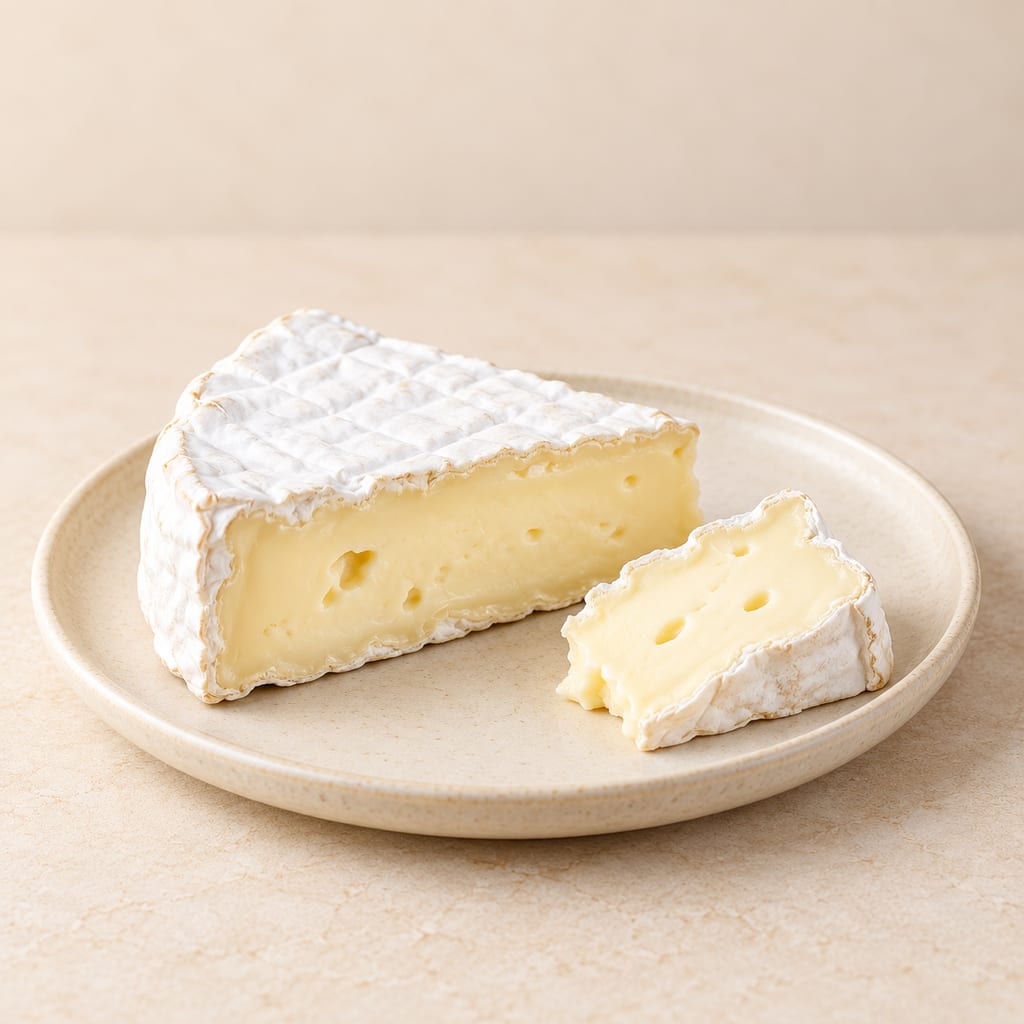
Brie, cream-enriched
A cream-enriched Brie with a white bloomy rind and a softening center, made from pasteurized milk with lactic and surface cultures.
 FermenteaWhere food goes to change
Salt
Food-grade sodium chloride selected for cheesemaking seasons curd and changes its moisture, microbial environment and rind; grain and application must suit the particular cheese.
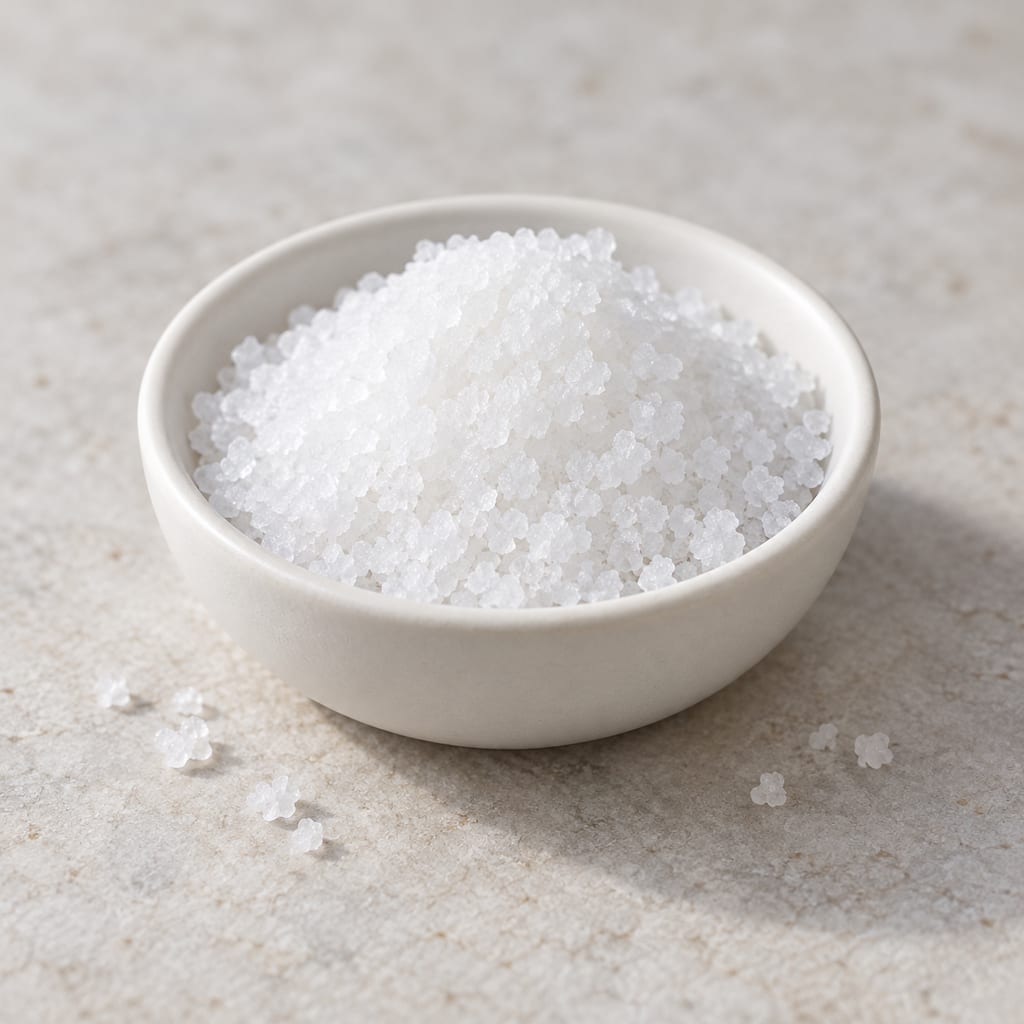
Cheese salt is edible sodium chloride selected and sold for cheesemaking. It is not salt extracted from cheese, and its name does not identify a separate mineral species. Its useful characteristics include purity, grain shape, grain size and the way it dissolves on moist curd. A cheesemaker needs the right amount of salt to reach the cheese through a particular process, rather than simply a product that tastes salty when sampled.
The name describes an application as much as a substance. Different suppliers offer different grades under it. A product recommended for mixing into a fresh cheese may not be the grade specified for slowly salting a formed wheel. The same sodium chloride can participate in different operations: seasoning a drained spread, drawing whey from curd, shaping a rind or moving into a cheese from brine. Those operations make the form and timing of addition meaningful.
Salting belongs to a long history of dairy processing. In the Roman agricultural work De re rustica, Columella describes curd being drained, pressed and salted, with further pressing and repeated salt treatment. He distinguishes cheese that could travel from cheese intended for prompt fresh eating. His account connects salting with the practical work of concentrating a perishable milk supply into a food that could be handled and moved.
This historical practice is broader than today's packaged cheese salt. It does not establish the date of a modern product grade or prove that an ancient salt had a contemporary specification. What persists is a technical problem: how to remove liquid, distribute salt and obtain a body suited to the intended use. Modern cheesemakers can investigate that problem with measurements of composition and salt retention as well as with the handling knowledge recorded in earlier dairy writing.
In 2002, researchers at the Wisconsin Center for Dairy Research compared four salt grades during Cheddar manufacture. Their experiment addressed an old disagreement about whether larger or finer crystals would leave more salt in the cheese. Fine flake salt had greater retention than two intermediate flake grades, while coarse salt was not significantly different from the other tested grades. The result challenged a simple rule that larger crystals must always work better.
Salt can be obtained from solid underground deposits or from salty water. In solution mining, water dissolves an underground deposit and the brine is brought to the surface. Evaporating the water then produces crystalline salt. Solar production instead uses sun and wind to concentrate saline water in shallow ponds. The available resources, climate and equipment shape which production route is practical.
Extraction is only part of the route to an ingredient. Salt intended for food needs suitable purity and processing, and its final crystals can be formed or prepared in different grades. The distinction between a bulk mineral and an edible dairy ingredient matters: a material sold for an industrial purpose is not made suitable for cheese merely by sharing the name sodium chloride. Procurement includes its intended food use and specification.
Commercial descriptions also differ. New England Cheesemaking Supply Company's cheese salt is sold as non-iodized salt without fillers. The dairy-use name alone does not establish a geological source or a complete grade specification. Neither the country where a retailer sells a bag nor the place where a cheese is made establishes where that bag's salt was mined or evaporated.
A crystal's work begins when it meets moisture. Salt applied to curd dissolves into the liquid at the surface, then moves through the moist cheese. Until it dissolves, its size, shape, contact and tendency to remain in place affect the delivery of sodium chloride. Flakes can adhere differently from large grains. Surface area changes dissolution, while loose crystals can be carried away by draining whey.
The Wisconsin Cheddar study illustrates why these effects can compete. Fine crystals may dissolve and enter the curd before whey washes them away. Coarser crystals may remain on the curd through the first release of whey because their greater size makes them less easily displaced. The proposed explanations concern a particular milled-curd system. They do not turn one grade into the correct choice for every soft cheese, rind or brine.
A volume measure adds another source of difference. A spoonful depends on the shape and packing of its crystals as well as their substance. Where a method gives a mass, weighing preserves the stated amount more directly than replacing it with a guessed spoon measure. Where a recipe specifies a volume and grade, both qualifications should be kept together. The useful instruction is the complete one, not a bare number detached from the ingredient form.
Cheese is a mixture of protein, fat, water and dissolved substances. Salt acts within its moist phase. The concentration of salt in that moisture is therefore a useful cheesemaking measurement, distinct from salt as a percentage of the entire cheese. Two cheeses with different water contents can have different conditions for microbes and enzymes even when their total salt percentages appear similar.
When dry salt dissolves on curd, salt moves inward and water can move outward. The escaping whey carries dissolved constituents, including lactose. Salting therefore affects both moisture and the sugar remaining available for fermentation. It also changes the physical environment in which microorganisms live. The operation is connected to acid development and drainage, rather than beginning only after all biological activity has finished.
Not all salt applied becomes salt retained. Some leaves with whey, some remains on surfaces and some enters the body. The quantity added and the quantity measured in a finished cheese answer different questions. Curd moisture, temperature, application method and time before further draining influence the outcome. This distinction is especially useful when comparing a production formula with a finished product's composition.
Salt influences microorganisms and enzymes as well as flavour. Lactic bacteria produce acid from residual milk sugar, while enzymes break down milk proteins and fats during cheese development. Changing the salt environment changes the conditions under which those activities proceed. The consequences can include differences in acidification, body and ripened flavour. Salt is therefore part of managing the make and cure, not only a finishing taste adjustment.
The point at which salt is introduced matters. A curd may first need time to acidify; salting it too early would create different conditions for that development. Conversely, delaying salt belongs to a process whose milk quality, temperature and other controls also matter. There is no universal moment at which all cheeses should receive salt, because fresh acid cheeses, pressed cheeses and mould-ripened cheeses develop through different sequences.
Uneven application can leave regions with different salt conditions. Clumps or poor mixing can produce low-salt areas while other parts receive more. These differences can affect both unwanted microbial growth and flavour defects. A measured total is consequently not enough by itself: distribution through the intended part of the cheese is also part of the operation. Salt alone is not a substitute for the other controls of the particular process.
Salt mixed into curd is distributed among many particles before they form a larger body. Mixing must suit the curd's strength: a tender fresh cheese and firmer milled curds cannot be handled in the same way. Drainage during and after the addition affects retention. Incremental applications and mixing are used in some methods to spread salt while whey continues leaving.
Surface salting begins from the outside of a formed cheese. Salt dissolves in surface moisture and gradually moves inward. The exterior initially experiences a different environment from the centre. Loss of water at the surface contributes to rind formation, while humidity and temperature during aging also affect that rind. A cheese is therefore not evenly salted at the instant its surface has been rubbed.
Brining places the cheese in a salt solution. Salt enters and water leaves through the boundary between cheese and liquid. Brine composition and condition matter alongside the length of immersion and the cheese's form. Calcium balance and acidity can affect the surface as well as sodium chloride uptake. A brine is managed as part of a cheese process, not assumed to remain unchanged after repeated use.
Fresh chèvre uses cheese salt after the cultured curd has drained. The salt is mixed into a soft body that will be chilled and eaten fresh. Here the ingredient contributes seasoning within a moist, spreadable cheese; it is not being used to build a dry outer rind around a large wheel. The physical condition of the curd makes gentle incorporation appropriate.
The cream-enriched Brie preparation salts formed cheeses after drainage has slowed. Top and bottom receive successive applications, with the sides also treated. Allowing the salt to dissolve and be taken up is part of the sequence. This exterior treatment precedes the development of the bloomy rind, and its effect on surface moisture belongs to the preparation of that living surface.
The Spanish-style blue preparation also salts a formed body in stages, treating the top, sides and bottom separately. Some salt is lost as moisture leaves, and a settling period allows it to move into the cheese. The applications are organized around a body whose internal spaces are important to the later blue development. These examples show why a fresh spread, a bloomy-rind cheese and a blue cheese should retain their own instructions.
Some cheese processes introduce sodium chloride earlier still. Domiati manufacture salts the milk before rennet is added, placing coagulation itself in a salty medium. Fahmi and Sharara investigated this sequence in 1950 by comparing salt additions to cow and buffalo milks and examining coagulation, drainage, composition and yield. It is a different technological starting point from rubbing a drained wheel or seasoning a fresh spread. This broader use of sodium chloride helps explain why a dairy-use name cannot supply a universal salting instruction: the ingredient can meet milk, separate curds, a finished body or a bath of liquid at very different moments.
Choose food-grade salt that matches the method's stated grain and composition. Many cheesemaking instructions specify a non-iodized product, and the linked commercial cheese salt is sold on that basis. That practical specification should be preserved without turning it into an unsupported promise that any amount of iodine always kills a culture. Salt formulation, dose and the organisms involved are separate questions.
Keep the product in a cool, dry place as directed by its supplier. Dry storage preserves a usable ingredient for weighing and distribution; it also avoids introducing damp utensils and cheese residues into the supply. Retain the product identification with the bag or container so that a later batch can use the same stated grade rather than an unidentified white powder.
Cheese salt is not automatically a curing mixture, and a name based on use should not obscure the full ingredient declaration. Nor does a retailer's purchase of certified kosher bulk salt necessarily certify its repacked product: New England Cheesemaking explicitly distinguishes those two situations. Product-specific dietary and allergen declarations need to be read at the level at which they are actually made. Sodium chloride contributes sodium to food, while the cheese's milk allergens come from its dairy ingredients.
No single crystal specification, source deposit or launch date covers all products called cheese salt. The exact purity and grain distribution of an individual supply depend on its specification.
The named retail product declares its listed food allergens absent; supplier-specific declaration does not establish every salt product or cross-contact condition.
Retailer identifies cheese-salt product but does not establish its deposit, evaporation site or manufacturer origin.
A cream-enriched Brie with a white bloomy rind and a softening center, made from pasteurized milk with lactic and surface cultures.
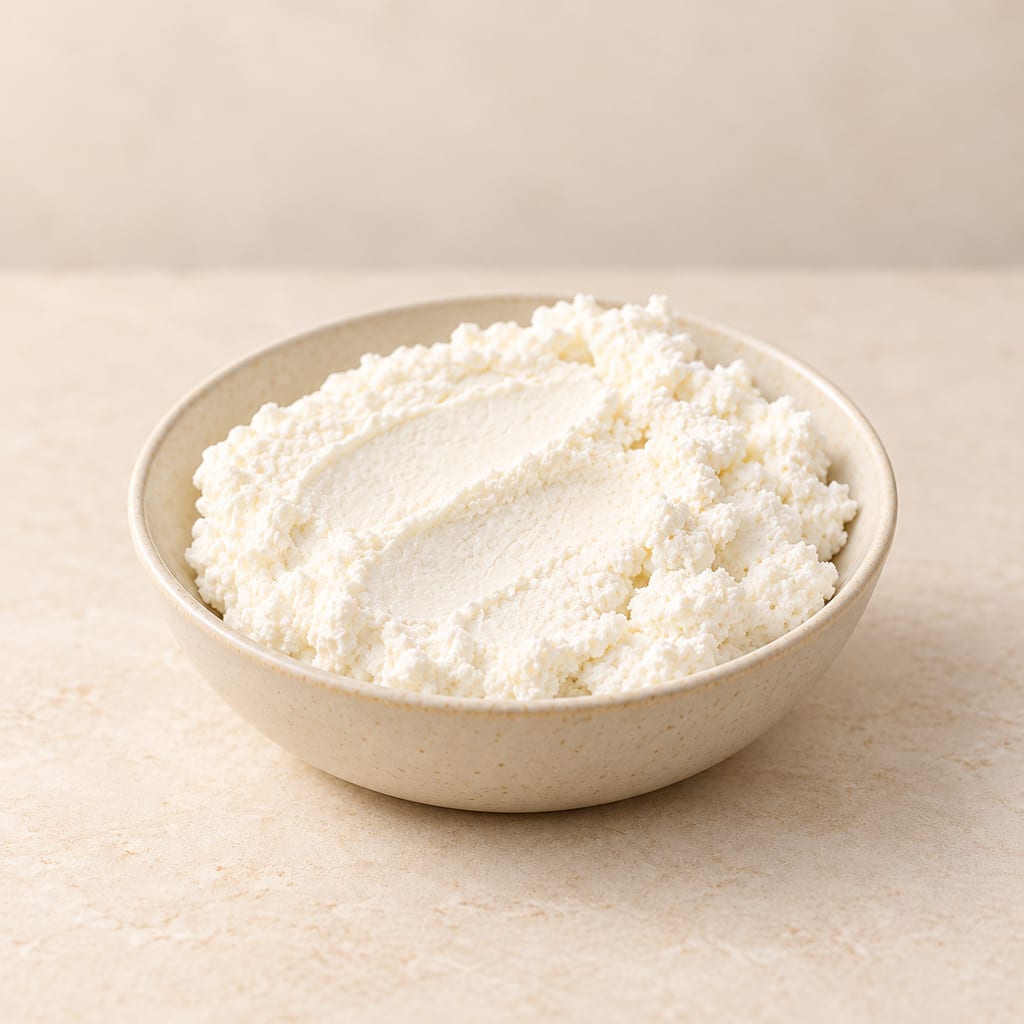
Fresh chèvre is a soft goat-milk cheese with a gently tangy flavour. This home method uses a combined lactic starter and coagulant, then drains the curd in cloth before salting and chilling.
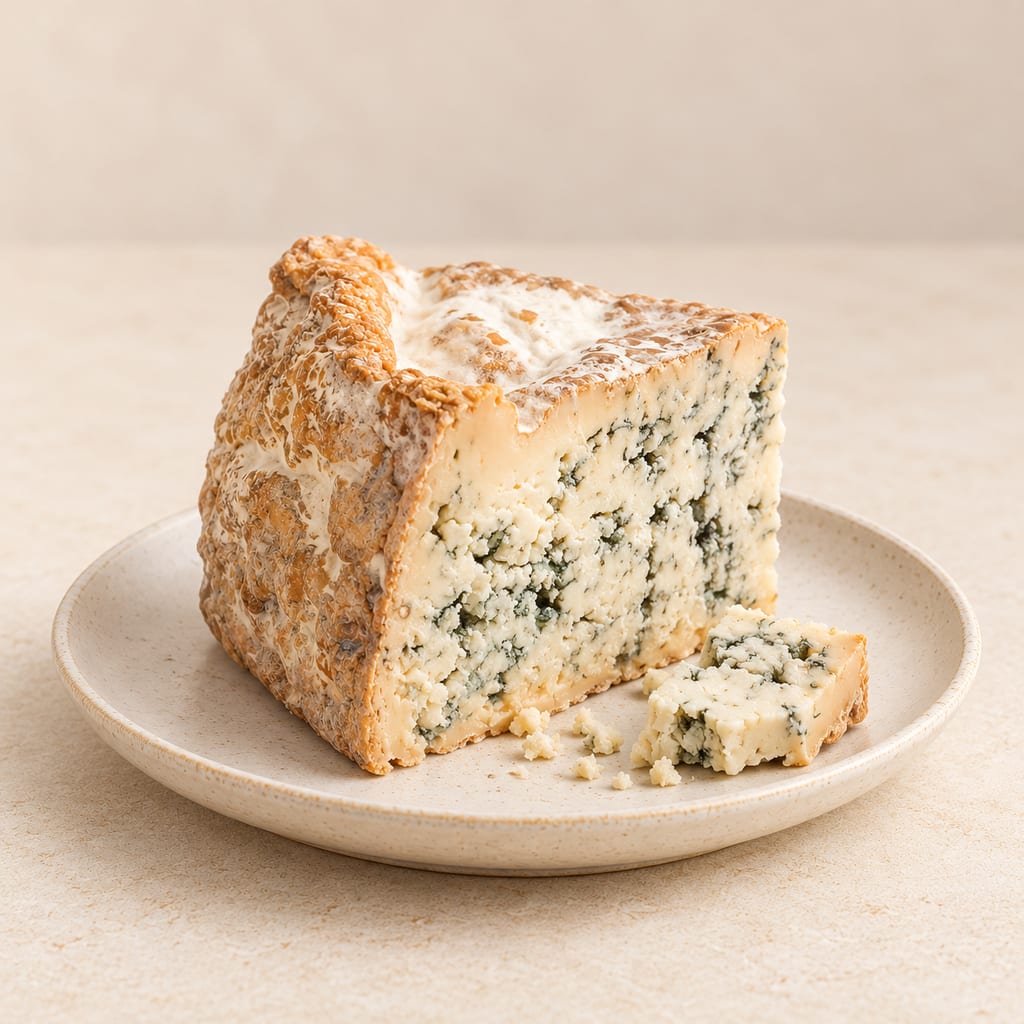
A moist blue cheese inspired by Cantabrian styles, made with pasteurized milk, a lactic starter and Penicillium roqueforti, then ripened in two stages.

Salt seasons a meal, shapes fermentation and preserves food. Its history follows the people who mine, harvest, trade and transform it, and the choices hidden inside an ordinary packet.
No community contributions have been published for this entry yet.
Sign in to contribute. Published comments and photos are free to read.
New England Cheesemaking Supply CompanyIngredient context
Cheese SaltProduct identity, non-iodized/no fillers, cool dry storage, declared allergen list and repacked kosher certification distinction. Blanket iodine-kills claim not adopted.
Cited in: A familiar mineral with a precise dairy job; From deposits or brine to a food ingredient; Choosing, storing and interpreting the label; Evidence gap
American Cheese SocietyIngredient context
Best Practices Guide for Cheesemakers 2025Salt in cheese moisture, diffusion, salting modes, clumping, moisture, rind and managed brine (printed pp. 88-90). The guide gives no single universal target or grade.
Cited in: A familiar mineral with a precise dairy job; The crystal matters before it disappears; Salt enters the cheese through its water; A control on fermentation and ripening; Mixing, rubbing and brining; Choosing, storing and interpreting the label; Evidence gap
Wisconsin Center for Dairy ResearchIngredient context
Salt Crystal Size and Salt Retention in Cheddar CheeseR.D. Rao and W.L. Wendorff, December 2002 (study text pp. 3-5): four salt grades, bounded Cheddar findings, and salt retention and loss in whey. The experimental targets apply to Cheddar only.
Cited in: Salt and the keeping of cheese; The crystal matters before it disappears; Salt enters the cheese through its water; A control on fermentation and ripening; Choosing, storing and interpreting the label; Evidence gap
FAOIngredient context
Small-Scale Dairy Farming Manual: Small Scale Cheese MakingGeneral curd drainage, lactose loss, salting modes and ripening chemistry.
Cited in: Salt enters the cheese through its water; A control on fermentation and ripening; Mixing, rubbing and brining
The Salt AssociationIngredient context
How Do You Make Salt?Producer-association account of rock salt, solution mining and brine evaporation, and solar production; it makes no claim about the sourcing of any specific commercial salt.
Cited in: From deposits or brine to a food ingredient
Columella; Latin transcription on ReadAncientTextsIngredient context
De re rustica VII.8: De caseo faciendoLatin text of Columella VII.8.3-6: tritis salibus, repeated weights and salt, and transport across the sea. The site English is an AI translation, so the Latin supports only limited paraphrase; it gives no precise date and no modern safety advice.
Cited in: Salt and the keeping of cheese
New England Cheesemaking Supply CompanyIngredient context
Chevre (Goat Cheese) RecipeFresh chèvre drained then salt mixed in; exact linked use.
Cited in: Three linked preparations, three applications
New England Cheesemaking Supply CompanyIngredient context
Brie Cheese RecipeSalting stages: delayed until drainage slows, top and sides first, then the other side, with drying before rind development. No temperatures are given.
Cited in: Three linked preparations, three applications
New England Cheesemaking Supply CompanyIngredient context
Blue Cheese Recipe: A Spanish BlueStaged salting of the top, sides and bottom, with salt moving inward; no universal salt target is given.
Cited in: Three linked preparations, three applications
FAOIngredient context
The technology of traditional milk products in developing countries: DomiatiSalt introduced to milk before rennet; comparison of salting sequence rather than claiming the assigned retail grade is used.
Cited in: Salt can enter before the curd exists
Journal of Dairy Research / Cambridge University PressIngredient context
429. Studies on Egyptian Domiati cheeseFahmi and Sharara, 1950 (extract only): experiments adding salt before rennet in cow and buffalo milk. Only the extract is cited; no full-paper results are claimed.
Cited in: Salt can enter before the curd exists