Name, form and identification context
Cantharellus cinnabarinus is the accepted name used by Index Fungorum for the red-orange chanterelle first described as Agaricus cinnabarinus in 1822. The transfer to Cantharellus followed in 1832. The current species name is consistent across the taxonomic record and the 2021 fungal assessment, although the databases do not all use the same family placement: Index Fungorum lists Hydnaceae, while the assessment and Missouri field guide use Cantharellaceae. That family-level difference should not be mistaken for a disagreement over the species name.
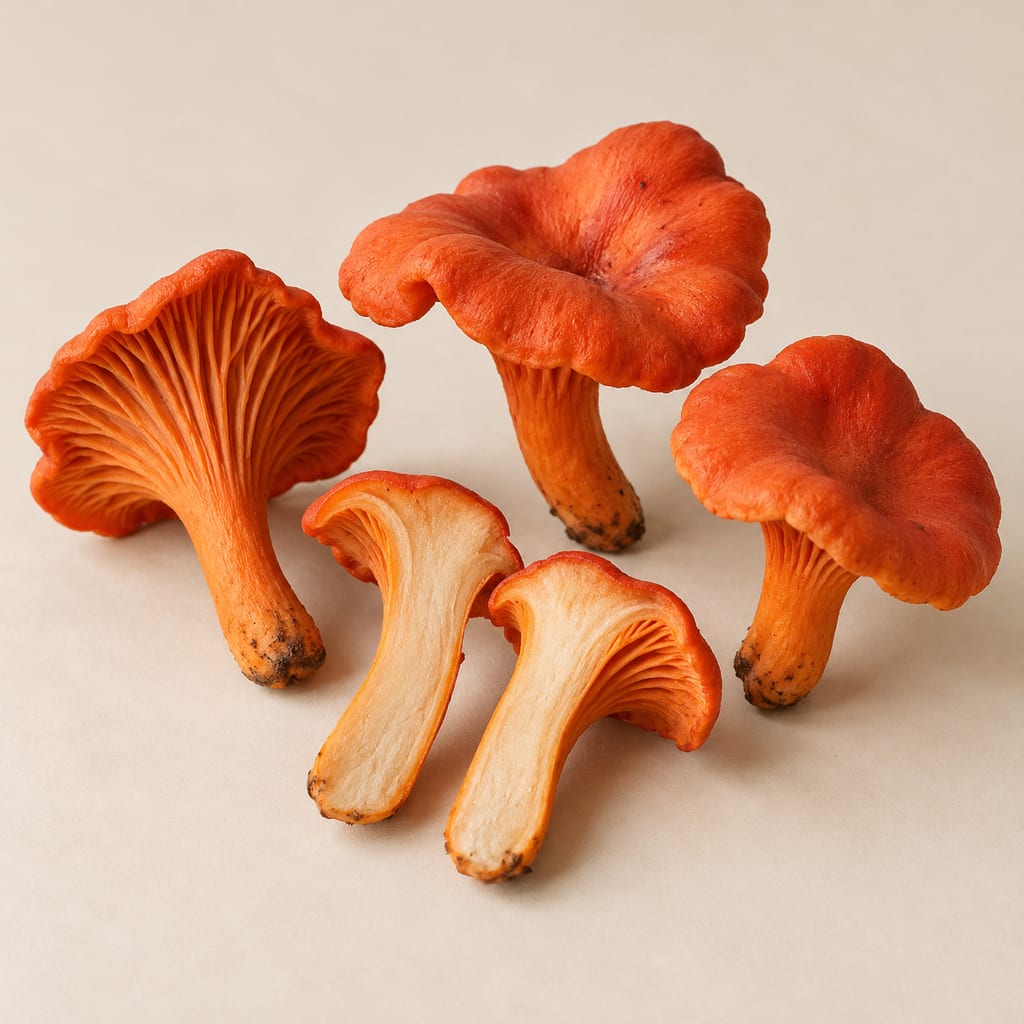
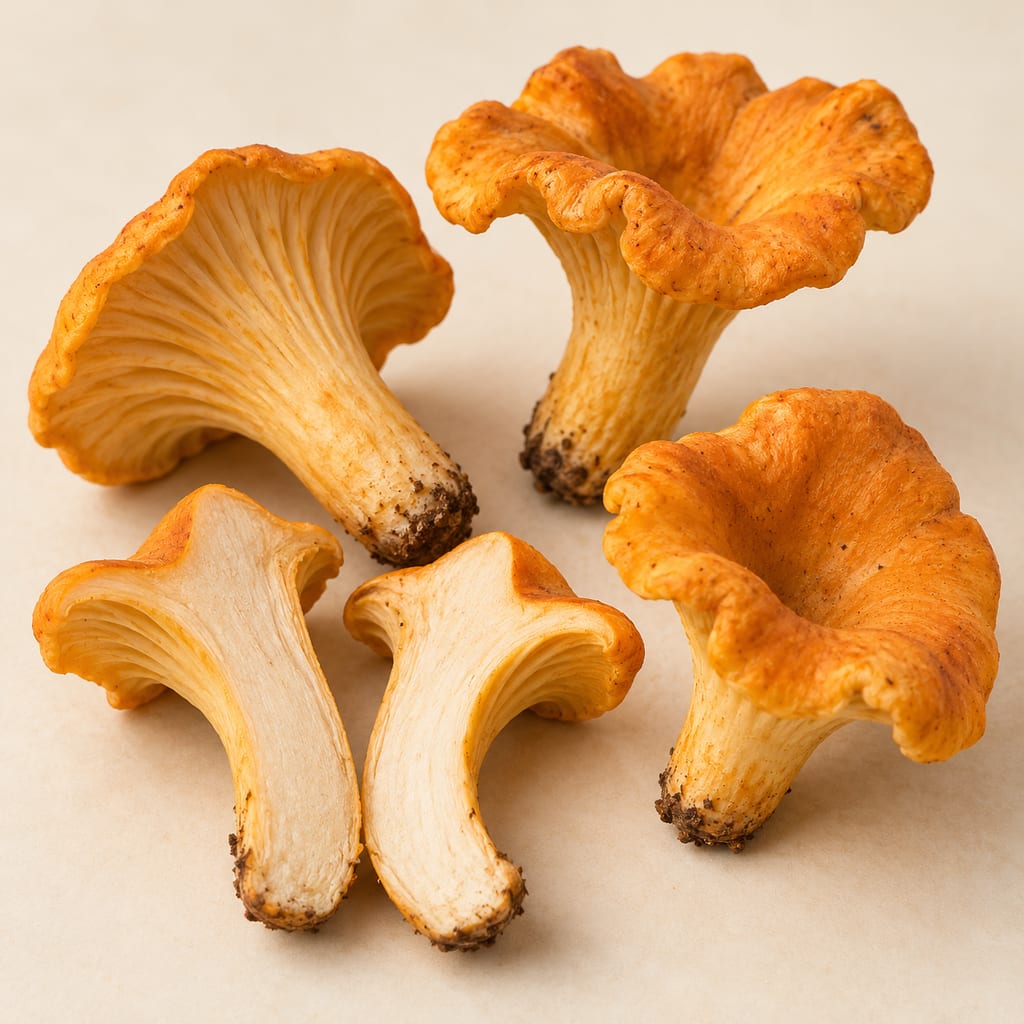
The Missouri Department of Conservation describes a small, soil-growing mushroom with a convex cap that flattens and develops a wavy, incurved margin. Its red-orange colour can shift toward pink with age. Underneath, the fertile surface is made of blunt, forked and cross-veined ridges that run down the stalk; it does not have the thin, separate true gills of many familiar mushrooms. The stalk is also red-orange and can taper or sit slightly off-centre. The guide reports a pinkish-cream spore print.
These traits are useful description, not a stand-alone identification key. The fungal assessment specifically warns that several recently named North American species—Cantharellus texensis, C. coccolobae and C. corallinus—have historically been called C. cinnabarinus. It calls for more collection and identification work to understand the complex and its range. A vivid colour or a photograph cannot resolve that taxonomic uncertainty.
Sources for this section
Hardwood ecology and range
The fruit body is the visible reproductive structure of a fungus whose living mycelium is largely in the soil. The Global Fungal Red List assessment describes C. cinnabarinus as ectomycorrhizal, especially with oaks (Quercus). In this type of association fungal threads connect with fine tree roots: the mushroom is part of a forest partnership rather than a plant growing independently from the soil. The assessment places it in young to mature hardwood forest, including slightly disturbed settings such as seasonal washes, stream banks, and road or trail edges.
The best-supported broad range is eastern North America. The assessment traces it from southern Maine west across the Great Lakes region of the United States and Canada to the eastern Great Plains, and south to Florida and Texas. It also extends the range into Mexico and possibly Central America, with the word possibly signaling that this southern extension is less certain. These are distribution statements, not proof of a local culinary tradition at every point in the range.
In Missouri, the state field guide calls the mushroom statewide and reports it growing singly or in groups in moss, leaves, and grass, on paths, and under oaks. Those observations supply a useful local picture, not a universal habitat rule. Oak association is especially emphasized by the wider assessment, while Missouri's list shows that fruit bodies may emerge through several kinds of ground cover in suitable wooded places.
Sources for this section
Fruiting season and its limits
The Missouri Department of Conservation gives a local fruiting window from late June through early August. That is the clearest species-specific calendar in the sources reviewed for this draft, and it should be attached to Missouri rather than presented as a continent-wide schedule. Rainfall, temperature, elevation, forest composition, and local conditions can shift the appearance of fruit bodies; the cited sources do not provide a validated forecast model or a date range for every part of the species' distribution.
The Global Fungal Red List account describes ecology and range but does not set a general fruiting season. Older field guides may use broader language such as summer into fall, but a broad seasonal label does not override the specific Missouri observation or establish that every region follows the same timing. No cultivation schedule or commercial harvest calendar is established here; the recorded supply context is wild gathering.
Sources for this section
Food use, flavour and handling limits
The Missouri field guide marks the species edible and calls it a good edible, while noting that the flavour is not strong and that the attractive colour remains after cooking. The 2021 assessment also describes it as edible and commonly collected for food. Together these sources support its place as a gathered culinary mushroom in eastern North America; they do not document a single traditional recipe, preservation method, or commercial supply chain. Its small size and modest flavour make it a distinctive seasonal find rather than a strongly flavoured bulk ingredient.
These sources provide sensory and food-use observations, not a species-specific preparation standard or a guarantee about an unknown specimen. Missouri's guide says to be absolutely sure of an identification and to try only a small amount the first time, because individual reactions are possible. The species-complex note makes the identification caution especially relevant: this page is not a field determination, and colour alone is not a safe basis for eating a wild mushroom.
The reviewed evidence does not establish a fermentation role, nutritional profile, storage life, cultivation method, or product-grade standard for this mushroom. It is described as a wild ingredient because the sources discuss naturally fruiting specimens. No fermented preparation is attributed to it without evidence, and no shelf-life or handling limit is invented.
Sources for this section
Geographic records that remain unresolved
The supplied research index also lists a Hong Kong SAR / China record and a Brazilian occurrence with variable source confidence, while marking the entry as not independently assessed. Those entries are retained as research leads rather than used to expand the mapped food-use range in this draft. The supported structured places are limited to eastern North America and the local Missouri record; an occurrence listing alone does not establish species-level identity or food use.
This distinction matters because a country label can conceal either an uncertain historical identification or a record that concerns occurrence rather than consumption. The geographic summary above therefore keeps the assessment's 'possibly' for Central America, keeps Missouri attached to its local guide, and makes no claim that the Hong Kong or Brazilian reports are confirmed culinary traditions.
Sources for this section
Places
Eastern North America
Documented use · Region evidenceThe 2021 fungal assessment describes the species as widespread in eastern North America and commonly collected for food. This is a broad region-level association, not a claim that every locality has an established food tradition.
Missouri
Documented use · Region evidenceThe Missouri Department of Conservation calls it a good edible and records it statewide. Statewide distribution and an edible listing do not establish that every specimen is correctly identified or safe for every person.