A large, patterned wood fungus
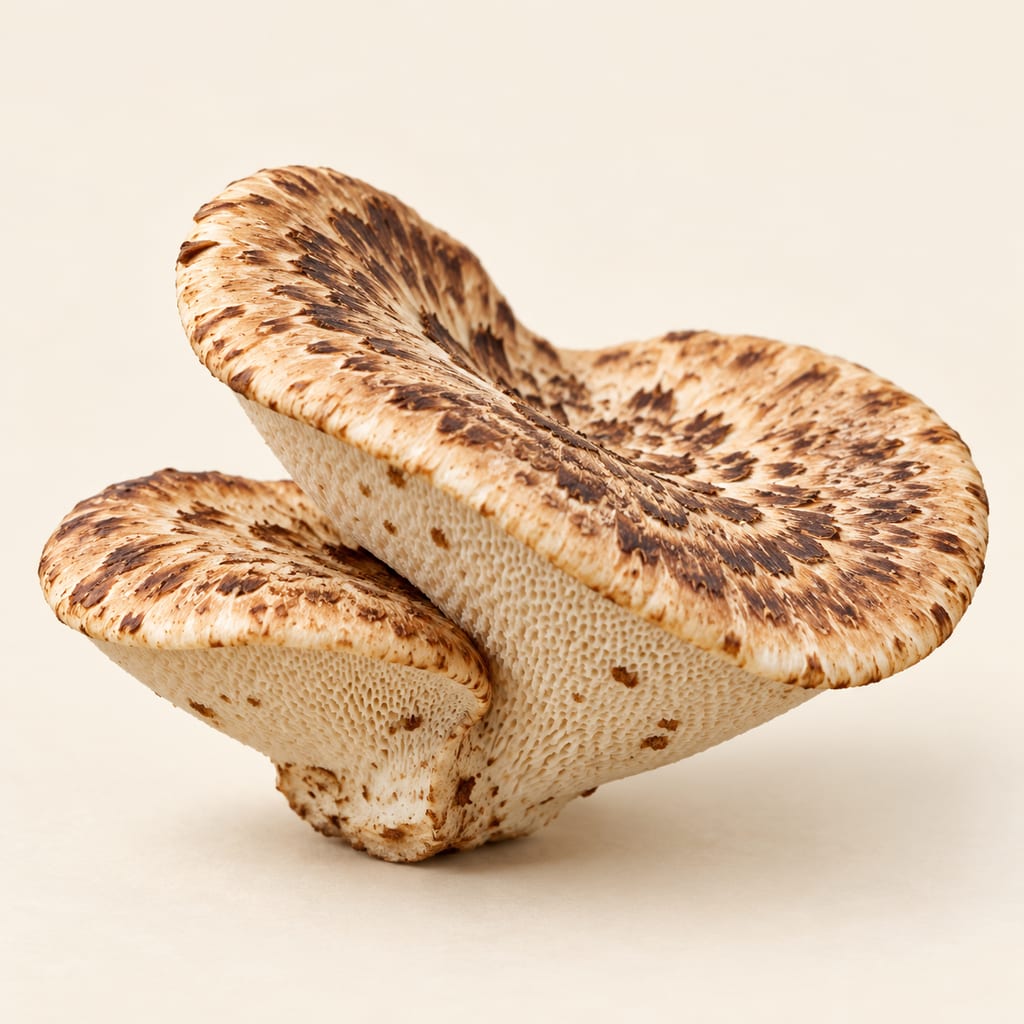
Dryad’s saddle is the common name for Cerioporus squamosus, a conspicuous polypore that grows from hardwood trunks and logs. Its broad cap can be fan-shaped, kidney-shaped or nearly circular; fruitbodies may appear singly or in overlapping shelves. The pale cream, buff or yellow-tan cap carries dark brown scales arranged in arcs or rings. The underside is not made of gills: it has a layer of tubes ending in large, angular pores, often pale when young and yellower with age. The pores extend down over part of the short, off-centre stem. The base of that stem is often dark or blackish. These features explain the common name pheasant’s back, which refers to the scale pattern, and the botanical epithet squamosus, meaning scaly.
Size and silhouette are variable. Regional field guides record caps that can reach very large dimensions, and both funnel-like and fan-shaped forms occur. Such measurements describe the upper end seen by observers, not a promise that every fruitbody reaches that size. A large mature bracket may be an impressive sight but is often no longer suitable as food: the flesh can pass from soft and succulent to corky or leathery as it expands and ages. The species’ recognisable architecture helps explain its names, but a common name or photograph alone does not establish a safe identification.
Descriptions of smell differ. A Missouri field guide compares it with watermelon rind; the Georgian species profile reports a strong meal-like odour. Both are sensory descriptions from regional sources and neither should be used as a stand-alone field test. Taste is similarly variable in the literature: some foragers enjoy the young edges, while the U.S. National Park Service author calls the flavor poor. This is useful context for a wild ingredient whose culinary reputation depends on age, portion of the fruitbody and personal preference, rather than a single consistent flavour profile.
Sources for this section
Names and taxonomic scope
Current taxonomic sources recognize Cerioporus squamosus (Huds.) Quél. Index Fungorum lists Polyporus squamosus (Huds.) Fr. as the older, familiar name and traces the name back to Boletus squamosus Huds. in 1778. This is why older field guides, food literature and image records often use Polyporus squamosus while newer records use Cerioporus squamosus. For searching, both names matter; for this page, the current name is used in the title and the synonym is retained as an alias.
The fungus is a polypore in Polyporaceae. Its pores and shelf-like fruitbodies distinguish it from gilled mushrooms, but broad brackets are a diverse group and regional guides point to other polypores as lookalikes. Naturalis’ guide names Polyporus tuberaster as a similar species. Identification therefore depends on a suite of features, habitat and reliable regional knowledge. A species label on a reference photograph is evidence about what the photographer or uploader intended to show, not independent confirmation of a specimen. This page describes the named ingredient; it is not a key for collecting wild mushrooms.
Taxonomic names also differ from food names. Dryad’s saddle and pheasant’s back are common English names, while Georgia’s ethnobiology database records several local names, including Dzerana and regional forms of Koris sok’o. The Turkish Black Sea review records Aladana, Peri Semeri and Pullu Mantar in different localities. These names document language and local recognition, but a common name may be applied differently between communities. It should not replace the scientific name when an observation, trade record or culinary account is being compared.
Sources for this section
A fungus of living and dead hardwood
The hidden mycelium lives in wood; the visible bracket is its reproductive structure. Missouri’s field guide describes the mycelium as parasitic in living trees and saprobic in dead wood: it can colonise a living tree, then continue digesting wood after death. Spores are produced within the tubes and released through the pores. This life cycle connects the food-like fruitbody to its main ecological role, the decomposition of hardwood. The mushroom is not a plant, and it does not take its nutrients from soil like an ordinary ground-growing mushroom; wood is the substrate that supports its mycelium.
Regional host lists include elm, maple, beech, ash, willow and poplar, among other deciduous trees. Missouri’s guide emphasizes deciduous wood; the National Park Service lists elm and maple as frequent eastern U.S. hosts and adds buckeye, alder, hackberry, tulip poplar, cottonwood, willow and basswood. The Georgian species profile highlights beech and elm. The North Carolina State University herbarium describes the fungus on living hardwoods, stumps, standing dead trees and fallen timber. No single host list applies everywhere, but together these sources show a broad association with broadleaf wood rather than one narrowly specific tree.
On a living tree, a bracket can indicate decay in the heartwood. The National Park Service explains that the fungus consumes dead central wood in otherwise living trees; the North Carolina State University herbarium describes white heart rot. A fruitbody can therefore be both a food subject and an ecological sign of wood decay. It does not, by itself, determine whether a tree must be removed: an arboricultural assessment considers the amount and location of decay and the tree’s setting. This distinction matters when collecting from park trees or photographing a specimen near a path or building.
Because it grows on wood, the species may return to the same trunk or stump over a period of years. Missouri reports repeated appearance at locations and fruiting more than once a year; other regional guides describe it as an annual polypore whose fruitbodies may show in multiple seasonal flushes. The visible brackets are temporary; the mycelium remains in its woody substrate. This explains why a fresh specimen at a known tree does not mean the fungus is cultivated or newly introduced. The catalogue lists wild supply, and the sources reviewed describe it as a forest or landscape fungus rather than a routine cultivated crop.
Sources for this section
Fruiting season varies by region
The species is associated particularly with spring in temperate North America and Europe, but the season is not a fixed calendar date. Missouri’s conservation guide records visible fruitbodies from May through October and notes repeat fruiting. Naturalis’ European guide records spring to autumn and sometimes two flushes in a year. The National Park Service describes it as one of the large fungi appearing in spring in the National Capital Region. The Turkish Black Sea review gives a May–September window. These accounts are not contradictory: they concern different climates and local recording systems. A season on one continent should not be transferred to another location without local evidence.
Georgia’s species profile says fruitbodies may be found throughout the year in that country. That local note is retained as Georgian evidence, not made into a worldwide claim. Rain and temperature influence when visible fruitbodies emerge, and some regions report a spring flush and a later autumn flush. The Turkish review likewise notes rapid growth following rain. Such descriptions explain why a mushroom may appear suddenly on a familiar log, but they do not let a forager forecast a safe collection date or infer freshness from month alone. The state of the fruitbody itself still matters.
Seasonal observation also shapes culinary associations. In parts of eastern North America, Dryad’s saddle appears around the spring morel season; both can occur in hardwood habitats, although they are different fungi and do not share the same food uses. The National Park Service describes spring fruiting in the capital region, while the Missouri guide extends its local window into autumn. It is more accurate to describe it as a broad, locally variable spring-to-autumn fruiter than as a mushroom available only in spring. Old brackets may persist visually after the season, but their continued presence does not mean that they are in good condition for eating.
Sources for this section
Texture, maturity and the edible portion
Age is central to the species’ culinary reputation. Fresh flesh can be soft, fleshy or succulent, especially toward the outer margin; the stem and point of attachment are usually tougher. As the bracket expands, its flesh becomes corky, leathery and eventually woody. This rapid change helps explain why field guides that agree on the species’ edibility can differ on whether it is worth gathering. Missouri calls it a good edible when young and recommends the tender edges. The National Park Service says only very young specimens are tender enough to eat and does not recommend it on flavor grounds. The Georgia profile also limits edibility to young, fresh fruitbodies. These are compatible claims about the age-related texture, alongside different judgments of taste.
Descriptions of smell include watermelon rind, meal or flour. They are sensory observations rather than objective quality grades. In the Georgian accounts, some communities describe the mushroom as pleasant, while one local description says the flavor is usually weak. The National Park Service author considers the taste poor. Such variation can reflect local preference, the age of a specimen and the fact that field guides describe different populations. The ingredient page therefore avoids promising a universal flavour or texture. It is most useful as a seasonal, wild mushroom whose outer portion is selectively used while young.
The wood attachment and large cap create a practical distinction between the tender margin and the thicker centre. Missouri’s guide says collectors can trim the tender edges and slice them small. The Turkish review’s emphasis on early growth similarly relates food quality to the young stage. Neither source establishes a universal test that can identify the species or certify freshness. A soft edge is only a texture observation; it cannot confirm what species it is, whether it grew at a clean site, or whether every diner will tolerate it.
Sources for this section
Regional food records and cooking
Food use is documented but culturally uneven. The Missouri Department of Conservation explicitly calls the mushroom edible and gives a local preparation: trim tender edges, slice them small and cook in butter. It then describes a sweet preparation in which cooked pieces are drained, patted dry, covered with sugar syrup and refrigerated, producing a watermelon-candy impression. This is a regional field-guide serving idea, not a validated preservation method. A syrup coating and refrigeration in that example should not be generalized into a shelf-stable product or a canning process.
In Georgia, the ethnobiology profile records use across several local communities, and the 2023 ethnomycology paper places C. squamosus among polypores used for food. Racha interviewees described eating young fruitbodies and also soaking dry, tough ones before grinding them into cutlets; Kakheti interviewees reported eating dry fruitbodies after prolonged frying. Another local account describes the mushroom as edible but not especially flavorful. These are place-specific reports of practice and preference, not an instruction to reproduce those methods for other mushrooms or to assume soaking makes an unidentified specimen safe. The profile names people and villages for some accounts, making clear that these observations document particular knowledge, not a universal Georgian recipe.
A 2018 review of Turkey’s Black Sea region reports local names, broad presence in regional mycobiota, May–September fruiting on deciduous logs and trunks, and consumption in some parts of the region. The authors state that it was not sold in local markets at the time of their account. This makes a useful distinction between gathering for household food and a formal market commodity: a fungus can be eaten locally without appearing in market surveys. The review is not a single documented household recipe, so this page does not assign it a standardized cooking method or commercial grade.
Across these sources, cooking appears as the common culinary stage, but details differ. The Missouri example uses butter and a sweet syrup; Georgian interviews refer to cutlets from rehydrated dry fruitbodies and to long frying; the Turkish review highlights use of young growth but does not give a reproducible process. The page records these as separate examples instead of combining them into a new recipe. It does not claim that every preparation is equally palatable, nutritionally equivalent or suitable for storage. A separate preparation record would need a source that gives a coherent, attributable method and the details required to explain it responsibly.
Sources for this section
Handling, uncertainty and limits
The edible-use evidence is not a substitute for identification. A field guide’s edibility label refers to the named species as understood by that source; it does not confirm a particular wild specimen. Several references mention other polypores, and this page is not a collection key. The National Park Service advises readers to be certain of a mushroom’s identity before eating it and points out that collecting is prohibited in many parks. Foraging rules vary by land manager and location, so a park’s regulations must be checked before collecting. The Missouri guide recommends cooking wild mushrooms thoroughly and trying only a small quantity at first because individual reactions can occur. These points describe limits of the food record, not a safety guarantee.
The sources reviewed do not validate fermentation, pickling, canning, drying for room-temperature storage or another preservation process for this species. The Georgian descriptions of dried specimens are reports of local food use, and the Missouri syrup example is a serving suggestion; neither gives a validated shelf life or preservation control. The catalogue entry therefore remains an ingredient rather than a fermentation recipe. Cleaning, trimming or cooking a mushroom does not make a preservation process validated, and no storage duration is offered here.
Nor does this page make medicinal or health claims. A Turkish review discusses nutritional and medicinal literature, but the material inspected here does not establish that eating this mushroom treats illness. Such claims would need separate critical evaluation and should not be inferred from the fact that a fungus has been studied for chemical constituents. The ingredient description stays with what the sources directly support: identity under a current and older name, hardwood ecology, local fruiting records, young-stage food use and the fact that mature fruitbodies often become too tough for the table.
Sources for this section
Places
Missouri
Documented use · Region evidenceMissouri's conservation guide documents young tender portions cooked; this is not a claim that every North American population is gathered.
Georgia
Traditional use · Country evidenceGeorgian sources document local food names and region-specific uses, including young and dry fruitbodies; practices are not generalized as a single national recipe.
Black Sea Region
Documented use · Region evidenceThe review reports consumption in some regional areas and local names; it says the mushroom was not sold in local markets at the time of publication.