What the mushroom is
Baorangia bicolor is a bolete, a mushroom with a sponge-like layer of tubes under the cap instead of gills. The name in the catalogue is Baorangia bicolor. Older literature and the Missouri field guide call it Boletus bicolor, and the catalogue records the name as a research label that has not been validated against the current taxonomic authorities.
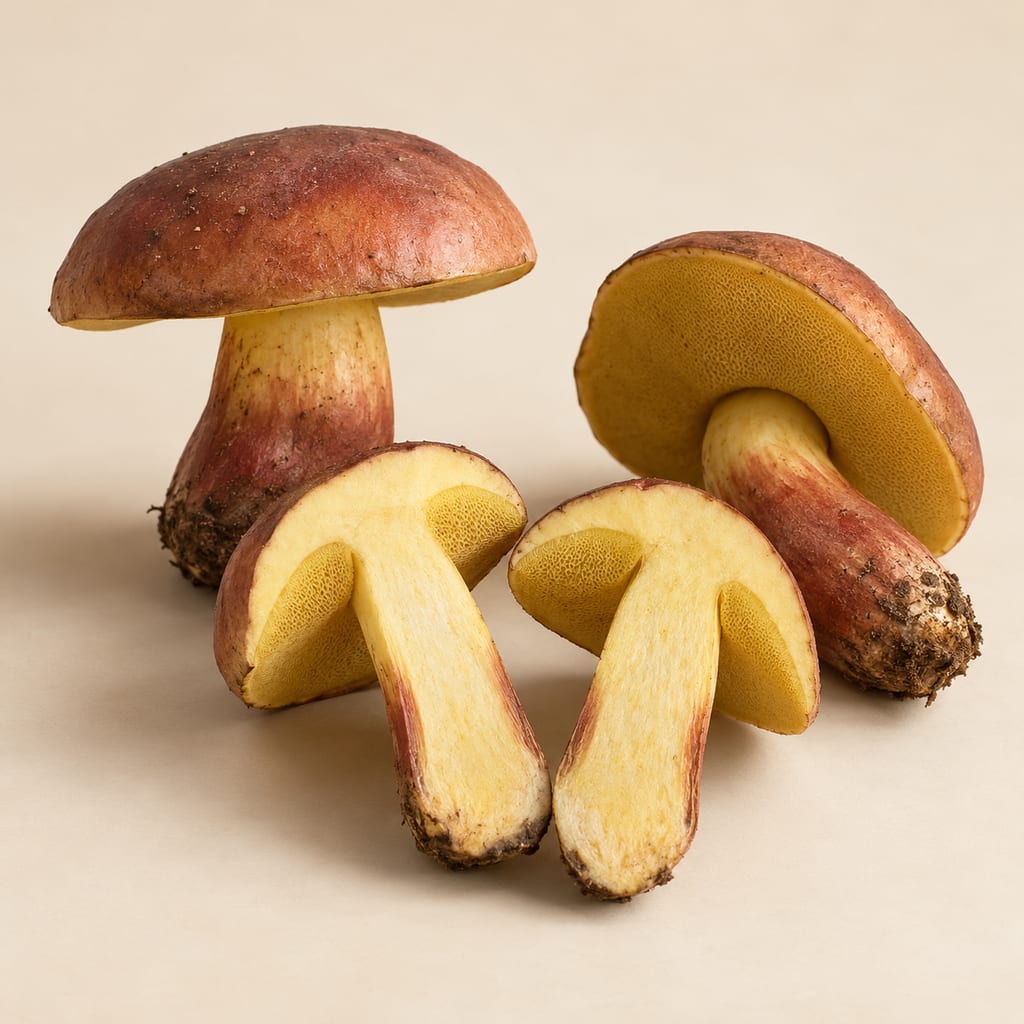
The cap is rose red to pinkish and sometimes yellowish toward the margin. It is dry and not shiny. The pores are tiny, angular and yellow, and they become paler with age. The stalk is reddish yellow and may be club-shaped. The flesh is thick and pale yellow, and it bruises blue slowly when cut or damaged. The spore print is dull olive brown.
Sources for this section
Habitat and season
The fungus grows on the ground under oaks, where it forms a mycorrhiza with the tree roots. It grows singly or in groups of up to several. The Missouri field guide gives the season as June to October. The catalogue records the supply as wild, with no cultivation.
Sources for this section
Edibility and look-alikes
Sources differ on eating this bolete. The catalogue records that an official regional guide discourages eating it, because of its confusion with poisonous boletes, and treats it as a research-only candidate until an expert has identified the specimen. The Missouri guide page as read carries an EDIBLE label, while a search summary reported a "Not recommended for eating" status for the same guide; this page could not confirm the second. The guide gives the warning that other boletes that look alike may be poisonous, and a bolete with orange to red pores or one that bruises blue should not be eaten. One West Virginia guide, reported in a secondary source, describes it as edible with caution and notes reports of gastrointestinal upset.
The main look-alike named in the sources is Boletus sensibilis, which is toxic. A deep blue or indigo bruise of the pore surface helps tell the two apart. One hobbyist guide describes the blue bruise as a harmless oxidation reaction. The Missouri guide treats blue bruising as a reason for caution and does not reduce it to a neutral feature, and this page follows the guide.
Sources for this section
Safety
Inclusion in the catalogue does not establish that this mushroom is safe to eat, and it is not an identification. The catalogue states that workbook review labels are retained as supplied and do not establish identity, edibility, a safe preparation, or professional review. The reported food use stays a regional record, and it should not be read as a species-wide food claim.
The sources do not identify a preparation that makes a misidentified bolete safe. The Missouri guide advises that anyone who collects mushrooms should be certain of the identification and should try only a small amount of a new species at first, because reactions occur. This page gives no edibility verdict for wild specimens.
Sources for this section
Use
Regional guides list the two-colored bolete as an edible wild bolete, and the catalogue records it as wild food. One hobbyist source advises that it be cooked thoroughly and never eaten raw. The sources give no tested preparation method or storage time, so none is stated here.
Sources for this section
Open questions
The catalogue cites a Virginia poison-centre document for this species, but the link returned a not-found page when it was checked on 29 October 2026, so no fact is taken from it. Species identity in the field, the accepted genus, and the extent of the regional food record all still need checking against expert and herbarium sources.
Sources for this section
Places
Eastern North America
Documented use · Region evidenceRegional record from the supplied catalogue; the regional guides that list it as edible are not all in agreement.
Missouri
Documented use · Region evidenceThe Missouri Department of Conservation field guide lists the species as found statewide and gives its edibility heading and cautions.