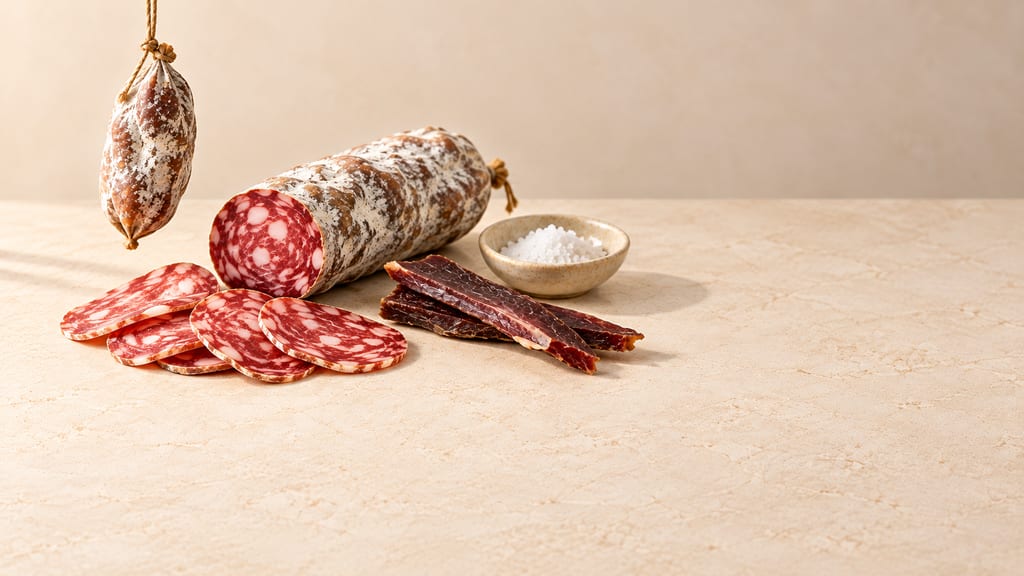
Fermented meat around the world
Dry salami, sour pork with rice, matured sheep and aged blubber follow different paths from animal to food. Their stories connect microbes with climate, slaughter, migration and the meals people share.
 FermenteaWhere food goes to change
Firsthand accounts describe eider-egg fermentation in Northern Greenland, including a 2019 encounter published in 2024. Sources give no validated controls; egg collection follows Greenland's licensing and seasonal rules.

This entry concerns eider eggs as a raw animal ingredient and a documented fermented food. The atlas lists fermented eider eggs as a supplementary entry in its circumpolar Arctic section, while correctly noting that eggs are animal foods rather than anatomical meat. “Eider” names a group of sea ducks, not a single species. Hauptmann's lecture does not identify the eggs in her particular example to species, so this account does not assign them to the common eider or king eider. The U.S. Fish and Wildlife Service identifies the common eider as Somateria mollissima; that taxonomic fact cannot fill the missing identification in the firsthand food account.
In a 2021 lecture, Greenlandic microbiologist Aviaja Lyberth Hauptmann describes eider eggs matured in northern Greenland. She says they are placed in pits in the ground and covered by rocks, in a way she compares with kiviaq, but without packing the eggs into a sealskin. She cautions that the rocks must be placed carefully so the eggs do not break. This is the process information actually given; the lecture does not specify how the eggs are selected or cleaned, how the pit is prepared, what else touches the eggs, or when the food is considered finished.
Hauptmann describes a cut egg with firm white and yolk and a dry, tan outer layer. She compares its flavour to cheese. These details record her observation of a particular food. They are not objective measures of fermentation progress and do not demonstrate pathogen control. The transcript's much longer description of kiviaq—the seabird-filled sealskin, treatment of seams with blubber, and burial under rocks—belongs to a different food and should not be copied into an eider-egg method. The comparison explains only the shared idea of ground maturation beneath stones.
Hauptmann returned to the subject in a 2024 article on food sovereignty, recounting her 2019 fieldwork in Avanersuaq. In the prologue, one woman tells her that the eggs can be collected on one day each year. Hauptmann presents the food as rare and saved for special occasions. This is evidence about that encounter and the household's account; it does not establish a calendar followed everywhere in Greenland, how many people make the food, or how often a given household prepares it.
The episode also records an unsuccessful egg. The woman opens one and says it has not fermented; it is still frozen. She then opens another, which she considers fermented. Hauptmann describes the second as darker, with a green edge after it is cut, and recalls a creamy consistency and a very strong cheese-like taste. These are observations of two eggs in one encounter. They do not show why the first remained frozen, prove that the second was safe, or provide a sensory endpoint that others can use. In particular, the woman's observation that the first egg had not “smelled up” is part of her account, not a safety test endorsed here.
This later narrative complements the 2021 lecture's pit-and-rock description but supplies no missing process controls. It says nothing about how long the eggs matured, their internal temperature, salt, acidity, water activity, storage, or microbiological results. The two accounts should be read together as testimony about a particular food and relationship to it, not combined into a complete recipe. The 2024 article also places the encounter within a wider discussion of Indigenous food sovereignty: the author reflects on how Indigenous foods are represented in public nutrition advice and on the tension between cultural practice and rules governing egg collection. That context helps explain why an ingredient entry should describe the food without treating it as spectacle or recommending collection.
The article's prologue says that the author's understanding of the law changed after a ministry representative told her eider eggs were illegal to collect. Its epilogue, written after Greenland's 2023 regulation, notes that regulated collection for traditional fermentation had become possible. The regulation itself is the controlling source for what is allowed: its specific licensed, seasonal, zoned and household-use exceptions remain narrower than a general permission. The later account therefore adds a dated perspective on how legal change affected the author's understanding, while the statute and current authority guidance supply the operative details.
The published lecture is a rare firsthand description, but it is not a recipe or a complete ethnography. It provides no measured maturation time, ambient or internal temperature, salt use, pH, water activity, storage period, or microbiological testing. It does not say whether this preparation was common, how many households made it, how it varied between communities, or whether all eider eggs described as fermented followed the same method. It also does not date the practice's beginning. A 2021 publication date is not evidence that the practice began in 2021; equally, the available materials do not justify assigning it an ancient or medieval origin.
Historical Arctic seabird-harvest research documents a broader history of egg gathering in Greenland, including eider eggs, and discusses the cultural importance of harvest in Northwest Greenland. Such records are relevant background for the place of eggs in subsistence and harvest histories, but they do not show that the gathered eggs were fermented by the method Hauptmann describes. This entry therefore leaves the fermentation's period unknown while recording the known date of its firsthand account.
The historical record gives this ingredient a wider setting without supplying a history of the ferment. A 2008 Greenland chapter in CAFF's circumpolar seabird-harvest report summarizes accounts of eggs as an important summer food for people staying at remote Northwest Greenland seabird islands. It cites an estimate of about 60,000 eider eggs collected per year at the beginning of the twentieth century. That is a historical estimate of all harvested eider eggs, not a count of fermented eggs, and it does not establish how many came from the northern region in Hauptmann's lecture. The same chapter records how regulation changed over time; those past rules are not a substitute for Greenland's current regulation.
Hauptmann locates the preparation in northern Greenland and describes her visit to Siorapaluk, connecting the food with family memory, regional life, food sovereignty and the transmission of local knowledge. This matters to how the food is represented: it is not an anonymous example of an “extreme” fermentation. The lecture itself argues that public discussion should consider why local foods matter and how interruption of practice can affect the passing on of knowledge. The available source documents one speaker's account and experience; it should not be treated as a universal statement on Inuit food practice or as proof that every community has the same preparation.
This regional association is intentionally narrower than “Inuit food” as a whole. The atlas row names Northern Greenland; the lecture also gives Siorapaluk as the setting of the speaker's trip. Neither source establishes a birthplace for the practice, its distribution across the whole island, or its continuity in every settlement. No locality beyond what the account names is added.
In the same harvest-history chapter, the authors describe eider-down collection as culturally and economically important in West Greenland during much of the nineteenth century. Down, eggs and meat are different products and their histories should not be collapsed into one story. Taken with Hauptmann's account of a fermented egg and her discussion of food sovereignty, this context shows that eider eggs sit within a broader history of relationships with seabirds and coastal resources. It does not turn a general harvest history into evidence for a particular fermentation technique.
Hauptmann says that when she encountered fermented eider eggs, egg collection was illegal in Greenland. That statement belongs to her 2021 lecture and describes the legal context she reported at the time. It must not be repeated as the current general rule. Greenland's 2023 self-government regulation begins from a prohibition on egg collection, then sets specific exceptions. A holder of a hunting licence may collect at most two common-eider or king-eider eggs from each nest for private consumption from 1 April through 15 June; a nest with unhatched eggs may not be emptied. In Zone 1, licensed collection of those species' eggs for manniusiorneq for private consumption is permitted from 15 through 25 June.
The Greenland Fisheries and Hunting Control Authority's 2026 public reminder restates these seasonal and Zone 1 restrictions and says that collected eggs must be reported annually. The legal exception is not a general authorization for anyone to collect eggs, to collect outside the stated dates and area, or to sell fermented eggs. Local rules, protected areas and nest-disturbance restrictions may also matter. Anyone considering collection must consult the current official rules for the exact area; this catalogue entry is not legal advice.
The common eider is a ground-nesting sea duck. Natural-history references describe a nest as a shallow scrape that is lined with vegetation and down, with the female incubating a clutch. This context helps explain why harvesting rules attach limits to each nest and protect unhatched eggs. It does not show that a given nest is safe or lawful to approach, that an egg has been abandoned, or that eggs can be collected without affecting breeding birds. The food account itself does not identify whether its eggs came from common eiders or another eider species.
Because the fermented-food description concerns a wild resource, access and ecological impact cannot be separated from the ingredient's provenance. Egg gathering is limited by license and time and place; the 2026 authority reminder also describes annual reporting and seasonal colony-protection rules. This record does not advise collecting wild eggs, and a photograph of a nest is not evidence of lawful harvest or consent.
Eggs can carry foodborne pathogens. FDA food-service guidance for raw shell eggs identifies Salmonella Enteritidis as a hazard and warns that illnesses linked to raw or undercooked eggs can be serious, especially for young children, older adults and people with weakened immune systems. Its guidance addresses regulated shell eggs and food-service handling; it does not study wild eider eggs, the pit-and-rock method, or the safety of fermented eider eggs. It cannot be used to infer a safe maturation schedule for this food.
No source consulted here supplies validated critical limits for the described fermentation. In particular, there is no supported time, temperature, salt concentration, pH, water-activity target or storage-life claim to publish. The firm appearance or cheese-like taste that Hauptmann reports is a sensory description, not a safety test. Nor does the fact that traditional knowledge matters imply that the process is safe when reconstructed from a short transcript without that knowledge. This entry documents the limits plainly rather than converting a cultural account into step-by-step instructions.
The strongest evidence for the preparation is Hauptmann's own account. The atlas points to that same 2021 lecture, but it is not an independent second witness. The Greenland regulation and 2026 authority notice are primary sources for harvest rules, not for food history or microbial safety. The CAFF report supplies older harvest context; it does not describe fermented eider eggs. Natural-history and food-safety references answer narrow background questions and should not be read as culinary evidence.
Egg
Hauptmann describes eider-egg fermentation in northern Greenland and situates her visit in Siorapaluk; this documents a regional account, not the food's origin or prevalence throughout Greenland.
Dry salami, sour pork with rice, matured sheep and aged blubber follow different paths from animal to food. Their stories connect microbes with climate, slaughter, migration and the meals people share.
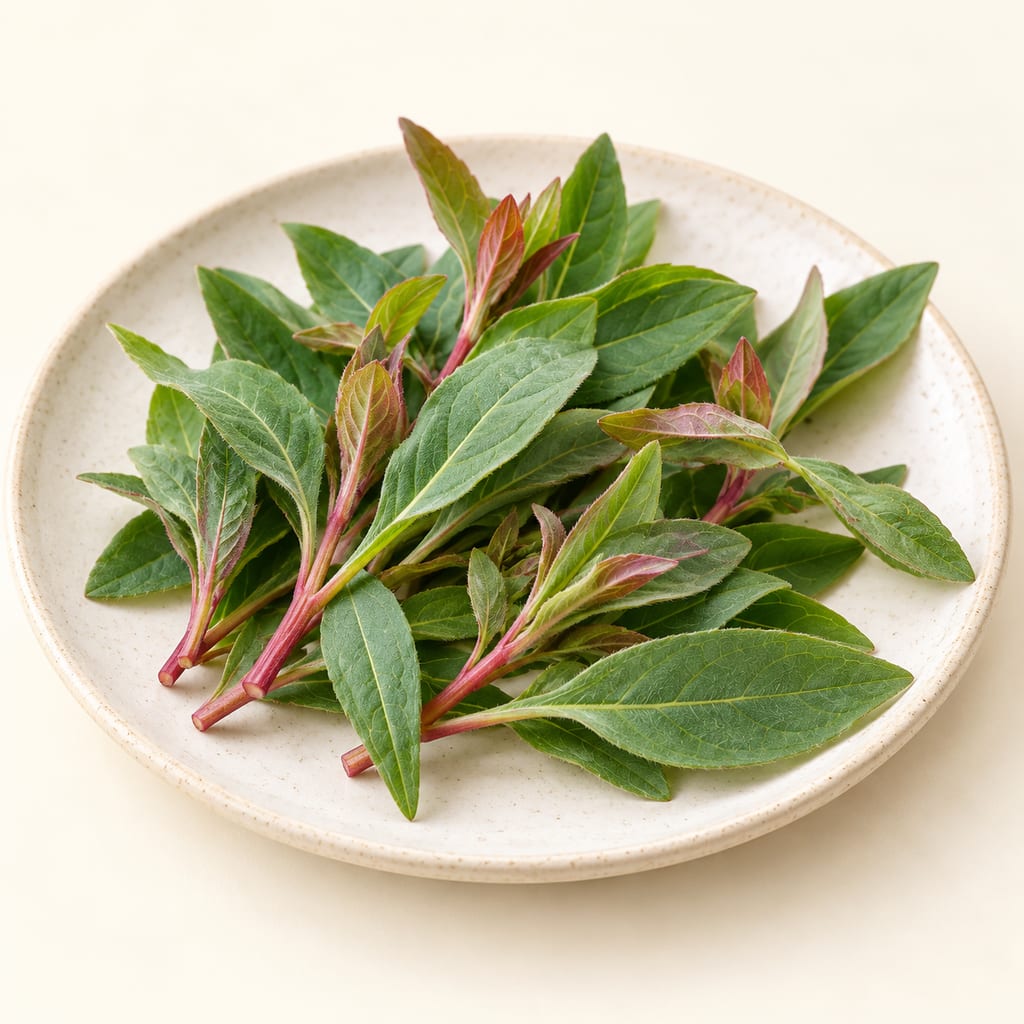
Dwarf fireweed (Epilobium latifolium) is a northern wild herb whose tender leaves and flowers appear in distinct Arctic food traditions.
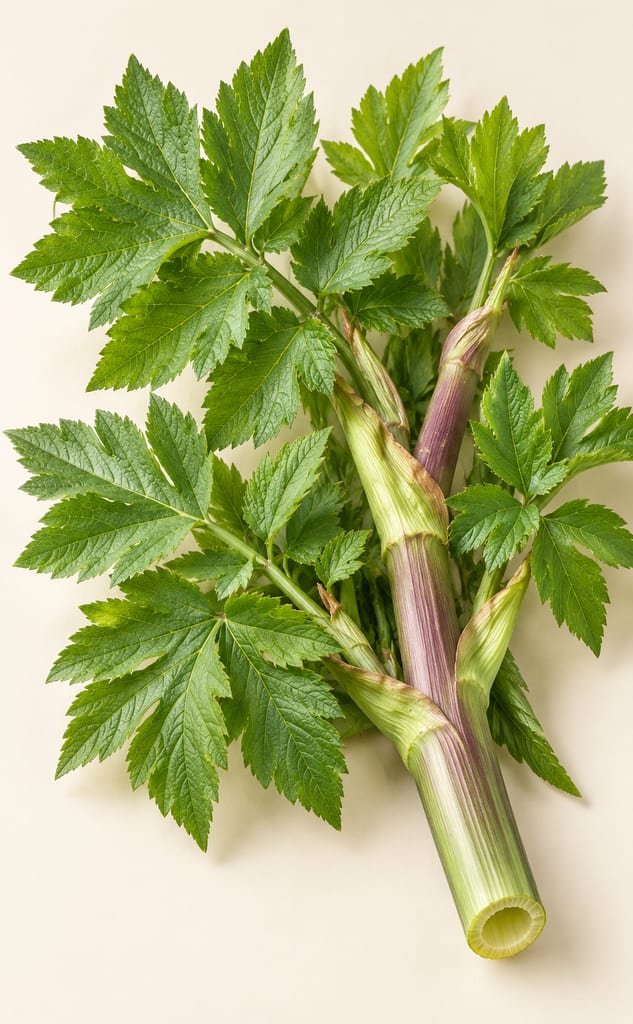
Angelica here means garden angelica (Angelica archangelica), an aromatic Apiaceae used as a vegetable, seasoning and candied stem, with Sámi food traditions linking it to preserved milk dishes.
Reindeer meat is the flesh of Rangifer tarandus, used fresh and preserved across northern foodways; animal populations, cuts, and regional practices differ, and no single culinary origin is established.
Seal blubber is the fat beneath a seal’s skin, used as food and oil. Greenlandic iginneq is a named fermented blubber food, distinct from aged seal meat.
Seal meat is the flesh of hunted seals, eaten fresh, frozen, boiled, dried and, in distinct preparations, aged or fermented. Species and community practices vary; the name describes neither one recipe nor one place of origin.
No community contributions have been published for this entry yet.
Sign in to contribute. Published comments and photos are free to read.
FermentologyIdentity · Preparation · Geography · Culture · History
Inuit Fermentation: Animal-Based & ArchaicHauptmann describes eider eggs matured in northern Greenland in shallow pits with rocks above them, not inside seal skin; she warns about cracking eggs with rocks.
She describes a halved fermented egg with firm white and yolk and a dry tan outer layer; her taste comparison is a personal sensory account, not a safety test.
The 2021 lecture locates her visit in Siorapaluk and discusses food sovereignty, community knowledge and intergenerational transmission.
Her statement that egg collection was illegal reflects her 2021 account and does not describe the exceptions in Greenland's 2023 regulation.
Cited in: What this ingredient entry means; The firsthand description; What the account cannot establish; Place and living knowledge; Harvest law and the 2021 account; Food-safety evidence and missing controls; How to read the evidence
Government of GreenlandLaw · Harvest · Geography
Selvstyrets bekendtgørelse nr. 22 af 30. maj 2023Section 11(3) permits hunting-licence holders to collect no more than two common-eider or king-eider eggs per nest for private consumption from 1 April to 15 June; a nest containing unhatched eggs may not be emptied.
Section 11(4) allows licensed collection for manniusiorneq in Zone 1 from 15 through 25 June for private consumption.
Section 11 begins with a general prohibition and sets these among enumerated exceptions.
Cited in: A 2019 encounter described in a later account; Harvest law and the 2021 account; Ecology is relevant, not a harvest instruction; How to read the evidence
Greenland Fisheries and Hunting Control AuthorityLaw · Harvest
Regulations on bird hunting, egg collection, bycatch from fishing, and catch reportingThe authority's 2026 reminder restates the limited eider egg collection dates and Zone 1 condition and says collected eggs must be reported annually.
The authority also warns that disturbance and protected-area restrictions apply; exact area rules must be checked.
Cited in: A 2019 encounter described in a later account; Harvest law and the 2021 account; Ecology is relevant, not a harvest instruction; How to read the evidence
U.S. Fish & Wildlife ServiceSpecies · Identity
Common Eider (Somateria mollissima)The common eider's scientific name is Somateria mollissima. The species page supports taxonomic identification, not identification of Hauptmann's particular eggs.
Cited in: What this ingredient entry means
U.S. Food and Drug AdministrationSafety context
Assuring the Safety of Eggs and Menu and Deli Items Made From Raw, Shell EggsFDA states that fresh eggs may contain Salmonella Enteritidis and that raw or undercooked shell eggs can cause illness, especially for vulnerable people.
FDA's document covers regulated shell eggs and food service; it does not test or validate wild eider eggs or a Greenlandic ground-maturation method.
Cited in: Food-safety evidence and missing controls; How to read the evidence
CAFF International Secretariat, Circumpolar Seabird GroupHistory · Harvest context
Seabird harvest in GreenlandThe 2008 Greenland chapter describes seabird egg harvesting, especially common-eider, murre and Arctic tern eggs, as historically important in Northwest Greenland; it summarizes a 1925 account of eggs as a prime food during summer stays at seabird islands.
It reports Salomonsen's estimate of about 60,000 eider eggs collected annually at the beginning of the 20th century. This historical estimate is not a count of fermented eggs.
The chapter says an all-species egg-collection ban was introduced by the 1988 order, while noting that local knowledge suggested the tradition was occasionally still practiced at the time it was written. This is historical context, not the current law.
Cited in: What the account cannot establish; Place and living knowledge; How to read the evidence
Cornell Lab of OrnithologySpecies context
Common Eider Life HistoryThe species account describes common eiders as ground-nesting birds whose nests contain eggs and down, and summarizes clutch and incubation biology; this is ecological context, not a food processing source.
Cited in: Ecology is relevant, not a harvest instruction
Aarhus UniversityBibliographic record
Seabird harvest in GreenlandConfirms that the chapter by Merkel and Christensen appeared in Seabird harvest in the Arctic, CAFF Technical Report 16, in 2008, pages 41–49.
Food and Foodways, 32(4), 279–301Preparation · Geography · Culture · History · Harvest law
Food sovereignty in Kalaallit NunaatThe prologue recounts Hauptmann's 2019 fieldwork encounter in Avanersuaq with a woman who said eider eggs were collected on one day each year.
One egg she opened was frozen and, according to the woman, had not fermented; a second was judged fermented and was darker with a green edge, creamy in texture and strongly cheese-like in taste.
The author describes the fermented eggs as a rare food reserved for special occasions; this is the account of one household encounter, not a measure of prevalence.
The article discusses the encounter in relation to Indigenous food sovereignty and notes the change in legal status after Greenland's 2023 regulation.
Cited in: A 2019 encounter described in a later account