The same plant, picked early
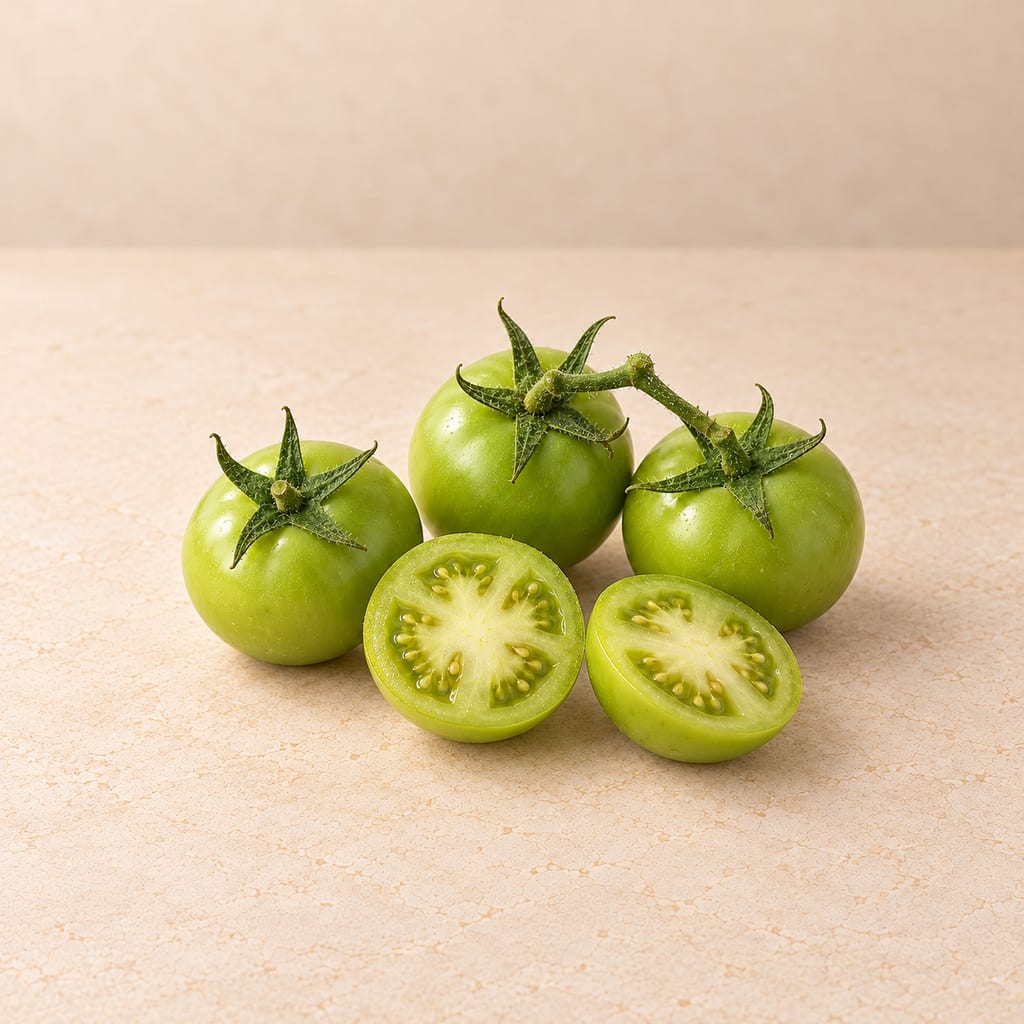
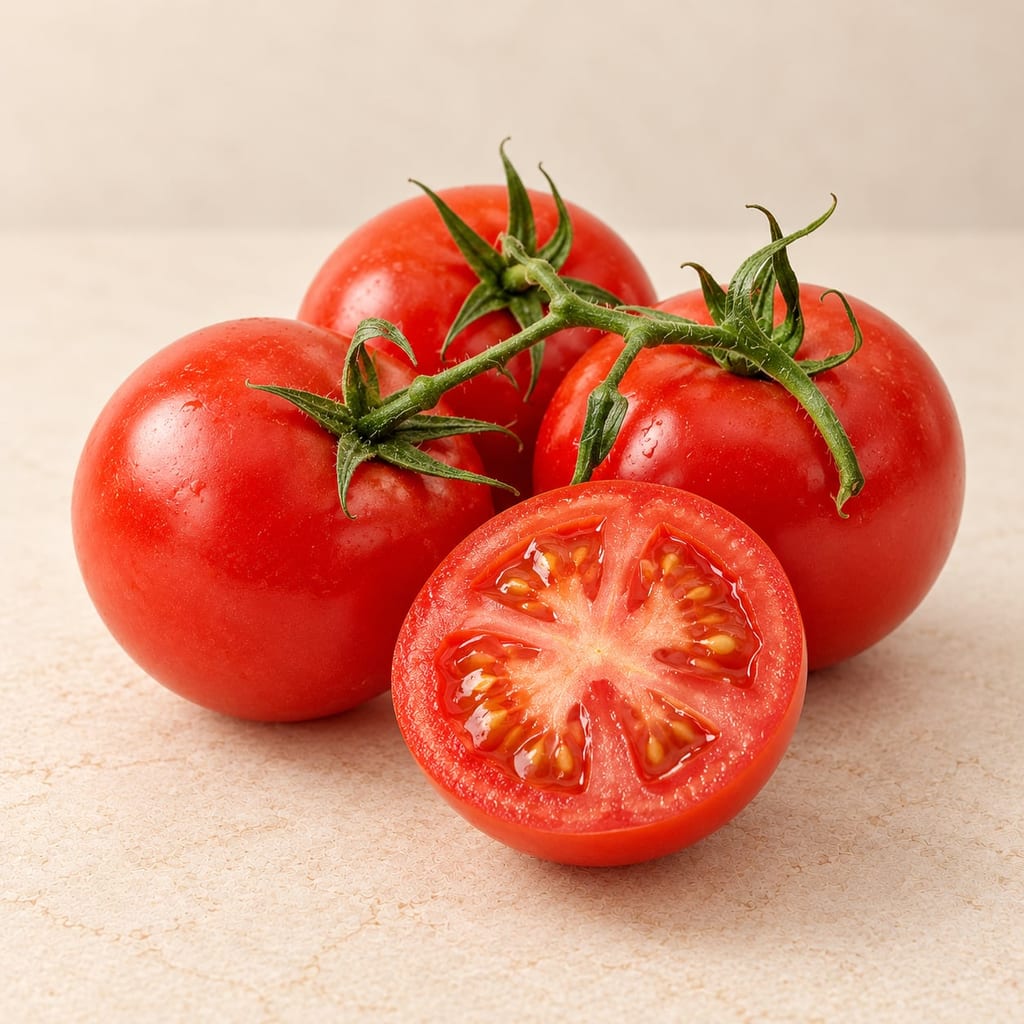
A green tomato is a tomato of the ordinary cultivated species, Solanum lycopersicum, picked before it has turned colour. It is not a separate fruit and it is not a tomatillo, which belongs to another genus. Fruit of any red cultivar is a green tomato at this stage. A few cultivars are green when they are ripe: Green Zebra, bred by Tom Wagner of Washington and introduced in 1983, is striped dark green and yellow at maturity and is tarter than a typical tomato, and newer selections blush red. Those are ripe fruit with a green look, and a tomato that is green because it is unripe is a different thing: firmer, more sour and carrying more tomatine.
What makes unripe fruit green and firm is where it stands in a developmental programme. Tomatoes are climacteric fruit, which means that ripening comes with a rise in respiration and in the plant hormone ethylene, and the fruit wall is where most of the ethylene is made. Experiments with fruit that lack the master regulator RIN show that the start of ripening, the colour and aroma changes and the softening can be separated. Ripening is the fruit's own work and not a microbial change, and it can go on after picking. Health Canada notes that tomatoes continue to ripen after picking, and Clemson's extension service adds that immature fruit should not be refrigerated, because cold stops its ripening; it should be kept at about 70 °F, and light is not needed. Green fruit holds for one to three weeks at 50 to 70 °F.
Sources for this section
Tomatine and the question of safety
Green tomatoes carry a compound that ripe ones lose. Tomatine is a steroidal glycoalkaloid made by the plant, and measurements in Japan found 16.5 milligrams per 100 grams of fresh weight in mature green tomatoes, 4.4 in turning fruit and 0.3 in ripe fruit. The compound is measured as alpha-tomatine and its relative dehydrotomatine. During ripening the alpha-tomatine that is most abundant in the flesh of mature green fruit is converted into a different compound, esculeoside A, while the combined total stays roughly constant; the change is a rearrangement of one position of the molecule, driven by the addition of a hydroxyl group at another, and it is part of the ripening programme and not a microbial or cooking effect. Health Canada names alpha-tomatine and dehydrotomatine as the tomato glycoalkaloids and says that levels fall as the fruit ripens.
The official advice is measured. Health Canada recommends eating ripe tomatoes, and green tomatoes and the products made from them, such as green tomato chow chow, fried green tomatoes and green tomato relish, in moderation. It says not to eat the green parts of the plant, the stem and leaves. Health Canada gives no tomato-specific symptoms; for glycoalkaloid poisoning in general, mainly from potatoes, it lists a bitter or burning sensation in the mouth, nausea, vomiting, cramps and diarrhoea, and neurological effects in severe cases. It states that the glycoalkaloids in potatoes are more toxic than those in tomatoes, and the 20-milligram-per-100-gram limit it sets applies to potatoes only. It also says that cooking by baking, boiling, frying or microwaving does not significantly reduce glycoalkaloid levels.
Research on tomatine in commercial green tomatoes agrees with that last point. A study of three commercial green varieties, Camone, Merinda and Nerina, ripened after harvest and stored at 22 °C, 10 °C and minus 20 °C, found that tomatine fell as the fruit matured, but also that it rose again with longer storage, after mould appeared and after a few days at minus 20 °C. Boiling green Camone tomatoes at 100 °C, which imitates industrial processing, did not change the total tomatine.
Sources for this section
Dishes made from green tomatoes
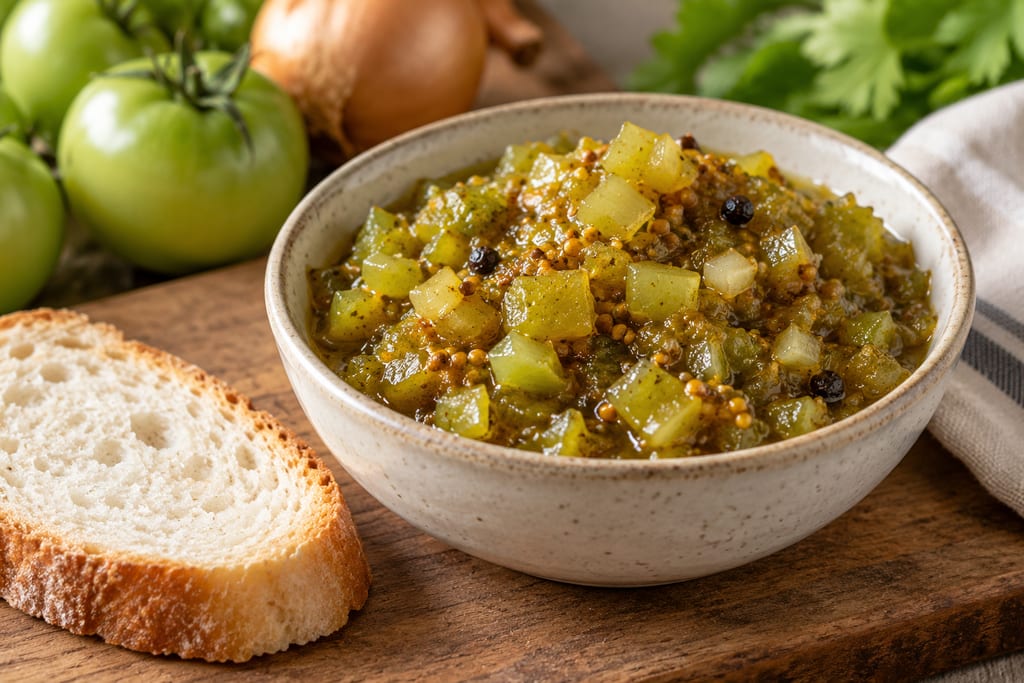
Health Canada names three preparations as examples of green tomato foods: green tomato chow chow, fried green tomatoes and green tomato relish. All three cook the fruit, and Health Canada notes that cooking does not significantly lower glycoalkaloid levels, so its advice to eat them in moderation applies to the cooked dishes too. Part of the tomato's slow acceptance in Europe in the sixteenth century was suspicion of the nightshade family it belongs to, and green fruit and green leaves are where that reputation has some basis.
Sources for this section
Fried green tomatoes
Fried green tomatoes are the best-known green tomato dish in North America. The slices are cut about an eighth to half an inch thick, seasoned with salt and pepper, coated with cornmeal, flour or breadcrumbs, and fried in butter or lard until both sides are golden brown. The Southern version uses cornmeal and green tomatoes picked throughout the season; the Pennsylvania Dutch version often uses white flour and is made at the end of the season, when the remaining fruit is picked before the first frost; in New Orleans the slices are served with shrimp remoulade. Cooks vary the dish with cayenne pepper or sugar in the coating, with slices soaked in salt water first, or with gravy at the table.
The dish is less Southern in origin than its reputation. Recipes appeared in a Kentucky church cookbook of 1875, in Good Housekeeping in 1888 and in Chicago cookbooks of 1892 and 1896. A food historian who surveyed American newspapers found 11 recipes between 1900 and 1911, all from the Northeast and Midwest, and concluded that the dish probably started there; the association with the South followed the 1991 film, although there is little evidence that it was widely cooked there earlier.
Sources for this section
Why a green tomato is firm and sour
The texture of a green tomato is part of its appeal in the kitchen. It is firmer than a ripe one, and it keeps a bite through frying or pickling that a soft red tomato cannot. The firmness numbers from a Romanian pickling study show how much of it is lost to the brine: fresh green fruit had a firmness of 7.26 newtons, and after 28 days in a sodium chloride marinade it measured 3.86 newtons, with cohesiveness falling from 0.67 to 0.50. Variants made with potassium chloride and magnesium chloride lost more, magnesium chloride firmness falling to 3.01 newtons.
The taste is a matter of what the fruit has not yet made. A ripe tomato's flavour depends on sugars, acids and some 25 to 30 volatile compounds that matter among more than 400 detected, and colour and aroma development belong to the ripening programme that has not yet started in a green fruit. Six-carbon compounds made from fatty acids, such as hexanal and (Z)-3-hexenal, make up the largest part of a ripe fruit's volatiles. Sweetness is not only sugar: one analysis found that about 62 percent of perceived sweetness can be explained by the volatiles and only about 29 percent by the sugars, so a fruit that has not begun to ripen, and so has not begun to make most of its aroma, tastes sharp and plain beside a ripe one.
Sources for this section
Green tomatoes in a pickle
A Romanian study of pickled green tomatoes, designed to test whether sodium chloride can be replaced entirely by potassium or magnesium chloride for people reducing their sodium intake, shows what the brine does to the fruit. Unripe tomatoes of an unnamed variety from a market in Galați were put into a vinegar-based marinade of water, 9 percent acetic acid, sunflower oil and sugar, with celery, onion, garlic and spices. Salt was added at 1 percent, in three batches that used sodium chloride, potassium chloride or magnesium chloride, and the batches were held at 16 to 18 °C for 28 days. The finished pickles measured between 0.55 and 0.74 percent salt.
Lactic acid built up even in this acidic bath. In the sodium chloride batch it rose by about 200 percent up to day 14 and then fell by about two thirds by day 21, and lactic acid bacteria reached 4.11 to 4.63 log colony-forming units per gram by the end while yeasts stayed below the detection limit. The brine cost the fruit its firmness: fresh green tomatoes measured 7.26 newtons and the sodium chloride pickles 3.86, and the potassium and magnesium batches lost more. Polyphenols and carotenoids rose during the pickling while flavonoids fell. Sodium chloride gave the most stable profile, and more than 65 percent of 15 tasters found the potassium and magnesium chloride pickles acceptable.
Sources for this section
Fermenting green tomatoes
Fermentation is a different route from vinegar pickling, with salt and the fruit's own microbes doing the work. The Georgian-style preparation of stuffed fermented green tomatoes shows the method: slit green tomatoes are salted and pressed, filled with parsley, celery, chile, dill and garlic, packed under a weighted brine, topped with grape leaves or parchment and fermented for 10 to 20 days. Its recipe is on the site as Georgian-style stuffed fermented green tomatoes, and it fits green fruit because the firm flesh holds the filling and survives the weeks in brine.
Researchers have also fermented unripe tomato for its own sake. Portugal is a major producer of industrial tomato and tomato paste, and roughly 112 million kilograms of non-red tomatoes are left in the field each year, and a team fermented unripe tomato paste for four days with Lactobacillus plantarum, Leuconostoc mesenteroides and the yeast Kluyveromyces marxianus. The paste turned acidic, with olive-like flavours, and had more ascorbic acid and antioxidant activity; the authors judged the alpha-tomatine in the fermented paste to pose no hazard to consumers. A separate 2025 study that fermented tomato powder, of unstated maturity, with Lactiplantibacillus plantarum for 24 hours reported total glycoalkaloids falling from 50.77 to 6.43 milligrams per 100 grams; the paper has internal inconsistencies, and it is a single result.
Sources for this section
Choosing and handling green tomatoes
Buy or pick firm, unblemished fruit and throw out bruised or spoiled tomatoes. Wash green tomatoes under cool running water, since gentle washing with water is as effective as produce cleansers, and cut out the stem scar. Do not soak tomatoes in a sink full of water, because they can pick up bacteria from the sink. Cut or peeled tomatoes should be refrigerated and used within three days, and discarded if they have sat at room temperature for more than two hours. Tomatoes grow close to the ground, so soil, water, animals and handling can contaminate them, and they have been linked to Salmonella illness.
For canning, extension advice treats all tomatoes as borderline for acidity: Clemson notes that some varieties test at or above pH 4.6, and recommends acidifying all of them; mixtures of tomatoes with vegetables such as okra, and spaghetti sauce with no added acid, must be pressure canned by a tested recipe.
Sources for this section
Allergy and what is not settled
Tomato allergy is among the commoner vegetable allergies and is mostly IgE-mediated, often linked with grass pollen and latex allergy.
Several points remain open. No source gives a canning rule specific to green tomatoes, or a history of green tomato dishes such as fried green tomatoes or the Australian green tomato relish. Tomatine levels vary with variety and storage, and no study measured tomatine in a finished home-style pickle or ferment, so what a kitchen batch contains is not known.
Sources for this section
Places
Galați, Romania
Documented preparation · Locality evidenceUnripe tomatoes from a local market were pickled in the cited study; a study site, not an origin.
Georgia
Modern adaptation · Country evidenceAn American publisher adapts a Georgian preparation of stuffed fermented green tomatoes.
Portugal
Modern adaptation · Country evidenceA major industrial-tomato producer where unripe tomatoes left in the field have been fermented as a paste.