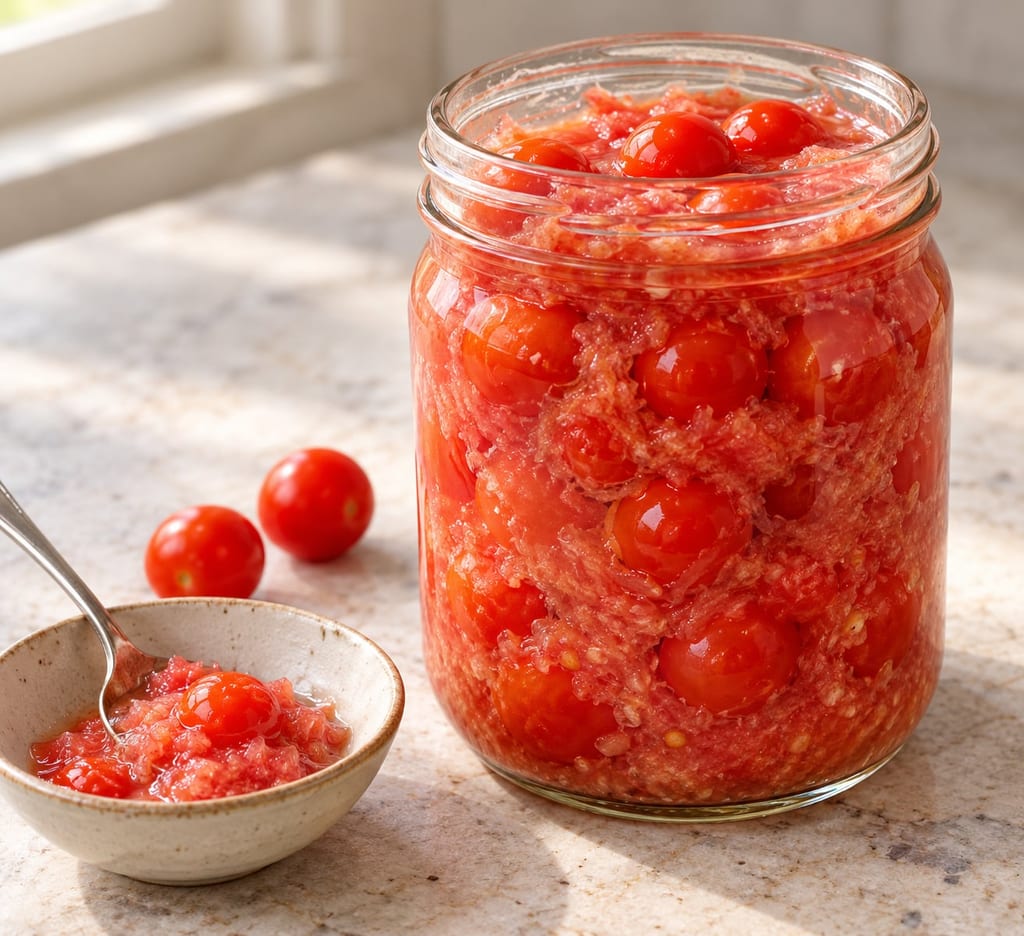
Lacto-fermented cherry tomatoes
Cherry tomatoes sit beneath a salted grated-tomato layer for a five-to-seven-day room-temperature fermentation.
 FermenteaWhere food goes to change
Substrates
Tomatoes are the fruit of Solanum lycopersicum, wild in the Andes and domesticated in Mesoamerica. They are eaten ripe or green, fresh, cooked, canned and fermented.
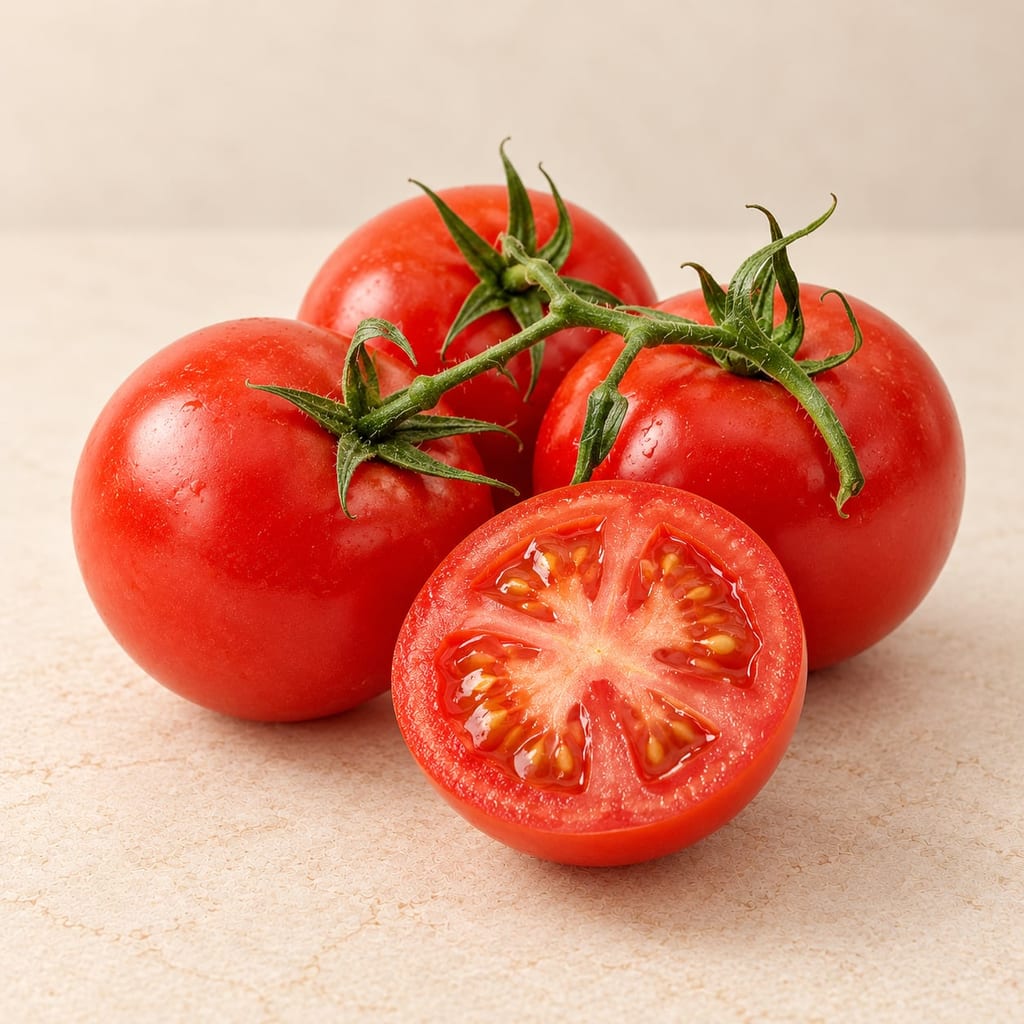
The tomato is the fruit of Solanum lycopersicum, a herbaceous plant of the nightshade family. Botanically it is a berry, with a fleshy outer wall and seed-bearing chambers; in the kitchen it is a vegetable, eaten raw in salads, cooked into sauces and soups, dried, canned and fermented. One species gives all the cultivated forms. Health Canada groups the popular types as beefsteak, plum and cherry, in red, yellow, pink and purple, and a name like beefsteak describes a size and shape that many cultivars share, without promising a sweetness or a composition.
The word reached English through Spanish tomate from Nahuatl tomatl, which an early Nahuatl vocabulary of 1571 glosses as a fruit that goes into stews and sauces. A modern dictionary of Nahuatl notes that unmodified tomatl may refer to the green husk tomato, the plant now called tomatillo, while miltomatl names small wild tomatoes. Both words are cited from Sahagún's sixteenth-century Florentine Codex, whose book on the market lists the kinds of tomato a tomato seller offered, and it records several kinds of tomato on a seller's stall. The Italian pomodoro comes from pomo d'oro, golden apple, a name that Matthioli's 1554 Latin edition of Dioscorides already uses.
The tomato's sixteen wild relatives live in a narrow coastal and Andean belt from Ecuador to northern Chile, including the Galapagos Islands. The closest is the currant tomato, Solanum pimpinellifolium, with populations on the coasts of Peru and Ecuador. Between wild and cultivated stands the cherry-type tomato, Solanum lycopersicum var. cerasiforme, native to the Andean region of Ecuador and Peru and now found across the subtropics.
How the crop was domesticated has been re-argued. A 2015 study of 1,008 accessions and 7,720 genetic markers supported a two-step process: a first domestication in South America, where fruit weight was strongly selected in Andean cherry tomatoes, and a second in Mesoamerica. A 2020 study that sequenced 166 whole genomes changed the order. It argued that the cherry-type tomato may have begun in Ecuador long before people, and that many traits typical of the cultivated tomato appeared there, were lost or reduced as populations moved north and were selected again, independently, in the cultivated tomato. Summaries of the work place the cherry type's origin at about 80,000 years ago and the domestication of the cultivated tomato in Mesoamerica at about 7,000 years ago, with substantial uncertainty; these are genetic model estimates, not archaeological dates. The chapter that surveys the field describes competing hypotheses and does not settle one birthplace.
Pietro Andrea Matthioli described the tomato in the first Italian edition of his commentary on Dioscorides in 1544, without an illustration, and the first picture appeared in 1553, an uncoloured woodcut by Rembert Dodoens, followed by a coloured one in 1554. Surviving specimens give a firmer record. Ulisse Aldrovandi's herbarium specimen of about 1551 from Bologna is considered the oldest extant botanical voucher of the crop; Francesco Petrollini's tomato in the Cibo herbarium dates from before 1553; and a specimen in the En Tibi herbarium, once dated 1542 to 1543, was made in Bologna around 1558. A letter of 31 October 1548 from Pisa to Florence, about tomatoes shown to Cosimo I, is the earliest written evidence of the term golden apples in Italian.
A study of ten surviving sixteenth-century specimens and thirteen illustrations found that the earliest European tomatoes came in a much wider variety of colours, shapes and sizes than had been thought. The fruit was received with mixed emotions. Growers who knew the nightshade family's reputation for toxic plants were slow to adopt it. Degraded DNA in old specimens limits what can be said about their flavour.
A tomato begins as a flower. Pollen from the anthers reaches the stigma, germinates and sends a tube towards the ovules, and the ovary swells into the fruit around the developing seeds. The domesticated tomato pollinates itself because of its flower structure, while wild tomatoes have a slightly protruding stigma and rely on insects or wind. Light, temperature, humidity and plant nutrition all affect pollination, and extension guidance for cool-climate growers explains how failures at each stage prevent fruit from forming; growers in greenhouses often have to assist pollination.
The fruit ripens through its own programme. Tomatoes are climacteric: ripening comes with a rise in respiration and in the plant hormone ethylene, which is made most in the fruit wall. Colour, aroma, flavour and softening develop through interacting processes, and experiments with fruit that lack the master regulator RIN show that the start of ripening, the colour and aroma changes and the softening can be separated. Softening on a windowsill is the plant's work and not microbial fermentation. This is also why Health Canada notes that tomatoes continue to ripen after picking.
Tomatoes are grown in nearly every country with a long enough growing season, and some experts consider the tomato the most important horticultural crop in the world. It is the most commonly planted garden crop in the United States, which has historically led commercial production, with California as the top producing state.
The flavour of a tomato is more than its sugar. Glucose and fructose are the main sugars, and citrate and malate contribute the acids, but the aroma matters as much. More than 400 volatile compounds have been detected in tomato, about 25 to 30 of them contributing significantly to flavour, and fatty-acid-derived volatiles make up more than half of the total. Aroma is the more surprising part of sweetness: one analysis found that about 62 percent of perceived sweetness can be explained by the volatiles and only about 29 percent by the sugars. The dominant volatiles of a ripe fruit are six-carbon compounds from fatty acids, such as hexanal and (Z)-3-hexenal, and the lists of important aromas also include apocarotenoids such as geranylacetone and beta-ionone, the branched-chain 2-isobutylthiazole, and phenylalanine-derived compounds such as 2-phenylethanol that are pleasant at low levels and unpleasant at high ones.
Breeding has cost the tomato some of this. Selection for yield, size, shelf life and disease resistance caused flavour loss, and growers are paid by quantity and not taste. The uniform-ripening mutation, carried by virtually all modern cultivars, gives evenly red fruit and is linked to lower sugars and carotenoids. A study of 398 modern, heirloom and wild lines found that modern varieties have significantly lower amounts of important flavour compounds than heirlooms. Two equally red fruits can therefore taste very different, and a cook's choice of cultivar is a choice of taste as well as structure.
Unripe tomatoes contain tomatine, a steroidal glycoalkaloid. Measurements in Japan found 16.5 milligrams per 100 grams of fresh weight in mature green fruit, 4.4 in turning fruit and 0.3 in ripe fruit. During ripening the alpha-tomatine of the flesh is converted into a different compound, esculeoside A, while the combined total stays roughly constant. Health Canada names alpha-tomatine and dehydrotomatine as the tomato glycoalkaloids, states that levels fall as the fruit matures and ripens, and advises eating green tomatoes and products made from them in moderation; the glycoalkaloids in potatoes are more toxic than those in tomatoes, and the 20-milligram limit it sets applies only to potatoes. It adds that cooking does not significantly reduce glycoalkaloid levels and that the stems and leaves should not be eaten. Green tomatoes are a food of their own in pickles, chutneys and ferments.
Tomato is a hospitable fruit for lactic acid bacteria. A Chinese study fermented heated, sterilised tomato puree at 23 °C and 37 °C for 16 hours and isolated 66 gram-positive bacteria, 36 of them Lactiplantibacillus plantarum. Thirteen strains were tested as starters in tomato juice adjusted to 12 degrees Brix; after 22 hours the pH had fallen to between 3.27 and 3.94, which the authors attribute to lactic acid. The work reported no texture or sensory results, so it shows that the bacteria grow in tomato, not what a fermented tomato tastes like.
Unripe tomato has had its own research. In Portugal, about 112 million kilograms of non-red tomatoes are left in the field each year, and a team fermented unripe tomato paste for four days with a consortium of Lactobacillus plantarum, Leuconostoc mesenteroides and the yeast Kluyveromyces marxianus. The result was an acidic paste with olive-like flavours, with more ascorbic acid and antioxidant activity, and with alpha-tomatine at a level the authors judged to pose no hazard. A 2025 study reported that fermenting tomato with L. plantarum for 24 hours cut total glycoalkaloids from 50.77 to 6.43 milligrams per 100 grams, a fall of 87 percent, against 65.5 percent for blanching; the paper has internal inconsistencies, so the figure is a single-study result.
Tomatoes also enter ferments as an ingredient. A commercial kimchi ketchup pairs tomatoes with fermented kimchi and names soybeans as an allergen of the finished sauce; the producer does not state the tomato variety, form, proportions or process. Ketchup has a fermented ancestry of its own. Most accounts trace the word to a fermented fish sauce of south-eastern China, called kê-chiap in Hokkien, which the British met at a trading post in Indonesia in the late seventeenth century; a tomato ketchup recipe is first recorded in 1812 and a preservative-free commercial version appeared in 1906. That history rests on a popular account, and no peer-reviewed source was read for it.
Tomatoes sit near the line between acid and low-acid foods. Clemson's extension service notes that some current varieties test at or above pH 4.6 and a few reach pH 5 or higher, because breeding for easy harvest has often made tomatoes milder. The National Center for Home Food Preservation therefore calls for acidification of whole, crushed and juiced tomatoes in both boiling-water and pressure canning: per quart jar, 2 tablespoons of bottled lemon juice or half a teaspoon of citric acid, and half those amounts per pint, or 4 tablespoons of 5 percent vinegar per quart, which may change the flavour. Tomato mixtures with added vegetables such as okra, or spaghetti sauce without acid, must be pressure canned by a tested recipe.
For fresh tomatoes, buy fruit that is firm but not hard, without bruises or cuts. Store whole tomatoes unwashed at room temperature until ripe, out of direct sun; once ripe, Health Canada advises refrigerating them and using them within a few days, and using cut or peeled tomatoes within three days. Wash them under cool running water, since gentle washing with water is as effective as produce cleansers, and cut out the stem scar. Throw away cut or peeled tomatoes left at room temperature for more than two hours. Fresh field tomatoes do not naturally carry the bacteria that cause illness; tomatoes grow close to the ground, so soil, water, animals and handling are possible routes of contamination, and tomatoes have been linked to Salmonella illness.
Tomato is one of the most prevalent allergenic vegetables. Most tomato allergy is IgE-mediated and is often linked with grass pollen and latex allergy, with oral itching and swelling after fresh fruit the commonest symptom. Reviewers of the field say the available data are not sufficient.
The sources read leave several points open: the place and date of first domestication, the earliest tomato foods of Mesoamerica, the effect of lactic fermentation on the texture of whole tomatoes, and current production statistics.
tomato
Range of the wild relatives; not a domestication site.
Probable region of domestication of the cultivated tomato; exact place uncertain.
Where the oldest surviving botanical voucher of tomato was made; evidence of early European study, not of arrival.
Major industrial-tomato producer where unripe tomatoes left in the field have been tested as a ferment.
Cherry tomatoes sit beneath a salted grated-tomato layer for a five-to-seven-day room-temperature fermentation.
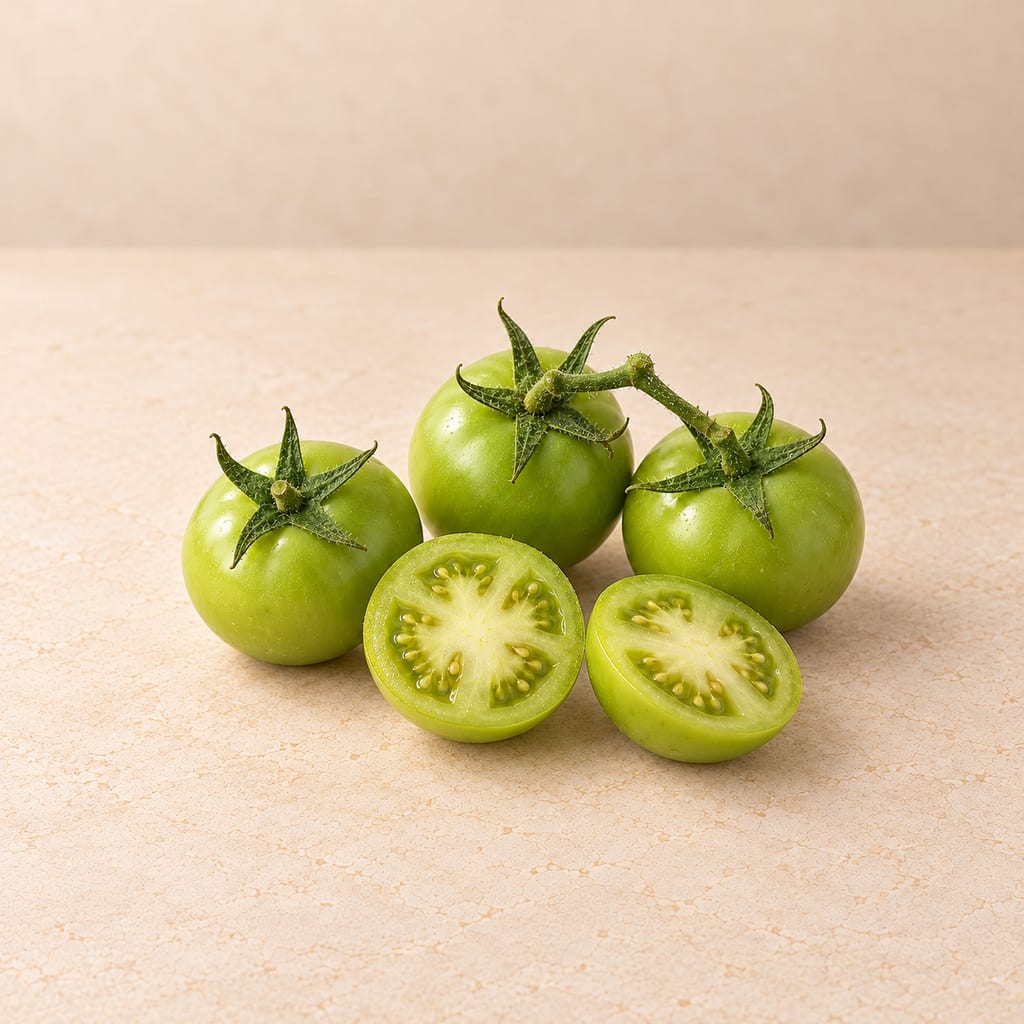
A green tomato is an unripe tomato, firm and sour, used for frying, pickling, relish and ferments. It carries tomatine, which falls as the fruit ripens.
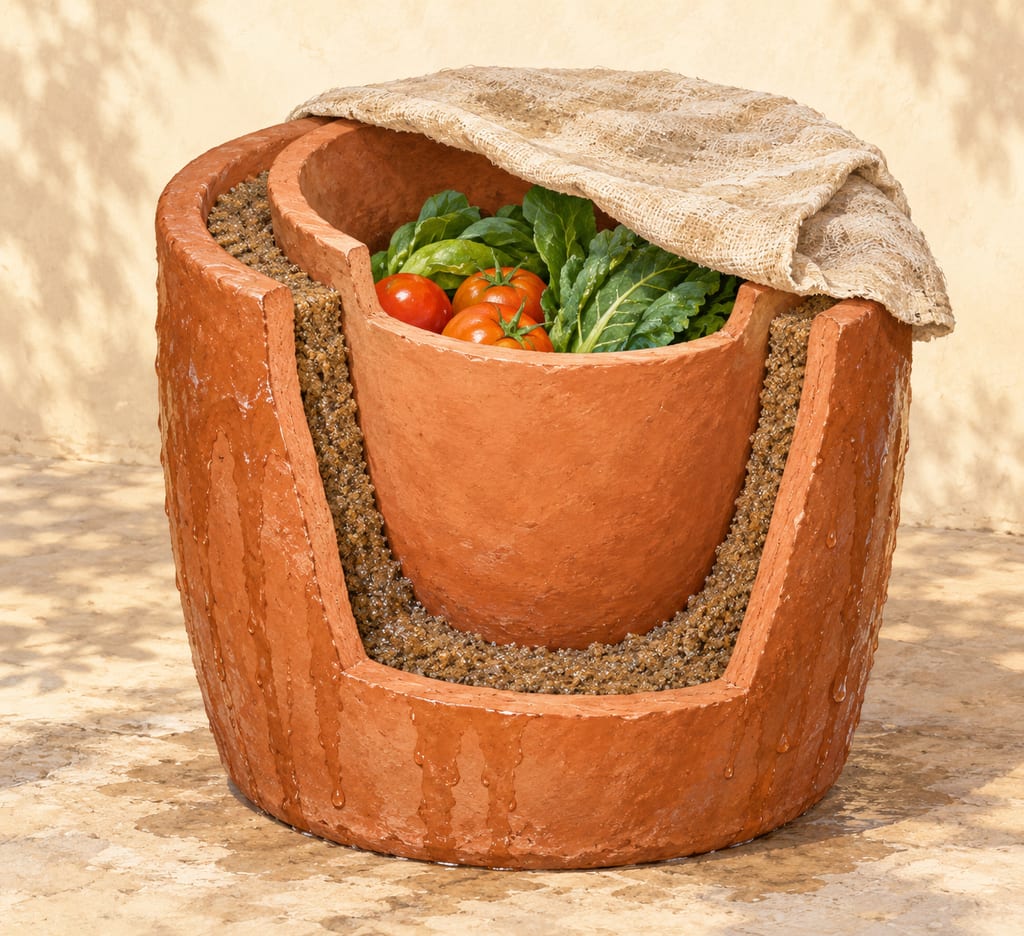
A household produce cooler built from two clay pots, wet sand and a damp cover. Evaporating water cools the inner chamber without a powered refrigerator; it suits hot, dry, ventilated settings.
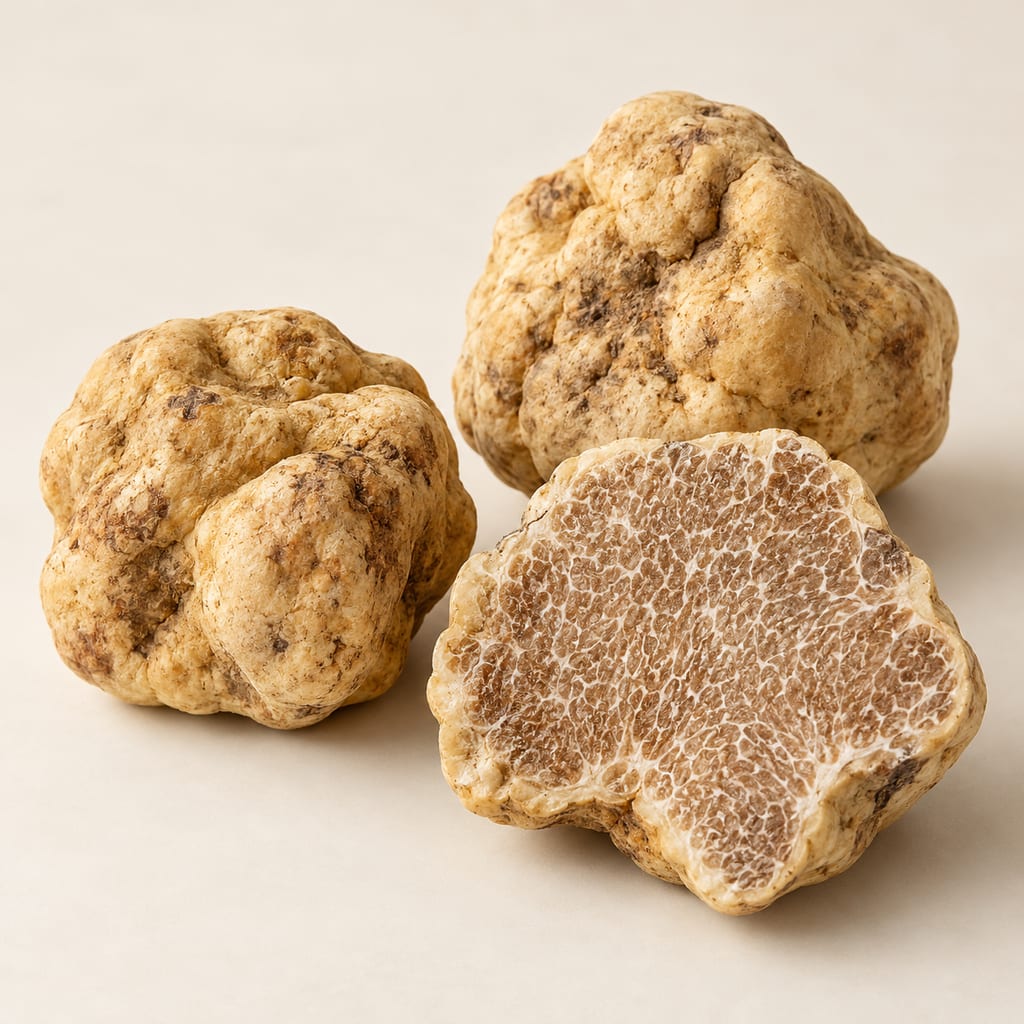
Tuber magnatum is a subterranean, tree-associated European truffle prized for its aroma. It is often shaved raw over warm, simply prepared foods during local autumn and winter seasons.
No community contributions have been published for this entry yet.
Sign in to contribute. Published comments and photos are free to read.
Goodlok PlayIdentity · Processing
Kimchi ketchupCommercial kimchi ketchup combines tomatoes with fermented kimchi and lists soybeans as an allergen; cultivar, form, proportions and process unspecified
Cited in: Tomatoes in ferments; Allergy and what is not settled
PeerJ10:e12790Identity · Processing
Sixteenth-century tomatoes in Europe: who saw them, what they looked like, and where they came fromMatthioli 1544; pomi d'oro 1554; Dodoens 1553 and 1554 images; Aldrovandi voucher about 1551; Petrollini before 1553; En Tibi specimen about 1558; Ferrini letter of 31 October 1548; ten specimens and thirteen illustrations; wider variety than thought; degraded DNA
Cited in: Tomatoes arrive in Europe
USDA ARS publication record; chapter in Genetic Improvement of Solanaceous Crops, volume2Identity · Processing
History, origin and early cultivation of tomato (Solanaceae)Wild relatives of western South America and competing domestication hypotheses
Cited in: Wild fruit of the Andes, crop of Mesoamerica
University of Alaska Fairbanks Cooperative Extension, HGA-00435Identity · Processing
Pollination & Fruit Development in TomatoesFlower-to-fruit development, pollination sensitivity to conditions, greenhouse assistance
Cited in: From flower to fruit
BMC Plant Biology14:11Identity · Processing
Tissue specific analysis reveals a differential organization and regulation of both ethylene biosynthesis and E8 during climacteric ripening of tomatoClimacteric ripening; tissue-specific ethylene production, highest in the fruit wall
Cited in: From flower to fruit
New Phytologist226(2):460–475Identity · Processing
Roles of RIN and ethylene in tomato fruit ripening and ripening-associated traitsRIN-deficient fruit separate ripening initiation, colour and aroma, and softening
Cited in: From flower to fruit
Frontiers in Plant Science14:1144113Identity · Processing
The dissection of tomato flavor: biochemistry, genetics, and omicsOver 400 volatiles detected, about 25 to 30 significant to flavour; fatty-acid-derived volatiles over half; glucose, fructose, citrate and malate; breeding trade-offs
Cited in: A berry, a vegetable and a sauce; Sugar, acid and aroma
Health CanadaIdentity · Processing
Food safety tips for tomatoesBeefsteak, plum and cherry types; colours; firm but not hard; ripen after picking; refrigerate once ripe; cut or peeled within three days; wash with cool running water; Salmonella; contamination routes
Cited in: A berry, a vegetable and a sauce; From flower to fruit; Acidity, canning and handling
Health CanadaIdentity · Processing
Glycoalkaloids in FoodsAlpha-tomatine and dehydrotomatine; levels fall as fruit ripens; green tomato products in moderation; cooking does not significantly reduce; do not eat stems and leaves; 20 mg per 100 g limit applies to potatoes
Cited in: Green tomatoes and tomatine
National Center for Home Food Preservation; adapted from USDA Complete Guide to Home Canning, revised2015Identity · Processing
Canning Tomatoes, IntroductionAcidification is required in whole, crushed and juiced tomato canning procedures
Cited in: Acidity, canning and handling
University of Illinois Extension, Garden ScoopOrigin
History of tomatoes: how a tropical crop became globalSixteen wild relatives from Ecuador to northern Chile; cherry-type origin about 80,000 years ago; domestication in Mesoamerica about 7,000 years ago; slow European adoption; self-pollination
Cited in: Wild fruit of the Andes, crop of Mesoamerica; Tomatoes arrive in Europe; A crop of nearly every country
BMC Genomics 16:257Domestication
Genomic variation in tomato, from wild ancestors to contemporary breeding accessions1,008 accessions and 7,720 SNPs support a two-step domestication, South America then Mesoamerica; cherry-type tomato native to Andean Ecuador and Peru
Cited in: Wild fruit of the Andes, crop of Mesoamerica
Molecular Biology and Evolution 37(4):1118-1132Domestication
Genomic Evidence for Complex Domestication History of the Cultivated Tomato in Latin America166 whole genomes; the cherry-type stage may have begun before domestication; traits lost and reselected during northward spread
Cited in: Wild fruit of the Andes, crop of Mesoamerica
Journal of the Agricultural Chemical Society of Japan 71(8):777-782 (AGRIS record)Glycoalkaloids
Absorptiometric measurement of tomatine in tomatoesTomatine 16.5 mg per 100 g in mature green, 4.4 in turning and 0.3 in ripe fruit
Cited in: Green tomatoes and tomatine
Journal of Agricultural and Food Chemistry 57(9):3786-3791Glycoalkaloids
C22 isomerization in alpha-tomatine-to-esculeoside A conversion during tomato ripening is driven by C27 hydroxylation of triterpenoidal skeletonAlpha-tomatine, most abundant in the flesh of mature green fruit, is converted to esculeoside A during ripening while the total stays roughly constant
Cited in: Green tomatoes and tomatine
Foods 13(22):3569Fermentation
Targeted Screening of Lactiplantibacillus plantarum Strains Isolated from Tomatoes and Its Application in Tomato Fermented Juice66 gram-positive isolates, 36 L. plantarum; 13 strains in juice at 12 Brix for 22 h; pH 3.27 to 3.94; no sensory results
Cited in: Tomatoes in ferments
Journal of the Science of Food and Agriculture 102(4):1422-1429Fermentation
Improving nutritional quality of unripe tomato through fermentation by a consortium of yeast and lactic acid bacteriaAbout 112 million kg of unripe tomatoes left in the field in Portugal each year; 4-day fermentation with L. plantarum, Leuconostoc mesenteroides and Kluyveromyces marxianus; olive-like flavours; alpha-tomatine judged no hazard
Cited in: Tomatoes in ferments
Food Science & Nutrition 13(9):e70970Fermentation
Probing the Effect of Ultrasonication, Probiotic Lacto-Fermentation, and Blanching on Bioactive Compounds, Antioxidants Activities, and Antinutrients of TomatoTotal glycoalkaloids fell from 50.77 to 6.43 mg per 100 g (87 percent) after 24 h L. plantarum fermentation versus 65.5 percent for blanching; the paper has internal inconsistencies
Cited in: Tomatoes in ferments
Antioxidants 11(4):644Allergy
Tomato Allergy: The Characterization of the Selected Allergens and Antioxidants of Tomato (Solanum lycopersicum): A ReviewOne of the most prevalent allergenic vegetables; mostly IgE-mediated; linked with grass pollen and latex; data not sufficient
Cited in: Allergy and what is not settled
Online Nahuatl Dictionary, Wired Humanities ProjectsNames
tomatlTomatl glossed in 1571 as a fruit used in stews and sauces; unmodified tomatl may refer to the green husk tomato; miltomatl small wild tomatoes
Cited in: A berry, a vegetable and a sauce
Clemson Home and Garden Information CenterPreservation
Canning Tomato Products: To Acidify or Not to AcidifySome current varieties are at or above pH 4.6, a few at pH 5 or higher; acidifying allows boiling-water canning; tomatoes with okra and unacidified spaghetti sauce must be pressure canned
Cited in: Acidity, canning and handling
National Center for Home Food PreservationPreservation
Since You Can't Have Too Many TomatoesPer quart 2 tablespoons bottled lemon juice or 1/2 teaspoon citric acid; per pint 1 tablespoon or 1/4 teaspoon; 4 tablespoons of 5 percent vinegar per quart; tomatoes are borderline in pH
Cited in: Acidity, canning and handling
Food Republic (popular account)History
The Early History Of Ketchup Has Nothing To Do With TomatoKetchup traced to a fermented fish sauce of south-eastern China (kê-chiap in Hokkien); tomato ketchup recipe of 1812; preservative-free commercial version of 1906; a single popular source
Cited in: Tomatoes in ferments