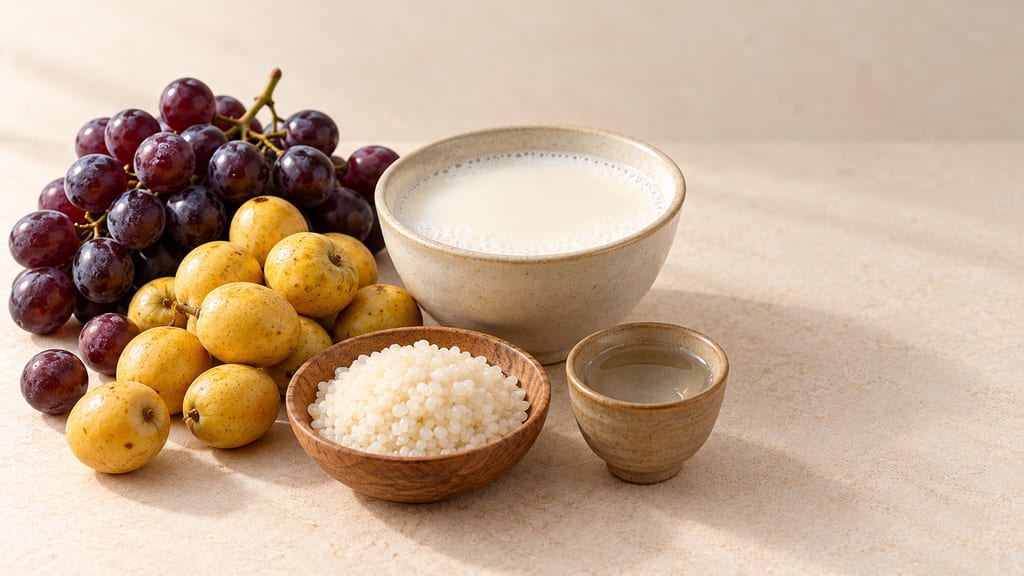
Harvests into drinks: fruit, grain and milk
A marula harvest, a rice mash and a bowl of fermented mare’s milk reveal different ways to make alcohol, and different kinds of knowledge behind the drink.
 FermenteaWhere food goes to change
Substrates
Mare milk is milk produced by a lactating female horse. Its composition varies with breed and lactation; raw milk, pasteurized milk and fermented drinks such as airag or qymyz are distinct forms with different handling and evidence.
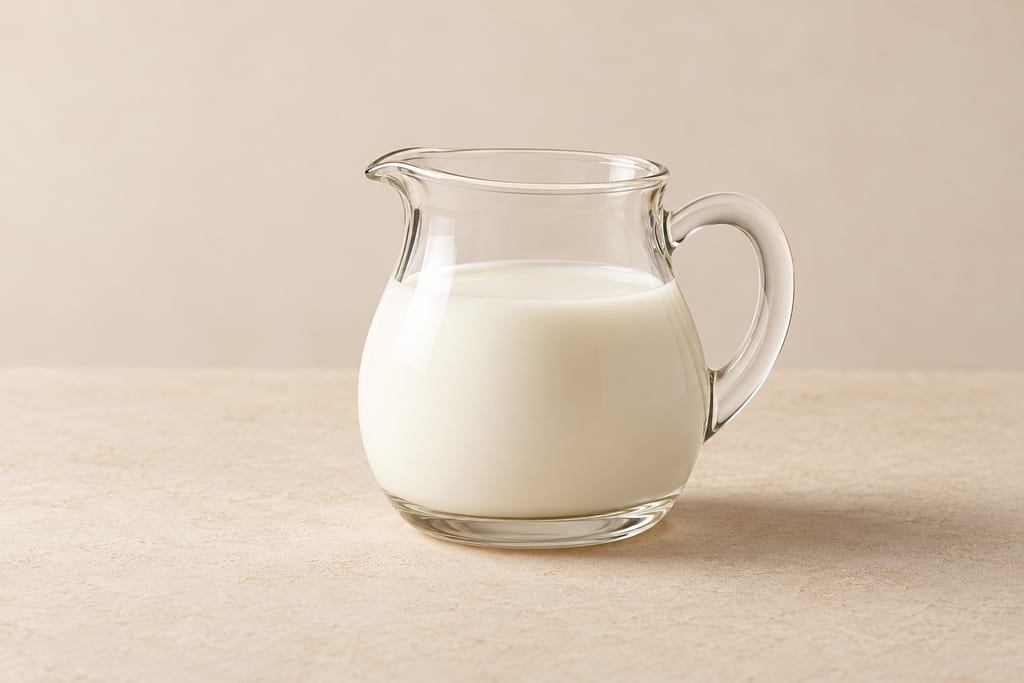
Mare milk is the milk produced by a lactating female horse. The name identifies the animal but does not tell you whether the milk is raw, heat-treated, fermented, frozen or dried. Those are different product states. A source that says “horse milk” may use horse as a broader animal term; check the producer or study before treating it as a specific retail product.
This page concerns the raw ingredient category. Raw means milk that has not undergone pasteurization; it does not establish how it was collected or whether it is safe. Pasteurized mare milk has a separate catalogue entry. Airag, koumiss and qymyz are fermented beverages made from mare milk, not names for the unfermented ingredient. Milk powder is also not interchangeable with liquid milk without a product-specific instruction.
Milk changes as it is handled. Raw milk is not fermented milk: before a controlled fermentation begins, its microbial community has not been defined by the process described for a finished drink. Pasteurization is a heat treatment, while drying removes water and creates a different product. These terms describe distinct operations and cannot be inferred from a source that simply calls its material mare milk. The product label, study method or recipe specification needs to state the condition.
Airag and qymyz are names for fermented drinks in their respective documented contexts. They are not evidence that every mare-milk product has fermented, and a commercial bottle named saumal is not automatically raw. A source may also translate these regional terms as koumiss or kumys. Where a producer's label or a historical account supplies a local spelling, retain that form rather than treating transliteration as proof that two products are identical in process.
The distinction matters in a recipe database. A recipe that begins with milk and a starter makes a fermented product; it does not make the milk itself. If a recipe specifies pasteurized mare milk, replacing it with raw milk changes a documented processing step. If it specifies a fermented drink, replacing that drink with fresh mare milk removes the fermentation. Neither change should be treated as a harmless name variation.
Mare milk is not a fixed formula. Breed, animal, lactation stage, feed and sampling methods can change measured composition. In one Tunisian study, researchers followed 16 Arabian mares during four months of lactation and recorded low fat and substantial lactose in their samples. Those results describe those animals under those conditions; they should not be copied onto every bottle or used as a nutrition promise.
Equine milk is often described as having less fat and casein and more lactose than cow milk, but comparisons depend on the animals and methods compared. People with lactose intolerance should not assume mare milk will resolve their symptoms. Milk proteins can also cause allergic reactions. A single case report or composition study cannot predict an individual's response.
The Tunisian Arabian-mare study measured average fat at 16.9 grams per litre, crude protein at 21.3 grams per litre and lactose at 61.5 grams per litre across its sampling programme. Its authors also measured physical properties and examined how the samples behaved in clotting trials. Those figures are a useful example of published research, not guaranteed label values for other breeds, farms or lactation stages.
That study followed a defined group of sixteen mares over four months and collected samples weekly. Its field method included hand milking in the foal's presence and immediate cooling for laboratory analysis. Such a controlled sampling protocol tells readers how the researchers obtained their data; it does not establish a universal farm routine, allowable delay before chilling, or consumer storage period. The study's measured pH is likewise an analytical result, not a home safety target.
Composition can change even within a single lactation. The article compares findings with published measurements from other breeds and reports differences in fat, protein, lactose and other properties. Cross-study comparisons bring their own limits because sample populations, lactation timing and laboratory methods may differ. Use the measured range from a source only when the breed, study design and intended comparison are stated.
Collecting mare milk takes place in relation to a foal's feeding. Dairy management has to accommodate both the foal's nourishment and the milk available for people. Historical accounts and modern studies describe the foal being present during milking. A small mammary storage capacity means production schedules may involve repeated access rather than long intervals familiar from cattle dairies.
A milking session may use hand milking or purpose-built dairy equipment. A laboratory protocol, historical account and commercial farm each describe a particular setting. None, by itself, sets a general household hygiene standard or safe storage time. Follow product-specific supplier directions and local food rules.
Fermented mare milk has a prominent place in several pastoral food traditions, but descriptions should remain local and specific. UNESCO's Mongolian entry focuses on making airag in a khokhuur and the knowledge associated with that vessel. A separate UNESCO listing describes seasonal rites connected with the first koumiss among a Kazakh horse-breeding community. These listings show living cultural practices and do not claim that all communities share one equipment set, beverage name or calendar.
William of Rubruck's account is an important historical witness to a drink made from mare milk in the thirteenth century, but it reflects the observer's language and the practices he encountered. His use of “cosmos” and his details about churning cannot stand in for every later Central Asian tradition. Nor should the account's statements about taste, effects or bodily response be repeated as tested food-science claims.
Modern dairy activity also differs from pastoral household milking. A research station, commercial farm, historic postcard or tourist photograph may document one technology or place. A photograph of a mare being milked cannot demonstrate how the resulting milk was cooled, treated, stored or sold. A producer's current process belongs to that producer and date; it should not be extrapolated to the whole animal-milk category.
Proteins preserved in human dental calculus provide evidence that people in Mongolia consumed horse milk by about 1200 BCE. The archaeological study identifies animal sources at the sites examined. It cannot show whether a particular sample was fresh, fermented, cooked or mixed with another food, so it does not establish the age of one specific recipe.
A 13th-century account by William of Rubruck describes a summer drink he calls cosmos, made from mare milk collected near foals and churned in a skin vessel. It is evidence from one historical observer about Mongolian practice, not a modern preparation guide or scientific safety assessment.
UNESCO inscribed the traditional technique of making airag in the khokhuur in 2019. Its record describes cooling fresh mare milk, repeated churning in a cowhide vessel and retained starter. Airag is the resulting fermented beverage. This tradition does not make raw milk safer, and the documented vessel and process are not substitutes for contemporary food-safety controls.
Mare-milk use is documented across parts of Eurasia. The archaeological evidence here is tied to Mongolia; UNESCO describes a Mongolian airag tradition and a distinct spring rite among Kazakh horse breeders. A Tunisian research station provides a modern study context. These sources support specific associations, not one birthplace for horse milk or a claim that communities use the same name, season or method.
The Kazakh rite is seasonal and tied to one community's first koumiss celebration. It should not become a rule that mares are milked only in spring. The linked photographs also show milking or horse-dairy contexts in Kyrgyzstan, Germany, the Netherlands and historical Samara. Those images document their depicted settings, not the full geography of mare-milk consumption.
Mare milk can be consumed as a beverage or used as a starting material for fermented products. Its composition differs from common ruminant milks, and its proteins do not behave identically in every cheesemaking process. A Tunisian laboratory study tested clotting under specified conditions; that experiment is evidence about those samples and trials, not a reliable household recipe.
The historical account describes separating material through repeated churning, but that description belongs to a fermented drink and its historical setting. It does not provide a tested way to make cheese from fresh mare milk. This entry therefore gives no ingredient ratios, starter dose, rennet amount, temperature, pH target or timing. Do not substitute mare milk into a cheese recipe unless that recipe specifically calls for it and supplies a process validated for it.
Raw mare milk can carry harmful microorganisms. In a survey of 123 horse-milk samples from the Netherlands and Belgium, researchers found hygiene and faecal indicators at varying levels. They did not detect Salmonella, Campylobacter or Listeria in the sampled milk, but artificially introduced pathogens were not reduced during the study's one-week storage challenge at 7 °C. The authors advised against consuming raw horse milk. A survey cannot show that another batch is pathogen-free.
CDC guidance explains that raw milk can cause foodborne illness and that young children, older adults, pregnant people and people with weakened immune systems face higher risk of severe illness. It recommends choosing pasteurized milk. This general guidance is not an equine-specific pasteurization schedule, shelf-life estimate or process validation; use appropriate product and jurisdiction-specific guidance.
A clean appearance, a low count in one test, familiar smell or taste, and visible fermentation do not prove raw milk is safe. Fermentation is not a dependable way to remove every hazard. Do not taste questionable milk to assess it. This entry gives no home pasteurization schedule or storage limit because the sources reviewed here do not establish one.
Treat raw mare milk as a perishable animal food whose handling and safety depend on its source and process. Available evidence supports its identity, variable composition, milking contexts, historic consumption and specific fermented traditions. It does not support a universal nutrient table, a safe raw serving, a shelf life or a home cheesemaking method.
For commercial products, read the package to distinguish raw from pasteurized milk and liquid from dried forms. Keep raw and pasteurized products separate in recipe specifications and kitchen handling. Airag and koumiss are fermented-food processes that need their own evidence; they should not be imported into this ingredient page.
The sources here do not provide a complete home method for obtaining, pasteurizing or storing raw mare milk. The Tunisian work explains how researchers sampled milk for analysis and tested clotting in a laboratory, while the historic account describes a fermented drink in its own social setting. Neither gives a validated household process with critical controls. A recipe writer should not fill these gaps with a generic cow-milk temperature, a guessed starter quantity or a presumed refrigeration time.
Before a preparation could be offered as a practical method, its animal source, collection hygiene, treatment, culture, equipment, process limits and intended storage would need evidence from relevant authorities and product-specific research. The horse-milk safety survey adds a reason for caution: pathogens introduced into challenge samples remained present during its stated storage test. It does not supply a complete alternative process, and its tested conditions cannot be generalized into a safe storage limit.
Until that evidence is available, this page remains an ingredient reference rather than a recipe. Readers can use it to identify what a source means by mare milk and to distinguish it from pasteurized, dried and fermented products. It should not be used as instructions for serving raw milk, making a fermented drink or producing cheese.
Archaeological dental-calculus proteins support horse-milk consumption at examined sites, not a precise origin place or processing method.
UNESCO documents traditional airag, a fermented mare-milk drink; this is not a raw-milk handling protocol.
A specific spring rite is associated with first koumiss among Kazakh horse breeders, not a universal season or origin.
A defined study sampled Arabian mares at a Tunisian horse-breed improvement foundation; not an origin claim.
A marula harvest, a rice mash and a bowl of fermented mare’s milk reveal different ways to make alcohol, and different kinds of knowledge behind the drink.
Camel milk from one- and two-humped camels supplies fresh drinks, fermented milks and specialised cheeses across pastoral food systems in Africa and Asia.
Milk supplies protein, fat and lactose for cultured drinks and cheese. Animal species, composition and processing each affect how it behaves.
Pasteurized mare milk is liquid horse milk treated before sale or fermentation. Its relatively low fat and casein and high lactose distinguish it from cow milk, with composition varying by animal and lactation.
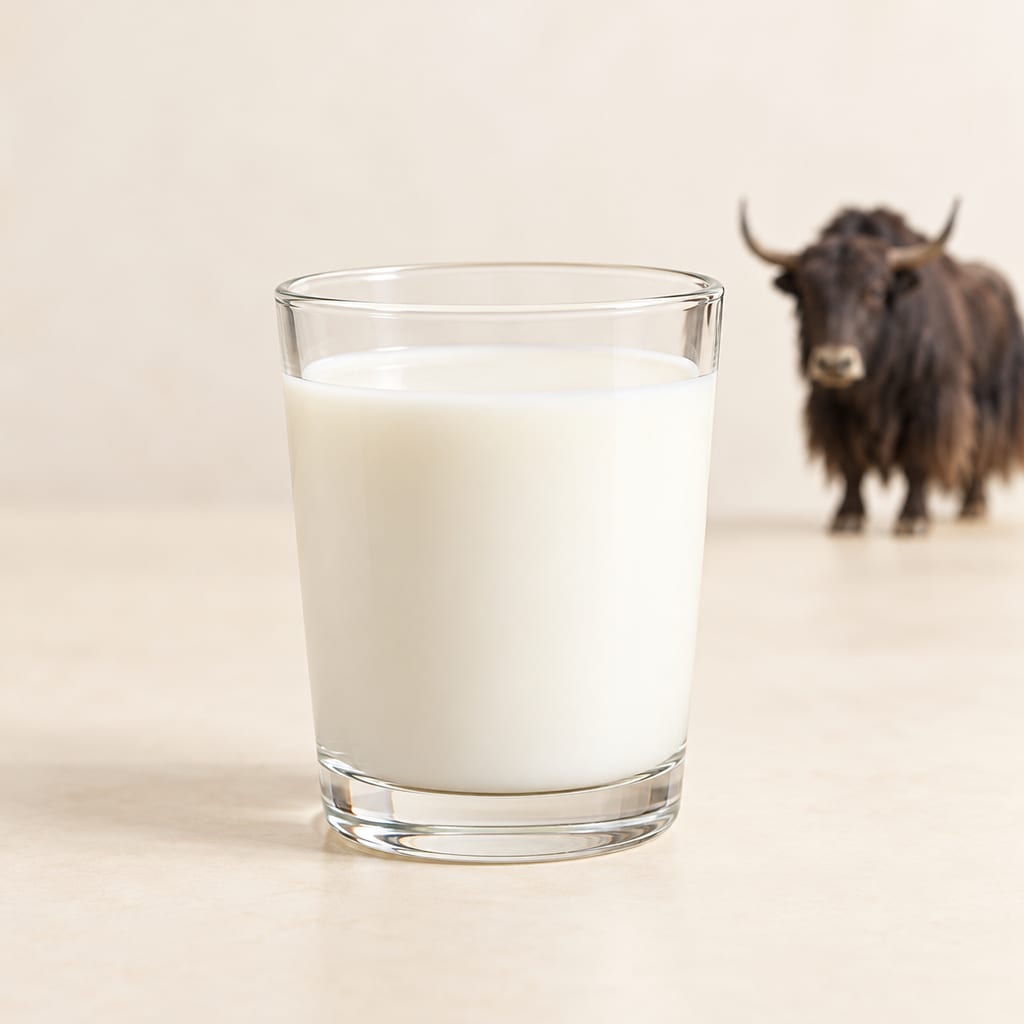
Milk from female domestic yaks is a rich, seasonal ingredient for household tea, butter, curds, and cheeses across highland pastoral systems.
No community contributions have been published for this entry yet.
Sign in to contribute. Published comments and photos are free to read.
Nature Ecology & EvolutionHistory · Geography
Dairy pastoralism sustained Eastern Eurasian Steppe populations for 5000 yearsDental-calculus proteins support horse-milk consumption in Mongolia by about 1200 BCE, but do not identify the drink or its preparation.
Cited in: Consumption and fermented products in the record; Several documented places, no single birthplace
UNESCO Intangible Cultural HeritageTraditional use · Traditional preparation
Traditional technique of making Airag in Khokhuur and its associated customsUNESCO’s 2019 record describes airag as a fermented mare-milk drink made by cooling fresh milk, repeatedly churning it in a cowhide khokhuur and retaining starter. This is not a raw-milk safety protocol.
Cited in: Why processing state matters; Uses and names across regions; Consumption and fermented products in the record; Several documented places, no single birthplace
Silk Road Seattle, University of WashingtonHistory · Traditional use
Rubruck on foodThe 1253–1255 journey describes foals, milking, skin vessels, churning and seasonal use of mare milk as a fermented drink; it is historical evidence, not current instruction.
Cited in: Production depends on the mare and foal; Uses and names across regions; Consumption and fermented products in the record; Cooking and cheesemaking
Journal of Food Science and TechnologyComposition · Production
Arabian mare’s milk characterisation and clotting abilityA Tunisian study sampled 16 Arabian mares over four lactation months and measured composition and clotting under controlled conditions; findings are sample- and protocol-specific.
Cited in: What the name means; Why processing state matters; A variable milk; Measurements describe samples, not every bottle; Production depends on the mare and foal; Several documented places, no single birthplace; Cooking and cheesemaking; Using this entry; What a household method would still need to establish
International Dairy JournalSafety
Microbial quality of raw horse milkIn 123 horse-milk samples from the Netherlands and Belgium, hygiene and faecal indicators varied. Three pathogens were not detected in the survey; challenge tests showed no reduction after one week at 7 °C, and authors advised against raw horse-milk consumption.
Cited in: Raw milk safety; Using this entry; What a household method would still need to establish
Centers for Disease Control and PreventionSafety
Raw MilkCDC states raw milk can carry disease-causing germs, recommends pasteurized milk and identifies groups at higher risk of severe illness; it does not give an equine-milk process schedule.
Cited in: Raw milk safety; Using this entry; What a household method would still need to establish
UNESCO Intangible Cultural HeritageGeography · Traditional use
Traditional spring festive rites of the Kazakh horse breedersUNESCO documents a particular spring rite associated with first koumiss among Kazakh horse breeders; not a universal mare-milking season.
Cited in: Uses and names across regions; Several documented places, no single birthplace