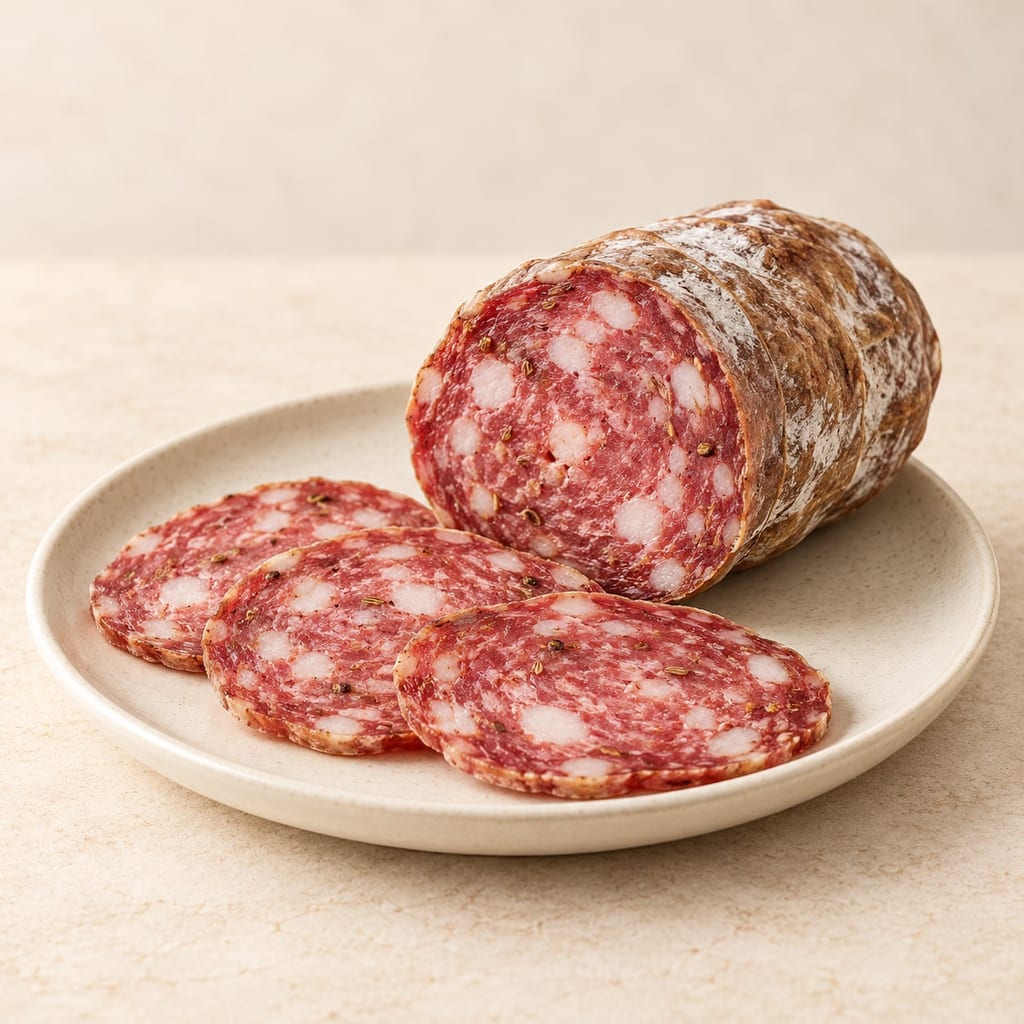
Finocchiona, starter-cultured
A Tuscan-style fennel salami made with pork and back fat. Toasted fennel, fennel pollen and Sambuca flavor this starter-cultured preparation.
 FermenteaWhere food goes to change
Fat or oil
Unrendered subcutaneous pork fat provides distinct pale pieces, texture and lipid flavor precursors in sausage, and differs from belly, leaf fat and rendered lard.
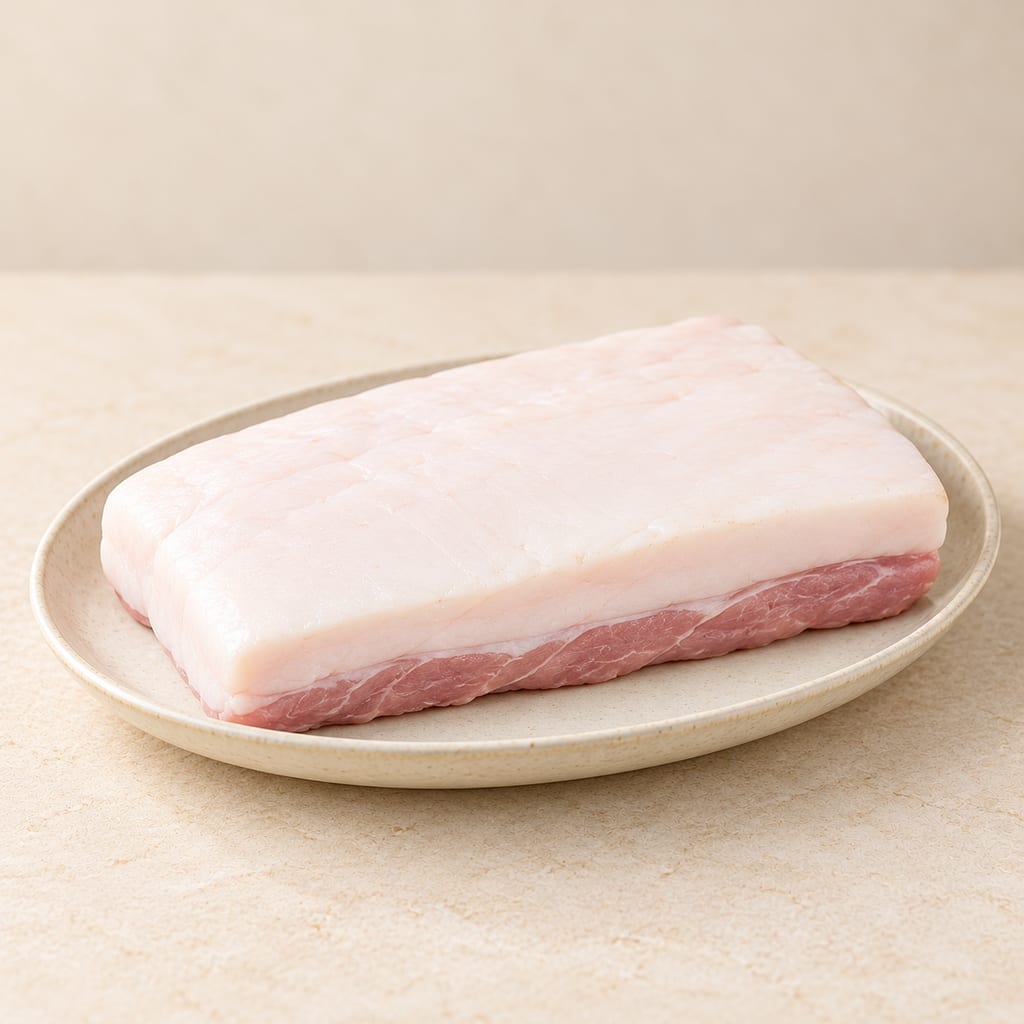
Pork back fat, or fatback, is the layer of fatty tissue beneath the skin along a pig's back. A raw slab is usually predominantly pale fat, sometimes carrying skin or an edge of lean meat according to how it has been cut and trimmed. It is a piece of tissue, not a tub of rendered lard. That difference matters immediately to a sausage maker: back fat can be cut into particles that remain visible in a finished slice.
In a coarse salami, those pale pieces interrupt the denser lean meat. Their size and distribution are part of the food's texture as well as its appearance. The lean fraction provides much of the binding protein framework, while the back fat contributes a softer bite and a lipid fraction involved in flavor development. The mixture depends on their partnership rather than treating fat as an accidental remainder to be removed.
The word fat can otherwise conceal several distinct ingredients. Fat beneath the skin, fat around internal organs, fatty belly and rendered lard do not have identical structures or working properties. A formula that asks specifically for back fat is identifying the raw material it expects the maker to handle. Buying by that identity is more useful than assuming any white pig fat will behave the same way.
Fat is stored in different parts of a pig. It occurs within muscle, between muscles, beneath the skin and around internal organs. Back fat is part of the subcutaneous deposit, while leaf fat is associated with the internal abdominal region around the kidneys. Jowl brings its own combination of fat, muscle and connective tissue; belly carries a recognizable layering of meat and fat.
These anatomical differences matter because fatty tissue contains more than isolated fat molecules. Its supporting tissue helps determine firmness and how it cuts. Technical meat-processing descriptions distinguish firm back fat from softer fatty materials and identify it as a useful component of dry and semidry sausages. The maker is selecting a material that can remain as discrete pieces through chopping, mixing and filling.
Language adds another layer. Italian lardo commonly refers to pig fat taken with its skin from the back and abdominal area, often preserved with salt or smoke. In some Tuscan usage it can also mean rendered fat, while strutto is another name associated with rendered pork fat. A translated ingredient name therefore needs its form alongside it. The material on a butcher's paper, a seasoned cured slab and a spoonable rendered cooking fat are different stages with different uses.
Historical pork cookery did not treat every fat deposit as interchangeable. Mary Randolph's The Virginia Housewife, published in 1824, paired finely chopped pork with leaf fat in its sausage instructions. That choice is especially revealing beside modern dry-sausage methods that call for back fat. The older text shows a cook identifying a particular internal fat, rather than simply asking for an anonymous amount of grease.
Virginia household accounts also describe the wider task of dividing a slaughtered pig into useful foods. Meat could be eaten fresh, salted, pickled or smoked; fat trimmings could be collected for rendering. Different portions went into different preparations, and the work of keeping the animal's products extended well beyond making a sausage. Salt supplies and weather were practical constraints, tied to household provision and trade.
Seasonal butchering concentrated a great deal of perishable material into a short period. The decisions about cuts, fat and preservation were ways of distributing that abundance across later meals. A slab of fat might become a cooking ingredient, part of a sausage mixture or a preserved seasoning material. The historical interest lies in those distinct choices, rather than in assigning all fatback cookery a single birthplace or one universal method.
At Colonnata, near Carrara in Tuscany, dorsal pork fat becomes the protected product Lardo di Colonnata. Its identity includes a particular place and handling tradition: fresh trimmed fat is treated with salt and seasonings and matured in marble basins known locally as conche. Garlic, rosemary and pepper are part of its aromatic setting. The marble is part of the working environment as well as the surrounding landscape.
The product's local history is tied to the quarry workers of Colonnata. A rich preserved food had a place in demanding working lives, while the nearby marble supplied the characteristic containers. The protected specification describes the relationship among local conditions, the basins and a continuing craft of production. This is a particular transformation of dorsal fat, with its own defined origin and method.
It also makes the distinction between ingredient and finished food easy to see. Fresh back fat is the raw tissue. Lardo di Colonnata is a matured, salted and seasoned preparation made under its own requirements. Its soft, aromatic slices have acquired their character through that process. The name cannot be transferred to every raw slab, and its method is not a general instruction for making all pork fat keep at home.
Back fat's usefulness in sausage starts before fermentation. Its connective structure and lipid composition affect how firm it feels and how cleanly it can be cut. Fatty-acid profiles vary with the animal, feeding and anatomical deposit. A back-fat sample and an internal-fat sample can differ even when both come from pigs. A breed name on its own does not describe every physical property of the slab in front of the maker.
A raw piece is therefore selected by its identity and condition as well as by the intended product. The presence of skin, lean tissue or an especially soft section can change the trimming and cutting work required. A supplier's description of fatback should be read as a description of a particular product, with its actual form and handling information.
Temperature changes the working behavior of the material. Chilled fat can retain a firmer structure during cutting, whereas softened fat is more prone to smear. That physical contrast explains why cold handling is emphasized in many sausage methods. The recipe's exact conditions remain attached to its own equipment, particle size and sequence; the ingredient's general firmness is a reason for those instructions, not an alternative schedule.
A grinder is intended to cut meat and fat into particles. When back fat cuts cleanly, the resulting mixture can retain visible pale pieces among the lean meat. Mixing distributes them through a binding matrix formed largely from meat proteins. The finished slice can then hold together while preserving the distinction between its components.
Smearing changes that structure. Softened fat spreads over surfaces rather than remaining only in separate pieces. During filling it can grease the inside of the casing, affecting the passage of moisture. The casing is not simply a wrapper that holds the mixture in place: it is also a boundary through which water must move during drying. A change at that boundary can affect the body enclosed by it.
This is why fat handling matters beyond appearance. A neat mosaic and an evenly filled casing begin with a suitable raw material and controlled cutting and mixing. Smearing is a physical behavior, distinct from the acid production of fermentation. Understanding the difference makes it easier to see why a starter culture, a grinder and a drying chamber each address separate parts of sausage making.
In fermented sausage, lactic acid bacteria consume suitable carbohydrates and produce acids. Back fat is present within that changing environment, but it is not the main fermentable sugar supplied to the culture. The lean meat, added carbohydrate, salt, curing ingredients and cultures establish a system in which the different materials change together.
As moisture leaves, the lean protein-rich matrix becomes firmer around the fat particles. Water must travel from the interior toward the surface before it can escape into the air. Drying too rapidly at the outside can create a resistant layer around a wetter center. The size of the sausage, its casing and the chamber environment consequently matter alongside the composition of the mince.
The fat pieces give a different textural response within that firming body. Their proportion and distribution influence how much lean meat and fat are encountered in a bite. A coarser product displays larger contrasts, while finer cutting distributes the components differently. Those are choices about the food's structure, not grounds for treating a single fat percentage as the definition of all fermented sausages.
Fat supplies material for chemical and enzymatic changes during maturation. Lipolysis releases fatty acids from fats, while subsequent reactions contribute to the developing aroma. Lean meat supplies proteins that can be broken into peptides and amino acids. The finished cured flavor emerges from these changes alongside the original seasoning and the effects of acidification and moisture loss.
Lipid oxidation is another process, distinct from the release of fatty acids by lipolysis. Research comparing fermented sausage systems has measured both and found that raw materials help account for differences between formulations. The balance depends on the fats present and the processing environment. It is more informative to understand those as separate transformations than to call every change in fat fermentation.
This also explains why the ingredient's condition deserves attention before stuffing. Later ripening works on the materials introduced at the start. A different fat deposit or a different distribution of particles changes what is present in the sausage, even when the spice mixture is kept the same. Selecting back fat is therefore a contribution to the eventual texture and aroma, not merely a way to fill the remaining weight of a batch.
A shop may sell fresh fatback, salted fatback, a regional cured lardo or rendered lard. Read the full name and ingredient statement. A raw slab and a preserved seasoning product differ in salt, processing and intended use, while rendered lard has already undergone a transformation that removes the original tissue structure. These distinctions belong on the ingredient line rather than being left to guesswork after purchase.
For sausage, identify whether the fat is skin-on or skinless and how much lean tissue accompanies it. Match the preparation to the formula's instruction, including any trimming required. Keep the supplier's label and handling information with the ingredient, especially when a product is sold frozen or has been salted or seasoned.
Raw fatback remains a perishable animal product requiring appropriate cold handling and separation from ready-to-eat food. A storage interval for a pork chop, ground pork or finished salami should not be silently assigned to it. Follow the information for the actual product and its supplier. Its pale appearance does not show what storage conditions it has experienced.
Fatback also has uses outside fermented sausage. It can contribute richness and flavor to soups, sauces and other cooked dishes, or be rendered into lard for cooking and baking. Salted versions serve as seasoning ingredients, bringing salt as well as fat. The raw product and its preserved or rendered forms consequently enter different parts of a meal.
A cured slab can be sliced to emphasize its softness and aromatic seasoning. In a sausage, back fat appears as particles held within lean meat. In a cooking pot, its contribution may be dispersed through a dish instead. The same anatomical material supports these different textures because the processing changes its form and its relationship with the other ingredients.
Mammalian fat can contain alpha-gal and is relevant to people managing alpha-gal syndrome; individual dietary decisions belong with their healthcare provider. Seasoned products can introduce other ingredients, so their labels also matter. The related recipes show the site's current uses of the raw ingredient, while each preparation retains its own formula and method.
Mammalian fat can contain alpha-gal. Check supplier ingredients and cross-contact information, especially for cured or processed purchases.
Unknown actual sourcing location for the raw fatback in linked recipes; Colonnata is a documented preparation tradition, not a universal supplier origin.
A Tuscan-style fennel salami made with pork and back fat. Toasted fennel, fennel pollen and Sambuca flavor this starter-cultured preparation.
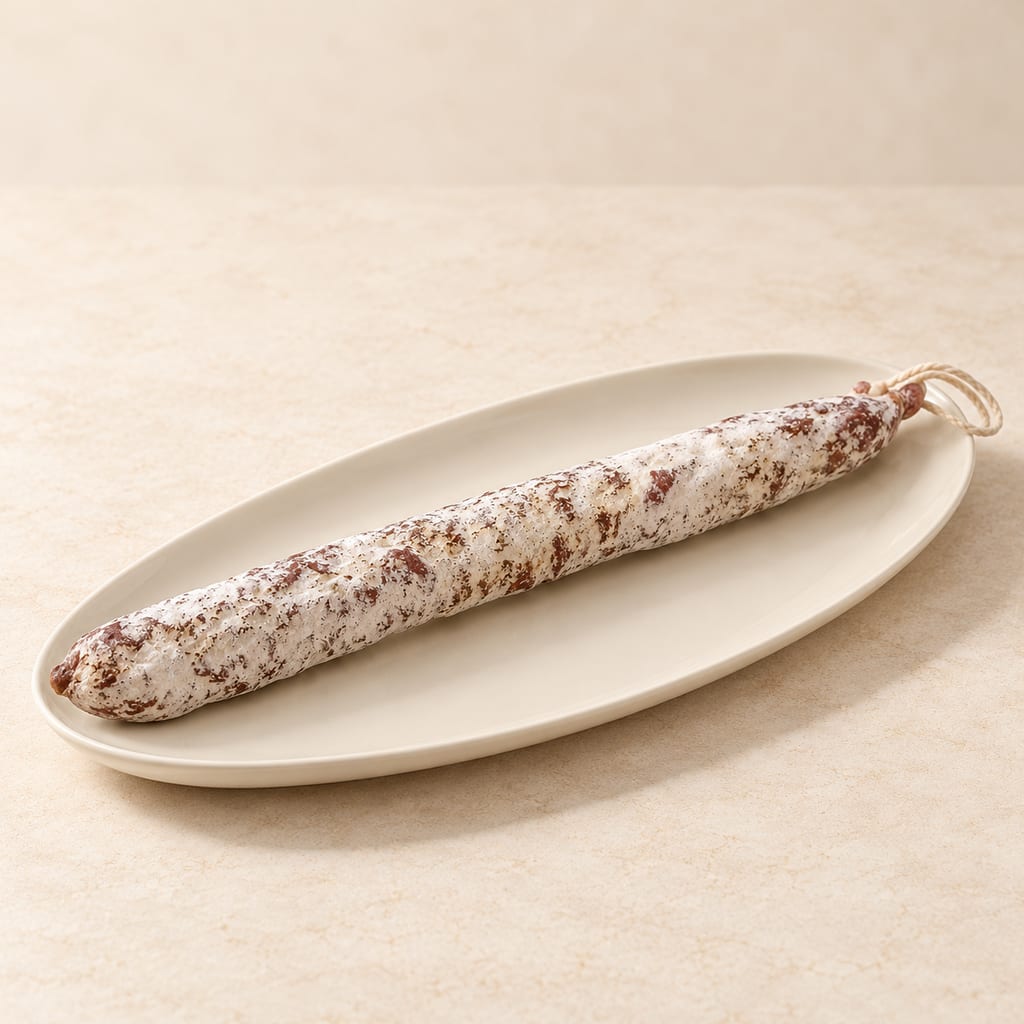
A documentary account of a modern starter-cultured Fuet formula and its place in Catalan sausage culture. The cited raw-pork process lacks matched safety validation, so this page does not present it as a household recipe.
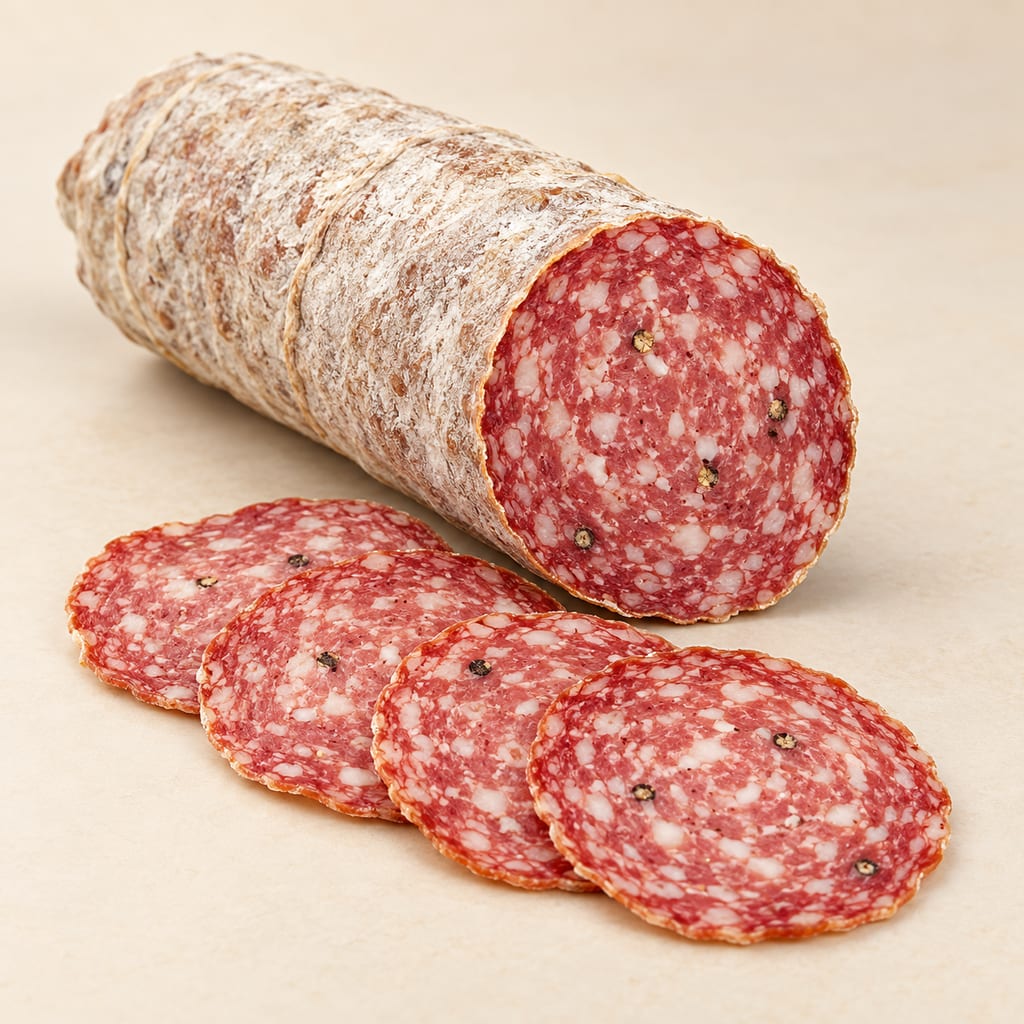
Pork, beef and back fat ferment with a named starter, cure and red wine before the sausages dry in casings. This contemporary formula uses no wood-smoke stage.
No community contributions have been published for this entry yet.
Sign in to contribute. Published comments and photos are free to read.
Food and Agriculture OrganizationIdentity · Science
Meat as raw material, non-meat ingredients and basic techniques in further processing of meatMeat contains muscle proteins, connective tissue and different fat depots. Salt extraction and mixing influence binding; soft fat can smear, and grease on a casing can reduce porosity and moisture migration.
Cited in: A cut with a structure of its own; Several useful fats from one animal; Firmness begins with the material; Pieces, smears and the casing; Fat and lean change together during drying; Ripening is more than concentrating the seasoning; Raw, cured and rendered are different purchases
NCBIIdentity · Science
Sus scrofa domesticus taxonomy recordThe domestic pig is identified as Sus scrofa domesticus, with Sus domesticus also used in taxonomy.
Cited in: A cut with a structure of its own
Centers for Disease Control and PreventionIdentity · Science
Products That May Contain Alpha-galMammalian meat and fat can contain alpha-gal, with individual reactions relevant to dietary choices.
Cited in: Flavor in the pot and in the slice
TreccaniIdentity · Science
LardoLardo is subcutaneous pig fat, distinct from rendered strutto, and is used in cooking and preserved regional preparations.
Cited in: Several useful fats from one animal; Raw, cured and rendered are different purchases
Colonial Williamsburg Foundation / Rosemary BrandauIdentity · Science
The Butchering and Processing of Pork in Eighteenth Century WilliamsburgThe Williamsburg account describes pork division and preserved or rendered fat. It reproduces Mary Randolph’s sausage preparation using leaf fat.
Cited in: A household divided the fat deliberately; Flavor in the pot and in the slice
Italian Ministry of AgricultureIdentity · Science
Lardo di Colonnata IGP production specificationLardo di Colonnata uses dorsal fat preserved in marble vessels with salt, garlic, rosemary and pepper, with a local quarry-worker food tradition.
Cited in: A raw layer becomes a named regional food
AOCS Lipid LibraryIdentity · Science
Animal FatsFat composition and properties differ with animal species, fat depot and feeding.
Cited in: Firmness begins with the material
Meat Science / Zanardi and colleaguesIdentity · Science
Lipolysis and lipid oxidation in fermented sausages depending on different processing conditions and different antioxidantsFree fatty acids and oxidative changes in fermented sausages depend on the raw material and processing conditions.
Cited in: Ripening is more than concentrating the seasoning
Heritage FoodsIdentity · Science
Back FatRaw pork back fat is sold as an unrendered ingredient for sausage and other culinary uses.
Cited in: Raw, cured and rendered are different purchases; Flavor in the pot and in the slice