
Garum intake
Garum and the many worlds of fish sauce
Garum, nước mắm, nam pla and patis share ways of turning fish into a savoury liquid, yet each belongs to its own food culture. This account follows ancient sauces, Asian and Japanese fish sauces, colatura and koji garums.
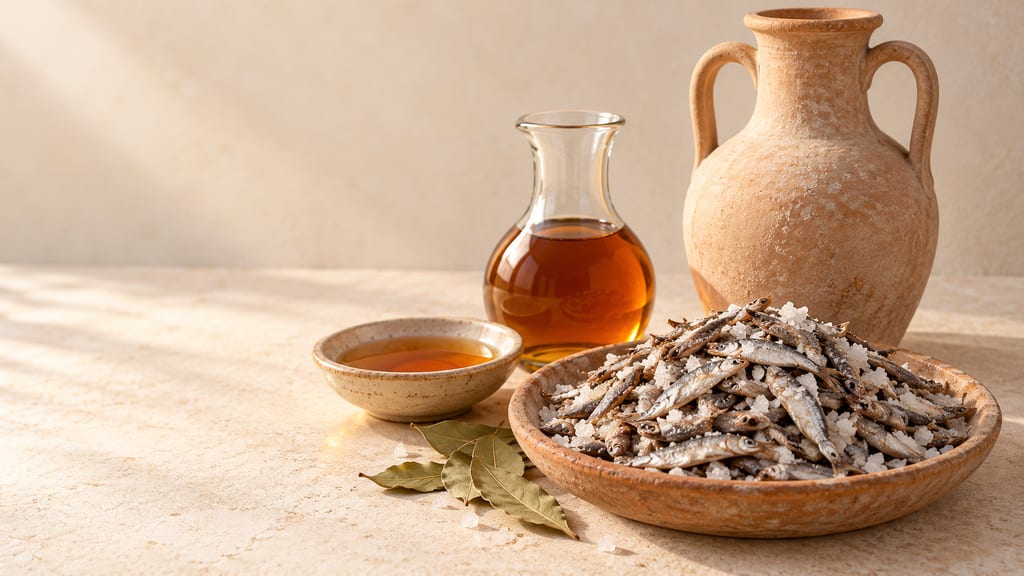
Salted anchovies, a Roman-style amphora and a bowl of clear amber fish sauce: one idea, made around the world.
Introduction
A few drops of fish sauce can give a vegetable broth the savoury depth of a much longer cooking. Ancient Mediterranean cooks knew that usefulness; so do cooks who reach for nước mắm, น้ำปลา or patis. Their sauces share some ways of transforming fish, but each belongs to a particular food culture. Modern mushroom and meat “garums” add another chapter: they borrow an ancient name while often drawing their enzymes from koji.
The story begins with a difficulty hidden by the familiar word. Garum was never a single recipe that travelled unchanged around the world. Even within the ancient Mediterranean, names, ingredients and expectations varied. To understand these sauces, it helps to follow three things together: what went into the vessel, what broke it down, and what the cook did with the liquid that emerged.
A sauce with several ancient names
Greek garos and Latin garum belong to a vocabulary that also includes liquamen, muria and allec, with spelling variants such as allex. These words recur in descriptions of food, medical writing, recipes and labels on containers. They do not always divide the products in the same way. A modern dictionary can make the distinctions look firmer than the surviving evidence allows.
One influential interpretation distinguishes a sauce made chiefly from small whole fish, often called liquamen in Latin, from a prestigious garum made from blood and viscera. It explains important differences in the texts and the simultaneous appearance of the two names on Pompeian labels. But it remains an interpretation, not a universal decoding key. Greek garos could cover several preparations, and authors writing in different periods did not necessarily mean the same thing by garum.
Pliny the Elder gives the reader both a product and a social judgement. In Natural History, book 31, he describes fish intestines and discarded parts worked with salt, then singles out a celebrated mackerel sauce associated with Carthago Spartaria, modern Cartagena. His list extends to other Mediterranean production centres, including Pompeii and Leptis. Fish sauce was geographically differentiated: origin and ingredients could carry a reputation.
Pliny also complicates a neat hierarchy of liquid and waste. Allec appears as the unfiltered residue of sauce-making, but he describes it being made separately and becoming a luxury in its own right. He names oysters, sea urchins and mullet livers among the materials drawn into this pursuit of particular flavours. A residue could therefore be a food with its own value, rather than something whose history ended when the liquid was removed.
Muria generally points towards brine associated with salted fish. That is a useful distinction from a liquid produced through extensive breakdown of fish tissue, though it should not become a claim that every ancient writer used the term consistently. The vocabulary records a market with several products, grades and uses. Translating all of them simply as “rotten fish sauce” throws away much of what the names preserve.
Fishing towns, workshops and a merchant's floor
At Baelo Claudia, beside the Strait of Gibraltar in southern Spain, fish processing occupied a substantial part of the town's working landscape. The surviving installations include masonry vats, preparation areas and storage spaces. Excavated fish bones, cutting traces, fishing equipment and transport vessels place sauce within a larger industry that also produced salted fish. A vat alone cannot tell us precisely which product it held on every occasion.
Production depended on catches, salt, skilled cutting, containers and routes to customers. Large ceramic vessels, or dolia, also served in the fish-processing workshops. Different vessels and work areas could serve different stages; the surviving buildings need to be read alongside their contents, rather than treated as enlarged household recipes. The workshops held much more than isolated jars left in the sun.
Pompeii supplies a more personal view. Mosaics in the house associated with Aulus Umbricius Scaurus depict sauce jars with inscriptions. The labels distinguish garum and liquamen and name the merchant's business. The lettering is part of the picture: the product's identity mattered enough to be worked into a domestic floor. One mosaic at Boscoreale's Antiquarium shows the characteristic small vessel used to sell and transport the sauce.
The evidence is unusually tangible. A name on a jar can identify a merchant; a fish name can identify a claimed ingredient; a word of praise can show how a product was sold. None of those inscriptions measures its salt or proves its precise manufacturing method. Nor does an amphora's shape guarantee that every surviving example carried the same contents. Containers could be reused, while liquid and solid fish products leave different kinds of traces.
That distinction matters when modern researchers recreate ancient sauces. A reconstruction can test whether an interpretation makes practical sense and explore the textures it produces. It cannot recover an ancient taste with certainty merely because its vessel, fish species or written description resembles an archaeological example. The most informative reconstruction states its choices and keeps them visible.
Byzantine garos and the problem of the surviving recipe
The Geoponica, a Byzantine agricultural compilation assembled in the tenth century, preserves earlier material. Its fish-sauce section describes several approaches rather than one standard operation. In one, salted small fish and entrails yield a liquid collected through a basket inserted into the mixture. Another is associated with Bithynia. A cooked preparation uses brine and herbs. A further sauce, haimation, uses tuna viscera, gills, fluid and blood.
These are consequential differences. Cooking fish in brine is not the same transformation as allowing enzymes to break down salted fish over time. Collecting liquid through a basket is a separation step, not the event that creates all its flavour. A sauce centred on viscera starts with a different balance of tissues and enzymes from one centred on whole small fish. Reading the descriptions separately is more revealing than combining them into an invented “authentic Roman” method.
The text is also later than the Pompeian workshops it is often used to explain. It is valuable evidence for a tradition of technical knowledge, but copying an older account does not tell us that every stage remained unchanged. Historical salt measures and phrases such as enough salt leave questions a modern processor cannot settle by enthusiasm or analogy.
Byzantine food vocabulary also remembers sauces mixed with water, wine, vinegar or oil. Names such as oxygaros and oenogaros make the combination part of the identity. Specialised vessels brought sauces to the table, sometimes warm. Preparing such a sauce for a particular dish was a further task after manufacturing the concentrated ingredient. A bottle of base sauce and a finished dressing are different culinary objects.
How fish becomes a liquid seasoning
Fish already contains enzymes: proteins that accelerate chemical reactions. Some help a living fish digest its food; others occur in its tissues. After death, these enzymes can continue acting under suitable conditions. In fish-sauce production, protein-breaking enzymes cut large proteins into smaller peptides and free amino acids. This breakdown is called proteolysis. When a food's own enzymes do the work, the process is described as autolysis.
That helps explain why viscera matter. They are not simply an inexpensive ingredient added for dramatic effect. They can supply digestive enzymes that act on other fish tissue. Whole fish, cleaned flesh and isolated viscera begin with different enzyme supplies as well as different proportions of muscle, fat, skin and bone. Substituting one for another changes the process being discussed.
Salt changes the environment in which this happens. It draws liquid from tissue, affects water availability, selects among microorganisms and changes enzyme activity. Its effect is not captured by saying that it “stops decay.” A salty mixture can still undergo microbial and chemical changes. More salt does not necessarily mean faster protein breakdown, and a ratio copied from one fish preparation cannot define another.
Microorganisms add a second layer. Salt-tolerant bacteria may grow in the mash and contribute acids, enzymes and aroma compounds. Their role depends on the raw material, salt conditions and production history. It is therefore misleading to credit the entire conversion either to living bacteria or to fish enzymes alone. Hydrolysis and microbial metabolism can operate together, without contributing equally at every stage.
Even a microorganism's species name is not enough to predict its behaviour. Fish-sauce research has examined histamine-producing and non-producing strains within the same bacterial species. That distinction is relevant to starter selection and process control; it does not turn a named bacterium into a universal good or bad culture. A list of organisms detected in one sauce is a description of that study's material, not a starter recipe for every fish sauce.
The finished flavour is likewise more than salt plus a single taste molecule. Protein breakdown supplies savoury components, while microbial metabolism and other reactions contribute aroma. Fat composition, extraction and any later heating also affect the result. A clear amber liquid and a cloudy, darker sauce may both be deliberate products. Appearance describes their form; it cannot establish how they were controlled.
Southeast Asia: related techniques, distinct foods
Thailand's nam pla, written น้ำปลา, is a liquid seasoning used both in cooking and at the table. In one established production approach, weights hold the fish beneath brine while the mixture matures. Makers draw off and filter the liquid, extract the remaining material again, and blend extracts to produce different grades. The first liquid and a later extraction therefore need not have the same concentration or flavour.
Nam pla can begin with freshwater, brackish-water or marine fish. Different raw materials and production methods bring different flavours to the bottle; no single fish species or schedule defines them all. For the cook, the important question is what the particular sauce contributes to the dish, including its saltiness, aroma and concentration.
Vietnamese nước mắm also belongs to a varied production landscape. Fish-sauce centres include Phan Thiết, Phú Quốc, Cát Hải and other coastal places. Fish choice can alter the sauce's colour and character. Anchovies are prominent, but regional descriptions also include scad and other fish. Treating all Vietnamese sauce as an identical anchovy liquid misses both household and commercial practice.
In traditional Vietnamese barrel production, packed fish and salt sit under weights, with a low outlet allowing the maker to draw off liquid. Moving and mixing the extracts helps manage concentration and consistency. This is an actively tended food, despite the long periods during which little appears to happen. Drawing liquid off can be part of extraction itself, well before the final bottling.
Phú Quốc has a more specific geographical identity. Its protected product is tied to anchovies, island production and the expertise of barrel houses. The first extraction, nước mắm nhĩ, is distinguished from later extracts, and sauces come in different nitrogen grades. Nitrogen measurements describe aspects of the dissolved fish material; they are not a complete ranking of culinary pleasure and cannot by themselves certify safety.
The European Union registered Phú Quốc as a protected designation of origin in 2012. That date marks legal recognition, not the invention of the sauce. A geographical designation also belongs to a defined product and production area. It should not be expanded into a claim that all Vietnamese fish sauce originates on the island, or that one protected method describes every neighbouring tradition.
In the Philippines, patis and bagoong isda draw attention to the relationship between liquid and paste. Patis is the liquid drained from fermented fish and salt; bagoong isda retains the fish mixture. Bagoong alamang uses small shrimp and belongs to a different ingredient identity. The distinctions matter at the table and for anyone who needs to know whether a condiment contains fish or crustaceans.
These names are not interchangeable stages in a universal recipe. A sauce may be extracted from a paste-making process, but a named paste has its own uses and production choices. Nor should every liquid from fermented seafood be relabelled garum. Kecap ikan in Indonesia and budu in Malaysia and southern Thailand extend the comparison, while retaining their local identities. A shared operation such as salting or filtering is evidence of a technical resemblance, not proof of a single line of descent from Rome.
Japan's fish sauces follow the catch
In Japan, fish sauce is often discussed alongside shōyu, but the raw materials and production histories differ. Shottsuru is associated with Akita. Sailfin sandfish is a familiar ingredient, though the regional tradition also uses other fish. Its place in the kitchen is not adequately explained by calling it a substitute for soy sauce: it brings the character of its own fish ingredients to soups and other dishes.
The Noto region of Ishikawa has ishiri and ishiru, with additional local naming variation. Squid viscera are important in one form; whole sardines and other fish materials appear in others. The distinction makes the relationship between ingredient and process visible. A sauce made from squid innards is not simply a darker version of an anchovy sauce. It begins with another animal and another balance of tissues.
In Noto, these sauces season hotpots, simmered seafood, dipping sauces, pickled vegetables and shellfish dishes. The same concentrated seasoning can enter food during cooking or be diluted for a particular use. Exchange with inland communities carried fish flavour away from the landing place in a convenient liquid form.
The precise origin of these Noto sauces remains uncertain. Their living regional identity does not require a confidently invented founding date. It is enough to recognise the makers, materials and uses that the evidence actually connects to the place.
Cetara's colatura: a Mediterranean comparison
Colatura di alici di Cetara is a clear, strongly savoury liquid from salted anchovies, Engraulis encrasicolus. Its protected identity ties the fishery to the Salerno coast and the processing to the local area. The anchovies are headed and eviscerated by hand before salting.
Wooden vessels matter to this identity. Fish and sea salt are arranged in terzigni or larger barrels, covered with a wooden disc called a tompagno and weighted. The liquid is eventually collected from the matured contents, with a hole in the base of a terzigno providing one documented route. These details describe a particular craft and product, rather than a generic jar of dissolving fish.
The resemblance to ancient liquid seasonings is clear enough to invite comparison. It does not, on its own, prove an uninterrupted recipe transmitted from a Roman workshop to a present-day producer. Colatura has its own materials, vessels and production choices. Its modern specification establishes product identity and traceability; it is not evidence that a similar household mixture follows the same controls.
When the enzymes come from koji
Modern chefs have widened the word garum to include sauces made from meat, mushrooms and plants. In Noma's adaptations, koji supplies enzymes that perform work analogous to that of fish digestive enzymes. That changes the possibilities: the main ingredient no longer has to bring a fish's viscera or its particular enzyme system into the vessel.
Koji is a cultured ingredient, commonly grain grown with a food-production mould such as Aspergillus oryzae. The mould produces enzymes while it grows. In a later sauce-making stage, those enzymes can act on a different ingredient. Making the koji and using its enzymes are therefore separate operations. A warm digestion stage does not imply that the mould is continuing to grow under the same conditions.
The distinction also explains why a mushroom garum is not an ancient fish sauce with one ingredient swapped. Its enzyme supply, composition and treatment may all differ. Roasting, smoking or pressing an ingredient can add further changes before digestion begins. “Garum” on a modern menu may describe the seasoning's culinary role more readily than its microbiology. A helpful description names the main ingredient and the use of koji instead of letting the old word do all the work.
Plant-and-koji sauces may share important features with East Asian grain and legume seasonings. Calling every savoury liquid garum can obscure those relationships. Naming the main ingredient and the source of its enzymes helps a diner understand the preparation, while acknowledging the traditions that explain its method.
A study of Greenlandic rock ptarmigan makes the boundary particularly visible. Researchers compared experimental koji sauces made from meat and from intestines in a project connected to Inuit gastrophagy, the eating of digestive organs and their contents. The sauces differed in microbial profiles and sensory assessments. This was a contemporary research preparation, not evidence of an ancient Greenlandic garum tradition.
The study also illustrates what such work cannot establish. Sequencing microbial DNA is not a demonstration that all detected organisms remain alive, and a sensory assessment is not a food-safety trial. Possible effects on the human gut were questions for further research. Neither a familiar culture nor an interesting microbiome makes a raw animal-protein experiment a validated household method.
Cooking with the finished sauce
Ancient compound sauces help explain the ingredient's versatility. Fish sauce could be combined with wine, vinegar, oil, herbs and spices, rather than poured undiluted over everything. The base supplied salt and savoury depth; the other ingredients shaped acidity, aroma, richness and sweetness. That distinction between concentrated seasoning and finished sauce remains useful in a modern kitchen.
The recipe collection associated with Apicius repeatedly puts liquid seasoning into vegetable preparations. It is a reminder that the flavour need not be reserved for fish. Yet translations require care: older English editions sometimes render liquamen as “broth” or “stock,” hiding its identity, and some vegetable names are uncertain. Reading a translated recipe as an exact modern shopping list can introduce ingredients the ancient text never meant.
With a commercially prepared sauce, begin by understanding the particular bottle. Read the ingredients and any storage instructions. A fish-only sauce, a sweetened seasoning blend and a koji mushroom sauce may perform differently. Their shared brown colour gives little guidance about how much salt or aroma they will add.
For a simple comparison, divide a prepared vegetable soup into two small portions and season one with a little of the finished sauce. Compare the savoury impression, aroma and salt balance. This is a way to learn an ingredient's culinary effect, not a test of whether a homemade ferment is safe. The same approach works when deciding whether a sauce belongs in a dressing or whether it would overwhelm a delicate broth.
The best substitution starts with the desired role. If a dish needs a salty liquid, several products might work; if it depends on the aroma of a particular regional fish sauce, a mushroom analogue changes the dish. Fish and shellfish allergens also remain relevant after a product has become clear liquid. A recipe's label should identify what is present, even when the amount used is small.
What the process evidence cannot promise
Fish sauce has specific hazards, not merely an abstract risk attached to “fermentation.” Some fish can accumulate histamine when bacteria convert the amino acid histidine. Histamine already formed is not removed by ordinary cooking or freezing. Preventing its formation is therefore different from killing bacteria at the end of production.
Botulism requires a separate assessment. Salt, acidity, water availability, temperature and storage conditions interact in controlling toxin formation; none can be borrowed casually from a different product. The fish species and the complete process determine which controls need validation. An ancient account, a restaurant adaptation or a broad regional description cannot establish those controls for a home recipe.
Long maturation is not itself a safety control. Neither a fragrant result nor complete liquefaction proves that a batch has met its necessary controls. Conversely, a sauce's strong characteristic aroma is not a chemical measurement. Quality observations and safety evidence answer different questions.
For a reader who wants to explore the subject through cooking, a properly labelled finished sauce offers access to flavour without reconstructing production from fragments. Anyone developing a new fish or meat sauce needs a process-specific assessment that covers raw-material handling, the complete transformation and storage. Salt concentration, maturation conditions and shelf life depend on that assessment.
Garum's worldwide story is most interesting when its differences remain visible: labelled jars in a Pompeian house, a Vietnamese barrel's outlet, squid viscera in Noto, anchovies beneath a weighted wooden disc in Cetara, and koji carrying enzymes into a new ingredient. They explain several ways of making savoury liquid foods. Their kinship is worth exploring without turning them into a single inherited recipe.
Related
Discussed in this article
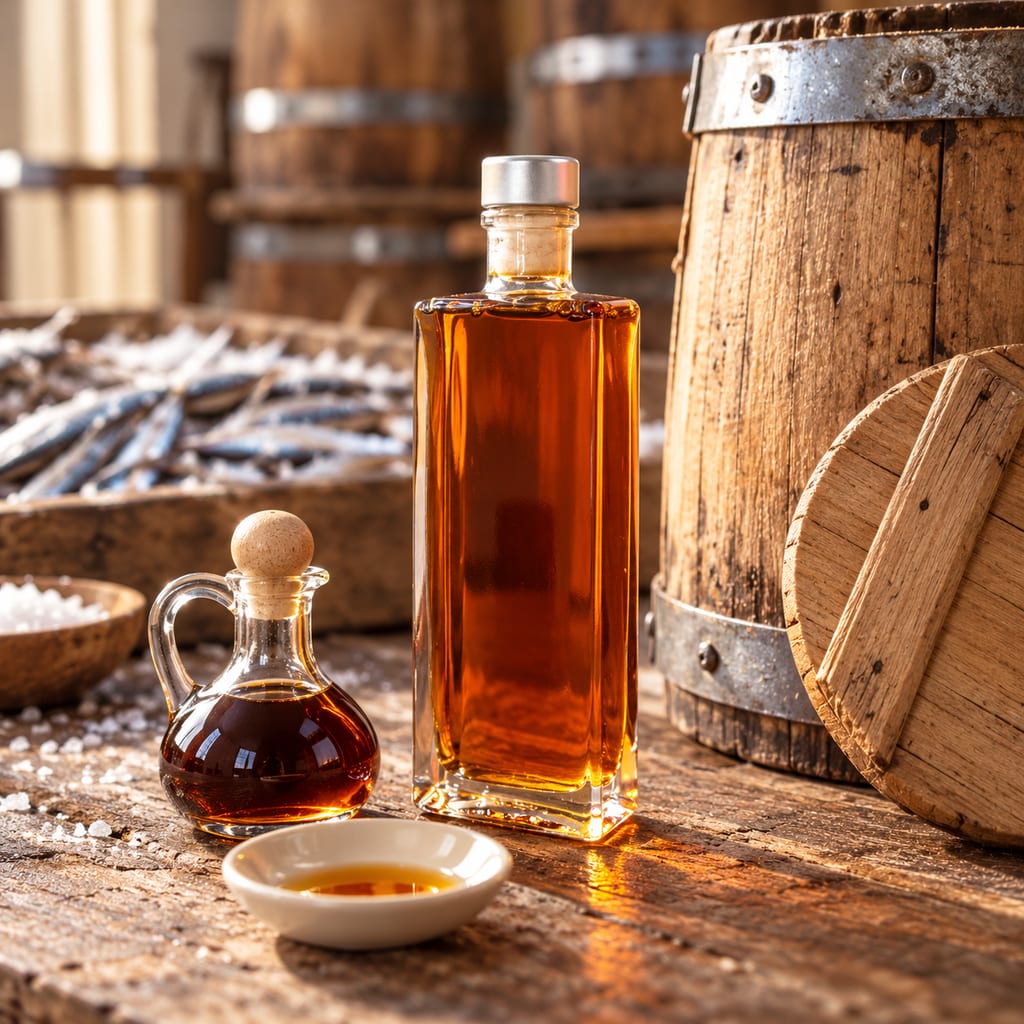
Colatura di alici di Cetara
Colatura di alici is the amber liquid drained from salted anchovies matured in wooden containers in Cetara, on the Amalfi coast of Campania, and sold under a protected designation of origin.
Fish sauce
Fish sauce is a clear, salty seasoning made by maturing fish with salt and drawing off the liquid. The broad family includes distinct regional sauces rather than one interchangeable method.
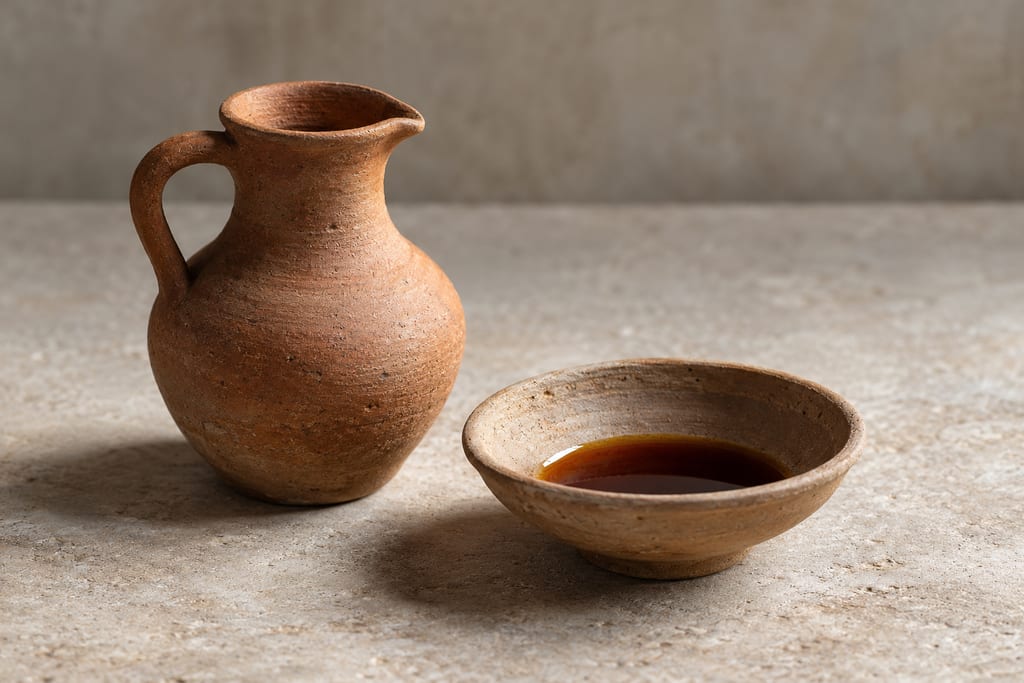
Garum (garos, liquamen)
Garum, Greek garos and Latin liquamen, was the fish sauce of the ancient Mediterranean: fish and viscera salted and left in the sun, then drained off as a savoury liquid.
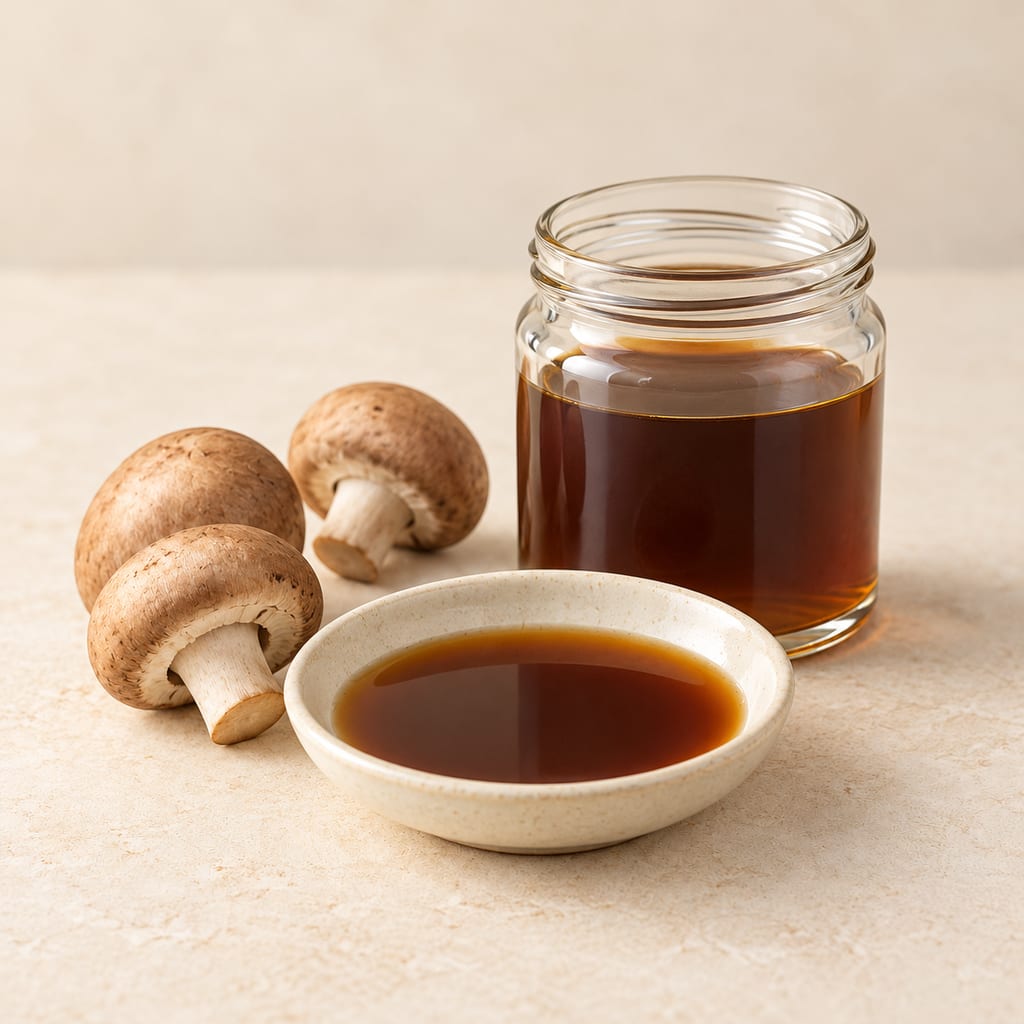
Koji mushroom garum
Mushroom garum turns mushrooms, rice koji, salt and water into a dark savoury seasoning. A sustained warm hold lets koji enzymes break down the mixture before straining.
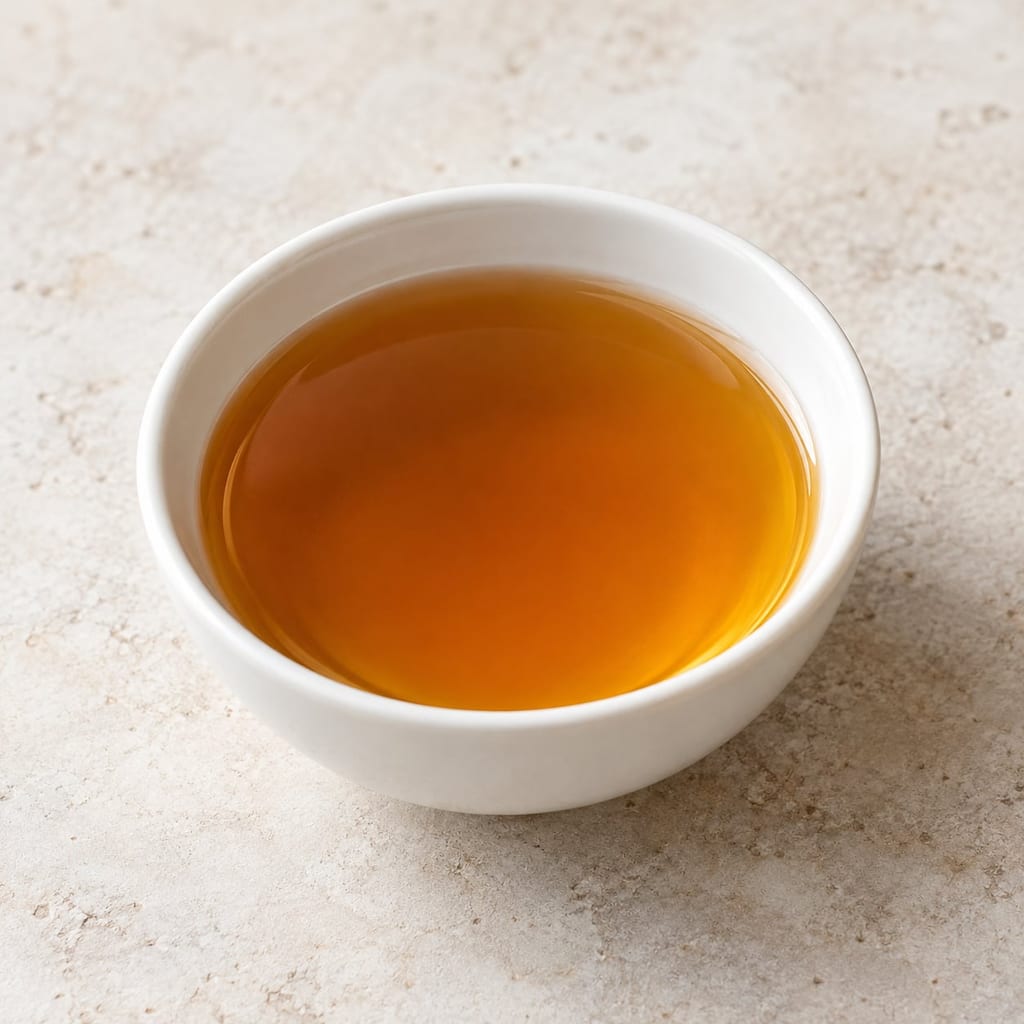
Nam pla
Thai fish sauce is a clear yellow-brown seasoning drawn from salted fish. Tank maturation produces a first extract, with further brine extractions giving other grades.
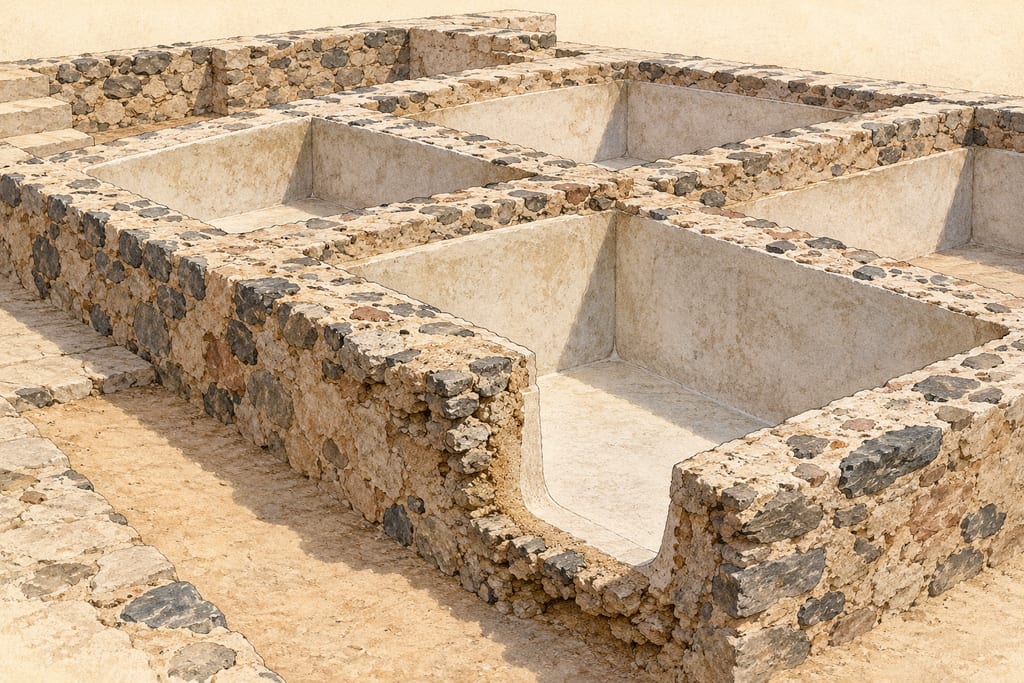
Roman cetaria: masonry fish-salting vats
A cetaria is a fixed masonry basin in a Roman fish-processing installation. Examples at Baelo Claudia, Tróia and Monte Molião show varied forms, not one universal design.
Community
No community contributions have been published for this entry yet.
Share what you made
Sign in to contribute. Published comments and photos are free to read.
Sources
Pliny the Elder; LacusCurtius, hosted by University of Chicago
Naturalis Historia, liber XXXICited in: Introduction; A sauce with several ancient names
Sally Grainger; Journal of Maritime Archaeology / Springer Nature
Garum and Liquamen, What's in a Name?Cited in: A sauce with several ancient names; Fishing towns, workshops and a merchant's floor
Sally Grainger; Routledge
The Story of Garum: Fermented Fish Sauce and Salted Fish in the Ancient WorldCited in: Byzantine garos and the problem of the surviving recipe
Conjunto Arqueológico de Baelo Claudia; University of Cádiz Research Group HVM-440; Conjunto Arqueológico de Baelo Claudia / Google Arts & Culture
The Roman City of Baelo Claudia and the Secrets of GarumCited in: Fishing towns, workshops and a merchant's floor
Parco Archeologico di Pompei; Pompeii Sites
Antiquarium, sala ICited in: Fishing towns, workshops and a merchant's floor
Pompeii in Pictures; photographs individually credited; Pompeii in Pictures
VII.16.15 Pompeii. Casa di Umbricius Scaurus (I) or House of Aulus Umbricius Scaurus, Father and Son (I).Cited in: A sauce with several ancient names; Fishing towns, workshops and a merchant's floor
Athanassions Vionis, researcher/recorder, spelling as displayed; Cyprus Food Museum
GarosCited in: Byzantine garos and the problem of the surviving recipe; Cooking with the finished sauce
Pedro Fernandes; Frontiers in Bioengineering and Biotechnology
Enzymes in Fish and Seafood ProcessingCited in: How fish becomes a liquid seasoning
Meiko Kimura et al.; Nippon Suisan Gakkaishi / Japanese Society of Fisheries Science
Isolation and identification of the causative bacterium of histamine accumulation during fish sauce fermentation and the suppression effect of inoculation with starter culture of lactic acid bacterium on the histamine accumulation in fish sauce processingCited in: How fish becomes a liquid seasoning
Japan International Research Center for Agricultural Sciences; JIRCAS, Database of Fermented Foods of Thailand
Nam-plaaCited in: Introduction; Southeast Asia: related techniques, distinct foods; Cooking with the finished sauce
Le Hai Dang; ICH Courier / ICHCAP; author affiliated with VICAS
Nước Mắm (Nuoc Mam): A Savory Depth of Flavor in Vietnamese Culinary LifeCited in: Introduction; Southeast Asia: related techniques, distinct foods; Cooking with the finished sauce
Intellectual Property Office of Vietnam; IP Vietnam
Phú Quốc extract of fishCited in: Southeast Asia: related techniques, distinct foods
European Commission; Official Journal of the European Union / EUR-Lex
Commission Implementing Regulation (EU) No 928/2012 of 8 October 2012 entering a name in the register of protected designations of origin and protected geographical indications (Phú Quốc (PDO))Cited in: Southeast Asia: related techniques, distinct foods
Ng Mui Chng and Hooi Kok Kuang, compilers; SEAFDEC Marine Fisheries Research Department
Southeast Asian Fish ProductsCited in: Introduction; Southeast Asia: related techniques, distinct foods
Ministry of Agriculture, Forestry and Fisheries, Japan; MAFF, Traditional Foods in Japan
Fishery fermented foodCited in: Japan's fish sauces follow the catch
Ministry of Agriculture, Forestry and Fisheries, Japan; MAFF, Traditional Foods in Japan
Ishiri / IshiruCited in: Japan's fish sauces follow the catch; Cooking with the finished sauce
Italian Ministry of Agriculture, Food Sovereignty and Forestry; Gazzetta Ufficiale; Regione Campania host
Disciplinare di produzione della denominazione di origine protetta «Colatura di alici di Cetara»Cited in: Cetara's colatura: a Mediterranean comparison
Eliot Beeby and Josh Evans; Sustainable Food Innovation Group
What's in a name?Cited in: When the enzymes come from koji
Mads Bjørn Bjørnsen et al.; PLOS ONE
Microbiota in the ptarmigan intestine—An Inuit delicacy and its potential in popular cuisineCited in: When the enzymes come from koji; What the process evidence cannot promise
Apicius collection; translated by Joseph Dommers Vehling; transcription and notes by Bill Thayer; Walter M. Hill, 1936; LacusCurtius
De re coquinariaCited in: Cooking with the finished sauce
U.S. Food and Drug Administration; FDA
Fish and Fishery Products Hazards and Controls GuidanceCited in: How fish becomes a liquid seasoning; Cooking with the finished sauce; What the process evidence cannot promise
Chau Minh Le et al.; Food Technology and Biotechnology
Proteolysis of Sardine (Sardina pilchardus) and Anchovy (Stolephorus commersonii) by Commercial Enzymes in Saline SolutionsCited in: How fish becomes a liquid seasoning; When the enzymes come from koji; What the process evidence cannot promise
Gaps
- This comparison is not exhaustive. Korean aekjeot and jeotgal, Chinese yulu, Cambodian sauces, Myanmar ngapi-derived liquids and further African traditions are not covered here.
Updated 2026-10-27