
Home equipment crafts
A slow cooker as a small dairy
A slow cooker can heat milk for mozzarella, paneer, ricotta, mascarpone, quark and yogurt, but its heavy crock keeps heating after it is switched off. This is what each fresh cheese needs from it.
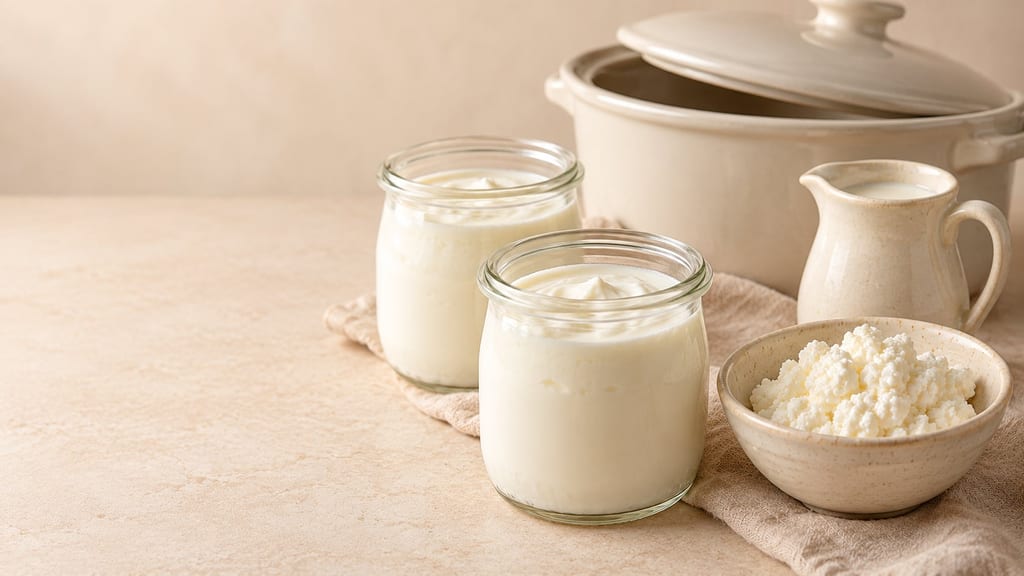
Yoghurt set in jars and fresh ricotta: dairy foods that depend on holding milk at the right warmth for the right time.
Six fresh dairy foods that begin with warm milk
Fresh cheese is milk turned into curd and eaten within days, without the weeks of ripening that a hard cheese needs. Charles O'Connor's 1993 cheesemaking manual for the International Livestock Centre for Africa reduces a cheese meant for prompt eating to four steps: heat the milk, coagulate it, break the coagulum, and separate the curds from the whey. A slow cooker helps with only the first, and whether that help is useful depends on what the next step needs.
The foods differ in how they set. Paneer, the pressed fresh cheese of South Asian cooking, is milk heated close to 90 °C and curdled with dilute acid. Jim Wallace's paneer recipe for New England Cheesemaking Supply notes that buffalo milk was the traditional choice and that whole cow's milk of 3 to 4.5 percent fat is what most cooks use today. Whole-milk ricotta works the same way, with heat and acid together. Wallace treats it as a separate product from whey ricotta, made by reheating the fresh whey left after a cultured cheese, and O'Connor describes the Italian ricotta of his day as made from skimmed milk and whey precipitated with vinegar or citric acid. Mascarpone, the cream cheese of northern Italy, sets cream rather than milk, again with heat and acid, and its traditional apparatus is the double boiler.
Quark is a different kind of cheese. Bacteria sour the milk slowly at room temperature until it sets, and the soft curd is hung to drain. A food-science chapter by S. Drusch and U. Einhorn-Stoll calls it a traditional German fresh cheese. Wallace's quark recipe states the difference from yogurt in one line: quark relies on Lactococcus lactis, which works at lower temperatures, while yogurt bacteria work warmer.
Mozzarella is a stretched curd. In its traditional form the stretch depends on acid that a culture builds over hours; O'Connor's recipe for scamorza, a related stretched cheese, keeps the cut curd warm in its whey until a piece dipped in water at 80–85 °C pulls into an elastic string about a metre long. Quick mozzarella gets its acid another way: citric acid goes into the cold milk before the rennet. It is a modern shortcut, not a copy of any regional cheese.
Yogurt completes the set: one published slow-cooker method makes it with nothing but the crock's own cooling, and the article One bath, many small jars covers the other appliances that can incubate it.
How milk becomes curd: acid, heat and rennet
Milk protein comes in two families. Of the roughly 32 grams of protein in a litre of cow's milk, about 26 grams are caseins, held in suspension as micelles, tiny clusters that form in the presence of calcium. The remaining 6 grams are whey proteins, mainly β-lactoglobulin and α-lactalbumin. O'Connor's 1995 training manual Rural Dairy Technology gives the dividing line: caseins precipitate when milk is acidified to pH 4.6 at temperatures above 20 °C, while whey proteins stay dissolved. Most whey proteins, however, become less soluble once milk is heated.
That chemistry explains three of the cheeses here. Paneer, whole-milk ricotta and mascarpone heat the milk or cream first and add acid afterwards. The heat changes the whey proteins; the acid pulls the casein out of suspension, and the curd forms within seconds or minutes rather than hours.
Rennet takes a different route. The enzyme cuts the κ-casein fraction of the micelles, and with calcium present the casein then sets into a gel. A rennet gel is fragile while it forms, which is why a cook who has been stirring milk in a crock must stop during the set.
Cultures acidify milk from within. Lactic acid bacteria ferment the milk sugar, lactose, into lactic acid, and as the pH falls toward 4.6 the casein sets into a soft, even gel with no acid added. Each culture has its own working range. The University of Alaska Fairbanks extension guide to yogurt, by Julie Cascio and Roxie Rodgers Dinstel, says its yogurt bacteria, Streptococcus thermophilus and Lactobacillus bulgaricus, "can be killed at temperatures above 54 °C and will not grow well below 37 °C", and it incubates at 43 °C. Quark's lactococci work at room temperature. A heater set for yogurt is the wrong place for quark.
The milk matters as much as the heater. Penn State Extension's home cheesemaking guide by Kerry Kaylegian says ordinary pasteurised milk works for cheese, but that ultra-pasteurised and UHT milk "have higher heat treatments that interfere with the ability of the proteins to coagulate into curds" and should not be used. It does not recommend raw milk for home cheesemaking at all. The UHT warning concerns cheese curd; it is not a rule for every cultured dairy food. Yogurt is a different process, and Miele's yogurt recipe allows UHT milk in place of its heating step, though it says heating gives a better texture.
What a slow cooker actually does
A slow cooker is a heating base, a removable stoneware crock and a lid. Crock-Pot's instructions for its 3.5-litre SCV400RD model show how little the user controls. A selector chooses High or Low, which the manual calls cooking temperatures without printing a number for either. A Warm position is "ONLY for keeping food that has already been cooked warm"; the manual says not to cook on it and not to use it for more than four hours. Crock-Pot's manual for its SCCPVL500FB cooker draws the same line: WARM is a holding function for food that is already cooked, with limits specific to the model, and not a general thermostat for fermentation. The dial chooses a heating level. It does not hold milk at a temperature the cook has chosen, and the label Low or Warm says nothing about how hot the milk will get.
The crock decides how the milk heats. Heat passes from the element through a thick ceramic wall, so the milk against the wall runs hotter than the milk in the middle until it is stirred. The ceramic also stores a great deal of heat. When the base is switched off, or the crock is lifted out of it, the hot wall goes on passing heat into the milk for some time, and a lid or a towel slows the loss further. That stored heat is a nuisance when a recipe needs the temperature to stop rising at a mark, and an asset when a recipe needs warmth to fade slowly over hours. Both cases appear below.
The same manual sets limits that any dairy experiment has to respect. Food goes only in the removable bowl, never directly in the base, and the base must never be immersed in water. The crock should be filled between half and three-quarters full, and the stoneware "will not withstand sudden temperature changes". Other makers and models differ; the manual of the cooker in use is the one to follow.
The two documented dairy uses below both heat on High and stop by lifting the crock out or switching off. Neither relies on Low or Warm.
Kathy Love's mozzarella: heat on High, lift the crock to stop
The clearest record of a slow cooker used as a cheese vat is a photographed demonstration by Kathy Love of Tucson, Arizona, published by New England Cheesemaking Supply. She made quick mozzarella from pasteurised, homogenised whole milk, citric acid, double-strength liquid vegetable rennet and cheese salt. Her quantities belong to the company's separate 30-minute mozzarella recipe.
Her setup solves the measuring problem first: she removed the handle from the lid, pushed a thermometer probe through the opening into the milk and taped the wire down.
The citric acid, diluted in cool non-chlorinated water, goes into the crock first, and the milk is stirred in straight after. The cooker heats on High to 35 °C. At that point she lifted the inner pot out of the heating base, stirred in the diluted rennet with an up-and-down motion for about 30 seconds, covered the pot and left it untouched for 15 minutes. She cut the curd in a checkerboard pattern, put the pot back in the base on High and heated the curds to 41 °C while stirring slowly. At 41 °C she lifted the pot out again and kept stirring slowly for two to five minutes, the full five for a firmer cheese. The curds drained in a colander lined with a flour-sack towel. The stretching happened away from the cooker: the curd was microwaved for one minute, drained and kneaded with gloved hands, then microwaved twice more for 35 seconds each, with cheese salt worked in after the last heating before the final stretch.
Each move matches a need described above. The acid goes in before the rennet, which is the point of the quick method: the milk already carries the acid that O'Connor's scamorza waits hours for a culture to build. Lifting the crock out at 35 °C removes the heat for the rennet set, when the gel must not be disturbed. Lifting it again at 41 °C stops the active heating, though the warm ceramic keeps giving up heat while the curds are stirred.
That marks the limit of what the demonstration proves. One cook, with one cooker and one batch, reached her temperatures by watching a probe and moving the crock. It does not show that the crock stops at 41 °C, or that another cooker heats the same milk at the same rate. Anyone repeating it should log the milk temperature every few minutes after each lift.
Turning the crock into a water jacket
A gentler arrangement puts water in the crock and the milk in a smaller stainless pot standing in that water. It has not been tried on a slow cooker, but each part of it has a precedent in cheesemaking. Wallace's Cheddar recipe calls a water bath, a pot set in the sink, "the most stable way" to bring milk up to temperature. O'Connor's scamorza instructions are illustrated with milk heated indirectly in its cheese container. Wallace's mascarpone sets a metal bowl over a pot holding 2–3 inches of water.
The water keeps milk off the hot ceramic wall, spreads heat around the whole pot, and lets the cook stop the heating by lifting the pot out, leaving most of the stored heat behind. The cost is speed: the milk gains heat only from the water, and the water only from the crock.
Two physical limits follow. Milk in a water bath cannot get hotter than the water around it, and it approaches the water's temperature more and more slowly as the gap closes. A bath that only just reaches 90 °C will not bring paneer milk to 90 °C in any useful time; the bath has to run hotter than the target, and the milk has to be lifted out when it arrives. The second limit is mechanical. The inner pot must sit on a rack or hang by its rim, so that it cannot float, tip when stirred, or rise as whey is ladled out, with its rim above the water and water reaching its sides and base.
Crock-Pot's rules still apply: water in the stoneware, never in the base, within the fill range, and no cold water into a hot crock. Circulator makers also keep food out of the bath water. Anova specifies that its Precision Cooker runs in water only, and Breville's HydroPro instructions say the circulator "is intended for use with water only" and that food must be in a bag or container separated from the water. A circulator bath with an open inner pot is the more controllable version of this idea, and the article One bath, many small jars describes it; the article Cheese in the brewhouse describes a brewing kettle used the same way at a larger scale.
A first trial should use water in both vessels, a probe in each, logging both temperatures on High, after switching off and after lifting the pot out. That shows lag and overshoot. It says nothing about curd yield or texture, which only a real batch of milk can show, and the trial has to use the intended batch size: a half-litre test will not predict a five-litre batch.
Paneer, ricotta and mascarpone: heat first, then acid
Wallace's paneer begins with one gallon of the freshest milk available, heated to 85–90 °C with slow stirring and held there for about 20 to 30 minutes. The milk then cools to 77 °C. One teaspoon of citric acid dissolved in 16 ounces of water, "a very diluted acid of about 2%", is added slowly with gentle stirring until white curd separates from yellow-green whey. Stirring stops as soon as the separation shows, and the pot sits quiet for 20 minutes. The curd drains for 30 minutes in a colander lined with butter muslin, and the tied cloth is pressed for 10 to 15 minutes under a plate and a pot holding one to two gallons of warm water; weight and time decide how dry it becomes. The recipe warns that skim milk gives a chewy, rubbery cheese. Fresh paneer, it says, should be used within a few days: four to seven days in the fridge unsalted, or ten days to two weeks lightly salted at 2 percent and packed airtight. Its lactose feeds any bacteria that reach it after making.
For a slow cooker the hard part is the first step. Bringing a gallon of milk to 85–90 °C and holding it there is a heating job at the top of what a crock is built for, and no slow cooker has yet been shown doing it. The untested route is milk directly in the crock on High, with a probe in the milk and steady stirring so that no milk sits against the hot wall. Stored heat matters less here than for mozzarella, because the recipe cools the milk to 77 °C before the acid anyway, and a water jacket suits paneer badly, since its water would have to run hotter than 90 °C. A trial should record the time to 85 °C, any milk solids stuck to the crock, and the time the cooling to 77 °C takes.
Ricotta from whole milk has a documented water-bath route. Anova's recipe platform carries a whipped ricotta by Emily Farris and Jeff Akin: 2 quarts of whole milk and 6 tablespoons of white wine vinegar sealed in a large zipper-lock bag and cooked for one hour in a circulator bath set to 78 °C. The curds are skimmed into a cheesecloth-lined strainer, drained for at least 10 minutes, and whipped with olive oil and salt; it keeps in the fridge for up to a week. Wallace's stovetop version uses 2 teaspoons of citric acid per gallon and heats the milk to 88–91 °C while stirring, looking for flakes of curd at 74–77 °C as the sign that the acid dose is right. His whey ricotta is the separate product: fresh whey from a cultured cheese, heated without stirring to 85 °C. A slow cooker could replace the circulator in the bag method only if its water held a known temperature.
Mascarpone already uses a water jacket. In Wallace's tartaric-acid method a metal bowl over a pot with 2–3 inches of water warms a pint of whole milk and a pint of heavy cream slowly to 85–88 °C. After a five-minute hold, a quarter teaspoon of tartaric acid dissolved in 2–3 tablespoons of water is stirred in gently, and the curd forms almost at once. The mixture cools for 20 to 30 minutes and drains in butter muslin for one to two hours for a traditional texture, or up to 12 hours in the fridge for a whipped one. It keeps 7 to 10 days. A slow-cooker water jacket or a circulator bath would replace the pot of simmering water, with the same target in the cream and a bath running above it. Wallace's cultured mascarpone, set with a crème fraîche culture at 20–23 °C for 10 to 12 hours, is a culturing job instead, and the article Cream four ways deals with cultured cream.
Quark: warmth at the start, then less of it
Wallace's quark hardly heats the milk at all. A gallon is warmed slowly, with stirring, to 30 °C. The culture is sprinkled on the surface, left about two minutes to rehydrate and stirred in. The recipe offers several: mesophilic lactococcus cultures, fromage-blanc and chèvre cultures that already contain powdered rennet, crème fraîche and buttermilk cultures, and rennet-free cultures that then take one to three drops of single-strength liquid rennet per gallon. The milk sits covered and quiet for 12 to 24 hours while the culture makes acid, and during that time the temperature "should be allowed to slowly drop to 68-71F" (20–22 °C). A thin layer of whey on top, a clean break with a knife and a taste tell the cook it is ready. The curd hangs in butter muslin for another 12 to 24 hours at 20–22 °C and keeps 7 to 10 days in the fridge.
The slow cooker's part in quark is the first warm-up and nothing more, and its stored heat could work against the method afterwards. A crock wrapped and left on a warm base, or set to Warm, would keep the milk warmer than the recipe intends, and a setting built for yogurt, which the Alaska guide incubates at 43 °C, would hold it on the wrong side of the line between lactococci and yogurt bacteria. The untested use is to warm the milk to 30 °C, switch off, move the milk out if the crock is still giving off heat, and let the room take over, with a probe in the milk to record how fast it falls against the recipe's 20–22 °C. In a cold kitchen a warm crock might help by slowing the fall. That too needs a measured trial. The same caution applies beyond quark: a yogurt programme should not be assumed to suit room-temperature cultures such as Scandinavian cultured milks; each mesophilic culture has its own range, and none has yet been matched to a particular heater.
A related but separate recipe, O'Connor's lactic curd cheese, heats milk to about 85 °C, cools it to 24 °C, adds 3 to 4 percent starter and sets in three to four hours. The gap between the two shows how far fresh cultured cheeses vary.
Yogurt from a crock that is cooling down
The Good Food team's slow-cooker bio yogurt, published by BBC Good Food Middle East, uses the cooker's heat once and its stored warmth after that. Two litres of whole milk heat in the covered cooker on High until they reach 82 °C, which takes a couple of hours. The cooker is switched off and the milk left to drop to 43 °C over a further two to three hours. A mugful of the warm milk is mixed with 100 ml of live yogurt, poured back and stirred well. The cooker is covered, wrapped in a big towel and left undisturbed for 9 to 12 hours until the yogurt sets. It keeps in the fridge for up to two weeks, and straining it through muslin makes it thicker.
Heating the milk hard does more than kill unwanted organisms. O'Connor's 1995 manual says heating milk for fermented products also drives out air and denatures the whey proteins, "which increases the viscosity of the product". The Alaska extension guide holds its milk at 85 °C, or up to 93 °C for a firmer yogurt, for 10 to 20 minutes, and warns that this does not replace pasteurisation of raw milk. Cooling protects the culture: starter added to milk above 46 °C can be killed. The Good Food method meets both needs with the crock's own cooling curve.
What the method does not give is the yogurt's temperature during those nine to twelve hours, and the cooling will differ between cookers, kitchens and towels. The extension guide incubates for four to seven hours at 43 °C, plus or minus 3 °C, and treats a firm set at pH 4.6 as the sign of the right acidity. A probe left in one batch would show whether a particular crock stays near that range or drifts below it. The recipe wraps a cooker that is no longer heating, which is a different strategy from leaving Low or Warm running for the whole incubation; that has no known temperature, and Crock-Pot's manuals reserve Warm for holding cooked food. An energised cooker should not be wrapped or insulated contrary to its instructions.
Other appliances perform the same stages with more control. Instant Pot's UK recipe heats a litre of milk on the Yoghurt programme's boil setting to about 83 °C, cools it in a sink of cold water to about 43 °C and incubates on the Yoghurt programme for eight hours, without pressure. A contributor recipe on Anova's blog, by Justin Borecky, incubates sealed 4-ounce jars in a 43 °C bath for 12 hours. Miele's Australian recipe uses a covered steam container in a steam oven at 40 °C for five to eight hours and says yogurt "cannot be made using temperatures over 45 °C"; Miele's operating instructions for its steam ovens also list proofing among the low-temperature uses. The article One bath, many small jars compares these routes side by side. Whichever appliance is used, the starter and its own instructions decide the conditions: dahi and other regional cultured milks are not interchangeable with one another or with a generic yogurt.
Strained yogurt is the simplest next product. Instant Pot's recipe drains chilled yogurt in a muslin-lined sieve kept in the fridge, about two hours for a thick yogurt and four hours or more for a firmer one. Labneh belongs to this family, but its salt and final texture need a recipe of their own.
Dulce de leche: a reduction the slow cooker does not yet fit
Dulce de leche, milk and sugar cooked down to a thick brown spread that is especially popular in South America, looks like a natural slow-cooker job. Its process says otherwise. Zerrin Yüksel Önür, in a 2018 study of commercial samples for the Turkish journal Gıda, describes milk and sucrose concentrated by boiling at atmospheric pressure to about 70 percent solids, with sodium bicarbonate added to keep the casein from curdling and to favour the Maillard reaction between sugars and milk proteins that gives the colour and flavour. Open kettles are the traditional and most widely used equipment. The one sample made for the study, from sheep's milk, was boiled for about 120 minutes with constant stirring by hand.
Evaporation and boiling are what a slow cooker is built to avoid; it keeps moisture in under its lid. Oregon State University Extension's fruit-butter guide by Nellie Oehler, which does use a slow cooker on Low for about 8 to 10 hours, has to tell the cook to keep the lid ajar "so the moisture can evaporate" and to stir against scorching. Fruit butter is not milk, and the guide's numbers do not transfer. For dulce de leche and the cajeta-style milk concentrates of Latin America, the design requirements are evaporation and browning. The candidate routes are an open slow cooker or a stirred multicooker for the long reduction, with stirring as needed, and separate controlled trials in sealed bags to study the browning on its own. None of these routes has been tried yet; a trial would measure how much water an open crock removes, how far the milk browns and whether it scorches. Pressure-cooking an unopened can of condensed milk is not a substitute and has no tested method. The article Fruit extraction and concentration takes up the fruit side of the question.
What the crock cannot do
A slow cooker heats. It cannot cool milk on cue, read the milk's temperature, hold the narrow range a culture wants, or tell when a curd is ready. Every temperature for these foods belongs to a named recipe. The appliance supplies heat; the probe, the cook and the recipe supply the control.
It changes nothing about safety. Raw milk does not become safe because it spent time in a crock. The Alaska guide tells cooks to pasteurise raw milk first or use commercially pasteurised milk, and to throw away yogurt that fails to set or smells of anything other than fresh acid; Penn State does not recommend raw milk for home cheesemaking. Storage limits stay with each recipe, and a fresh cheese that looks, smells and tastes fine has not thereby been shown to be safe.
The record that makes a result repeatable is short: cooker model and crock size, milk type and volume, the setting used, milk temperature against time with the probe position noted, when the crock was lifted or switched off, how long the curd took to form, the drained weight and the texture. A recipe built on such a record should say which cooker and batch size it was tried with, and claim no more.
Related
Discussed in this article
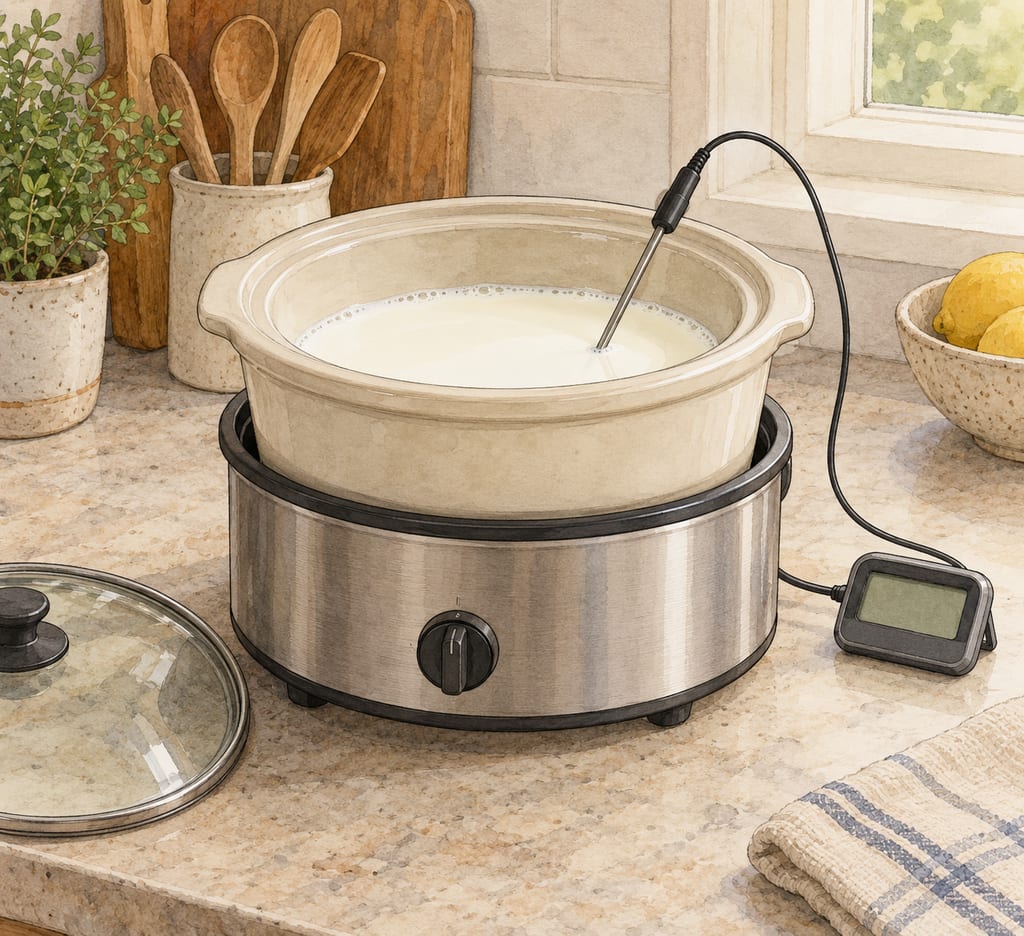
Direct milk in a slow cooker
Milk heated directly in the removable crock with a probe in it; the cook stops the heating by lifting the crock out of the base or switching off.
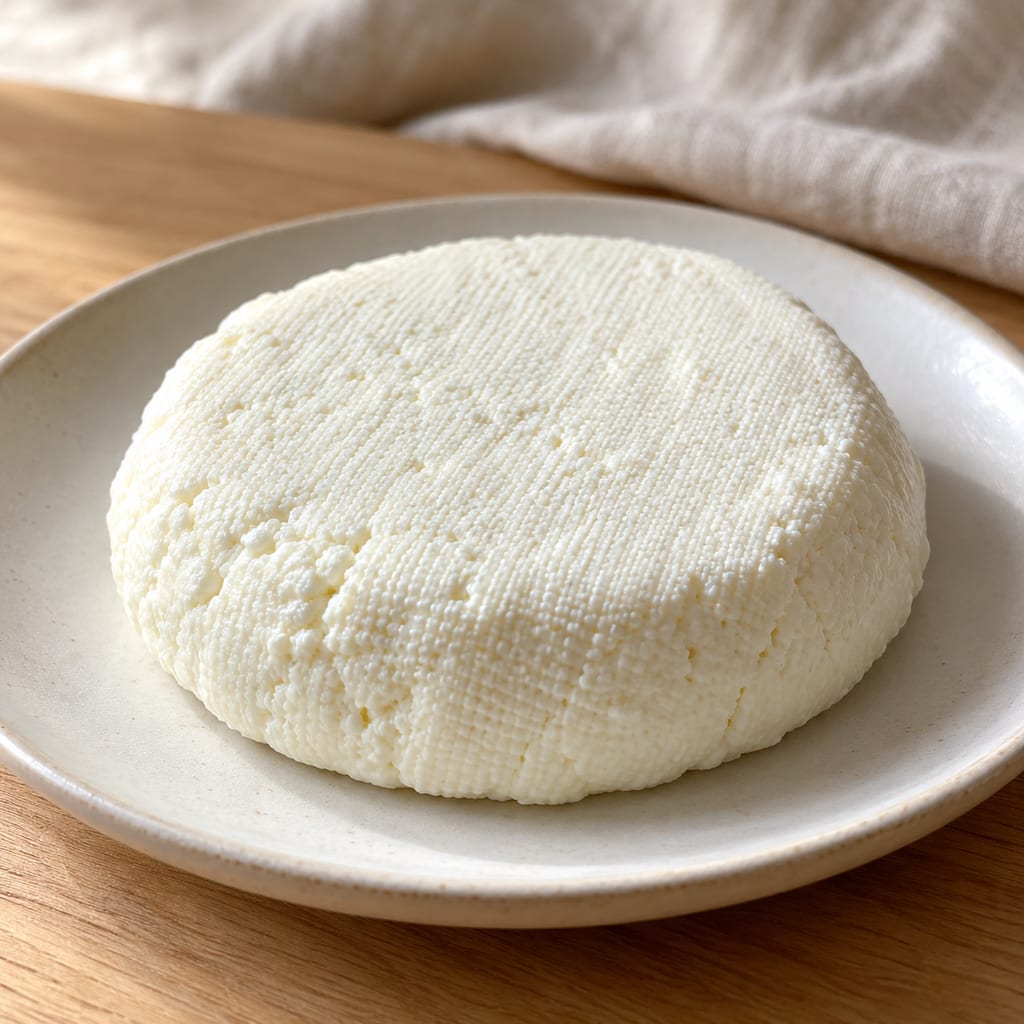
Lemon paneer
A half-gallon milk batch is coagulated with lemon juice, rinsed and pressed into fresh paneer for sweets or savoury dishes.
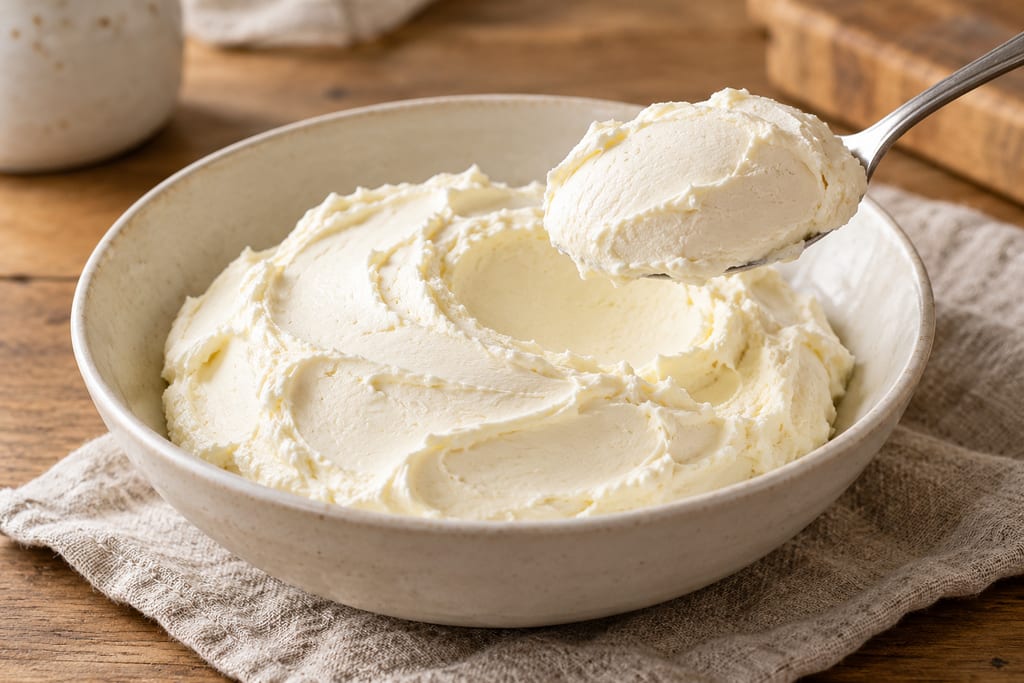
Mascarpone
A rich fresh cheese made by heating milk and cream in a double boiler and setting them with tartaric acid, or by culturing them with a crème fraîche culture.
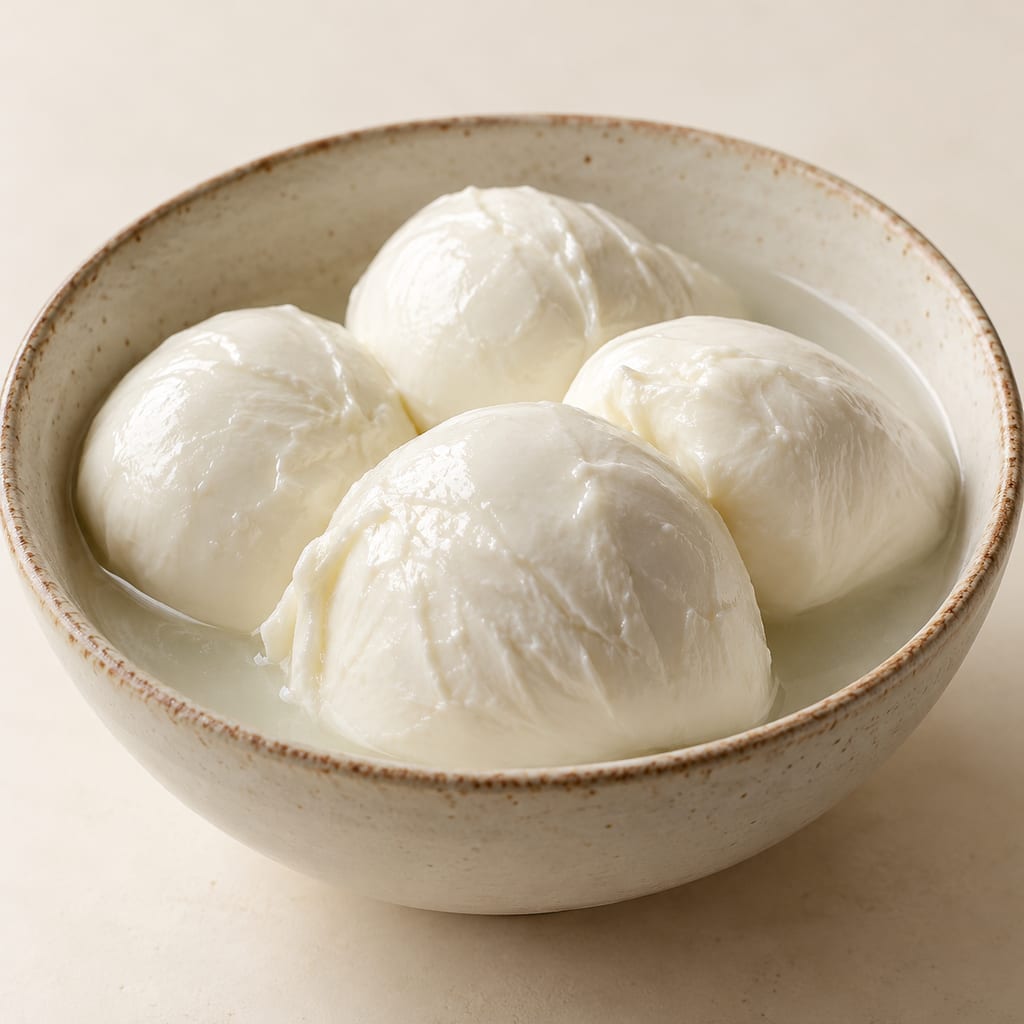
Quick acidified mozzarella
A stretched fresh curd made by acidifying cold milk with citric acid before adding rennet, so the curd can be stretched as soon as it has formed.
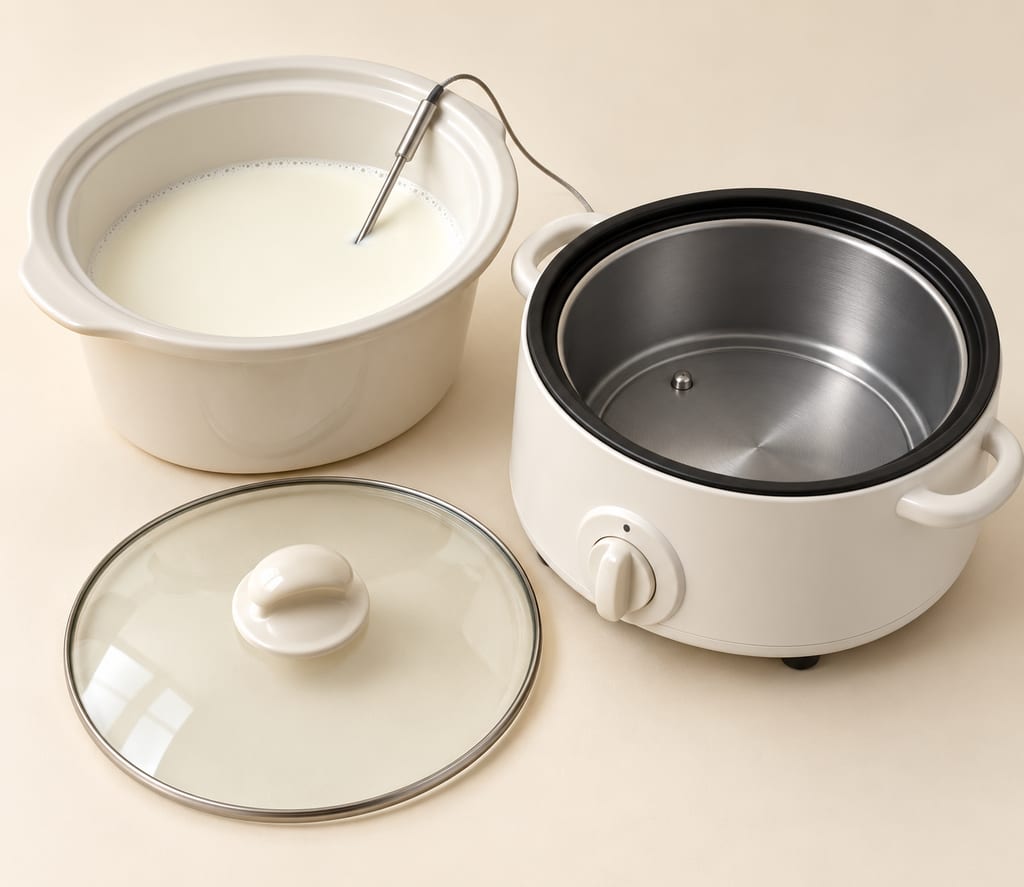
Slow cooker
An electric slow cooker warms a removable heavy crock under a lid. Stored heat aids gradual cooking, but its settings are not a universal fermentation thermostat.
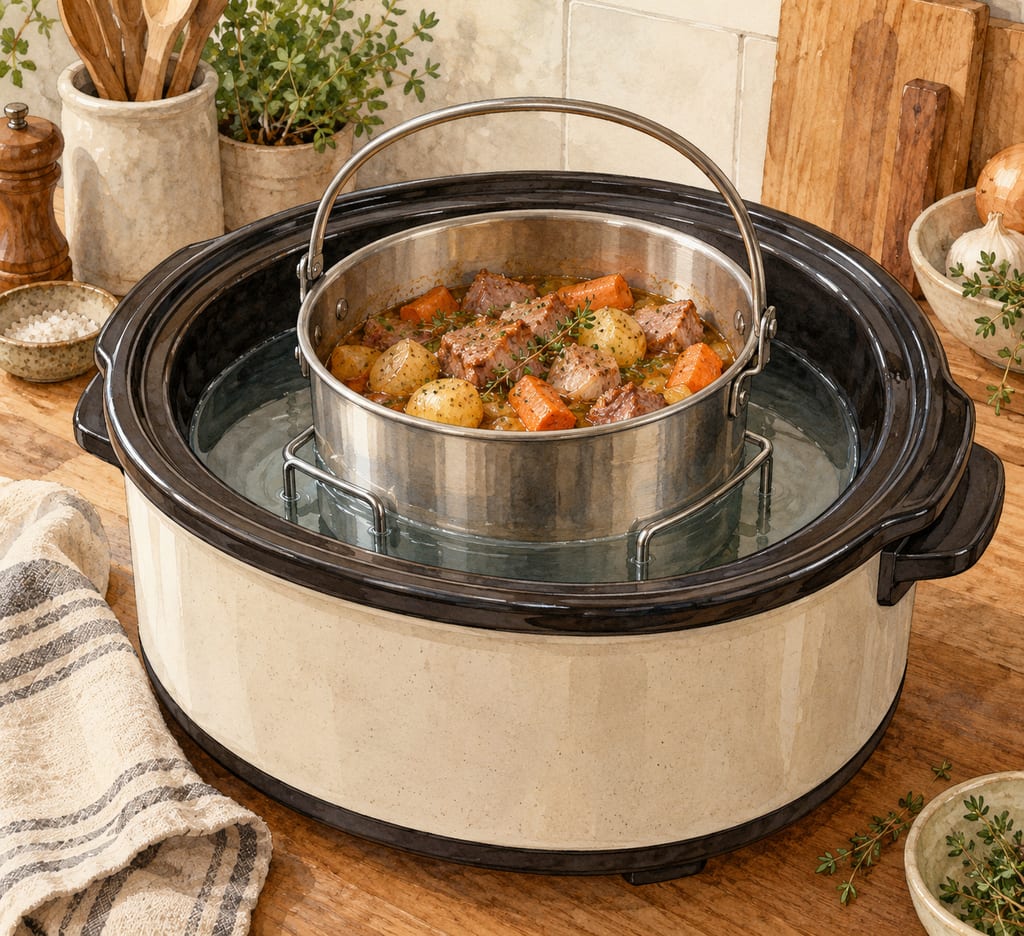
Slow cooker as a water jacket
Water in the crock with a smaller stainless pot or heat-safe jar supported inside it, so the food never touches the hot ceramic and can be lifted out to stop heating.
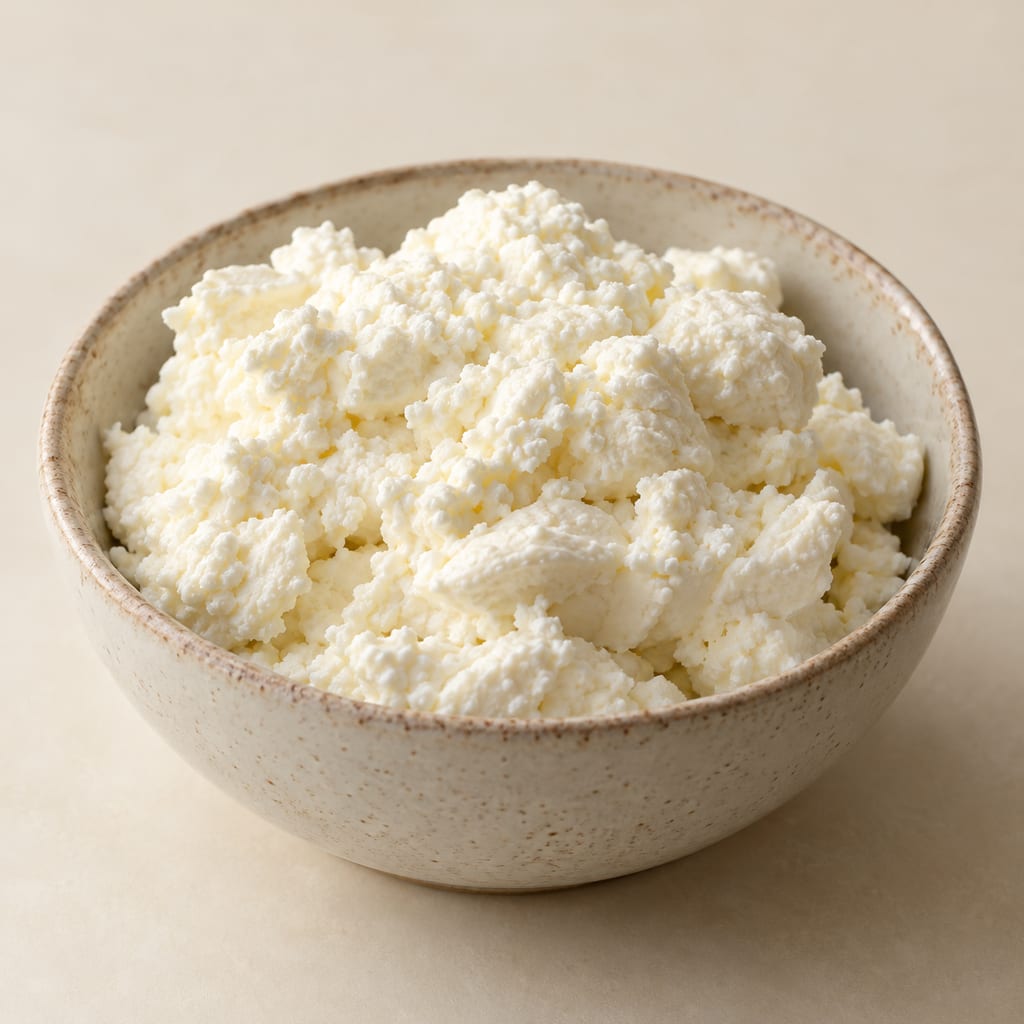
Whole-milk ricotta-style fresh curd
A soft fresh curd made by heating whole milk with acid; distinct from ricotta made by reheating the whey left after a cultured cheese.
Community
No community contributions have been published for this entry yet.
Share what you made
Sign in to contribute. Published comments and photos are free to read.
Sources
New England Cheesemaking Supply Company
Making Mozzarella in the Slow CookerCited in: What a slow cooker actually does; Kathy Love's mozzarella: heat on High, lift the crock to stop; What the crock cannot do
Breville (PolyScience)
the HydroPro™ Plus & the HydroPro™ Instruction Book - CSV750/CSV700Cited in: Turning the crock into a water jacket
Anova Culinary (recipe platform)
Sous Vide Whipped RicottaCited in: Paneer, ricotta and mascarpone: heat first, then acid
New England Cheesemaking Supply Company
Mascarpone Cheese Making RecipeCited in: Six fresh dairy foods that begin with warm milk; Turning the crock into a water jacket; Paneer, ricotta and mascarpone: heat first, then acid
University of Alaska Fairbanks Cooperative Extension (republished by Master Food Preservers of Humboldt & Del Norte Counties, University of California Cooperative Extension; reviewed November 2015)
Making Yogurt at HomeCited in: How milk becomes curd: acid, heat and rennet; Quark: warmth at the start, then less of it; Yogurt from a crock that is cooling down; What the crock cannot do
Instant Pot UK (official UK site)
Creamy, Home-Made YoghurtCited in: Yogurt from a crock that is cooling down
Miele Australia (recipe page)
YoghurtCited in: How milk becomes curd: acid, heat and rennet; Yogurt from a crock that is cooling down
BBC Good Food Middle East
Slow cooker bio yogurtCited in: What a slow cooker actually does; Yogurt from a crock that is cooling down; What the crock cannot do
Anova Culinary (blog)
Ultra-Simple Sous Vide Yogurt from #anovafoodnerd Justin BoreckyCited in: Yogurt from a crock that is cooling down
New England Cheesemaking Supply Company
Cheddar Cheese Making RecipeCited in: Turning the crock into a water jacket
New England Cheesemaking Supply Company
Paneer Cheese Making RecipeCited in: Six fresh dairy foods that begin with warm milk; Paneer, ricotta and mascarpone: heat first, then acid; What the crock cannot do
New England Cheesemaking Supply Company
Ricotta Cheese Making RecipeCited in: Six fresh dairy foods that begin with warm milk; Paneer, ricotta and mascarpone: heat first, then acid
New England Cheesemaking Supply Company
Quark Cheese Making RecipeCited in: Six fresh dairy foods that begin with warm milk; Quark: warmth at the start, then less of it; What the crock cannot do
Penn State Extension (The Pennsylvania State University), code ART-4803, 2019; copy hosted by UC Agriculture and Natural Resources
Home CheesemakingCited in: How milk becomes curd: acid, heat and rennet; What the crock cannot do
International Livestock Centre for Africa (ILCA), Addis Ababa, 1993
Traditional cheesemaking manualCited in: Six fresh dairy foods that begin with warm milk; Kathy Love's mozzarella: heat on High, lift the crock to stop; Turning the crock into a water jacket; Quark: warmth at the start, then less of it
Crock-Pot (Newell Brands), UK manuals page
Crock-Pot SCV400RD 3.5L Slow Cooker instruction bookletCited in: What a slow cooker actually does; Turning the crock into a water jacket; Yogurt from a crock that is cooling down
International Livestock Research Institute (ILRI), Addis Ababa, January 1995
Rural dairy technology (ILRI Training Manual 1)Cited in: How milk becomes curd: acid, heat and rennet; Yogurt from a crock that is cooling down
Springer US, in Modernization of Traditional Food Processes and Products (2016), pp. 21–30, doi:10.1007/978-1-4899-7671-0_3
Quark: A Traditional German Fresh CheeseCited in: Six fresh dairy foods that begin with warm milk
Gıda / The Journal of Food 43(6): 1091–1099 (2018), doi:10.15237/gida.GD18111
Milk Jam or Dulce de Leche: Physicochemical CharacterizationCited in: Dulce de leche: a reduction the slow cooker does not yet fit
Oregon State University Extension Service (revised October 2025)
Fruit butters (SP 50-304)Cited in: Dulce de leche: a reduction the slow cooker does not yet fit
Crock-Pot (Newell Brands)
Crock-Pot SCCPVL500FB instruction manualCited in: What a slow cooker actually does; Yogurt from a crock that is cooling down
Anova Culinary (support centre)
Safety Procedures While Using the Anova Precision® CookerCited in: Turning the crock into a water jacket
Gaps
No unresolved gaps are listed.
Updated 2026-10-27