The Naxon Beanery and the Crock Pot
The early patent trail for the electric slow cooker begins with Irving Naxon, an inventor who applied in 1936 for a cooking apparatus and received the patent in January 1940. The Smithsonian National Museum of American History's archival record describes the Naxon Beanery entering production in Chicago in the 1950s. It used a ceramic crock with a heating element arranged around an inner chamber, a design intended to heat the vessel evenly.
Naxon sold his company to Rival Manufacturing in 1970. Rival introduced its reworked and renamed Crock Pot at the 1971 National Housewares Show in Chicago, then sold it with tested recipes. The Beanery's and Crock Pot's histories are part of the modern electric appliance, not evidence that earlier cooks used the same portable device. A family story connects Naxon's idea to memories of cholent cooked overnight in a bakery oven around Shabbat; that recollection helps explain the inspiration, while patent and company dates provide the dated record.
Sources for this section
A crock over an electric heater
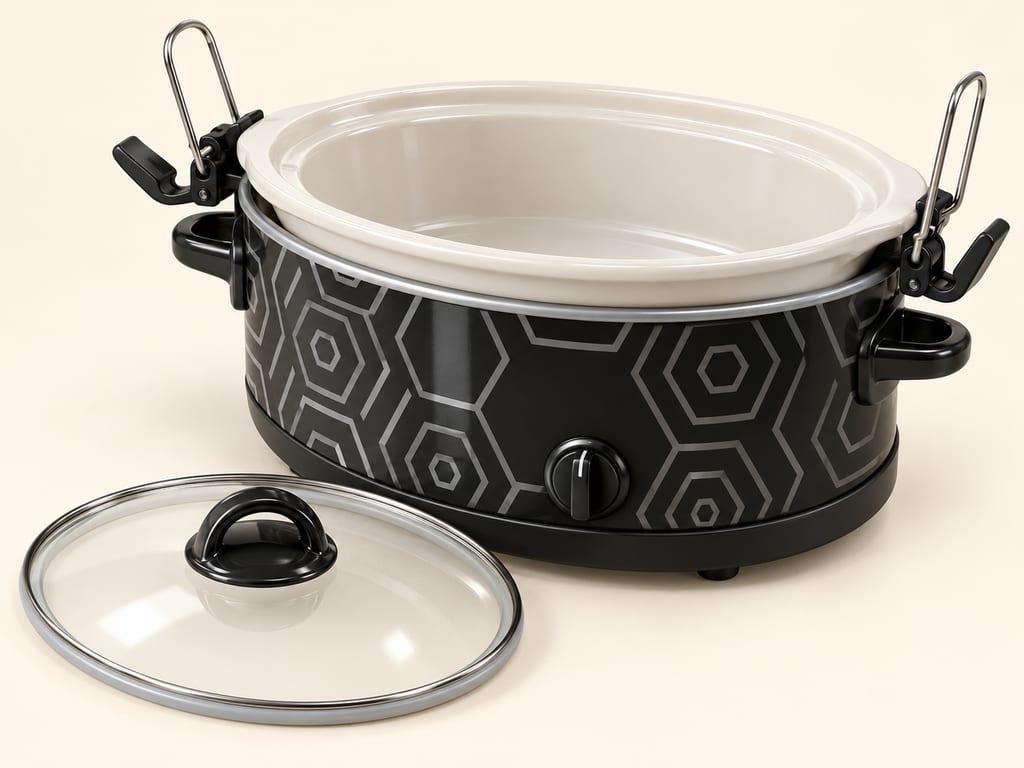
A slow cooker joins a heated base to a removable crock and lid. Many familiar household models use a substantial ceramic or stoneware insert; the exact shape, glaze, outer casing, control and capacity depend on the maker. The crock holds the food and receives heat from the base, so this appliance is different from a pressure multicooker, which has a sealed pressure-cooking system and may combine several programs. A locking lid on a travel model does not by itself make it a pressure cooker.
The heavy insert changes how the appliance responds when switched off. It stores heat and continues to warm its contents as the ceramic releases that heat. That can be useful when a process benefits from a gradual fall in temperature, but it complicates stopping at a precise point: lifting the crock from the base removes active heating, not the heat already stored in the vessel. A probe in the food gives a measurement of that batch; the dial alone does not tell the cook the food's temperature.
Sources for this section
A documented dairy use
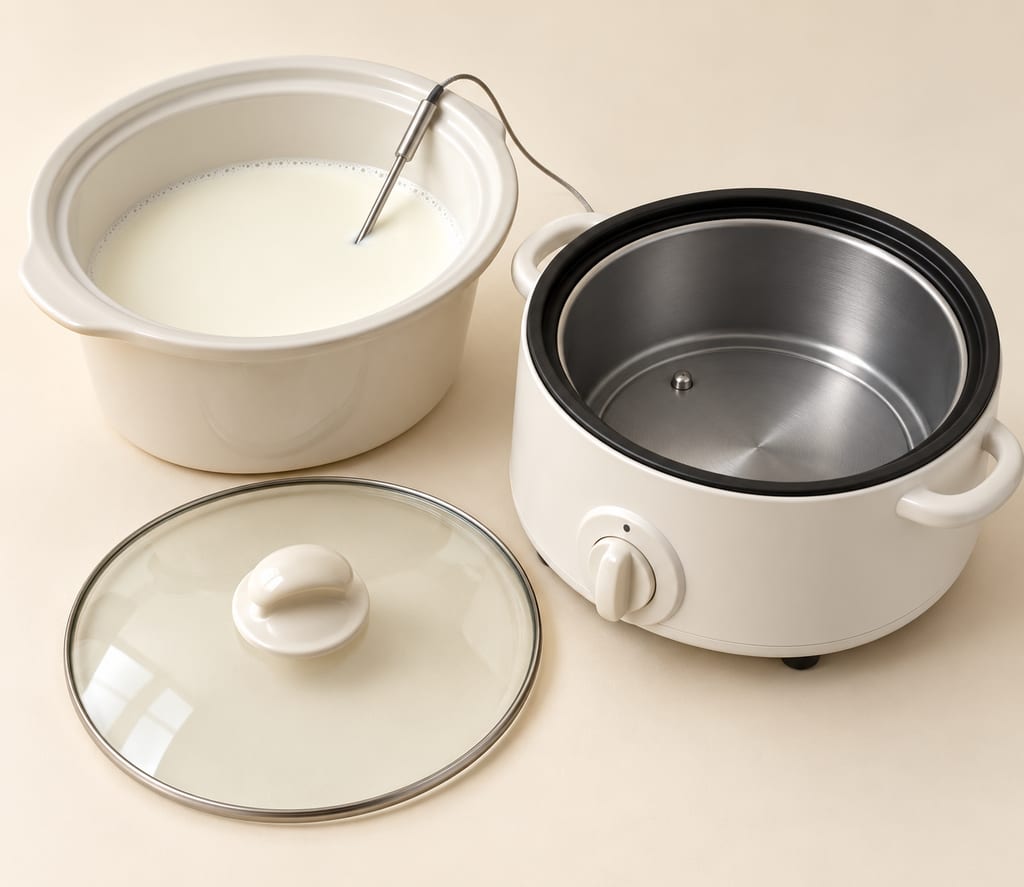
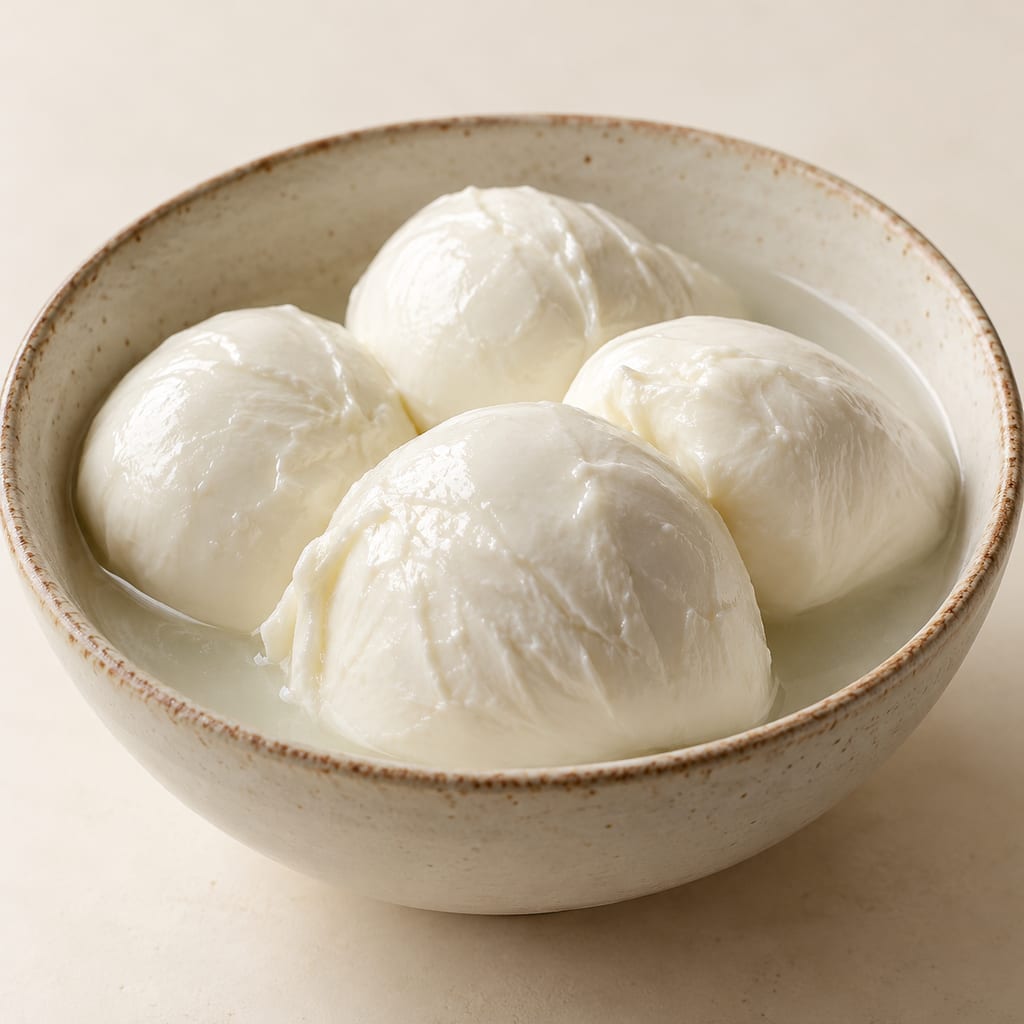
A photographed demonstration by Kathy Love in Tucson uses a slow cooker to heat pasteurised, homogenised whole milk for quick mozzarella. A thermometer probe enters through the opening in the lid handle. Love watches the milk rather than treating the setting as a thermometer: she heats on High, removes the crock from its base when the milk reaches the point for adding rennet, lets the curd set undisturbed, then returns the crock to the base for a later rise in temperature. She lifts it out again and keeps stirring because the curd and ceramic remain warm.
This is a documented use of one cooker for one cheese method. It does not show that all slow cookers heat at the same rate, that High reaches a fixed temperature, or that the appliance can hold a culture at an exact incubation temperature. The dairy demonstration's recipe is linked in the source gallery; it should be followed with its own directions and suitable food-safety controls rather than generalized to other cheeses or fermentation batches.
Sources for this section
Controls, care and limits
Manual slow cookers commonly offer cooking settings such as High and Low, with some models also providing Warm; programmable versions add controls whose behavior varies by manual. The SCV400RD booklet, for example, gives no numeric temperatures for High or Low and says Warm is only for keeping already-cooked food warm, not for cooking, with a four-hour limit. These are instructions for that model, not a universal specification for every slow cooker. Do not use a Warm setting as a fermentation thermostat unless the manufacturer documents that use and its temperature behavior.
The Crock-Pot booklet directs users to put food in the removable stoneware, not in the electrical base. It warns that the stoneware cannot withstand sudden temperature changes and supplies a model-specific fill range. Crock-Pot's general guidance recommends filling its slow cookers between one-half and three-quarters full for best results; follow the manual for the exact appliance in hand. Capacities, power ratings, dimensions and heating profiles differ, so none should be inferred from the class name or from a related model.
Sources for this section
A historical starting point, not a single universal design
The Beanery provides one documented early form; later slow cookers differ in shape, heating arrangement, controls and materials. Today's generic class should therefore be read through the exact appliance manual rather than by transferring the Beanery's construction or any one Crock-Pot model to every cooker. The current class includes manual and programmable domestic appliances, while the separately published Crock-Pot SCCPVL500FB page describes one specific Cook & Carry model.
Sources for this section
History
The Smithsonian National Museum of American History archival account records Irving Naxon's patent application for a cooking apparatus on 21 May 1936 and grant on 23 January 1940. It places Naxon Beanery production in the 1950s, Naxon's sale of his business to Rival in 1970, and Rival's Crock Pot introduction at the 1971 National Housewares Show in Chicago. The associated family account of the idea's cholent inspiration is oral history, not evidence that a portable electric cooker was used in the earlier bakery practice.
Equipment details
CapacityCapacity is model-specific; consult the rating plate and maker's manual.
SizeDimensions vary by model.
PowerElectric Powered heating base; voltage and wattage are model-specific.
How you get oneBought, manufactured Sold as a domestic countertop appliance; dimensions, capacity, controls, and materials vary by model.
CareUse only the supplied inner crock as directed by its manual. Protect ceramic or stoneware from sudden temperature changes; keep the electrical base dry and unplug before cleaning. Follow the exact manufacturer's care and fill instructions.
Made of
- Stoneware or ceramic — Removable cooking crock
Common form documented in Crock-Pot manuals; exact clay body and glaze vary by maker and model. - Metal and electrical components — Heater base
The heating base warms the removable crock; the cooker must be used according to its own manual. - Glass — Lid on cited models
The cited Crock-Pot manuals describe a glass lid; lid construction varies across the wider class.
Limits
A High, Low or Warm label does not specify a fermentation temperature. The cited SCV400RD booklet gives no numeric temperature for High or Low, and restricts Warm to holding food already cooked; those instructions are model-specific.
Source →A slow-cooker mozzarella demonstration shows one measured batch and one user's method, not repeatable temperature control across models or batch sizes.
Source →Places
United States
Documented use · Country evidenceDocuments one dairy demonstration in Tucson, not the appliance's place of origin or a universal regional tradition.
United Kingdom
Modern adaptation · Country evidenceA UK-market booklet documents one model; it does not establish manufacture or invention in the UK.
Chicago, Illinois
Historical attestation · Locality evidenceThe Smithsonian archival account locates the documented production and launch in Chicago; this is not a claim that the appliance was invented there.