← Equipment

Equipment · Kettles, coppers and boilers

Bean pot

bean-hole pot · bean-hole bean pot

Loading ratings…

A covered iron vessel used in Maine bean-hole cooking, set into a preheated stone-lined pit and buried for a slow cook.

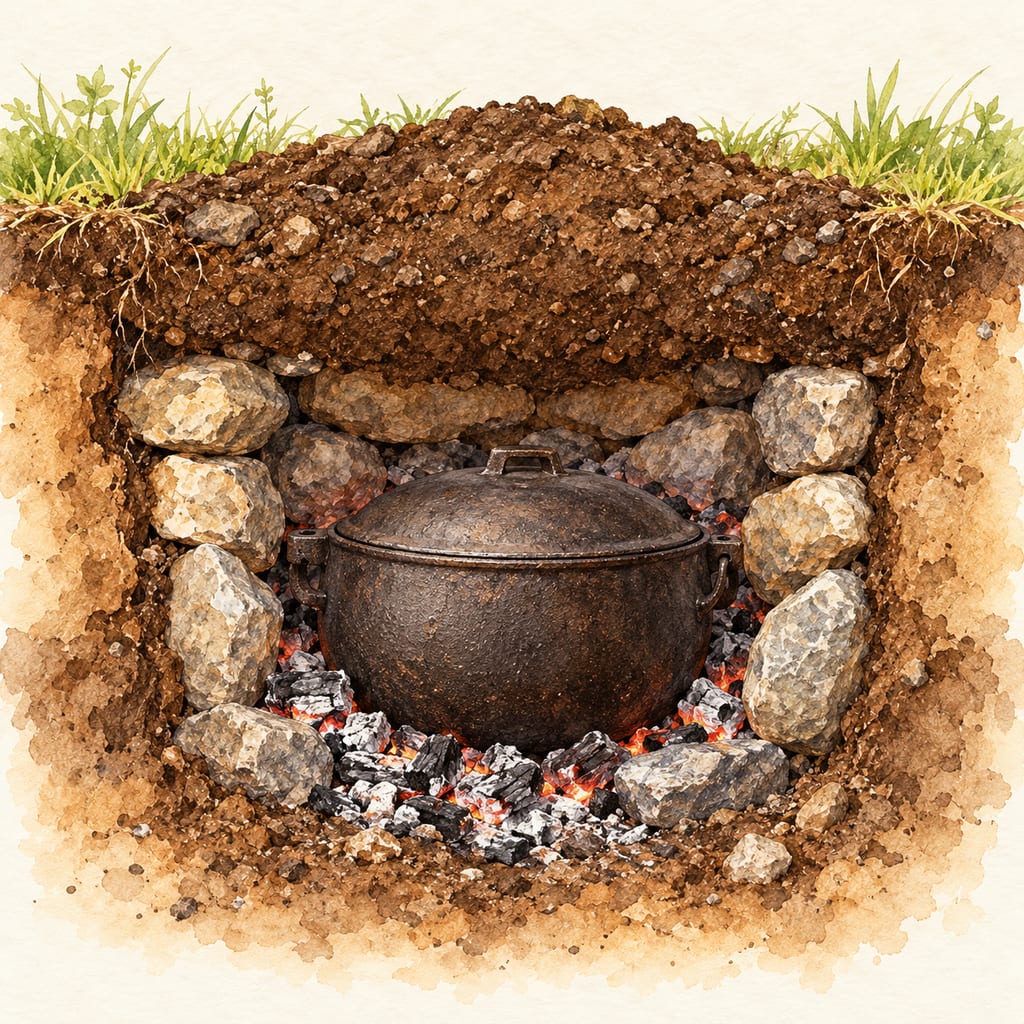
Illustrated cutaway of a covered iron bean pot set among embers and stones in a pit beneath the soil surface.

A separate vessel inside the earth oven

In Maine bean-hole cooking, the bean pot is the portable vessel placed inside a pit built and heated in the ground. Stones, coals and earth form the surrounding cooker, while the iron pot holds food and cooking liquid. A Maine State Museum account connects baked beans with logging-camp meals and describes a cast-iron pot set in a stone-lined hole over coals, then covered with soil for an overnight cook. Its account includes a menu from 1923, a dated example rather than an origin date. A regional account discusses Indigenous antecedents and later logging-camp forms as separate historical matters; the evidence cited here does not establish a direct, unbroken lineage from one to the other.

Sources for this section

Form and material

The sources support an iron vessel with a cover, but do not define one standardized silhouette. An oral-history recollection describes a close-fitting iron cover and a pot among ashes and coals. A separate family account records a three-legged cast-iron kettle with a flared sheet-metal cover. These are documented examples, not a specification every bean pot followed. Historic New England’s eighteenth- and nineteenth-century iron kettle provides a useful comparison for period kettle construction, including a bail handle and small feet, but it is a general kettle in a museum collection and is not identified as a bean pot. This page therefore assigns no fixed number of legs, handle arrangement, lid profile, capacity or dimensions.

Sources for this section

How the pot works in a buried cook

The pit is heated before the covered pot goes in. In the oral-history account, a fire heats the stone lining; hot ashes and coals are moved to make room for the pot, then drawn back around it, and the hole is closed with ash and earth. The Maine State Museum’s description likewise places the pot over coals in a stone-lined pit and covers the assembly with soil. The pot separates beans and cooking liquid from direct contact with stones and surrounding soil. Heated masonry and retained coals warm the vessel from outside, while its fitted cover helps keep the contents enclosed. The overnight duration belongs to the museum account and should not be treated as a controlled temperature or universal schedule.

Sources for this section

What the records establish—and leave open

The Library of Congress transcript gives approximate dimensions for the hole, not the pot. Those numbers cannot be used to infer the vessel’s capacity or height. Archival Ashland photographs, credited to Red Boutillier and dated to the 1960s in the accompanying article, document people retrieving a buried pot with a chain and wooden pole. They establish a local historical record of the method, but do not reveal a universal pot design. The sources do not identify a maker, cost, current supplier, iron grade, exact capacity, or care routine. They also do not establish that a modern household casserole or storage container is suitable for burial or direct contact with hot stones. Use cookware intended for the heat and handling involved; historical descriptions are not a present-day safety certification.

Sources for this section

Equipment details

CapacityNo inspected source specifies pot capacity; oral-history measurements describe the pit, not the vessel.
SizeNo inspected source gives vessel dimensions. Reported measurements belong to the bean hole.
PowerFire or solid fuel Wood heats stones and coals in the pit; the pot is warmed by the stored fire.
How you get oneNot established Inspected sources do not identify a maker, supplier, price or current acquisition route.
CareThe sources describe use but not cleaning, seasoning, storage or maintenance.

Made of

  • iron — vessel
    Maine records describe a covered iron or cast-iron pot; an oral-history account recalls a close-fitting iron cover.

Limits

No standard capacity, exact dimensions, iron grade or universal lid design is established by inspected sources.

Source →

Places

Maine

Historical attestation · Region evidence

Ashland

Historical attestation · Locality evidence

Related

Community

No community contributions have been published for this entry yet.

Share what you made

Sign in to contribute. Published comments and photos are free to read.

Sources