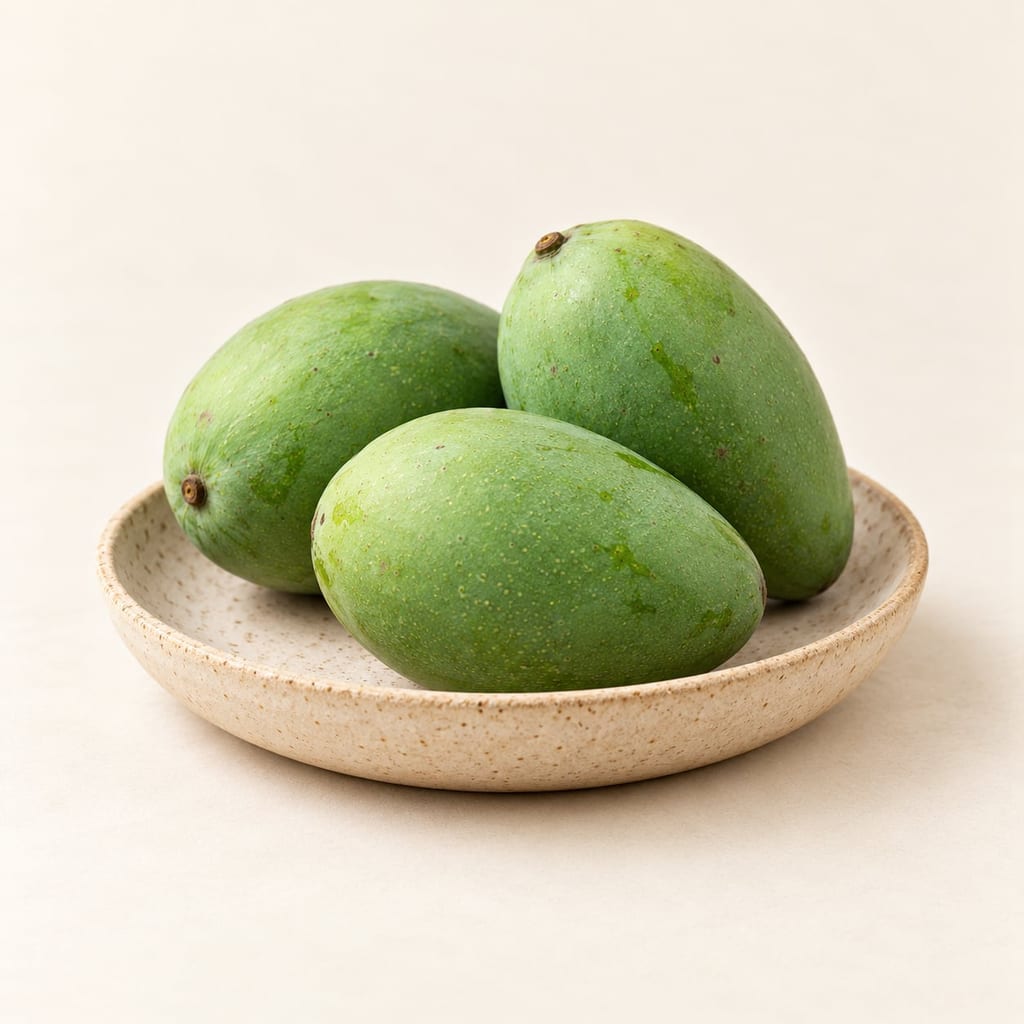
Unripe mango
Unripe mango offers sourness and firm texture at several maturity stages, from tender whole pickle fruit to mature-green slices for cooking or drying.
 FermenteaWhere food goes to change
Modern method
Amchur powder · Amchoor powder
Thin slices of sour unripe mango are sun-dried over four days and ground into a tangy powder, following a five-fruit account published with an Indian mango study.
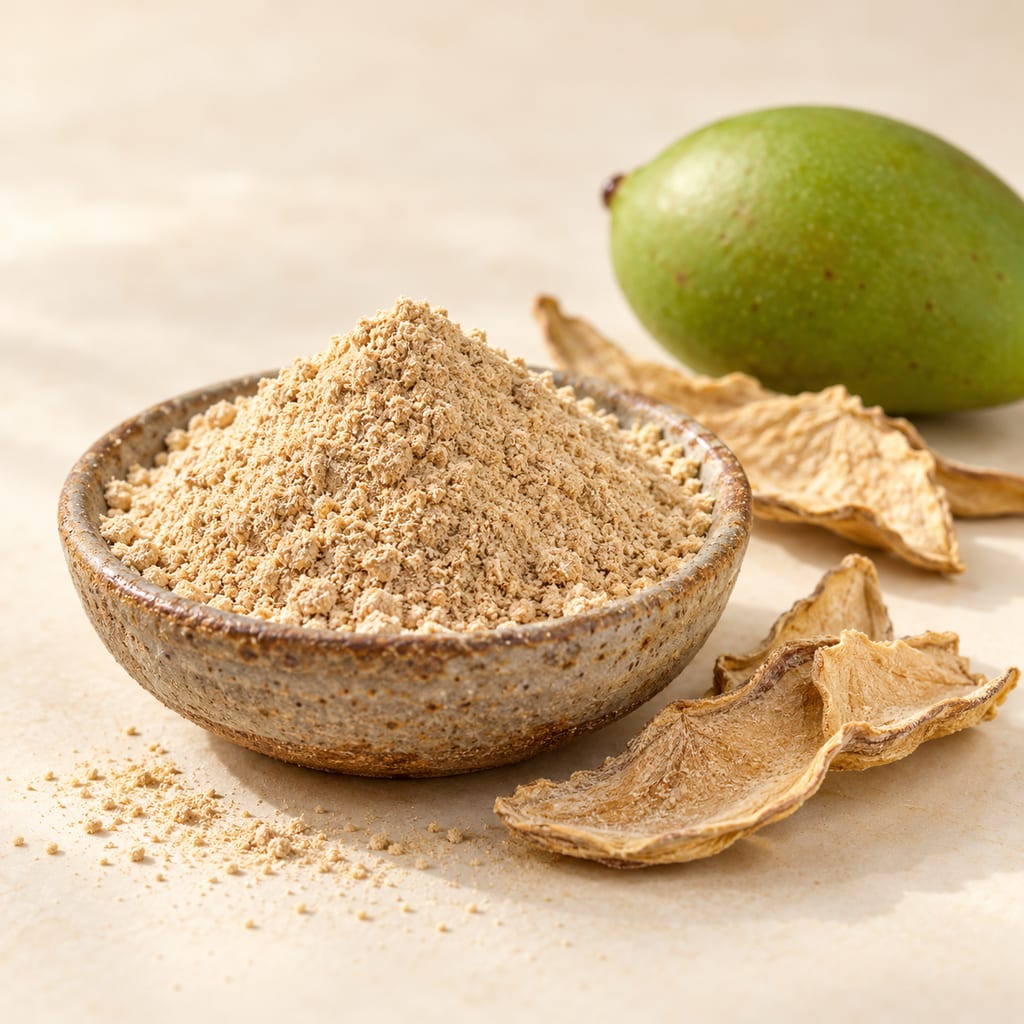
Amchur, also written amchoor, is dried unripe mango used as a souring spice. The finished powder is usually pale beige to tan, with a dry, slightly fibrous or sandy feel and a sharp fruit acidity that can seem greener and less rounded than ripe mango. Its practical distinction from lemon juice, tamarind pulp or fresh mango is that it can add fruit-like sourness without bringing a spoonful of liquid or pulp into a dish. Dried slices are also sold and cooked whole or broken up; grinding them makes the familiar powder.
The English spelling varies because the name has moved through transliteration and commercial usage. The 2024 article that prints this particular five-fruit method calls the result amchur and describes it as a souring ingredient for North Indian dishes. An Oxford food reference describes dried unripe mango flesh as a preparation associated with northern India, marketed either as slices or powder. These are accounts of a food and its use, not evidence that the 2024 household recipe began in a particular state or district.
The powder is not a ferment. Its sourness comes from the fruit's acids, concentrated in a dry ingredient as moisture is removed. That gives cooks an additional way to balance rich, starchy or legume-based dishes while keeping their consistency. It does not behave exactly like fresh lime or tamarind: those add water and their own aromas and textures, while amchur is a dried fruit seasoning whose strength varies with mango, drying and milling.
Amchur appears in the title of an 1885 paper by Calcutta chemist Ram Chandra Datta, published in the Indian Medical Gazette as “Amchur or Dried Mango-Pulp as an Antiscorbutic.” The article analyzed three sun-dried samples and discussed their citric and malic acids. Its title and measurements establish that the word and a dried-mango product were in print by 1885; they do not establish an invention date, a first place of production or a modern health claim. The historical medical framing belongs to that period's concern with preserved foods and scurvy, not to present-day medical advice.
A further 1886 medical account describes amchur in market and household contexts, including plain dried mango and more elaborate mixtures seasoned with salt, oil, lime-juice powder and other spices. It also records different household blends rather than one fixed formula. Those observations make the category's flexibility visible: the name could refer to dried mango itself or to a seasoned condiment built on it. That is a historical variation, not a direction to add those ingredients to this single-ingredient powder.
Later culinary descriptions place amchur among everyday souring ingredients. A university course text describes dried mango powder as a souring agent in North Indian cooking and notes its role in some vegetarian dishes in Uttar Pradesh and Bihar when fresh tart mango is out of season. The Oxford reference similarly discusses curries, chutneys and soups. These sources describe broad use and regional practice; they do not pinpoint the provenance of the five-fruit formula printed in the 2024 agronomy paper. The associated mango-genotype study site in Nandurbar belongs to its field research, not automatically to the separately printed household method.
Mango is not chemically static as it ripens. Research on mango fruit describes starch being broken down and soluble sugars increasing during ripening, while pectin and other cell-wall material change as the flesh softens. For a dried souring ingredient, the recipe's choice of very sour, unripe fruit points toward a firmer, less sweet starting material with the tart profile cooks want. This is general mango physiology; cultivar, growing conditions and maturity mean that one fruit's composition cannot be assigned to every batch.
Acidity is only one part of flavor. The raw fruit contributes aroma compounds and plant solids as well as water, sugars and acids. Removing water changes the balance by weight, while drying and storage can also change acidity and aroma. In an 1885 analysis, Datta measured both citric and malic acids in dried mango samples. A modern study of amchur from five named mango types likewise measured different starting compositions and different product outcomes. Neither study supports treating all powders as chemically identical or assigning a fixed sourness to a teaspoon.
The resulting ingredient works by adding tartness, fruit aroma and dry solids to a dish; it is not the same as fermentative acidification. Its use in a simmered curry may soften its sharp edge and spread its flavor through the liquid. Sprinkled into a dry filling or spice mixture, it adds a concentrated sour note without thinning the mixture. Because product acidity and particle size vary, the account gives no universal conversion to lemon juice or tamarind.
The 2024 paper prints a household method using five medium, very sour, thick-fleshed unripe mangoes. It directs the cook to wash and dry the fruit, peel it, then shave it into thin strips. Thin pieces expose more surface to moving warm air and make the slices more uniform than thick chunks; however, the paper does not establish a measured thickness or a controlled drying temperature. It is a small household account, not a validated commercial process.
The strips are spread on clean steel plates, covered with dry muslin and put in the sun for four to five hours. The muslin is intended to keep dust and dirt away while allowing air to move around the pieces. The procedure calls for bringing them indoors when drying stops, then tossing and redistributing them on later days. This sequence spans four drying days, with the final day's time dependent on the condition of the pieces. Turning redistributes slices that may otherwise sit in sheltered or exposed positions and gives the maker a chance to compare their progress.
Once the pieces are dry enough to crumble, the method grinds them smooth and reports a yield of about half a cup. That crispness cue is the paper's household quality test, not a measured moisture or water-activity endpoint and not proof that the powder is shelf-stable. The paper directs airtight storage but does not validate a storage duration for this batch. The separate recipe fields preserve its quantities, timings and steps; they do not convert the source into a controlled safety protocol.
Drying preserves by removing water that would otherwise remain in the fresh slices, but the sun method depends on weather, airflow, exposure and the piece thickness. A four-day description cannot guarantee that another kitchen will reach the same dryness in four days. The National Center for Home Food Preservation's general sun-drying guidance emphasizes shielding food from insects and birds and bringing it indoors overnight or when rain threatens. Those are practical protections for outdoor drying; they do not validate this particular amchur batch or its storage life.
A 2018 post-harvest study compared amchur made from Chinnarasam, Nallarasam, Totapuri, Neelum and local mangoes using sun drying or tray drying. It found that cultivar and drying method affected measured moisture, acidity, sugars and ascorbic acid, and reported better overall quality for its tray-dried treatments than its sun-dried treatments. The study used a controlled university laboratory and prepared its samples with a potassium-metabisulfite dip, so its results cannot be silently substituted into this five-mango household method. Its useful lesson is narrower: fruit variety and drying conditions matter.
The same study observed moisture increasing during storage under its experimental conditions, consistent with amchur's capacity to absorb moisture from the air. Powder that takes up humidity can clump and lose its crisp, free-flowing character. That observation explains why dry handling and a closed container matter for quality; it does not establish a safe home storage period. The source recipe has no validated drying endpoint, so no shelf-life claim belongs here.
Amchur is encountered as dried slices and as a ground powder. Slices preserve the fruit's visible form and can be broken or ground when required; powder disperses quickly and is easier to distribute through a dry mixture. The exact recipe on this page makes powder. It begins with peeled, thinly shaved mango and grinds the slices only after drying, so the method does not describe a seasoned powder or a fermented preparation.
Variety is not a decorative label. The 2018 study's five mango types began with differing moisture, acidity, sugar and ascorbic-acid measurements, and the final powder reflected both the fruit and the drying treatment. Its results are tied to the cultivars and controlled conditions it studied. A market powder may therefore taste more or less sour, look paler or darker, or feel more coarse than another without that difference identifying a single geographic style. The 2024 household recipe does not name a cultivar; it specifies medium, very sour unripe mangoes.
Regional context belongs to the use evidence, not to an invented birthplace. The university course text describes amchur as prominent in North Indian dishes and records particular use in Uttar Pradesh and Bihar; the Oxford account places its preparation in northern Indian states. Historical and present-day sources may speak at different levels of precision. The five-fruit method's author, original household and locality are not named, so those details remain unknown even though the article itself is situated in an Indian mango research setting.
Amchur's useful quality is tartness without added liquid. It can season lentils, vegetable curries, soups and chutneys, and the university text lists dals, stews, salads and savoury fillings among its uses. A little dry souring spice can sharpen a potato or chickpea filling without making it wet; in a sauce or gravy it can bring an acidic counterpoint alongside other spices. The source descriptions range across dishes, so this page does not prescribe one amount or promise a fixed substitution ratio.
Fresh tart mango and amchur can play related seasonal roles, but they are not interchangeable ingredients. The university text describes fresh pieces being cooked with lentils or vegetables in season, with dried mango taking over when that fruit is unavailable. Fresh pieces contribute moisture, texture and a different aroma; powder contributes a concentrated dry sourness. Tamarind pulp and lime juice also bring liquid, pulp or citrus character that changes the structure of the finished dish.
Some historical descriptions mention amchur in mixtures with salt, oil or other spices, while current market products also vary in grind and color. Those are separate forms and formulations. The recipe here contains mango alone: no salt, turmeric, chilli or preservative is listed. In cooking, it belongs with the spice additions and adjustments of the specific dish being made. Its sourness is best understood in context with the other ingredients rather than as a stand-alone measure of a dish's acidity or keeping quality.
The recipe account gives a visual and tactile endpoint: the mango pieces should break readily and crumble when ground. That is useful for reproducing the texture described in the article, but it is not an instrument reading. No moisture percentage, water activity, drying temperature or validated shelf-life limit is given for this method. A reader should not infer safe long-term storage from the sound, feel, smell or appearance of the powder.
Outdoor drying exposes food to changing conditions. The National Center for Home Food Preservation advises protection from insects and birds and moving food indoors during wet weather or overnight. The recipe's covering and indoor pauses are compatible with those basic protections, but they do not supply controlled drying. The laboratory trial's moisture results concern its own mangoes, pretreatment, tray or sun treatment and storage setup; they cannot set a limit for the household batch.
After grinding, the printed method says to place the powder in an airtight container. This records what the recipe says, not a guarantee of room-temperature stability or a storage duration. Moisture pickup may cause clumping and change the powder's quality. The batch's sourness and color will also depend on the fruit, degree of immaturity, slice thickness and drying conditions. The source does not report a measured final yield weight, and its half-cup estimate should be read as a rough volume for its five-fruit batch.
Amchur shows how a fruit can move from a short season into a pantry in a form suited to everyday cooking. The surviving descriptions record dried mango in multiple forms: a plain slice, a powder and, historically, a seasoned mixture. The agricultural study also frames unripe fruit that falls before maturity as material that can be used in processed products. That is one economic and practical context for drying; it does not show that every traditional amchur batch began as fallen fruit or that this was the only motive for making it.
The 1885 analysis, the regional cooking accounts and modern post-harvest trials answer different questions. A period medical journal shows that dried mango was known and chemically discussed in late nineteenth-century Calcutta. Culinary references explain where cooks use it and what role it plays. Laboratory work measures how cultivars and drying treatments affect product properties. The 2024 five-fruit recipe documents one household route, but leaves its authorship, place and validated storage behavior unstated.
Read together, these records explain why amchur tastes and behaves as it does while leaving room for variation. Unripe mango supplies a tart fruit base; drying removes much of its water; grinding turns the dried flesh into a convenient souring spice. The taste is not a fermentation by-product, and the household directions are not a universal standard. Keeping those distinctions clear lets the reader use the recipe as a documented preparation and understand the wider ingredient without attributing unsupported origins or safety guarantees.
A 2024 Plant Archives article on mango genotypes prints this five-fruit amchur method without naming its household source. The study collected fruit in Dhadgaon, Nandurbar district, in 2016, but that field location does not locate or date the inserted recipe. The article identifies unripe Mangifera indica fruit and names the resulting powder as a souring ingredient in North Indian dishes.
Yield 0.5 cup · Scaling: source batch only
Open-air drying can expose fruit to birds, insects and night moisture.
Hazard sourceThe printed household method uses a crispness cue but gives no measured moisture or water-activity endpoint or verified storage life.
Hazard sourceCover drying fruit with a food-safe screen and shelter it at night or when rain threatens.
Control sourceCrispness is a quality cue in this account, not proof of a safe storage endpoint. No validated home shelf life is established.
The 2024 paper does not identify the five-fruit recipe's place of preparation; its Nandurbar study site belongs to the agronomic work.
Unripe mango offers sourness and firm texture at several maturity stages, from tender whole pickle fruit to mature-green slices for cooking or drying.
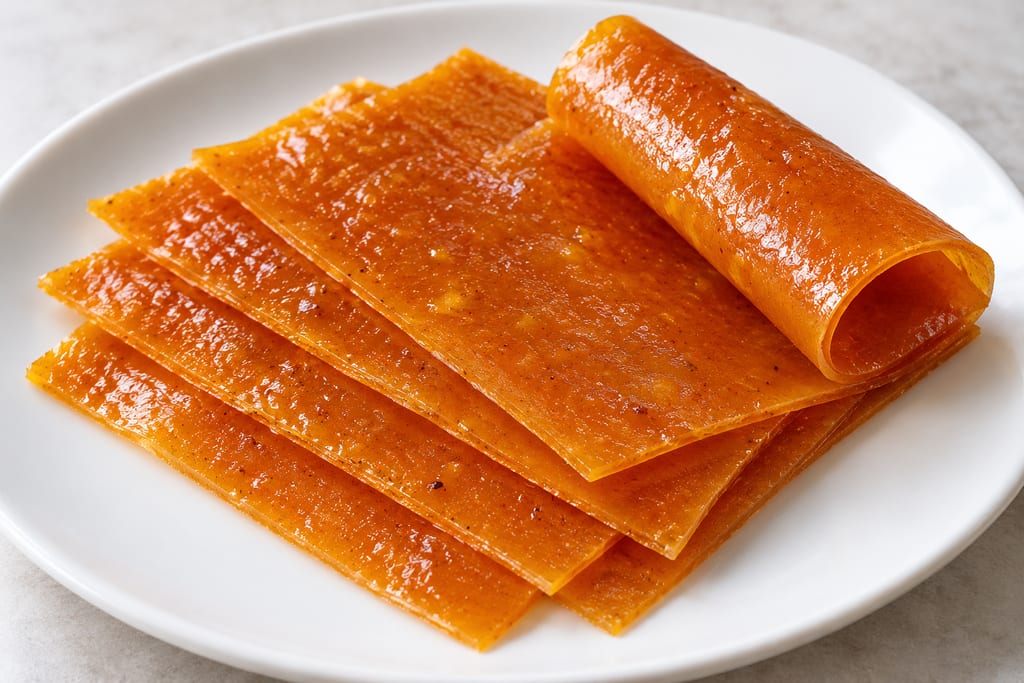
Ripe mango pulp spread thin and dried as a chewy fruit leather. This entry records one controlled unsweetened experiment and distinguishes it from Bengali sun-dried aamshotto and sweetened or spiced variants.
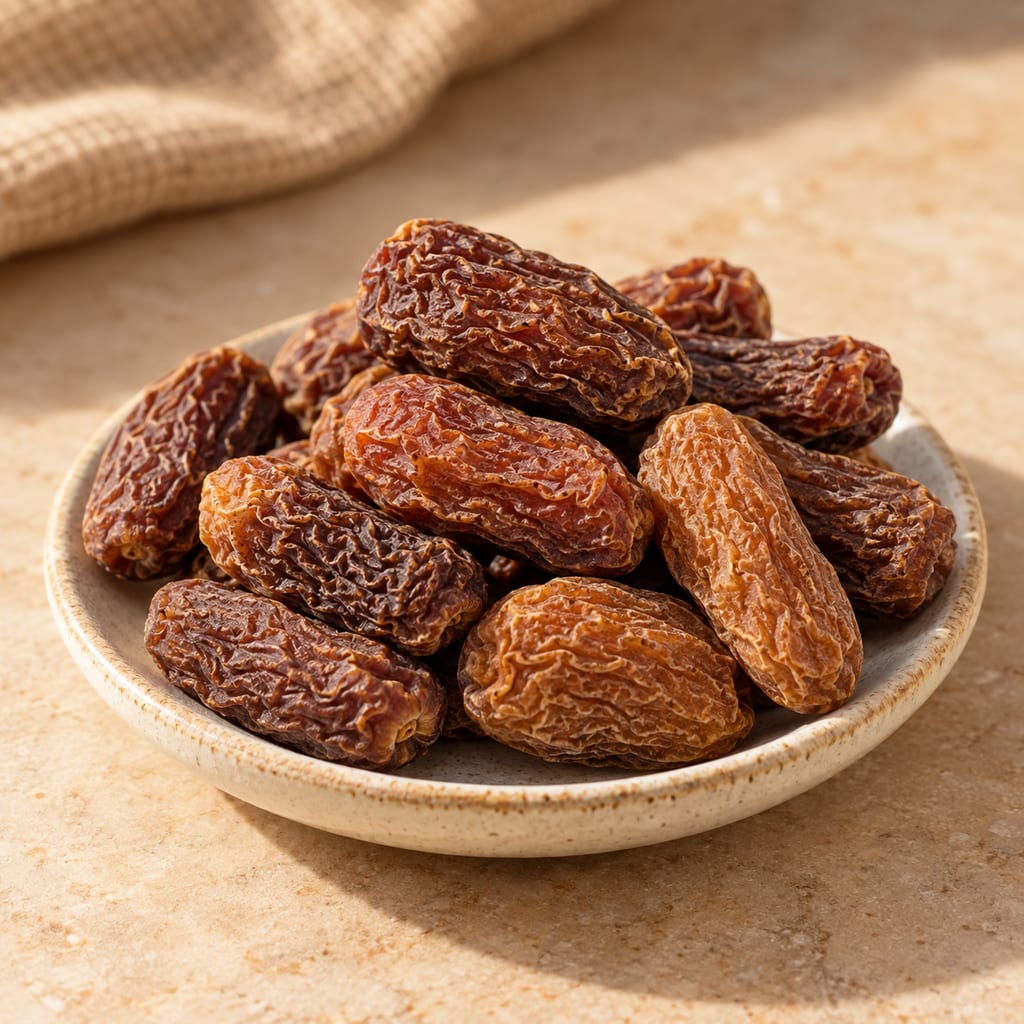
Chuhara is a processed dried-date product named in Pakistani date-production studies, distinct from other dried dates. Its household method is not established.
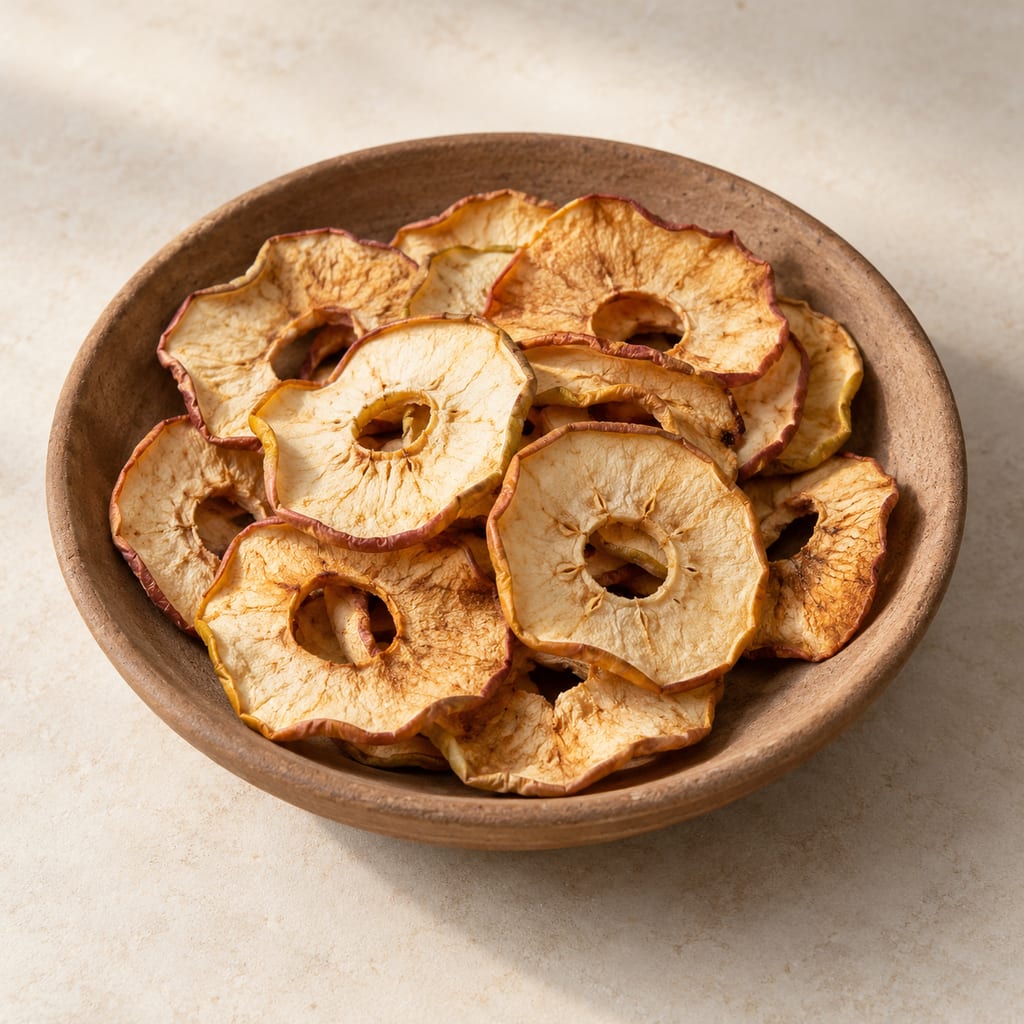
Apple slices dried until most of their water has gone, shrinking and concentrating into leathery or crisp rings, with the modern controls that a plausible old technique turns out to need.
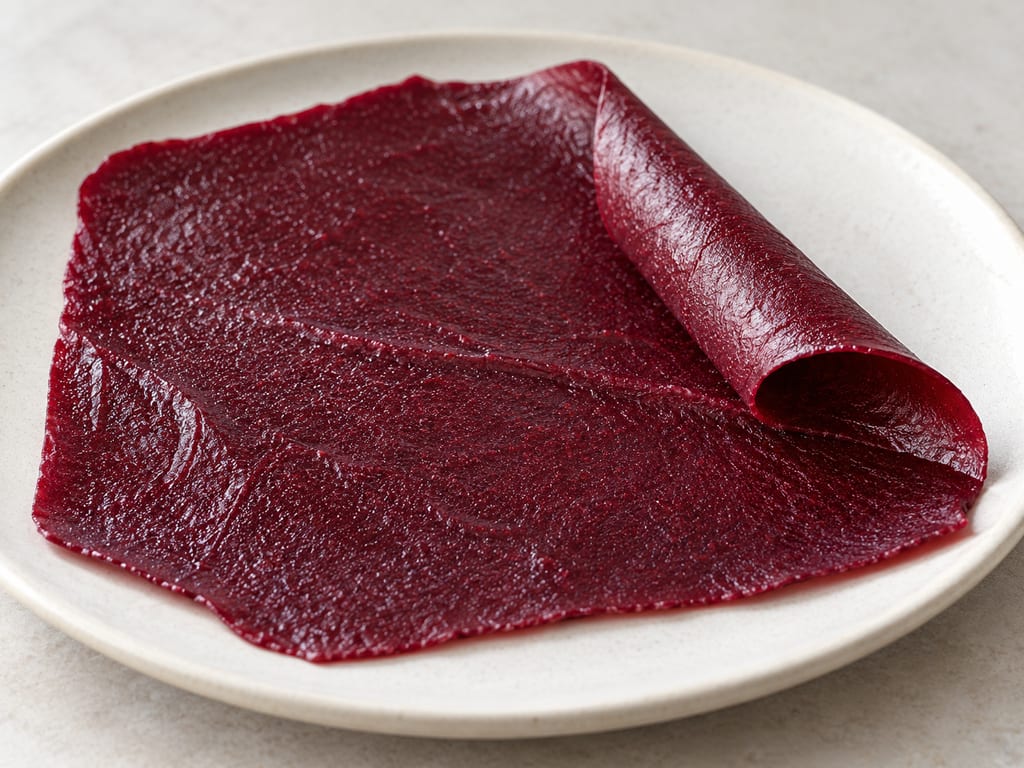
Fruit pulp spread into thin sheets or shaped into cakes and dried, a compact, portable way of keeping fruit in western and central Asia and among Indigenous North Americans.
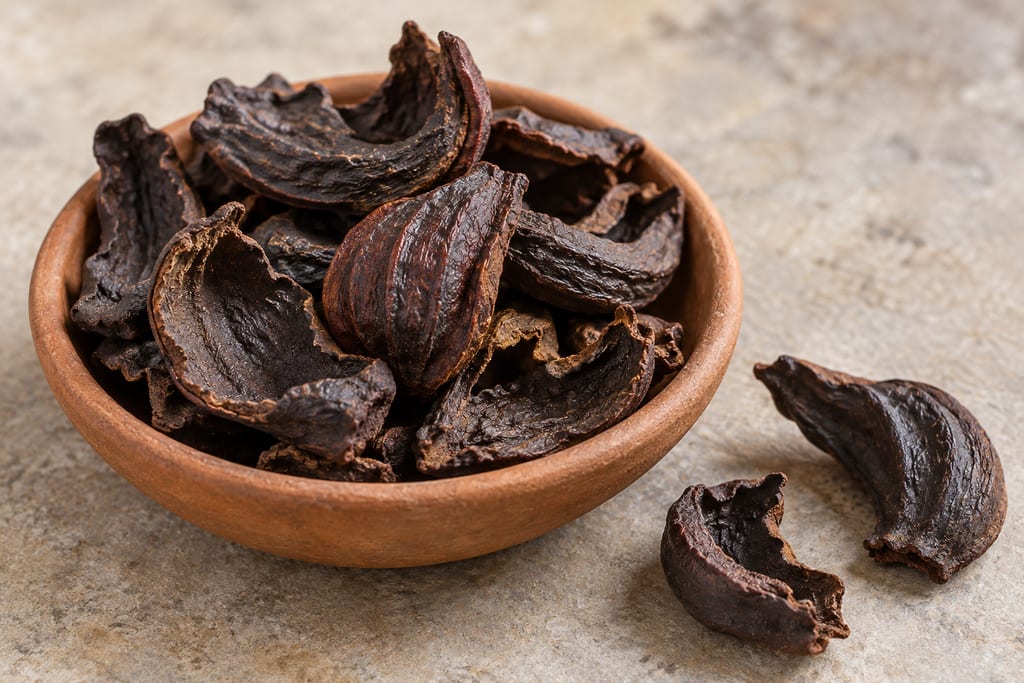
Goraka is the dried rind of Garcinia quaesita, a souring ingredient for Sri Lankan curries. Its drying is documented, but no complete household method is.
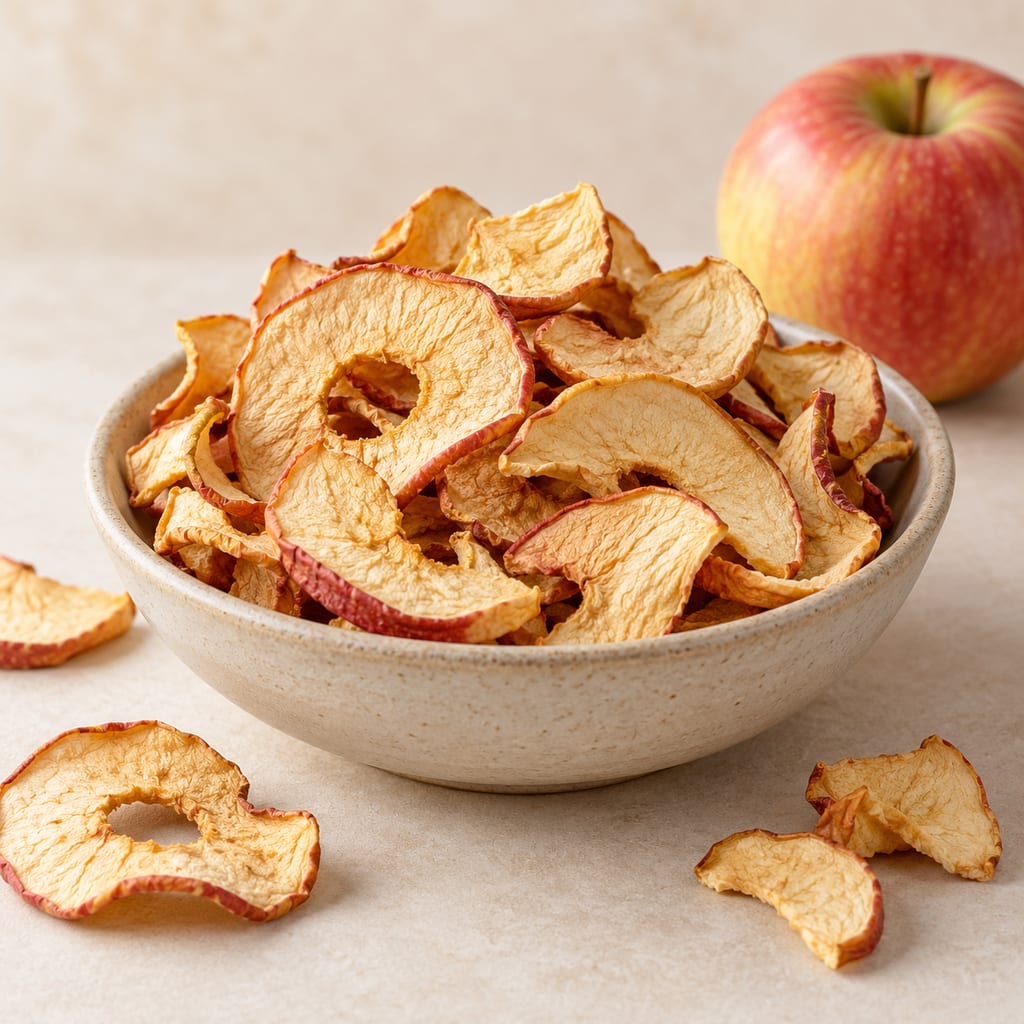
Křížaly are Czech dried apple or pear pieces. The name has regional meanings beyond apple slices, and drying practice varies by place and dryer.
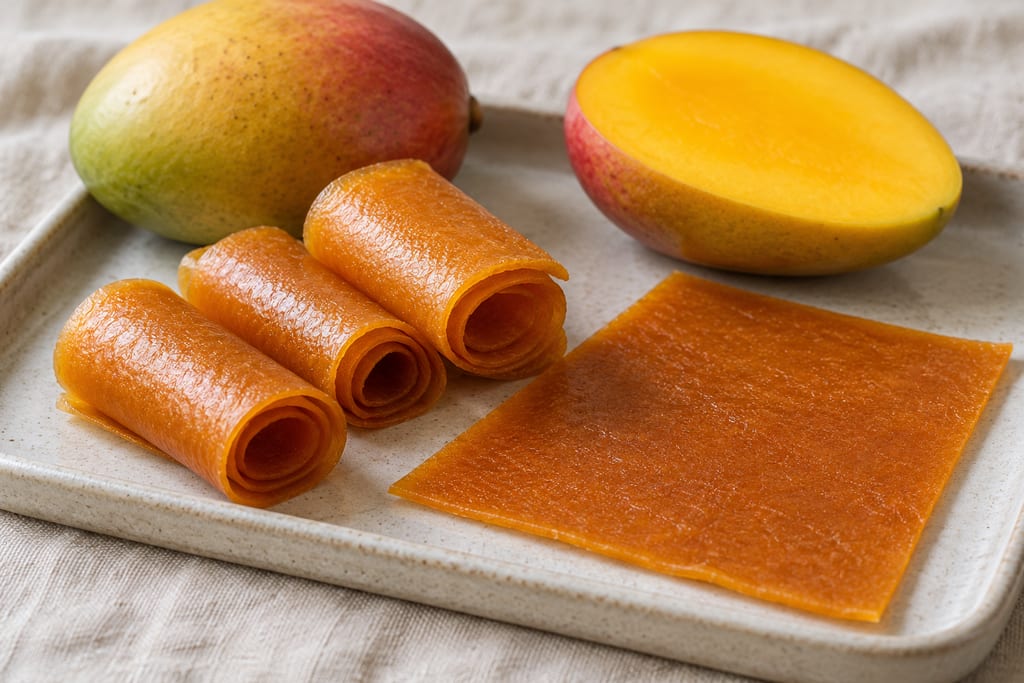
Sieved mango purée with honey and warm spices, spread a quarter inch thick and dried at 140 °F (60 °C) for about 10 hours into a flexible fruit sheet.
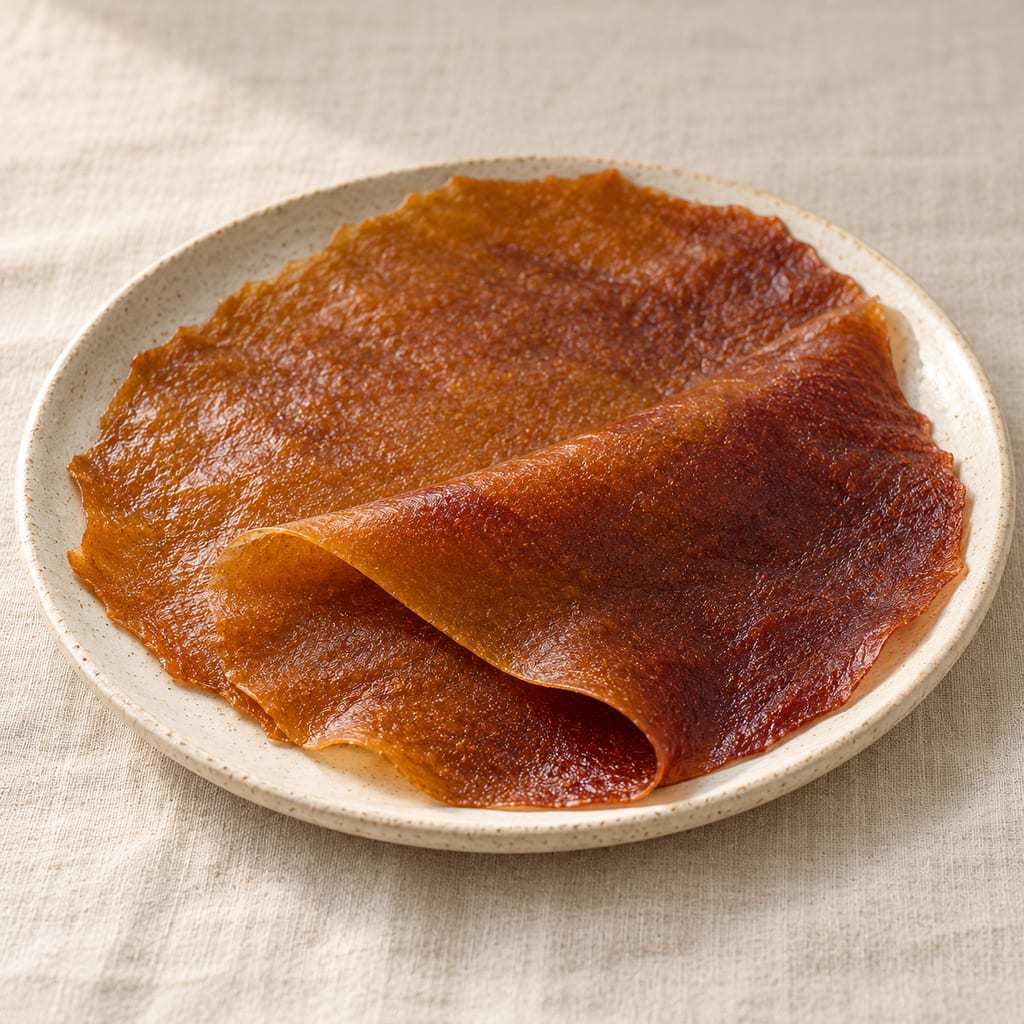
A reported Khizabavra household method cooks mulberry juice with wheat flour into a thin porridge before drying it on cloth; batch measures and a measured endpoint are absent.
No community contributions have been published for this entry yet.
Sign in to contribute. Published comments and photos are free to read.
Plant Archives 24(2), pp. 1350–1356Process · Inspiration
Studies on Morphological Characters of Promising Mango Genotypes for AmchurProcedure starts printed1351/PDF2; stages and five-fruit yield printed1352/PDF3 (zero-based2).
Cited in: A dry souring fruit; Printed traces and a history with limits; The five-fruit account and its stages; Drying changes the fruit and the result; Forms, fruit varieties and regional differences; Handling the household result; A seasonal souring ingredient, not a universal formula
National Center for Home Food PreservationSafety
Sun DryingOutdoor fruit drying needs protection from birds and insects; take drying food inside at night or when rain threatens.
Cited in: The five-fruit account and its stages; Drying changes the fruit and the result; Handling the household result
Indian Medical Gazette, via PubMed CentralHistory · Composition
Amchur or Dried Mango-Pulp as an AntiscorbuticAn 1885 article uses amchur in its title and reports analysis of three sun-dried mango-pulp samples, including citric and malic acids.
Cited in: Printed traces and a history with limits; Why an unripe mango tastes different; A seasonal souring ingredient, not a universal formula
Historical medical journal, via PubMed CentralHistory · Variation
Notes on the Prevention and Treatment of Scurvy in Peace and WarAn 1886 account records amchur in market and household use and describes seasoned household variations.
Cited in: Printed traces and a history with limits
International Journal of Chemical Studies, 6(6), 1570–1573Process · Composition · Variation
Influence of variety and drying methods on yield and quality of the Amchur prepared from fallen unripe mango fruitsThe 2016–17 experiment compared five varieties and sun versus tray drying; measured product qualities varied by variety and drying method, and moisture increased during the study's storage period.
Cited in: Why an unripe mango tastes different; Drying changes the fruit and the result; Forms, fruit varieties and regional differences; How cooks use its dry acidity; Handling the household result; A seasonal souring ingredient, not a universal formula
The Oxford Companion to Food, ckbk.comIdentity · Uses · Geography
AmchurDescribes dried unripe mango in northern Indian states, sold as slices or powder, used to sour curries, chutneys and soups.
Cited in: A dry souring fruit; Forms, fruit varieties and regional differences; How cooks use its dry acidity; A seasonal souring ingredient, not a universal formula
Yashwantrao Chavan Maharashtra Open UniversityUses · Geography
HTS401: Introduction to Indian CookingDescribes amchoor in North Indian cooking and seasonal souring use in Uttar Pradesh and Bihar.
Cited in: A dry souring fruit; Printed traces and a history with limits; Forms, fruit varieties and regional differences; How cooks use its dry acidity
Frontiers in Plant ScienceScience
Chemical Composition of Mango (Mangifera indica L.) Fruit: Nutritional and Phytochemical CompoundsReview describes mango fruit composition and general starch, sugar and pectin changes during ripening.
Cited in: Why an unripe mango tastes different