Lines, beams and bunches
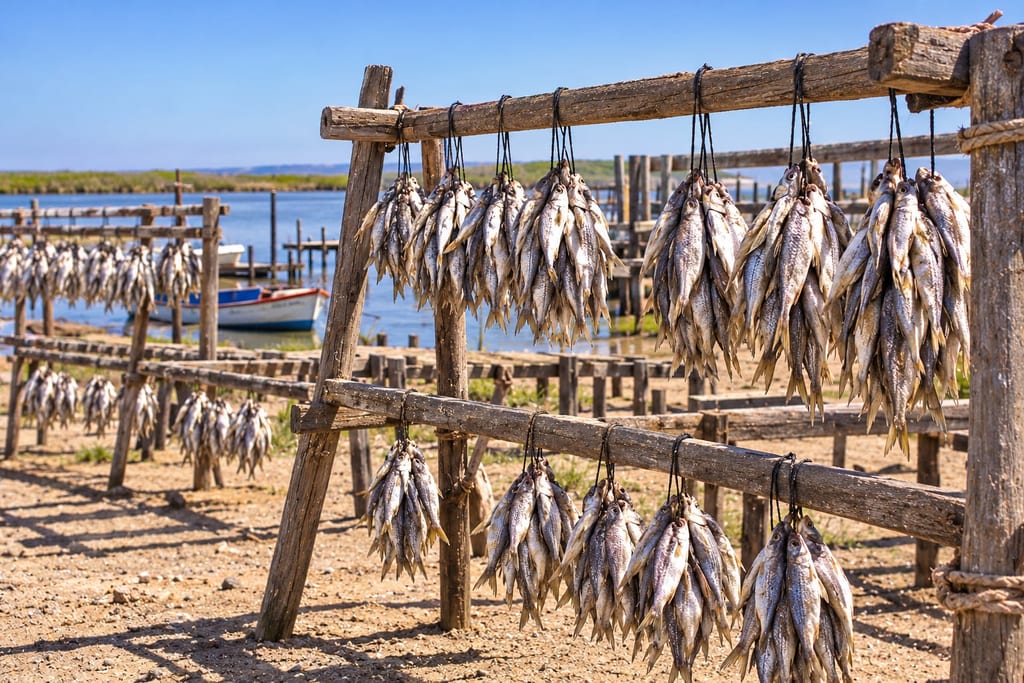
In Velddrif, drying equipment is part of a working fish-house landscape along Bokkomlaan beside the Berg River. Makers thread small harders—local mullet—through the eyes and gather them into bossies, or bunches. In 2024, bundles of ten hang from thread. A maker’s home has beams set up for hanging, with additional space along Bokkomlaan when the household has more fish than its home beams can hold. The reports give no standard rack design, dimensions, wood species or line fibre.
The supports keep whole fish suspended while air reaches their surfaces. The line carries the tied bunch; beams and racks provide places to hang the lines. These open structures are used alongside fish houses rather than as powered dryers. Makers move the bunches between outdoor air and indoor space as their practice and the weather require. This is the documented arrangement, not a universal design.
Sources for this section
A seasonal working system
Fish first sit in salt water for days, are rinsed, threaded into bunches and hung outside; they are then taken inside the fish house to dry, with wind and sun part of the outdoor stage. Amos Jantjies and Luwellon Albridge of Ubuntu Visserye work on Bokkomlaan. The reporting also follows Velancia and Jowinel Dampies’ home business. Their beams and available space determine how many bunches can be worked at once; their home setup was reported to accommodate at most 1,300 bossies. That is a site-specific figure, not a standard rack capacity.
In 2024, Jantjies contrasted about a month in a cooler period with one week in summer. A 2019 visit recorded a 14–21-day summer drying period. These observations under different conditions are not one controlled schedule. A rack or line holds fish but does not measure dryness or establish a food-safety endpoint. Construction plans, cleaning routines, repairs and material specifications are not given.
Sources for this section
Place and limits
This arrangement is documented in Velddrif, on South Africa’s Western Cape coast, especially among makers along Bokkomlaan and at homes serving the local bokkom trade. The 2019 account describes fish threaded belly-to-belly on strings at fish houses; the 2024 report records bundles of ten, outdoor hanging, indoor drying and household beams. Together they establish a system of thread, beams, open air and fish-house space, while leaving construction details unknown.
The reporting concerns people, place and practice rather than a standardized manufactured product. It does not say whether a complete rack is portable, who builds the beams, which materials are food-contact safe, or how supports are cleaned. Nor does it define a validated cure. Seasonal observations belong to their reported setting and are not guaranteed drying instructions.
Sources for this section
History
This drying equipment is documented on Bokkomlaan, Velddrif, in 2019 and 2024. The reports do not date its first use.
Equipment details
PowerAmbient or cellar Outdoor wind and sun are used; hanging also occurs inside a fish house. No powered airflow or heat is described.
How you get oneNot established Reports show working lines and beams but do not say whether makers build, buy or commission them.
CareAvailable reporting gives no construction, cleaning, repair or storage instructions.
Made of
- Thread or line; beam and rack material unspecified — Suspends fish bunches for drying
Reports name thread and beams but do not identify fibre, wood species, dimensions or standard construction.
Limits
The supports do not establish a fixed drying time. A Velddrif maker contrasted about one month in a cooler reported period with one week in summer; weather affects production.
Source →