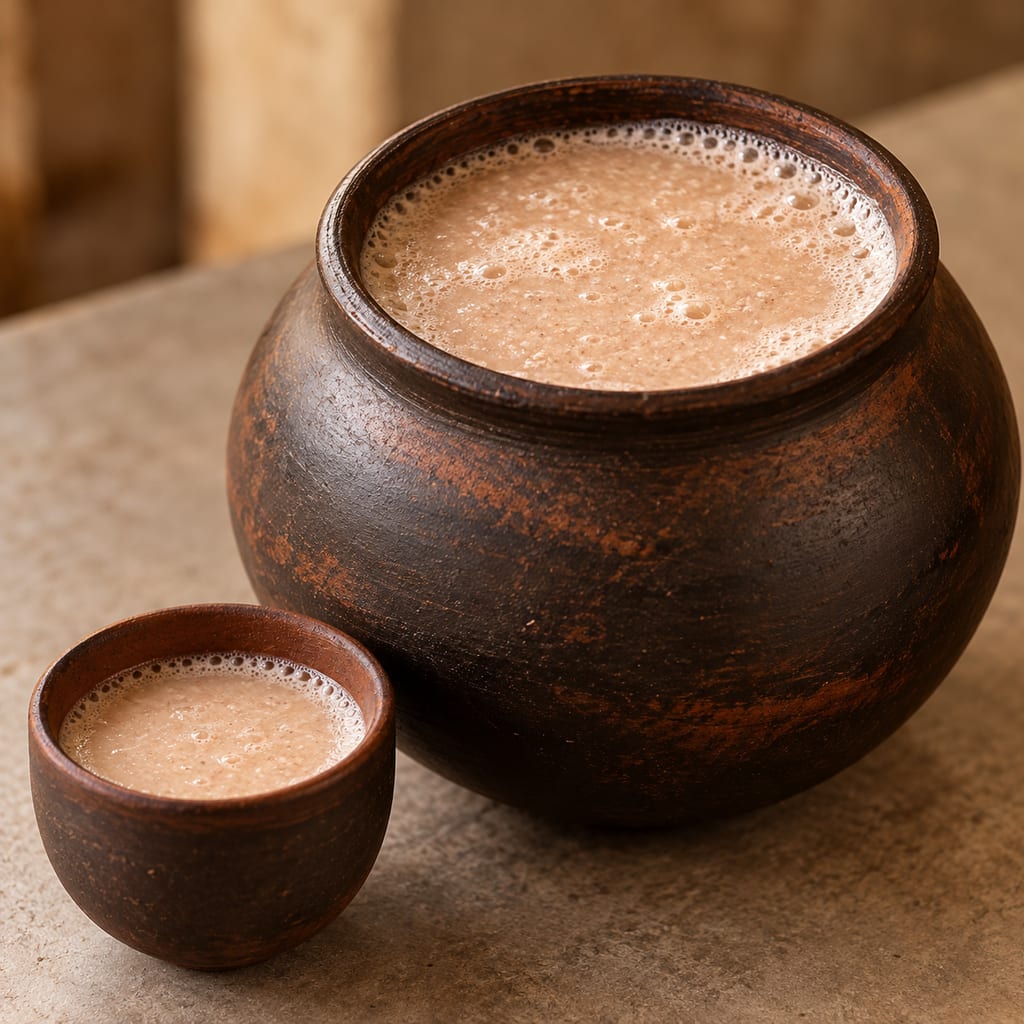
Umqombothi
South Africa's opaque sorghum beer, soured by lactic acid bacteria before its mash is cooked and fresh malt stirred in, leaving a cloudy, creamy, cereal-thick drink that keeps only a day or two.
 FermenteaWhere food goes to change
Equipment · Jars, pots and crocks
A Zulu earthenware brewing vessel used for grain beer; a woven basket cover keeps out dirt and insects. Imbiza is a distinct pot class, not the serving ukhamba or transport uphiso.
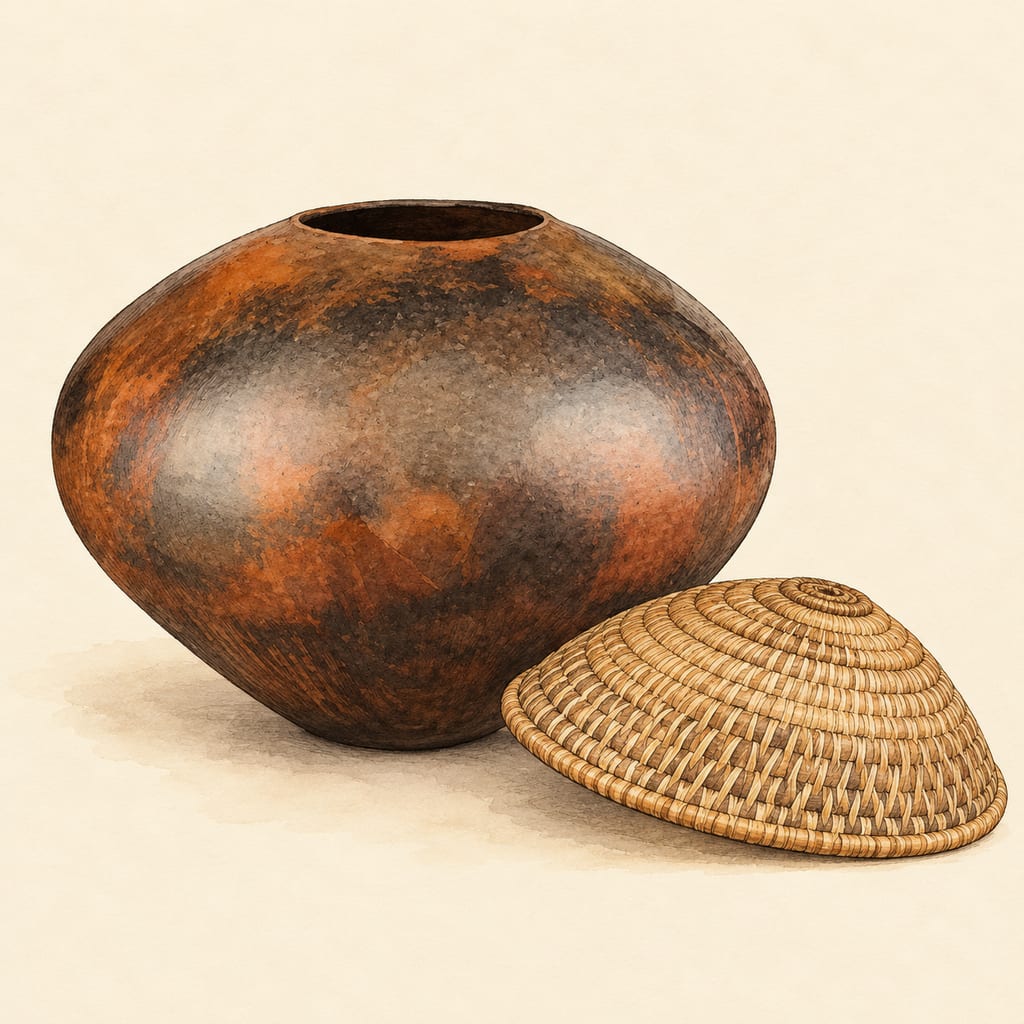
Imbiza (plural izimbiza) names a Zulu beer-vessel class used for brewing. It is not a catch-all word for every pot that touches beer. Frank Jolles's classification separates imbiza from uphiso, ukhamba and umancishana, types that have different roles and forms. A separate study of Zulu-speaking potters in KwaZulu-Natal labels two brewing forms imbiza ugaga and imbiza impofana; it distinguishes these from serving forms and transport pots. The record therefore keeps uphiso and umancishana out of its aliases.
The accessible evidence spans different objects and roles. A Princeton museum record identifies a particular late-twentieth-century Imbiza by potter Mncane Zinindeli Nzuza as a beer-storage vessel. Its broad, rounded earthenware body and open mouth make it a useful visual example of an imbiza, but the museum does not say that this object is the brewing example in the process descriptions. The object is 68.6 cm high and 58.4 cm across; those measurements are specific to Nzuza's vessel, not a standard size.
The brewing vessel is described as a substantial clay pot. In UThukela fieldwork, potters made pottery from locally selected clays and shaped vessels by building coils around a slab base, smoothing the joins and shaping the rim. Tools, clays, surface treatments and firing fuel differed between the upper and lower basin; these observations describe those potters and should not be turned into a single mandatory recipe for every imbiza.
A woven basket lid over the brewing pot keeps dirt and insects out. The cited account does not describe a gasket, water seal, or pressure-locking lid. An imbiza's open mouth and basket cover should therefore not be depicted or explained as an airtight fermentation system. Surface finish also needs care: Jolles found no evidence for characteristic blackened Zulu ceramic ware before the mid-nineteenth century. A black or burnished finish can identify a documented style or object, but cannot by itself prove an ancient lineage.
In the described process, grain beer remains in the large clay imbiza through brewing and fermentation. A woven cover helps shield the vessel from larger debris and insects while leaving it unlike a modern airlocked fermenter. One museum account gives about a week for sorghum beer to ferment; that is a reported process duration, not a promise that every household batch or season follows the same schedule. The pot is part of a larger sequence, from preparing the grain mixture through fermentation and onward to serving.
For the reader following a South African opaque sorghum-beer preparation, the related Umqombothi recipe provides that process context. The recipe also records that household equipment and methods vary, including contemporary plastic or metal vessels; linking it here identifies a documented traditional option without implying every version uses an imbiza. Serving vessels remain separate: ukhamba is a communal beer vessel, while uphiso is a named transport pot in the typology.
Zulu pottery is not one unchanging regional design. Jolles grouped twentieth-century beer vessels into several styles associated with areas including Phongolo, Nongoma, Hlabisa, Melmoth-Eshowe, Lower Thukela and Msinga, while noting that movement of people and pot-making families blurred those boundaries late in the twentieth century. The UThukela study adds detailed field observations from the upper and lower basin in KwaZulu-Natal. These accounts support a South African and regionally varied context, not one village of origin for all imbiza.
The sources reviewed here describe modern and twentieth-century examples, but do not establish when imbiza brewing vessels first appeared. The historical caution about blackened ceramics concerns the period for which that surface tradition is evidenced; it is not an invention date for the pot itself. A separate late-twentieth-century object by Nzuza is a documented example, not a template for every potter or family.
The UThukela field study records women potters gathering and preparing clay, shaping pots with coils, drying them, firing them in shallow pits or depressions and applying different finishing treatments across the upper and lower basin. It is a study of pottery practice, not a step-by-step construction specification for this one pot. Princeton's named example confirms an individual maker and an earthenware body; it does not provide a universal commission route. Readers seeking one would need to consult a contemporary potter or cultural institution directly, and the sources here do not establish cost, availability, a standard capacity or a care schedule.
Jolles's study classifies twentieth-century vessels by four distinct types and regional styles, and finds no evidence for characteristic blackened Zulu ceramic ware before the mid-nineteenth century. A late-twentieth-century earthenware Imbiza (beer storage vessel) by Mncane Zinindeli Nzuza is held by Princeton University Art Museum. These records document later forms and a specific object, not an ancient origin date.
The documented woven basket cover keeps dirt and insects out; sources do not describe it as an airtight seal or pressure-control device.
Source →The imbiza name identifies a brewing-pot class; a serving ukhamba, transport uphiso and umancishana are separately classified vessel types, not interchangeable names for this pot.
Source →These sources identify Zulu beer and imbiza brewing vessels in South Africa; this country-level association is not a claim of a single origin or exclusive use.
Ethnoarchaeological fieldwork among Zulu-speaking groups documents pottery making in the upper and lower UThukela Basin; its typology distinguishes beer-brewing izimbiza from serving and transport forms. This is a documented region, not an asserted point of origin.
South Africa's opaque sorghum beer, soured by lactic acid bacteria before its mash is cooked and fresh malt stirred in, leaving a cloudy, creamy, cereal-thick drink that keeps only a day or two.
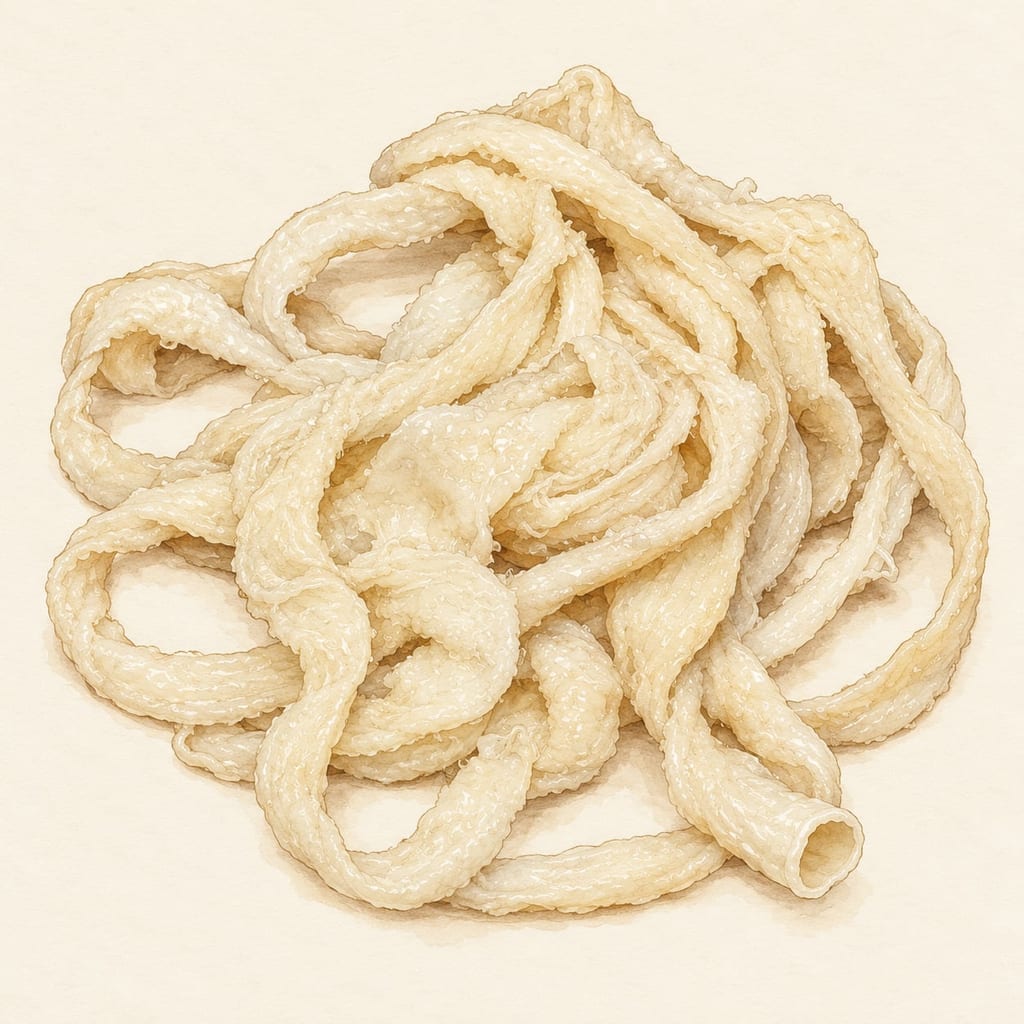
A natural sausage casing is a cleaned animal intestine or, for some products, another prepared organ used as an edible envelope. Its anatomy shapes the sausage, while diameter and material affect stuffing and drying.

Soft, spreadable Calabrian pork sausage made with a great deal of red chilli and fatty pork, stuffed into natural casings, sometimes smoked and matured while staying soft.

A way to add independent temperature logging to an existing food dehydrator without changing its built-in controls or protections. It is a monitoring method, not a rewiring plan.

Pleurotus cystidiosus is the abalone mushroom, a cultivated oyster-type fungus with dark brown caps that grows more slowly and is more demanding than other Pleurotus species.

A dark, balanced vinegar from Emilia-Romagna made by combining cooked or concentrated grape must with wine vinegar, then acetifying and refining it in wood under a protected specification.

A living dairy inoculum that starts controlled cream fermentation, developing acidity and aroma before sour cream or cultured butter is finished.

A small electric incubator holds jars at a selected temperature for yogurt and other documented warm food preparations. Controls, capacity and vessel arrangement vary by model.

Adygean salt is a seasoned table salt associated with Adygea and the wider North Caucasian culinary tradition. Salt is blended with garlic and a variable selection of herbs and spices; the exact mix depends on the named style and maker.

The African Caesar-group mushroom, Amanita masasiensis, is a wild ectomycorrhizal species of central and southern African woodlands, eaten locally. The genus contains deadly poisonous species, so identification needs care.
No community contributions have been published for this entry yet.
Sign in to contribute. Published comments and photos are free to read.
Wiener Museum of Decorative Arts (WMODA)Brewing vessel function · Basket cover · Beer context
Zulu BeerThe article describes large clay vessels called imbiza used during roughly week-long sorghum-beer brewing and fermentation, covered with woven basket lids to keep out dirt and insects.
It distinguishes ceremonial serving in ukhamba and describes Zulu beer's social and ritual settings.
Cited in: Clay body, open rim, woven cover; Holding grain beer through brewing and fermentation
Southern African Humanities, vol. 17Vessel classification · Regional variation · Chronology
The origins of the twentieth century Zulu beer vessel stylesThe study classifies four distinct beer-vessel types: imbiza, uphiso, ukhamba and umancishana; it documents regional form and surface variation.
It reports no evidence for characteristic blackened Zulu ceramic ware before the mid-nineteenth century; this does not establish the invention date of imbiza.
Cited in: A brewing pot, distinct from the vessels around it; Clay body, open rim, woven cover; Holding grain beer through brewing and fermentation; A regional record, not a single origin story
Antiquity Project Gallery, Cambridge University PressRegional field research · Pottery making · Brewing pot distinction
Ethnoarchaeology of Zulu pots in the UThukela Basin, KwaZulu-Natal, South AfricaFieldwork in 2012 included interviews with six potters in the upper and lower UThukela Basin; the paper describes regional clay choices, coil construction and firing variation.
Its pottery typology names izimbiza ugaga and impofana for beer brewing, separately from izinkhamba for serving or storing and iziphiso for transport.
Cited in: A brewing pot, distinct from the vessels around it; Clay body, open rim, woven cover; A regional record, not a single origin story; Making and obtaining one
Princeton University Art MuseumSpecific object and material · Late twentieth century example · Maker and geography
Imbiza (beer storage vessel), object 2025-15The museum identifies a late-twentieth-century earthenware Imbiza (beer storage vessel) made by Mncane Zinindeli Nzuza, born in the Sese Area of the Lower Tugela River Valley in KwaZulu-Natal and active in the province.
Its dimensions belong to that particular storage vessel and are not generalized to brewing imbiza; the museum states that the image is copyright or otherwise restricted.
Cited in: A brewing pot, distinct from the vessels around it; A regional record, not a single origin story; Making and obtaining one