
'Nduja di Spilinga
Soft, spreadable Calabrian pork sausage made with a great deal of red chilli and fatty pork, stuffed into natural casings, sometimes smoked and matured while staying soft.
 FermenteaWhere food goes to change
Built structures · Cellars, caves and ripening rooms
Brick evaporative cooling chamber · Brick and sand cooler · Evaporative cooling chamber
A built-in-place, double-walled brick chamber with the space between the walls filled with sand that is kept wet. Water evaporating from the sand cools the produce stored in shaded crates inside.
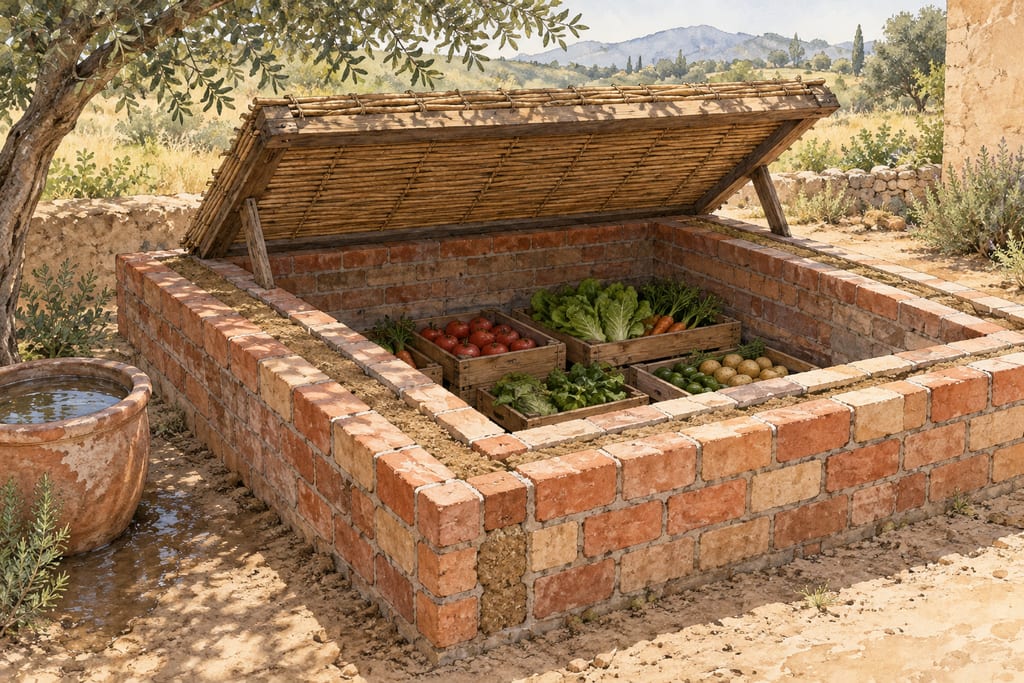
A brick evaporative chamber stands on the ground or part way into it. Two walls of brick enclose a gap filled with sand. The sand is kept wet, and as the water evaporates the chamber's interior cools. Vented crates of produce sit inside the chamber, and the top is covered to keep the sun off.
The design is built in place and is not portable. The work of MIT D-Lab, with the World Vegetable Center and Movement e.V., published a guide in 2018 covering clay pot coolers and brick evaporative cooling chambers.
Water in the sand evaporates into the air in the gap. Evaporation takes heat from the sand and the walls, and the cooled walls lower the air inside. Water must be added regularly, usually about once a day, because the rate of evaporation depends on the weather.
The inspected summaries report a minimum internal temperature about 10 to 15 °C cooler than the surrounding air. That figure comes from the Engineering for Change listing and should be checked on site.
Testing in Mali reported shelf life of up to 10 days for hot peppers and eggplant, 8 days for tomatoes and 7 days for okra. Without cooled storage the same produce lasted 2 to 4 days, according to the Engineering for Change listing.
These are trial results for particular crops in one climate. They do not show that the chamber suits other produce or wetter places.
Evaporative cooling works best in dry air. In wet seasons the sand stays wet and the effect shrinks, and rain can wet the chamber from outside. Standing water also breeds insects and must be avoided.
The chamber does not suit produce that needs dry storage, and it is not a refrigerator for meat. A traditional form or a locally made design needs an authenticated plan and a check of water hygiene, refill demand and insect control.
The brick evaporative chamber was developed in MIT D-Lab work in partnership with local groups, and its design is open-source. The inspected summaries do not date the earliest use of brick evaporative chambers.
A build is made where it stands: moving it means building it again.
Standing water in the sand and wet surfaces can carry insects and hygiene risks.
Hazard sourceKeep the water supply clean and the sand moist but not standing, and keep the chamber covered and shaded
Control sourceThe chamber does not hold produce that needs dry storage. Check the internal temperature against local ambient before storing any produce.
No source in this record establishes a place.
Soft, spreadable Calabrian pork sausage made with a great deal of red chilli and fatty pork, stuffed into natural casings, sometimes smoked and matured while staying soft.

A way to add independent temperature logging to an existing food dehydrator without changing its built-in controls or protections. It is a monitoring method, not a rewiring plan.

Pleurotus cystidiosus is the abalone mushroom, a cultivated oyster-type fungus with dark brown caps that grows more slowly and is more demanding than other Pleurotus species.

A dark, balanced vinegar from Emilia-Romagna made by combining cooked or concentrated grape must with wine vinegar, then acetifying and refining it in wood under a protected specification.

A living dairy inoculum that starts controlled cream fermentation, developing acidity and aroma before sour cream or cultured butter is finished.

A small electric incubator holds jars at a selected temperature for yogurt and other documented warm food preparations. Controls, capacity and vessel arrangement vary by model.

Adygean salt is a seasoned table salt associated with Adygea and the wider North Caucasian culinary tradition. Salt is blended with garlic and a variable selection of herbs and spices; the exact mix depends on the named style and maker.

The African Caesar-group mushroom, Amanita masasiensis, is a wild ectomycorrhizal species of central and southern African woodlands, eaten locally. The genus contains deadly poisonous species, so identification needs care.
No community contributions have been published for this entry yet.
Sign in to contribute. Published comments and photos are free to read.
MIT D-LabDesign · Method
Evaporative Cooling Best Practices Guide2018 guide covering clay pot coolers and brick evaporative cooling chambers, with the World Vegetable Center and Movement e.V.
Cited in: Overview; Limits
MIT D-LabProject
Brick Cooling ChambersBrick evaporative cooling chamber project page.
Cited in: Overview
Engineering for ChangeConstruction · Performance · Trials
Evaporative cooling chambersTwo brick walls with sand between; covered with wood, straw or burlap; water added about once a day; 10 to 15 °C cooler than ambient; Mali shelf-life figures.
Cited in: How it cools; Shelf life in trials; Limits