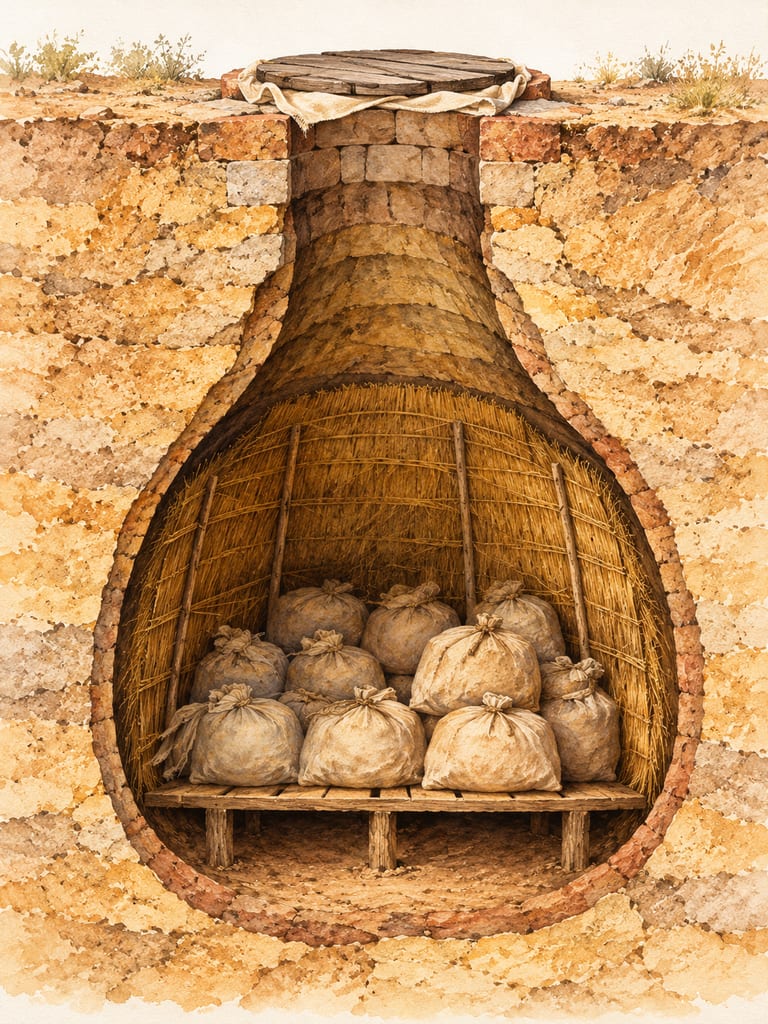
Fossa cheese pit
A sandstone pit near Sogliano al Rubicone finishes the ripening of already-made cheese. Sources describe flask-like forms, straw lining and sealed wooden lids, but no universal excavation plan.
 FermenteaWhere food goes to change
Built structures · Cellars, caves and ripening rooms
metato · metati · seccatoio · seccatoi · essiccatoio
A metato is a small chestnut-drying building found in parts of Italy, with a slow fire below and an open timber floor above where chestnuts dry.
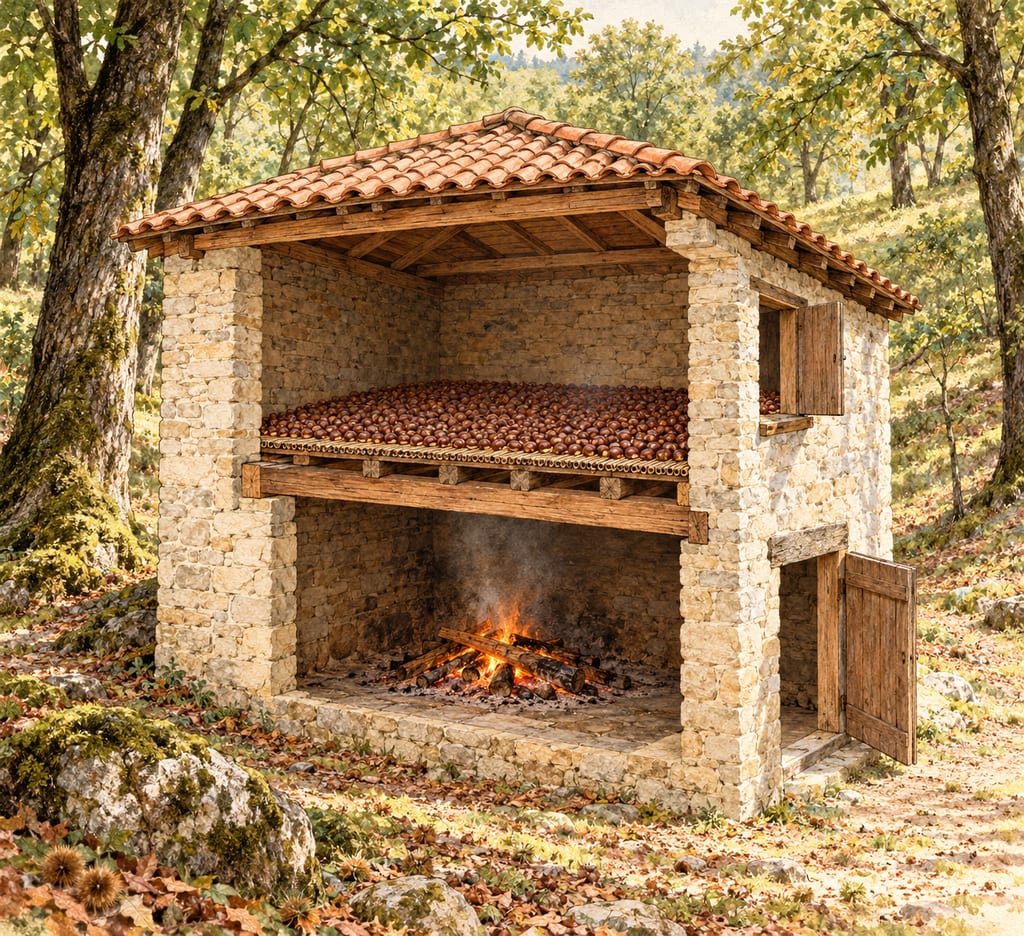
A metato is a small building where chestnuts dry above a low fire. The name is associated with the Val Serchio in northern Tuscany, while related chestnut-drying buildings elsewhere in Italy may be called seccatoi or essiccatoi. A fixed masonry structure belongs to the place where it stands: it is not a portable dryer or a household appliance.
Metati were commonly placed among chestnut groves, close to the harvest and the work of drying. Records also note examples near farmhouses or inside settlements, where the harvest could be watched more closely. The EU specification for Farina di Neccio della Garfagnana ties this architecture to the local chestnut economy: small buildings were constructed for drying, and the region still preserves them as part of its rural heritage.
An Italian heritage catalogue places traces of metati in Garfagnana as far back as the seventeenth century. This dates regional evidence, not every building. The same catalogue says the word metato is typical of the Val Serchio dialect and is also used for similar buildings in other regions.
The usual arrangement described in the regional records is a modest building with a lower fire chamber and an upper drying chamber. At Marola, the municipality describes one room divided into two levels by thin wooden beams. A close layer of wattles, or cannicci, rests on those supports. Chestnuts are spread above the fire rather than placed in a sealed box, allowing warmth and smoke to rise through the drying crop.
The Gallicano heritage record describes a simple square or rectangular masonry structure made with local stones and lime mortar, sometimes mixed with sand. It records timber beams and smaller crosspieces carrying boards and narrow poles laid across them. In that particular example, the side entrance to the combustion chamber has a wooden lintel, while an opening at the back of the drying room admits chestnuts. Those openings are details of a documented building, not a universal template.
Roof forms changed between places and periods. The catalogue describes early roofs of timber boards covered with stone slabs, some roofs of rye straw, and later use of terracotta tiles. The Gallicano building it records has a two-pitched roof with slate on one side and tiles on the other. These alternatives should remain separate examples rather than being combined into a newly invented standard roof.
The documented construction features support a broad sequence: a small local-stone masonry shell; two vertically arranged chambers; a timber-supported upper drying floor; and a roof selected from the coverings actually recorded for the region. They do not provide foundations, wall thickness, beam sections, spans, fasteners, a mortar formula, a chimney design, or dimensions for the doors and loading opening. The steps on this page summarize known features and cannot be used as a structural drawing or a modern building specification.
The records also emphasize upkeep. The heritage catalogue says the simple buildings required regular maintenance and periodic repairs. That observation matters because the walls, roof, upper timber floor and nearby fire all belong to one structure, but the source gives no load ratings or modern safety clearances. Any new construction or reuse would need site-specific structural and fire-safety design from qualified local professionals.
The fire was kept low and steady, not driven like a cooking flame. In the Gallicano record, chestnut wood is burned at the centre of the lower chamber; larger logs are added after ignition to extend the heat, and husks left from the previous year's crop are placed over the fire. The Marola account likewise describes a fire on the stone floor that burns slowly for about forty days. The catalogue gives roughly forty to forty-five days for its recorded practice and says frequent supervision and experience were necessary.
Those timings are not a universal specification. A 2025 study of two metati in Molazzana reports chestnut-drying runs of forty-four and sixty-three days in 2023. Differences in the building, crop, weather and operator may matter, but the study does not turn those two measurements into a general operating rule. What is consistently documented is the long, gradual drying period and the close attention it demands.
Drying made chestnuts easier to store, peel and mill into flour, an important food in mountain communities. The municipal account of Marola traces dried chestnuts to mills along the Tresinaro stream. The Garfagnana PDO specification connects slow metato drying with the flour's characteristic chestnut flavour and slightly bitter aftertaste; it also records the importance of local varieties, stone milling and designated municipalities. The metato is one stage in that chain, not the mill or the finished flour.
The evidence covers particular historic buildings and working practices rather than a modern safe construction recipe. It does not establish exact capacity, dimensions, combustion-air path, fire separation, structural loads or a universal roof and rack arrangement. The account therefore leaves measurements out and distinguishes the Gallicano and Marola examples instead of filling gaps with guessed specifications.
An Italian heritage catalogue records metati in Garfagnana from the seventeenth century and describes a varied local building tradition; that regional trace is not a date for every surviving structure.
A build is made where it stands: moving it means building it again.
The documented metato puts chestnuts on timber-supported cannicci above a fire that burns for about forty to forty-five days; the sources provide no modern fire-separation or clearance design.
Hazard sourceThe records describe local masonry and timber supports but give no wall dimensions, beam sections or load ratings.
Hazard sourceThe historical descriptions do not specify foundations, structural loads, chimney or combustion-air dimensions, or fire clearances; they are not a safe modern construction plan.
The catalogued example and the regional date note do not establish Gallicano as the origin of all metati.
A separate documented example; not evidence that every regional structure shared its exact arrangement.
The EU product specification connects the regional flour tradition with slow drying in metati located in chestnut fields.
A sandstone pit near Sogliano al Rubicone finishes the ripening of already-made cheese. Sources describe flask-like forms, straw lining and sealed wooden lids, but no universal excavation plan.

A gelling polysaccharide extracted from red seaweeds, sold as kanten strips or powder; it sets firm at a low concentration and stays solid until about 85 °C.

A Dominican table and seasoning condiment of sour orange juice, mixed with lime and salt and bottled raw; garlic, oregano or a hot pepper may be added for meat or a spicier bottle.

Cicerbita alpina is an alpine perennial whose tender shoots and leaves have been eaten raw or cooked. Sámi milk preparations and modern Carnian dishes are distinct uses, with serious identification and preservation limits.

Japanese skipjack tuna cooked, then repeatedly smoked and dried over a wood fire by the hand-fired tebiyama method into a hard block for shaving into dashi: the first stage of katsuobushi.

A Swedish-style spirit vinegar made by fermenting neutral alcohol with live vinegar bacteria, with a separate guide to commercial ättika strengths.

A yeast-raised wheat ring shaped from a firm dough, briefly boiled and baked. This source-batch formula gives a gently malted crust and a chewy crumb.

A warm dip of garlic, anchovy and olive oil, often enriched with butter, that Piedmont serves over a flame with raw and cooked vegetables and bread.

Bechamel is a white sauce of milk thickened with a butter and flour roux, one of the French mother sauces, and the base from which Mornay and other cheese and cream sauces are made.
No community contributions have been published for this entry yet.
Sign in to contribute. Published comments and photos are free to read.
Catalogo generale dei Beni Culturali; Istituto Centrale per il Catalogo e la DocumentazioneHistory · Design · Materials · Geography · Process
Metato (non determinabile), catalogue record 09-ICCD_MODI_2062407558461The catalogued Gallicano structure is modest masonry, rests against a slope, and has two pitched roof planes, one tiled and one slate.
The record describes local stone walls with lime mortar, a ground-floor combustion chamber, an upper drying chamber, timber supports, transverse boards and cannicci.
It records different roof coverings, maintenance needs, chestnut-wood fuel, previous-year husk residues, gradual heating for roughly 40–45 days and frequent supervision.
The record says traces of metati in Garfagnana date from the seventeenth century and that the term is typical of the Val Serchio dialect.
Cited in: A chestnut dryer built into its landscape; Two chambers and a permeable floor; A construction outline, not a measured plan; Slow drying and the work of tending the fire; Chestnut flour, local economies and limits of the evidence
Comune di CarpinetiDesign · Use · Geography
Metato di MarolaThe municipal account describes a one-room, two-level dryer with timber beams and a dense cannicci floor.
It records chestnuts loaded through a side window and a slow fire on the stone floor for about 40 days.
It describes local metati around chestnut groves and identifies the Marola example as a current educational site.
Cited in: Two chambers and a permeable floor; Slow drying and the work of tending the fire; Chestnut flour, local economies and limits of the evidence
European Commission, Official Journal of the European UnionHistory · Geography · Documented use
Single document: Farina di Neccio della GarfagnanaThe protected flour is produced in a defined group of municipalities in Lucca province, Italy.
The specification connects its slightly bitter chestnut taste to slow fire drying in metati located in chestnut fields.
It estimates roughly 5,000 metati in the defined area in 1950 and records their preservation as cultural and environmental heritage.
Cited in: A chestnut dryer built into its landscape; Chestnut flour, local economies and limits of the evidence
Foods (MDPI)Modern use · Process · Materials
Comparative Evaluation of Traditional and Controlled Drying Methods of Chestnuts (Castanea sativa Mill.): Impact on the Chemical Composition, Aromatic, and Sensory Profile of FlourThe 2025 study describes metati as two-level structures, typically stone, lime and sand, with chestnuts on upper racks and slow fire below.
It reports two traditional metati in Molazzana producing chestnut flour from 2023 drying runs of 44 and 63 days, demonstrating that durations vary by site.
Cited in: Slow drying and the work of tending the fire