
'Nduja di Spilinga
Soft, spreadable Calabrian pork sausage made with a great deal of red chilli and fatty pork, stuffed into natural casings, sometimes smoked and matured while staying soft.
 FermenteaWhere food goes to change
Equipment · Industrial and laboratory plant
A cocoa-bean winnower cracks roasted beans and separates nibs from lighter shell by airflow, often with sieves. Small-scale methods range from tray-and-hair-dryer winnowing to powered machines.
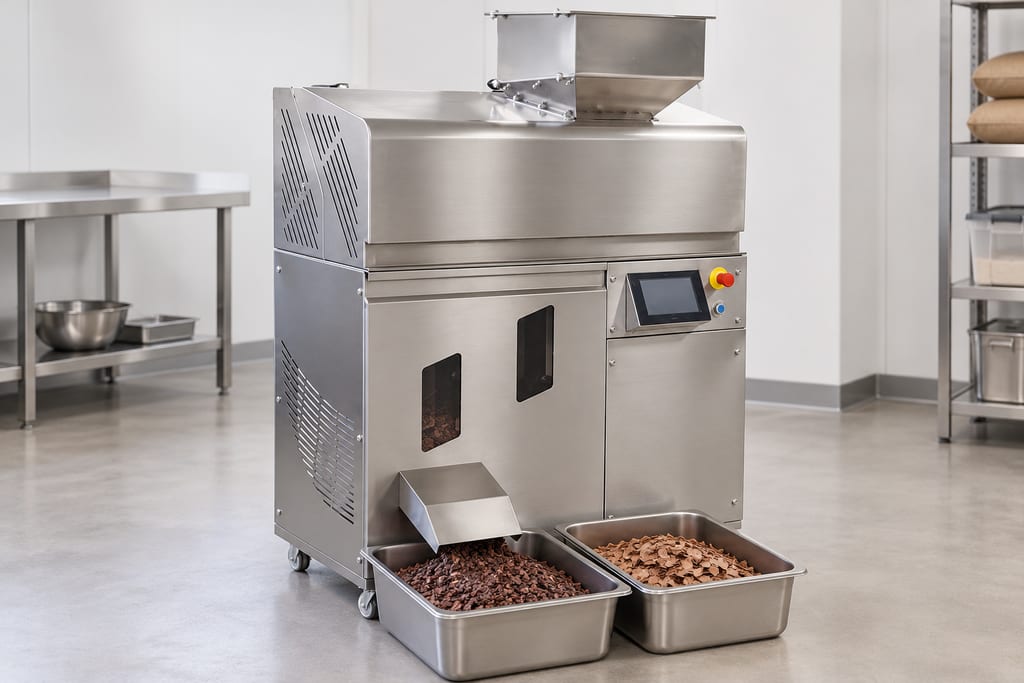
A cocoa-bean winnower separates the shell from the nib after the beans have been roasted and cracked. The kernel fragments that remain are cacao nibs, the material that can then be ground into cocoa mass. Winnowing is a physical sorting step: it does not itself roast, ferment or grind the beans into chocolate.
The supplied recipe-development index names winnowing in the sequence for cacao nibs and chocolate liquor but gives no apparatus description. A 2023 Cacao of Excellence guide supplies a useful distinction between manual, self-made and powered approaches. It does not establish a single historic machine or identify the manual methods as ancient tradition.
For small quantities, the guide documents cracking cacao with a rolling pin and using a hair dryer to blow lighter shell away from the heavier fragments in a shallow tray or bowl. The operator gently tosses the material so more of it meets the air stream. This is a semi-manual method: a common household dryer supplies airflow, while the tray, hand movements and later inspection do the rest.
The same guide illustrates a self-made winnower built from pipe fittings and driven by a vacuum cleaner, with a separate ventilator controlling the flow. Broken beans enter through a hopper; the material can be passed through repeatedly and the outgoing nibs checked. Shells still attached to nibs may need to be removed by hand. These are documented practical approaches, not evidence of an older cultural apparatus or a standard commercial specification.
Commercial and laboratory machines combine controlled breaking with separation. Selmi describes a stainless-steel crushing unit followed by two adjustable air flows that carry peel away from nibs. Its published product page and technical sheet disagree on tank or hopper capacity and hourly rate, so those figures should be confirmed for the exact model rather than blended into one specification. The datasheet names AISI 304 L for food-contact parts, PTFE gaskets, stainless crusher rollers, a 2 kW electric supply and a 110 × 115 × 145 cm footprint.
Bühler's LAB Winnower uses crushing, sieve decks and air classification. Its page describes frequency-controlled crushing, adjustable aspiration and vacuum at each deck, and sampling from the decks to inspect separation. Bühler advertises throughput up to 150 kg per hour for that laboratory machine. This is a different design and capacity from Selmi's bean-to-bar unit; a vendor's maximum is not a general target for cacao processing.
At small scale, a tray and hair dryer need little dedicated equipment but leave more hand sorting. A self-made aspirator adds a feed path and controlled airflow; a powered commercial unit integrates breaking and shell separation for repeated production. The key adjustment is the balance between shell left among the nibs and good nibs lost with the shell stream. Too much crushing creates finer fragments that are harder to separate cleanly, while insufficient cracking leaves larger pieces with shell still attached. The Cacao of Excellence guide therefore emphasizes inspecting the output and removing residual shell rather than assuming that one pass produces a perfectly clean fraction.
For machinery, compare how the model breaks beans, how air and sieves are adjusted, the actual feed and collection arrangement, throughput definitions, power supply, contact materials and cleaning instructions. The figures cited here describe individual manufacturers' products and differ between sources in Selmi's case. No inspected source establishes a single manufacturing origin, global distribution pattern or historical beginning for winnowers as a class.
The supplied RC-V04 intake names winnowing as a step for cacao nibs but describes no apparatus. Cacao of Excellence's 2023 guide documents semi-manual hair-dryer and self-made vacuum/ventilator methods as well as electrical machines; it does not identify these as an ancient or traditional device. Manufacturer pages document current powered examples.
Semi-manual hair-dryer winnowing does not remove every shell; the guide calls for a final inspection and removal of shells that remain attached to nibs. Airflow-based separation also trades shell carry-over against nib loss, so settings must match the machine, feed and desired separation.
Source →Selmi's product page and PDF datasheet report different hopper/tank capacities and hourly rates (5 kg and 50 kg/hour versus 20 kg and 40 kg/hour); confirm current specifications for the exact machine and configuration.
Source →The source set documents current methods and equipment but does not establish a historical origin or a particular traditional winnowing apparatus.
Source →Manufacturer product pages establish current offerings but not manufacturing origin or a place of use. Company contact addresses are not treated as factory locations.
Soft, spreadable Calabrian pork sausage made with a great deal of red chilli and fatty pork, stuffed into natural casings, sometimes smoked and matured while staying soft.

A way to add independent temperature logging to an existing food dehydrator without changing its built-in controls or protections. It is a monitoring method, not a rewiring plan.

Pleurotus cystidiosus is the abalone mushroom, a cultivated oyster-type fungus with dark brown caps that grows more slowly and is more demanding than other Pleurotus species.

A dark, balanced vinegar from Emilia-Romagna made by combining cooked or concentrated grape must with wine vinegar, then acetifying and refining it in wood under a protected specification.

A living dairy inoculum that starts controlled cream fermentation, developing acidity and aroma before sour cream or cultured butter is finished.

A small electric incubator holds jars at a selected temperature for yogurt and other documented warm food preparations. Controls, capacity and vessel arrangement vary by model.

Adygean salt is a seasoned table salt associated with Adygea and the wider North Caucasian culinary tradition. Salt is blended with garlic and a variable selection of herbs and spices; the exact mix depends on the named style and maker.

The African Caesar-group mushroom, Amanita masasiensis, is a wild ectomycorrhizal species of central and southern African woodlands, eaten locally. The genus contains deadly poisonous species, so identification needs care.
No community contributions have been published for this entry yet.
Sign in to contribute. Published comments and photos are free to read.
Cacao of Excellence / Alliance of Bioversity International and CIAT; Bioversity InternationalOperation · Manual and self made methods · Process limits · Care
Guide for the Assessment of Cacao Quality and FlavourDocuments semi-manual cracking and winnowing with a rolling pin and hair dryer, a self-made vacuum-and-ventilator winnower, and electro-mechanical cacao equipment; describes repeated passes and removal of residual shells; dates this guidance to 2023.
Cited in: From roasted bean to nib; Small-scale manual and improvised methods; Choosing and using a winnower
Selmi Group S.r.l.Form · Function · Capacity · Acquisition
Winnower: Roasted cocoa beans crusherCurrent product page describes a machine that cracks roasted cocoa beans and separates peel with two adjustable air flows; lists a 5 kg hopper and 50 kg/hour rate.
Cited in: Powered machines: crushing and air classification; Choosing and using a winnower
Selmi Group S.r.l.Materials · Dimensions · Power · Capacity
Winnower, Roasted cocoa beans crusher: Data sheetDatasheet lists 1100 × 1150 × 1450 mm, 200 kg empty weight, AISI 304 L food-contact surfaces, PTFE gaskets, a 20 kg tank, 2 kW, 220 V single phase and 40 kg/hour production.
Cited in: Powered machines: crushing and air classification; Choosing and using a winnower
Bühler GroupForm · Function · Capacity · Materials
LAB WinnowerDescribes cocoa-bean crushing and shell/nib separation by sieving and air classification; advertises up to 150 kg/hour, adjustable crushing and vacuum/aspiration per sieve deck, and a closed stainless-steel processing zone.
Cited in: Powered machines: crushing and air classification; Choosing and using a winnower