
'Nduja di Spilinga
Soft, spreadable Calabrian pork sausage made with a great deal of red chilli and fatty pork, stuffed into natural casings, sometimes smoked and matured while staying soft.
 FermenteaWhere food goes to change
Equipment · Drying kilns and dryers
A recirculating drying cabinet that removes moisture from its own air in a separate stage and drains the water away. The sources do not establish how well such a cabinet performs at food-drying conditions.
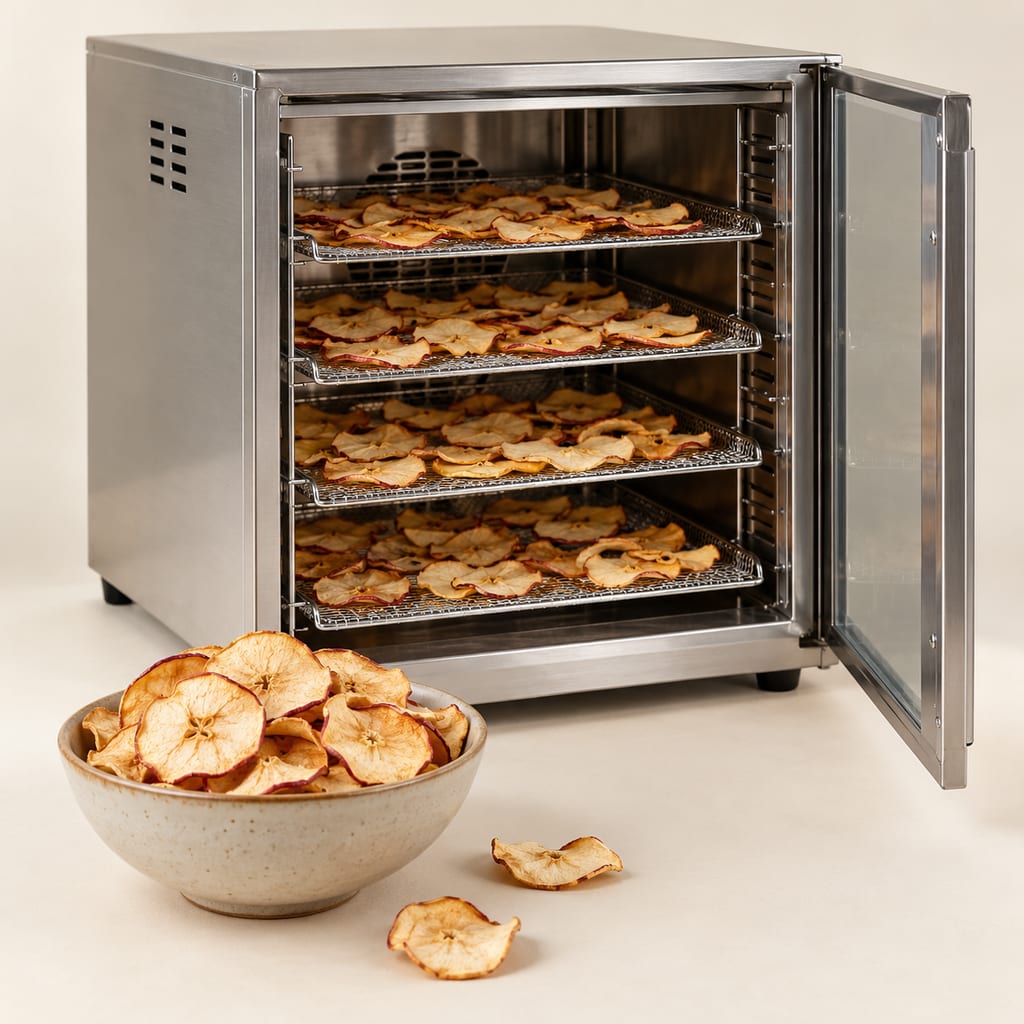
A dehumidifying cabinet dryer is a drying cabinet whose air is recirculated and dried in a separate stage. Warm air carries moisture off the product, passes through a dehumidifying unit that removes the water, and returns to the product dry again. The water leaves the cabinet as condensate rather than as moist exhaust, which is the feature that distinguishes it from a vented cabinet.
The idea suits cool or damp surroundings, where venting outside air would bring in more moisture than it removes. The same closed loop is also the risk: nothing in the loop removes the moisture unless the dehumidifying stage is working and its water is drained away.
Ventilation removes moisture when the air leaving a space carries more of it than the air entering. The WHO guideline states this as a steady-state relation between airflow and the difference in absolute moisture, and it assumes uniform conditions. A recirculating dryer breaks the link to outside air, so its removal rate depends on the dehumidifying unit rather than on the vents.
Where the water goes is a design choice with consequences. A condensing unit has to drain its water, and a leak onto the product or the floor is a hygiene and safety problem. An adsorbing unit has to be regenerated. The sources do not describe either route for food use.
A removal rate, energy use per kilogram of water and a tested food-drying design are not established for this equipment family.
The purpose-built dehydrator is the comparator. It has an enclosed heater, a fan, vents and a thermostat, and its temperature and airflow are designed together. A dehumidifying cabinet has to show equivalent control and a measured removal rate before it can be recommended for a food process.
The steady-state relation for moisture removal by ventilation is documented in the WHO indoor-air guideline. The biltong review describes household fan and light boxes as home practice, but it does not describe a dehumidifier cabinet or a tested food-drying design.
Air that is recirculated without a fresh-air or exhaust path can hold moisture and reduce drying. The sources describe purpose-built enclosed dehydrators, not recirculated dehumidifier loops.
Hazard sourceLog relative humidity and temperature in the product zone during each run
Control sourceDo not treat a dehumidifier's headline capacity as the removal rate at food-drying conditions.
The air path, condensate route and hygiene of recirculated air need review before any food use.
Headline capacity figures for household dehumidifiers are not a reliable guide to removal at food-drying temperature and humidity. Each unit needs measurement under the intended conditions.
SourceThe steady-state moisture relation in the WHO guideline assumes uniform conditions. A drying cabinet with a changing wet load does not meet that assumption, so the simple relation only gives a starting estimate.
Source →Biltong and similar studies report missing industrial relative-humidity and air-velocity records. Any performance claim for this cabinet needs its own logged data.
Source →No source in this record establishes a place.
Soft, spreadable Calabrian pork sausage made with a great deal of red chilli and fatty pork, stuffed into natural casings, sometimes smoked and matured while staying soft.

A way to add independent temperature logging to an existing food dehydrator without changing its built-in controls or protections. It is a monitoring method, not a rewiring plan.

Pleurotus cystidiosus is the abalone mushroom, a cultivated oyster-type fungus with dark brown caps that grows more slowly and is more demanding than other Pleurotus species.

A dark, balanced vinegar from Emilia-Romagna made by combining cooked or concentrated grape must with wine vinegar, then acetifying and refining it in wood under a protected specification.

A living dairy inoculum that starts controlled cream fermentation, developing acidity and aroma before sour cream or cultured butter is finished.

A small electric incubator holds jars at a selected temperature for yogurt and other documented warm food preparations. Controls, capacity and vessel arrangement vary by model.

Adygean salt is a seasoned table salt associated with Adygea and the wider North Caucasian culinary tradition. Salt is blended with garlic and a variable selection of herbs and spices; the exact mix depends on the named style and maker.

The African Caesar-group mushroom, Amanita masasiensis, is a wild ectomycorrhizal species of central and southern African woodlands, eaten locally. The genus contains deadly poisonous species, so identification needs care.
No community contributions have been published for this entry yet.
Sign in to contribute. Published comments and photos are free to read.
World Health OrganizationMethod
Guidelines for Indoor Air Quality: Dampness and MouldSteady-state moisture removal by ventilation equals airflow multiplied by the difference in absolute moisture between indoor and supply air.
The relation assumes steady, uniform conditions.
Cited in: What it is; How the moisture is removed
SciELO South AfricaHistory · Method
Biltong review (Jones et al., 2017)Household fan and light boxes are described for biltong; industrial relative humidity and air-velocity records are missing.
Cited in: What is not established
National Center for Home Food PreservationMethod · Safety
Food DehydratorsPurpose-built dehydrators have enclosed heat, a fan, vents, a thermostat and washable mesh trays.
Cited in: What is not established