
'Nduja di Spilinga
Soft, spreadable Calabrian pork sausage made with a great deal of red chilli and fatty pork, stuffed into natural casings, sometimes smoked and matured while staying soft.
 FermenteaWhere food goes to change
Equipment · Instruments
A densitometer measures density directly or through an instrument-specific cell. For kombucha alcohol analysis, TTB describes measuring specific gravity after distillation; untreated ferment density alone does not isolate alcohol.
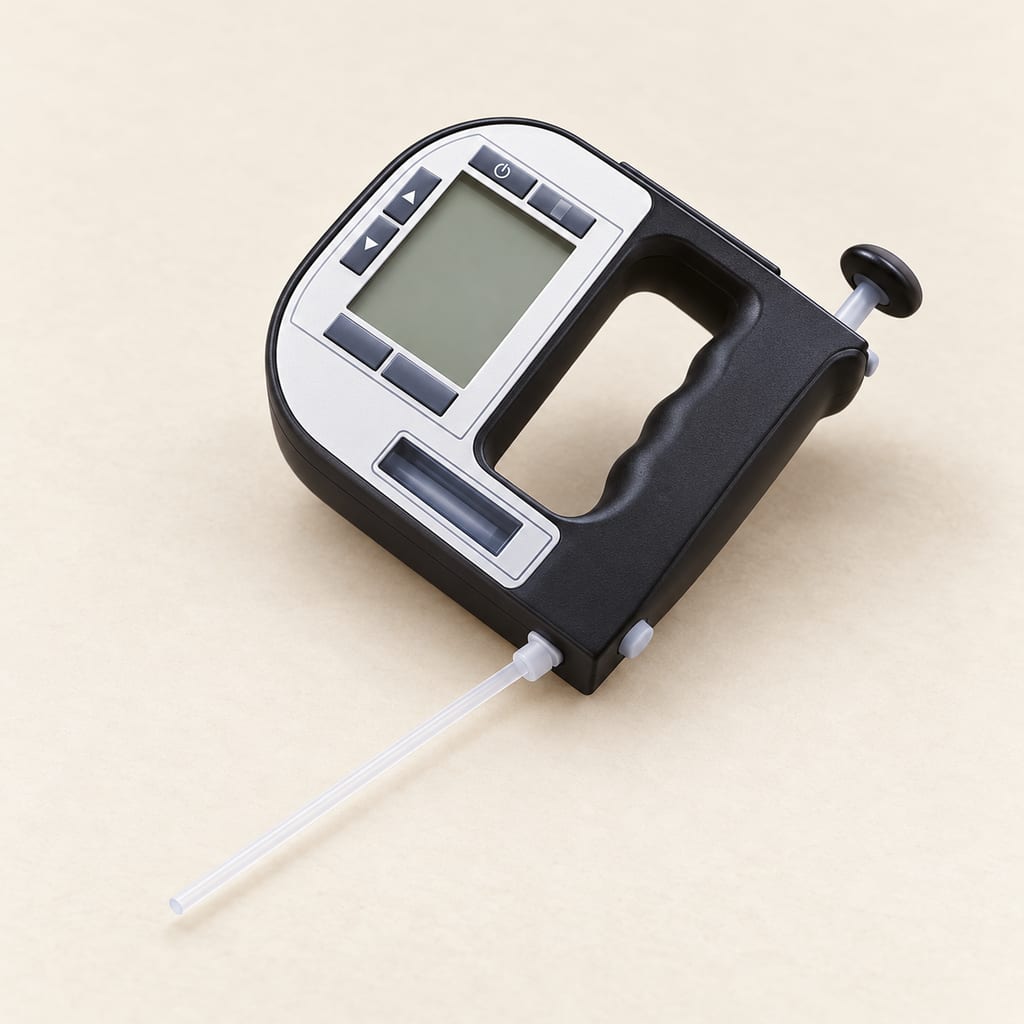
A densitometer measures the density of a material: mass in a given volume. In fermentation work, the result is useful only when the sampling and interpretation fit the liquid and the question being asked. An instrument may report density, specific gravity, or a concentration value calculated from density through a selected scale or table. Those displays are related, but they are not interchangeable statements about what a complex sample contains.
The term covers instruments that determine density by different physical arrangements. The densitometer in the United States Alcohol and Tobacco Tax and Trade Bureau’s kombucha method is used after distillation, in place of a pycnometer for the specific-gravity measurement. That application is analytically distinct from dipping a glass hydrometer directly into an untreated ferment.
One current portable form is the electronic density meter built around an oscillating measuring cell. In the oscillating U-tube principle described by Anton Paar, the filled tube vibrates at a frequency affected by the sample; the instrument determines that frequency and calculates density. Temperature, cell design and sample characteristics affect measurement performance, so an instrument’s stated range and operating conditions matter.
Anton Paar’s DMA 35 Basic illustrates the handheld category: it draws a small sample through a filling tube and can present density, specific gravity or selected concentration scales. Its published product specifications list a 2 mL sample volume and battery operation. These are specifications for that model, not universal properties of densitometers or a recommendation that this handheld model is suitable for every laboratory method.
A density result describes the combined sample. A concentration display is a conversion that depends on a suitable relationship between density and composition, such as a table for a defined solution. When several dissolved compounds are present, one density value cannot identify each of them. A refractometer asks a different optical question, using refractive index and scales such as apparent °Brix; a hydrometer floats and reads a calibrated scale from buoyancy. The three devices should not be treated as synonyms simply because each can appear in a beverage laboratory.
Kombucha makes this limitation especially clear. During its fermentation, ethanol can be produced and consumed; sucrose is hydrolysed, acids accumulate, microbial biomass and cellulose form, and water may evaporate. These changes can move density in overlapping ways. An untreated kombucha density reading therefore cannot, by itself, resolve the alcohol content.
TTB’s kombucha testing FAQ describes distillation followed by specific-gravity measurement using a densitometer instead of a pycnometer (AOAC method 935.21). The sequence separates alcohol before the density measurement; that separation is the point that makes this method different from measuring the original mixed kombucha directly. TTB’s answer is marked last reviewed or updated on 17 September 2015, so it should be read as the agency’s published method description, not as a complete current regulatory guide.
The agency also says that other formally validated or otherwise scientifically valid methods may be used when they are accurate, precise and specific to the intended purpose. That statement concerns analytical methods, not a blanket validation of every instrument or a home measurement. For a result used to establish alcohol content, the method must be appropriate to the sample and the intended accuracy.
Choose by the measurement method first, then check the instrument’s supported units, sample requirements, temperature range, calibration and documented suitability. Some digital density meters report a converted alcohol or sugar scale, but a menu option does not validate that conversion for every ferment. The cited handheld product is one example of an instrument sold for beverage applications; it does not establish that it implements the exact AOAC procedure.
Follow the model’s instructions for sampling, cleaning, calibration and maintenance. A measuring cell has to be filled and handled as its manufacturer specifies; residues, bubbles, temperature differences or an unsuitable sample can undermine a reading. The sources reviewed here do not establish one cleaning procedure or calibration schedule for the instrument class, so these should not be guessed or transferred between models.
The available references establish a current family of manufactured instruments and one long-used analytical application, but they do not establish a single inventor, original place or one universal design for densitometers. Anton Paar’s account of digital density measurement documents an oscillating U-tube form; the TTB method names the densitometer as the measuring instrument without specifying its make, model or sensor design. It is therefore more accurate to describe the digital meter as a contemporary form than to assign its history to the broader instrument category.
Manufactured density meters are sold internationally, with the cited model documented on manufacturer pages for different markets. Their size, power, cell geometry and obtainable service vary by model. Density measurement can support a defined analytical method; it cannot, without a suitable preparation or validated conversion, reveal the unique composition of a fermented liquid.
The source set documents a contemporary oscillating-tube digital form and TTB's use of a densitometer in a distillation-specific-gravity procedure. It does not establish a single inventor, origin place, or shared design for all densitometers.
Density is a combined property of the sample. A displayed concentration requires a suitable conversion relationship and does not identify every component in a complex ferment.
Source →For kombucha alcohol testing, TTB describes distillation followed by specific-gravity measurement with a densitometer. This does not make an untreated kombucha density reading a direct alcohol measurement.
Source →The TTB FAQ's method answer is marked last reviewed or updated 17 September 2015; it is a published method description, not a comprehensive current regulatory guide.
Source →A model specification or selectable scale does not establish suitability for every analytical method; use requires method-specific validation and instrument instructions.
Source →The inspected sources do not establish a specific place of origin or a representative place of use for this equipment category. Manufacturer-specific examples do not establish the geography of the broader type.
Soft, spreadable Calabrian pork sausage made with a great deal of red chilli and fatty pork, stuffed into natural casings, sometimes smoked and matured while staying soft.

A way to add independent temperature logging to an existing food dehydrator without changing its built-in controls or protections. It is a monitoring method, not a rewiring plan.

Pleurotus cystidiosus is the abalone mushroom, a cultivated oyster-type fungus with dark brown caps that grows more slowly and is more demanding than other Pleurotus species.

A dark, balanced vinegar from Emilia-Romagna made by combining cooked or concentrated grape must with wine vinegar, then acetifying and refining it in wood under a protected specification.

A living dairy inoculum that starts controlled cream fermentation, developing acidity and aroma before sour cream or cultured butter is finished.

A small electric incubator holds jars at a selected temperature for yogurt and other documented warm food preparations. Controls, capacity and vessel arrangement vary by model.

Adygean salt is a seasoned table salt associated with Adygea and the wider North Caucasian culinary tradition. Salt is blended with garlic and a variable selection of herbs and spices; the exact mix depends on the named style and maker.

The African Caesar-group mushroom, Amanita masasiensis, is a wild ectomycorrhizal species of central and southern African woodlands, eaten locally. The genus contains deadly poisonous species, so identification needs care.
No community contributions have been published for this entry yet.
Sign in to contribute. Published comments and photos are free to read.
Alcohol and Tobacco Tax and Trade Bureau (TTB), U.S. Department of the TreasuryAnalytical method · Kombucha alcohol
Testing Methods to Measure Kombucha Alcohol ContentTTB describes its general marketplace kombucha method as distillation followed by specific-gravity measurement using a densitometer instead of a pycnometer, AOAC 935.21.
The FAQ says other formally validated or otherwise scientifically valid methods may be used when accurate, precise and specific to purpose; the densitometer answer is last reviewed or updated 17 September 2015.
Cited in: What a densitometer measures; Density is not identity; Why the distillation step matters; History, reach and limits
Anton PaarCurrent product example · Form · Specifications
Handheld Density Meter: DMA 35 BasicThe manufacturer describes an electronic handheld density meter using a built-in pump and filling tube, for density or selected concentration displays.
The published DMA 35 Basic specifications list 2 mL sample volume, 140 × 138 × 27 mm dimensions and two AA batteries; these belong to this model only.
Cited in: A contemporary digital form; Choosing and handling a meter; History, reach and limits
Anton Paar WikiMeasurement principle · Digital form · History
Density and density measurementDescribes digital density meters based on oscillating U-tube: the sample-filled tube oscillates at a frequency from which density is calculated.
Describes sensor and measurement principles; Anton Paar reports its first digital density meter in 1967, a company-reported history milestone rather than an established origin for all densitometers.
Cited in: A contemporary digital form; Density is not identity; Choosing and handling a meter; History, reach and limits