
'Nduja di Spilinga
Soft, spreadable Calabrian pork sausage made with a great deal of red chilli and fatty pork, stuffed into natural casings, sometimes smoked and matured while staying soft.
 FermenteaWhere food goes to change
Built structures · Cabinets and chamber conversions
Forced-air evaporative cooling chamber · Container evaporative cooling room
An enclosed room, based on a used shipping container, in which fans draw hot dry air through wet cooling pads. The cooled air then passes over produce crates. It is an advanced, powered design for hot, dry climates.
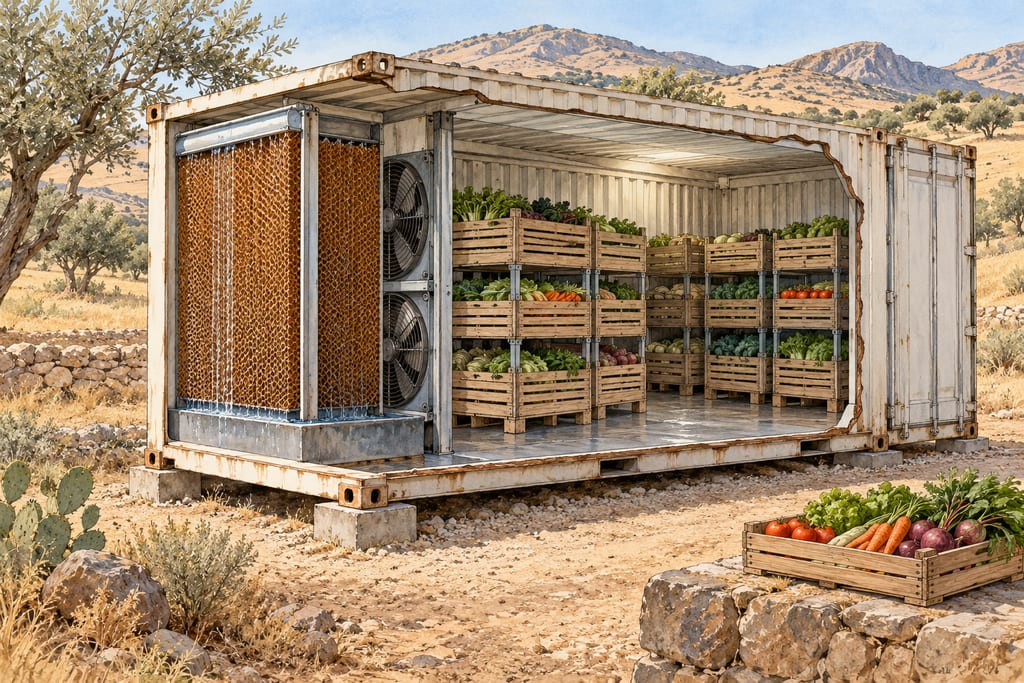
A forced-air evaporative cooling room moves hot dry outside air through a wet pad, where the water evaporates and cools the air. The cooled air then moves through a room of produce crates. Fans and a pump drive the process, which makes it a powered design rather than a passive one.
The MIT open-source design is built in a used shipping container. It is documented in a set of guides covering dimensional design, airflow, electrical, plumbing and construction.
Industrial exhaust fans draw hot dry air into the chamber and through porous wet pads. The water evaporates from the pads and cools the air before it reaches the crates. The pump recirculates water to the pads, and solenoid valves control the flow.
Bypass airflow, where air avoids the pads, lowers the cooling. That is why the design is not simply shrunk: small changes in geometry change how much air meets the pads.
The MIT material states that the design costs about half as much as a typical refrigerated cold room of similar capacity, and uses about one quarter of the energy. These are the design team's comparisons and should be measured against local cold-room prices and energy use before being relied on.
Pilot units in Kenya and India used packaged evaporative pads about 6 inches thick, 50 mm insulation panels, galvanized iron supports and an IoT-connected control system.
The electrical guidelines cover the power supply, the industrial exhaust fans, a submersible pump that recirculates water to the pads, and electrically activated solenoid valves. Plumbing guidelines cover the water side.
Because water and electricity share one structure, the layout matters as much as the cooling performance. The design documents should be followed closely, and any change should be checked by a qualified person.
The design is meant for hot, dry conditions. Humid climates reduce the cooling a wet pad can give, so results from a dry climate cannot be carried over to a humid one without testing.
Passive cooling is the simpler comparison. Energy, water and crop performance should be measured against a passive cooler for the same produce before the powered room is chosen.
MIT D-Lab and the MIT Building Technology Program developed the forced-air design. Pilot units were built in Kenya and India, and the design documents are published open source.
A build is made where it stands: moving it means building it again.
Water, pumps and fan motors share one enclosure, so electrical faults and water leaks are a real hazard.
Hazard sourceFollow the electrical system guidelines in the design documents and keep electrical parts clear of the water supply
Control sourceElectrical work should be done by a qualified installer to the applicable code. Measure airflow and temperature before storing produce.
No source in this record establishes a place.
Soft, spreadable Calabrian pork sausage made with a great deal of red chilli and fatty pork, stuffed into natural casings, sometimes smoked and matured while staying soft.

A way to add independent temperature logging to an existing food dehydrator without changing its built-in controls or protections. It is a monitoring method, not a rewiring plan.

Pleurotus cystidiosus is the abalone mushroom, a cultivated oyster-type fungus with dark brown caps that grows more slowly and is more demanding than other Pleurotus species.

A dark, balanced vinegar from Emilia-Romagna made by combining cooked or concentrated grape must with wine vinegar, then acetifying and refining it in wood under a protected specification.

A living dairy inoculum that starts controlled cream fermentation, developing acidity and aroma before sour cream or cultured butter is finished.

A small electric incubator holds jars at a selected temperature for yogurt and other documented warm food preparations. Controls, capacity and vessel arrangement vary by model.

Adygean salt is a seasoned table salt associated with Adygea and the wider North Caucasian culinary tradition. Salt is blended with garlic and a variable selection of herbs and spices; the exact mix depends on the named style and maker.

The African Caesar-group mushroom, Amanita masasiensis, is a wild ectomycorrhizal species of central and southern African woodlands, eaten locally. The genus contains deadly poisonous species, so identification needs care.
No community contributions have been published for this entry yet.
Sign in to contribute. Published comments and photos are free to read.
MIT D-LabDesign · Documentation
MIT open-source evaporative cooling chamberOpen-source design documentation in six sections: introduction, dimensional schematics, airflow, electrical, plumbing and construction guidelines.
Cited in: Overview; How the air moves; Cost and energy; Electrical and water systems; Climate and limits
Community Jameel, MITDesign · Cost · Pilot units
Design: Forced-air evaporative cooling chamberBased on a used shipping container; industrial exhaust fans draw air through wet pads; pilot units in Kenya and India used 6-inch pads and 50 mm insulation.
Cited in: Overview; How the air moves; Cost and energy; Electrical and water systems; Climate and limits