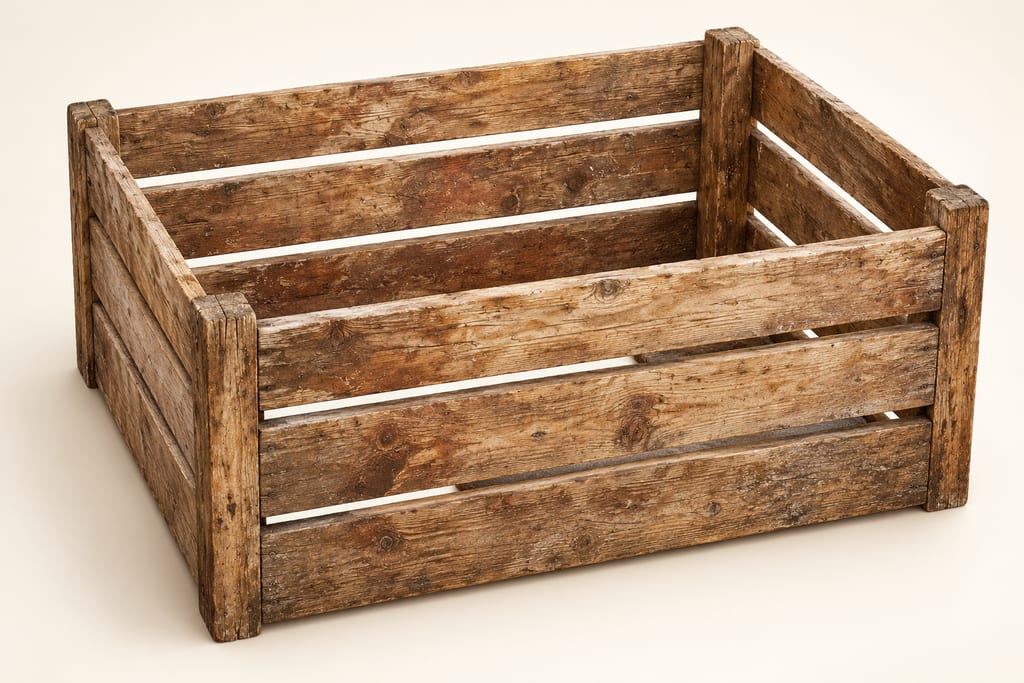
Perforated containers for shark maturation
Movable perforated containers hold Greenland-shark cuts during the modern Icelandic maturation of hákarl, letting liquid drain; the best-documented example is a wooden box used in a 2021 study.
 FermenteaWhere food goes to change
Equipment · Barrels and casks
wooden herring barrel · herring-curing barrel
A coopered wooden barrel held herring and salt during northern European curing. Siglufjörður's early-20th-century station is one documented setting; barrel forms and processes varied.
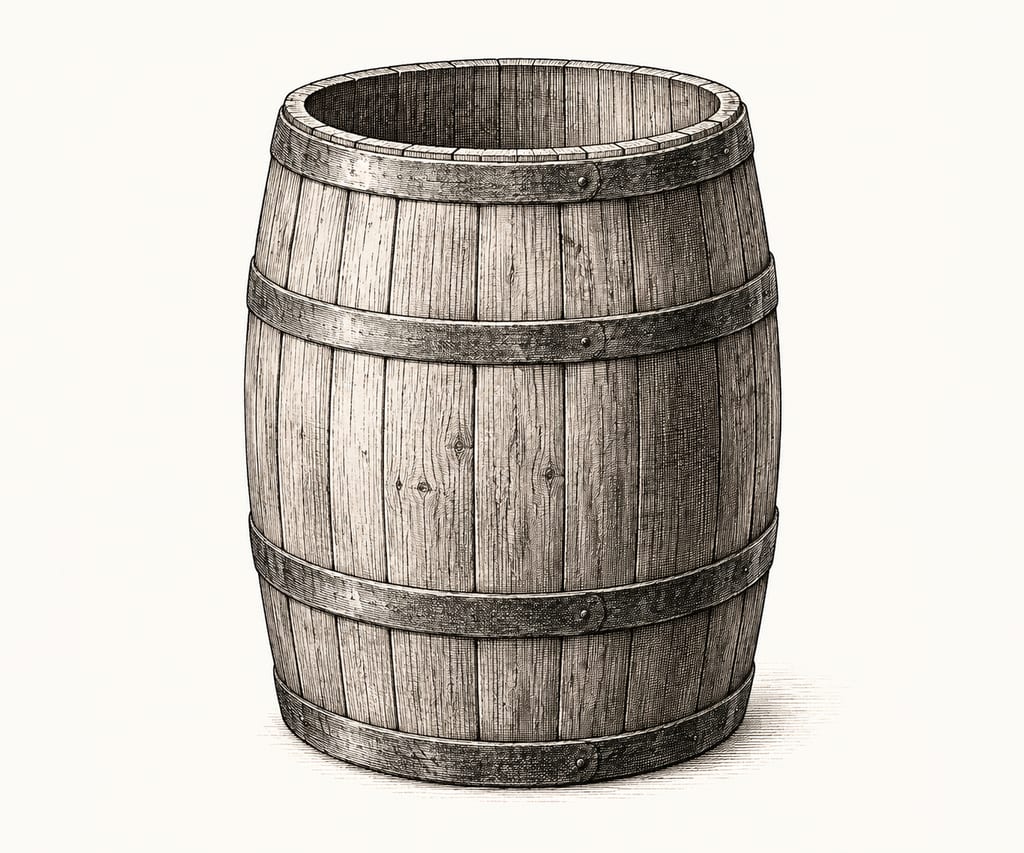
A herring salting barrel is a coopered wooden vessel assembled from shaped staves and held together by hoops, with fitted heads that close the ends. A 1792 harbor-side print by S. Vdr. Meulen depicts herring packing beside open upright barrels; it gives a direct visual record of the vessel's historical form in use, though it is an illustration rather than a technical drawing. The archive record does not identify the harbor, so it cannot place this barrel form in Iceland.
In use, the barrel could hold fish and salt together as contents settled and brine accumulated. Barrels made a substantial catch easier to store, move from shore and send to markets. The sources do not establish one standard capacity, timber species, hoop material or stave profile. The print cannot identify the maker or every material detail. The form shown here is a coopered herring barrel, not a large upright fermentation vat or a modern plastic tub.
At Siglufjörður in northern Iceland, Róaldsbrakki is a former salting station built in 1907. The Herring Era Museum now preserves the building and interprets the industrial fishery and processing work that shaped the town. Fjallabyggð describes dockside demonstrations in which herring is gutted and packed in barrels to recreate part of the historical working scene.
A contemporary demonstration is not a photograph of the original operation. It shows how the museum presents the task today, while the preserved station anchors the setting in the early-twentieth-century Icelandic herring industry. It does not prove that every barrel had the same profile, volume or construction.
The atlas describes open barrels packed with fish in ordered layers with salt, then covered. Keeping herring and salt together made the barrel useful for curing, storage and transport. A barrel’s opening also allowed workers to add fish or adjust the contents before closing it, but the sources do not provide a universal pack order or fixed amount of salt for this equipment entry.
A 1905 photograph in the Scottish Fisheries Museum archive shows a fisher girl topping up a barrel with brine. Its caption says that after ten days the barrels were topped up through a hole in the side. That is useful comparative evidence for barrel handling in North East Scotland; it is not a schedule or instruction for the Icelandic station.
The barrel is equipment, not a process label. Northern European barrel-salted herring could be salted and ripened, while products such as Swedish surströmming follow a distinct fermentation tradition. The review by Skåra and colleagues treats barrel-salted ripened herring across the region and discusses surströmming separately. A barrel photograph on its own therefore cannot tell a reader whether a batch was intended for ordinary salting, longer ripening or a specific fermented product.
The page links the vessel to the preparation record for salted herring because the archive describes layered herring and salt in open wooden barrels. This records a supported equipment relationship; it does not make the barrel exclusive to one recipe or imply that every herring cure is fermented.
A 1792 print by S. Vdr. Meulen depicts open upright barrels and a barrel on its side in a harbor-side herring-packing scene; its archive record does not name the harbor. It is an early attestation of use, not an origin claim or evidence that the pictured barrels were used in Iceland. Róaldsbrakki at Siglufjörður is a later documented station built in 1907; Scottish museum images provide separate early-twentieth-century comparison.
A photograph of a barrel does not establish one standard shape, capacity, stave species or hoop material.
Source →The Scottish archive image is a comparison from North East Scotland, not proof that its pictured brine-topping schedule was used in Iceland.
Source →Barrel-salted herring and fermented herring products are not interchangeable; the vessel alone does not establish the process or degree of fermentation.
Source →This place row records a documented Icelandic salting-station example, not an origin claim or the full geographic range of coopered herring barrels.
Movable perforated containers hold Greenland-shark cuts during the modern Icelandic maturation of hákarl, letting liquid drain; the best-documented example is a wooden box used in a 2021 study.

A gelling polysaccharide extracted from red seaweeds, sold as kanten strips or powder; it sets firm at a low concentration and stays solid until about 85 °C.

A Dominican table and seasoning condiment of sour orange juice, mixed with lime and salt and bottled raw; garlic, oregano or a hot pepper may be added for meat or a spicier bottle.

Cicerbita alpina is an alpine perennial whose tender shoots and leaves have been eaten raw or cooked. Sámi milk preparations and modern Carnian dishes are distinct uses, with serious identification and preservation limits.

Japanese skipjack tuna cooked, then repeatedly smoked and dried over a wood fire by the hand-fired tebiyama method into a hard block for shaving into dashi: the first stage of katsuobushi.

A Swedish-style spirit vinegar made by fermenting neutral alcohol with live vinegar bacteria, with a separate guide to commercial ättika strengths.

A yeast-raised wheat ring shaped from a firm dough, briefly boiled and baked. This source-batch formula gives a gently malted crust and a chewy crumb.

A warm dip of garlic, anchovy and olive oil, often enriched with butter, that Piedmont serves over a flame with raw and cooked vegetables and bread.

Bechamel is a white sauce of milk thickened with a butter and flour roux, one of the French mother sauces, and the base from which Mornay and other cheese and cream sauces are made.
No community contributions have been published for this entry yet.
Sign in to contribute. Published comments and photos are free to read.
Visit IcelandHistory · Geography · Industrial context
The Herring Era MuseumThe museum in Siglufjörður includes Róaldsbrakki, a Norwegian herring station dating to 1907, and exhibits on Iceland's herring fishery and processing industry.
Cited in: The Icelandic station at Siglufjörður
FjallabyggðHistory · Use · Geography
Galleries and workshopsFjallabyggð describes the Herring Era Museum's preserved Róaldsbrakki salting station and live salting demonstrations that recreate herring packing at the site.
Cited in: A coopered barrel for salted fish; The Icelandic station at Siglufjörður
Scottish Fisheries Museum Photo LibraryHistorical visual reference · Barrel use
Fisher girl topping up barrelsThe archive captions a North East Scotland image to 1905 and describes a barrel being topped up with brine through a side hole after lying for ten days.
The source describes the pictured Scottish process; it does not establish that the same topping schedule or barrel details applied at Siglufjörður.
Cited in: A coopered barrel for salted fish; Layers, salt and brine
Journal of Ethnic FoodsRegional history · Process context
Fermented and ripened fish products in the northern European countriesThe review discusses barrel-salted ripened herring across northern Europe and distinguishes it from specific fermented fish traditions such as surströmming.
The review describes a long regional history of salted herring, but does not establish one universal barrel form or a single origin for the vessel.
Cited in: Layers, salt and brine; Salted herring is not always fermented herring
Wikimedia CommonsHistorical visual reference · Site context
Siglufjörður–Róaldsbrakki Salting StationThe photograph documents the exterior of Róaldsbrakki, the Herring Era Museum's salting station in Siglufjörður; it is a contemporary view of the building, not a historic salting scene.
The file page lists the image under CC BY-SA 3.0.
Freshwater and Marine Image Bank, University of Washington, via Wikimedia CommonsHistorical visual reference · Barrel form · Process context
Packing of the Herrings into the BarrilsA print dated 1792 depicts open upright staved barrels and a barrel lying on its side during harbor-side herring packing.
The print is an illustrative historical scene, not a technical record; it gives no precise place, dimensions, timber species, or hoop material.
Cited in: A coopered barrel for salted fish