
'Nduja di Spilinga
Soft, spreadable Calabrian pork sausage made with a great deal of red chilli and fatty pork, stuffed into natural casings, sometimes smoked and matured while staying soft.
 FermenteaWhere food goes to change
Equipment · Tanks and vats
cooler mash tun · cooler mash/lauter tun · picnic cooler mash tun
An insulated drink cooler adapted to hold a grain mash and drain wort through a filter into a separate kettle.
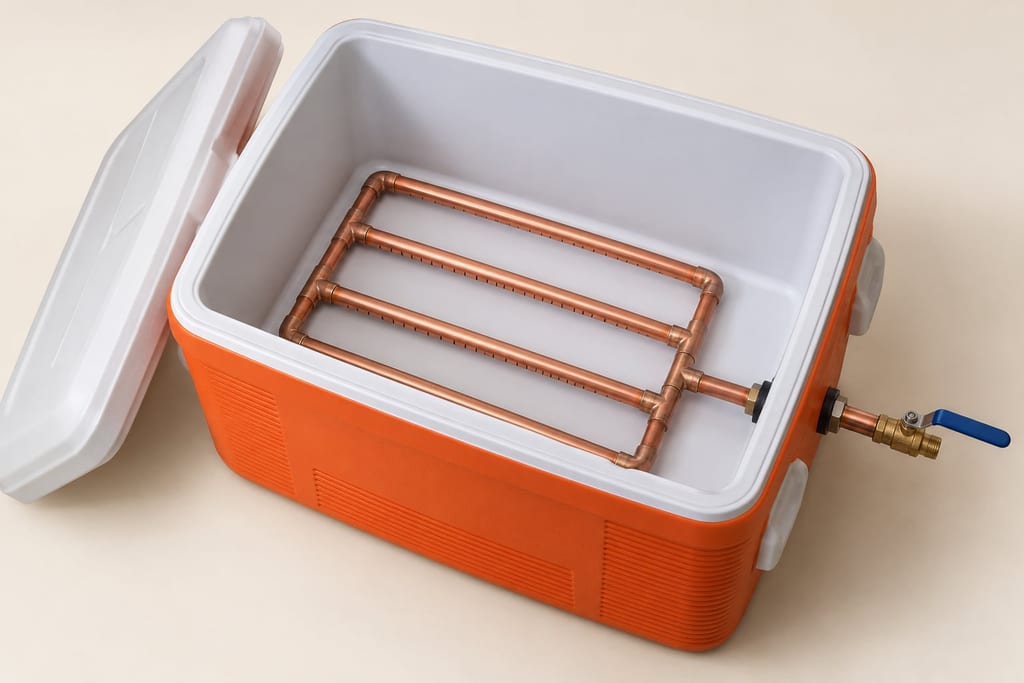
A cooler mash/lauter tun is an insulated drink cooler used first to hold the grain-and-water mash and then to drain sweet wort away from the spent grain. The first operation is mashing: crushed grain rests in heated water while the mash is held at its target conditions. Lautering is the later separation and collection of wort. The same cooler performs both roles, which is why homebrewers call the vessel a mash/lauter tun.
The format is one option within all-grain brewing. The American Homebrewers Association also describes brew-in-a-bag and other mash-tun forms. A modified picnic cooler is attractive to some homebrewers because an insulated vessel can hold a mash rest without a built-in heating element. The shell itself is not a boiler: the AHA batch-sparge example heats strike water in the boil kettle and prepares sparge water in another kettle.
A lower outlet alone would let the crushed grain follow the wort. A cooler conversion therefore pairs its outlet with a filter near the floor. One AHA tutorial uses the stainless-steel braid from a flexible supply line as a cylindrical screen, connected to the cooler's original opening with a bung, tubing and a valve. That combination is an example of a simple drain screen, not a universal parts list.
Other cooler tuns use a copper manifold or a separate false bottom. In Glenn Frazee's own conversion, an arranged network of copper plumbing pieces filters the wort; its dimensions are fitted to his specific cooler and should not be read as a common specification. Retailers also offer systems with stainless-steel false bottoms and mesh tubing manifolds. These are different ways to draw wort through the grain bed, not parts that belong in every tun.
Once the mash has rested, wort flows through the grain bed, the filter and the outlet into a brew kettle. A pitcher or small pot lets the brewer return the first collected wort to the top of the grain bed in a vorlauf. The AHA guide explains this circulation as a way to let the bed settle before collection; its example says to open the valve slowly to reduce the chance that sediment will clog the manifold.
After the initial runnings, the brewer may rinse remaining sugars from the grain by sparging. Batch sparging drains the tun before more hot water is added and stirred through the grain; fly sparging adds water gradually while wort continues to drain. The cooler provides the holding and draining vessel, while hot-liquor storage, water heating, wort collection and the sparge-water distributor may come from separate equipment. Some packaged cooler systems include a sparge arm, but the AHA's batch-sparge route does not require one.
A converted vessel can be built around a round or rectangular cooler. The AHA braid example uses a 48-quart rectangular cooler, while its broader brewing guidance says mash-tun size and material vary with the brewer's setup and goals. Retail listings document other individual sizes, including 10-gallon and 12-gallon models. None of these examples sets the minimum, maximum or standard capacity for every cooler tun.
The same caution applies to measurements and fittings. The diameter of a false bottom, the length of a manifold, the cooler's outlet and the route of a hose depend on the chosen vessel. Frazee explicitly says his copper lengths fit his 10-gallon cooler and may need changing for a different cooler. A catalogue entry can explain the design family, but it cannot turn a part sized for one cooler into a universal build specification.
The cooler does not heat itself. In the AHA setup, heat and hot water come from separate brewing vessels, and wort leaves the tun for a boil kettle. A sparge arm, pump, thermometer or recirculation loop belongs to a particular configuration; none is part of every insulated cooler mash/lauter tun.
The sources document individual hobby builds and products rather than a single standard design. They do not establish one capacity, one cooler material, one filter, one outlet assembly, a worldwide distribution pattern or a universal maintenance routine. Follow the instructions for the actual cooler, valve and filter being used; the equipment references here describe alternatives and do not validate a brewing process.
Modern brewing guides and product listings document insulated cooler conversions and assembled cooler systems. The sources consulted do not establish the design's date of invention or one place of origin.
The cooler mash/lauter tun does not itself heat strike or sparge water in the AHA batch-sparge setup; that guide uses a boil kettle for strike water and calls for another kettle to prepare sparge water.
Source →There is no class-wide capacity or size: the AHA describes mash tuns as varying with the brewer's system and goals, and the listed products are individual models.
Source →No source in this record establishes a place.
Soft, spreadable Calabrian pork sausage made with a great deal of red chilli and fatty pork, stuffed into natural casings, sometimes smoked and matured while staying soft.

A way to add independent temperature logging to an existing food dehydrator without changing its built-in controls or protections. It is a monitoring method, not a rewiring plan.

Pleurotus cystidiosus is the abalone mushroom, a cultivated oyster-type fungus with dark brown caps that grows more slowly and is more demanding than other Pleurotus species.

A dark, balanced vinegar from Emilia-Romagna made by combining cooked or concentrated grape must with wine vinegar, then acetifying and refining it in wood under a protected specification.

A living dairy inoculum that starts controlled cream fermentation, developing acidity and aroma before sour cream or cultured butter is finished.

A small electric incubator holds jars at a selected temperature for yogurt and other documented warm food preparations. Controls, capacity and vessel arrangement vary by model.

Adygean salt is a seasoned table salt associated with Adygea and the wider North Caucasian culinary tradition. Salt is blended with garlic and a variable selection of herbs and spices; the exact mix depends on the named style and maker.

The African Caesar-group mushroom, Amanita masasiensis, is a wild ectomycorrhizal species of central and southern African woodlands, eaten locally. The genus contains deadly poisonous species, so identification needs care.
No community contributions have been published for this entry yet.
Sign in to contribute. Published comments and photos are free to read.
American Homebrewers AssociationForm · Materials · Construction · Lautering
How to Build a Mash TunThe AHA describes a rectangular picnic cooler adapted for batch-sparge brewing.
Its example uses a stainless-steel supply-line braid as a screen, attached through a cooler outlet with tubing and a valve.
The guide presents the design as one approximately five-gallon-batch example and lists its 48-quart cooler, materials and construction sequence.
Cited in: A cooler with two jobs; The outlet is a filter as well as a drain; Choose a configuration, not a universal size
American Homebrewers AssociationFunction · Process · Limits
All-Grain: Batch SpargingThe guide defines mashing and lautering and describes a modified rectangular picnic cooler as an approachable homebrew mash-tun option.
It distinguishes fly sparging from batch sparging and describes vorlauf as recirculating wort to settle the grain bed before collection.
Its example uses separate kettles for strike and sparge water and collects wort through a mash-tun manifold.
Cited in: A cooler with two jobs; From the grain bed to the kettle; Choose a configuration, not a universal size; The limits of the vessel
Glenn FrazeeIndividual build · Alternative filter · Materials
DIY Mash/Lauter Tun From a CoolerFrazee documents his own 10-gallon Igloo cooler conversion using stainless and copper fittings.
His specific design uses copper tube and fittings for the wort filter instead of a stainless mesh false bottom.
The author states that his pipe lengths fit his chosen cooler and may need adjustment for other coolers.
Cited in: The outlet is a filter as well as a drain; Choose a configuration, not a universal size; The limits of the vessel
Adventures in HomebrewingProduct example · Configuration · Photographs
All Grain Cooler SystemThe listing describes one cooler mash/lauter system with a false bottom, integrated thermometer and separate hot-liquor tank.
The specific listing describes a 12-gallon tun and provides its own model dimensions; those figures are not class limits.
The product gallery captions identify a fully assembled system, top-down views of the tun and sparge arm, internal graduations and a bulkhead tube.
Cited in: The outlet is a filter as well as a drain; From the grain bed to the kettle; Choose a configuration, not a universal size; The limits of the vessel
Great FermentationsProduct example · False bottom variant · Photographs
10 Gallon Cooler Mash Tun w/False BottomThe retailer describes a 10-gallon insulated cooler with a false bottom and front-mounted valve.
The retailer marks this listed model no longer available and gives no specifications.
Its gallery identifies a full tun, a valve detail and a separate false-bottom photograph.
Cited in: The outlet is a filter as well as a drain; Choose a configuration, not a universal size
Home Brew StuffFilter variant · Product example
5 Gallon Igloo Cooler Stainless Steel Mesh Mash ManifoldThe seller describes a stainless-steel mesh-tubing manifold with high-temperature John Guest push fittings for an Igloo cooler mash tun.
Cited in: The outlet is a filter as well as a drain
American Homebrewers AssociationEquipment context · Process
Homebrew EquipmentThe AHA distinguishes brew-in-a-bag from batch-sparge mash-tun equipment.
It describes the mash tun as holding heated water and grain during the mash and separating wort from grain.
It lists a sparge pot and pitcher as separate tools for sparge-water preparation and vorlauf.
Cited in: A cooler with two jobs; From the grain bed to the kettle; The limits of the vessel
