
'Nduja di Spilinga
Soft, spreadable Calabrian pork sausage made with a great deal of red chilli and fatty pork, stuffed into natural casings, sometimes smoked and matured while staying soft.
 FermenteaWhere food goes to change
Equipment · Incubators and warm holds
Microbiological incubator · General-protocol laboratory incubator
A manufactured cabinet that controls chamber temperature for laboratory samples. Some models add cooling or humidity features; those capabilities are not universal and do not make every unit a food-contact vessel.
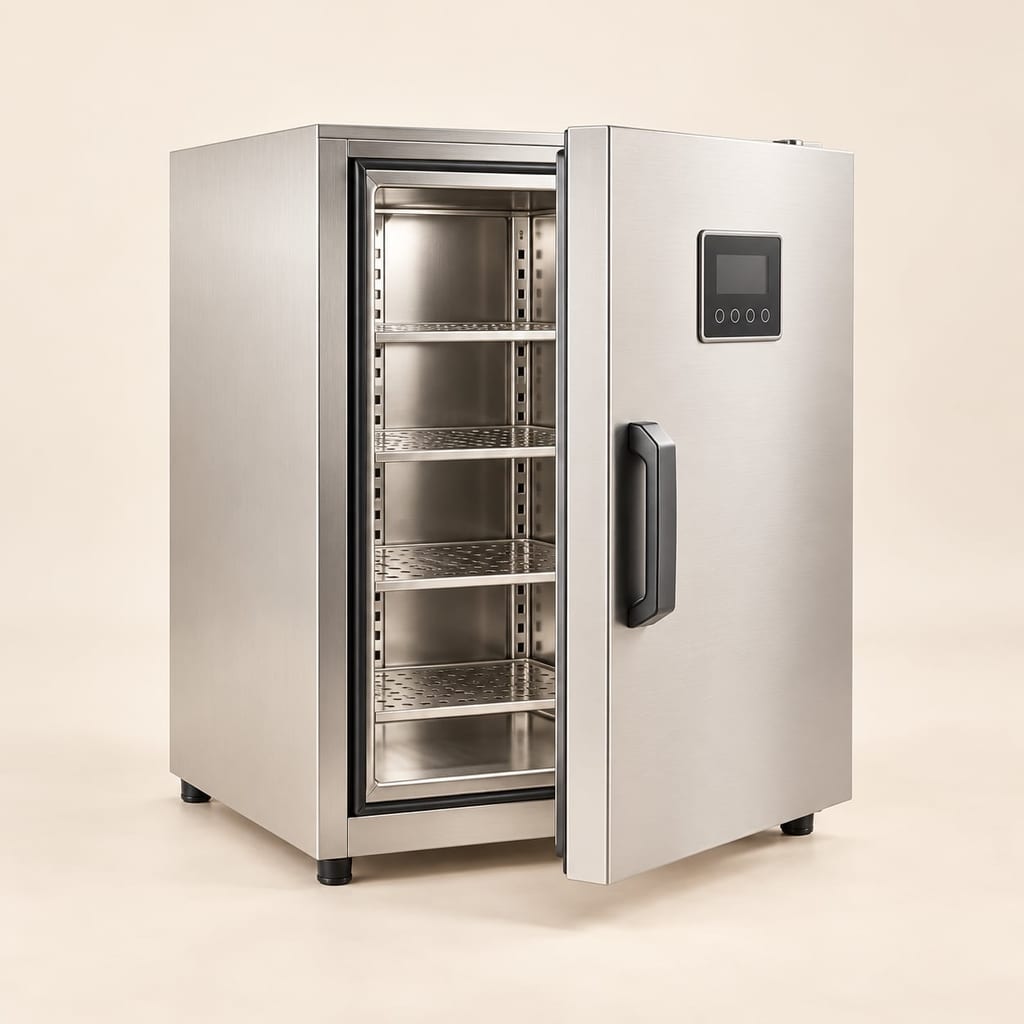
A laboratory incubator is a manufactured cabinet that regulates the air around samples. A general-protocol microbiological incubator commonly has an insulated outer shell, a metal chamber, shelves, a sensor and a temperature controller. Thermo Fisher’s Heratherm line illustrates this form: its product page describes a microprocessor-controlled instrument with a stainless-steel interior and removable shelves. Those are details of one product family, not universal specifications.
The chamber conditions the space around a separate sample vessel. It is not itself a fermentation jar, tank or food-contact container. Manufacturer documentation describes laboratory samples and model-specific operating procedures; it does not establish every incubator as suitable for direct food contact.
The main function is controlled chamber temperature. Air movement, humidity and cooling are separate design choices. Thermo Fisher lists a distinct refrigerated-incubator family with Peltier cooling, which shows why a buyer cannot assume a standard laboratory incubator can cool below its ambient operating range. Humidity control is likewise a feature to confirm on the exact model, not a defining feature of every incubator.
For solid-state koji, the supplied research dossier lists a laboratory incubator as an option because it can provide accurate air temperature, while cautioning that humidity control or active cooling of a dense bed may still be absent. This is a high-level equipment limitation, not a production schedule. The temperature in a chamber is not automatically the temperature within a loaded food bed, and a product line’s published uniformity values apply only to the specified model and conditions.
A laboratory incubator is factory-made as a laboratory instrument. A converted cabinet or unused refrigerator is a different way to make an enclosed warm space: Nordic Food Lab describes its own koji chamber as an upright refrigerator switched off and fitted with a heating mat and probe connected to a controller. Both can surround a separate tray or container, but their construction, control behavior and intended use are not interchangeable.
The distinction matters more than the shared word incubator. A lab model is selected from its own validated specifications and operating manual; a converted cabinet is an improvised enclosure whose performance depends on its parts and arrangement. Neither name alone proves that a specific model controls humidity or removes heat from a dense load.
Choose and care for the instrument by its exact manual: model families differ in control range, convection, shelves, chamber material, cooling and alarms. Do not transfer one manufacturer's capacities or temperature performance to another unit. The supplied dossier's koji comparison is a reminder to distinguish measured chamber air from the conditions in the actual load.
The manufacturer's product page does not establish where laboratory incubators were invented or where any particular unit was made. This is contemporary laboratory equipment with unknown equipment-class origin and manufacturing geography.
The cited general-protocol family regulates chamber temperature; humidity control is not established by this source and must not be assumed for all laboratory incubators.
Source →Cooling belongs to a separate refrigerated-incubator family in Thermo Fisher's catalog; do not assume it exists on general models.
Source →The manufacturer documentation describes laboratory samples and does not designate the chamber as a food-contact vessel.
Source →The inspected manufacturer's product page documents one product family, not the invention or global origin of laboratory incubators. Manufacturing location for this model is not established in the cited page.
Soft, spreadable Calabrian pork sausage made with a great deal of red chilli and fatty pork, stuffed into natural casings, sometimes smoked and matured while staying soft.

A way to add independent temperature logging to an existing food dehydrator without changing its built-in controls or protections. It is a monitoring method, not a rewiring plan.

Pleurotus cystidiosus is the abalone mushroom, a cultivated oyster-type fungus with dark brown caps that grows more slowly and is more demanding than other Pleurotus species.

A dark, balanced vinegar from Emilia-Romagna made by combining cooked or concentrated grape must with wine vinegar, then acetifying and refining it in wood under a protected specification.

A living dairy inoculum that starts controlled cream fermentation, developing acidity and aroma before sour cream or cultured butter is finished.

A small electric incubator holds jars at a selected temperature for yogurt and other documented warm food preparations. Controls, capacity and vessel arrangement vary by model.

Adygean salt is a seasoned table salt associated with Adygea and the wider North Caucasian culinary tradition. Salt is blended with garlic and a variable selection of herbs and spices; the exact mix depends on the named style and maker.

The African Caesar-group mushroom, Amanita masasiensis, is a wild ectomycorrhizal species of central and southern African woodlands, eaten locally. The genus contains deadly poisonous species, so identification needs care.
No community contributions have been published for this entry yet.
Sign in to contribute. Published comments and photos are free to read.
Thermo Fisher ScientificIdentity · Form · Temperature control · Product example
Heratherm General Protocol Microbiological IncubatorsThe manufacturer's general-protocol product example is a microprocessor-controlled cabinet with a stainless chamber and shelves; the stated temperature range and uniformity are specifications for that family, not all laboratory incubators.
The page describes this product family for laboratory applications and does not designate its chamber as a food-contact vessel.
Cited in: A controlled chamber for samples; Temperature control is not the whole environment; Different from a converted koji cabinet; Selection, care and geographic limits
Thermo Fisher ScientificOperation · Care · Safety
Heratherm General Protocol Microbiological Incubators (120V), Operating InstructionsThe manufacturer provides model-specific operating and installation instructions for the incubator; use its exact manual for care and operation.
Cited in: A controlled chamber for samples; Selection, care and geographic limits
Thermo Fisher ScientificVariants · Cooling
Heratherm Refrigerated IncubatorsThe manufacturer lists a separate refrigerated-incubator product family with Peltier temperature control; cooling is a specialized product feature rather than a capability to assume for a general incubator.
Cited in: Temperature control is not the whole environment
Nordic Food Lab ArchiveComparison · Koji context
Koji – history and processThe article documents a separate koji chamber built from a switched-off upright refrigerator, heating mat and probe connected to a PID controller; this is not a laboratory incubator.
Cited in: Different from a converted koji cabinet
