
'Nduja di Spilinga
Soft, spreadable Calabrian pork sausage made with a great deal of red chilli and fatty pork, stuffed into natural casings, sometimes smoked and matured while staying soft.
 FermenteaWhere food goes to change
Built structures · Place · Smokehouses and smoke rooms
The Baron Tossizza Foundation’s Metsovo cheese factory combines cheesemaking and ripening, with Metsovone smoked after its maturation. Sources document the room used for ripening but not the smoking chamber’s design.
The Metsovo dairy considered here is the Baron Tossizza Foundation cheese factory, not a generic “traditional Greek dairy.” The Foundation dates the start of its factory to 1958. Tatiana Averoff-Ioannou's chapter in the Greek Ministry of Culture's 2024 volume places the project in a wider effort to support local livestock raising, preserve regional cheesemaking knowledge and train young cheesemakers. It describes the factory as a practical school as well as a producer.
The chapter distinguishes this mid-twentieth-century factory from older pastoral cheesemaking. Before the factory, small cheese makers worked in simple huts close to seasonal grazing grounds; the account says some were improvised, roofed with beech branches and ferns, and oriented north for cooler conditions. The Foundation later established two small cheesemaking facilities at summer pastures for local pastoral cheesemakers to use. These are distinct settings and dates: the hut account does not describe how the 1958 factory was built, and the factory's modern room does not stand for every older hut.
The Foundation says the cheese factory has remained a practical training place, where young people from Metsovo could learn cheesemaking and establish dairies of their own. Its account connects study visits to artisan dairies in Italy with the development of Metsovo's distinctive cheeses, including smoked Metsovone. The chapter presents this as an example of deliberate exchange and innovation within a regional dairy tradition, rather than as proof that the cheese or its equipment is unchanged from antiquity.
The Ministry chapter describes milk arriving twice daily, being inspected and weighed, then moving in stainless-steel pipes to cheesemaking vats on the floor below. The height difference allows gravity flow instead of pumping. These details document how milk is handled in the modern factory; they do not reveal the building's footprint, room dimensions or the design of its smoking area. The Foundation's current page confirms the factory remains active, while noting that production facilities are not open to guided tours for hygiene and food-safety reasons.
The Ministry chapter describes Metsovone as a year-round, semi-hard cheese made mainly from cow's milk, with up to one fifth sheep's and goat's milk. It reports three months of maturation in controlled temperature and humidity before smoking. At the end of maturation, the cheese receives natural smoke from grapevine branches and aromatic herbs of the region. The chapter does not give a smoke duration, chamber temperature, fuel amount, air path or room design, so those details cannot be reconstructed from its account.
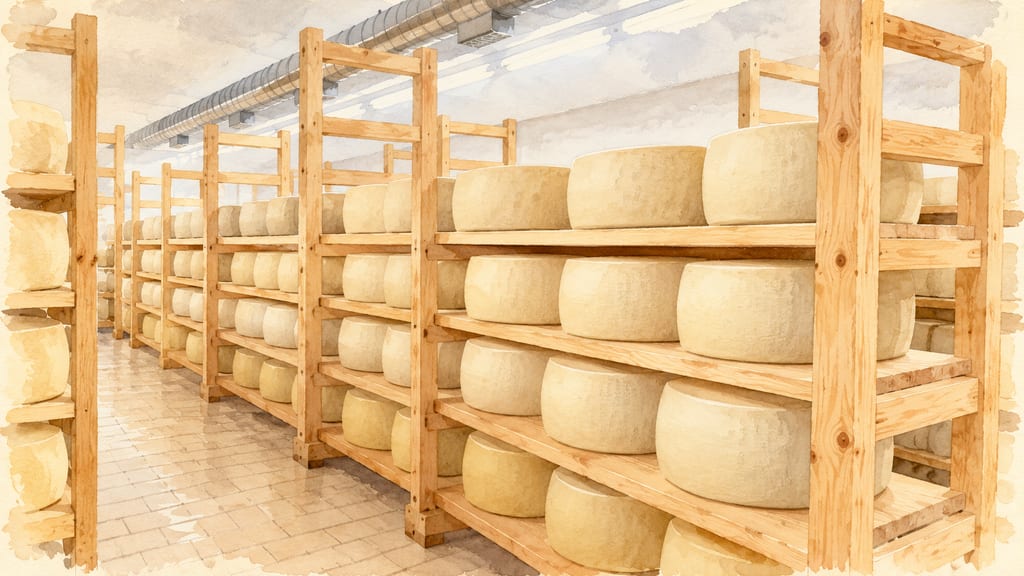
The Ministry book captions a photograph as a Metsovone ripening room. A separate photograph on the Foundation's own factory page shows large cheeses on wooden shelves in a clean, modern room, but the Foundation page does not identify those cheeses or label the room as the Metsovone smoke chamber. The image in this entry therefore represents the documented ripening-room stage; it does not depict smoke, fire or an undocumented chamber arrangement.
The available sources document a factory founded in 1958, its teaching purpose, a Metsovone maturation stage and a final smoking treatment. They do not specify the factory's construction materials, floor plan, site measurements, rack capacity, smoke-room enclosure, ventilation, fire separation, clearances, cleaning routine or smoking controls. The museum-style account of historic north-facing huts concerns earlier pastoral practice and should not be transferred to this modern facility.
Wood shelves are visible in the official factory photograph, but a photograph is not a construction plan. The source text identifies a Metsovone ripening-room photograph, while the factory website image does not identify the cheese in its room. No source inspected here establishes that either photograph shows the smoking room. This record documents the cheesemaking and maturation facility and the product's final smoke stage without treating an unpictured chamber as a known design.
The Tositsas Foundation factory began operation in 1958 and continues as a cheesemaking school and producer. The Ministry of Culture's 2024 account describes its modernized facilities and the sequence of Metsovone maturation followed by smoking.
A build is made where it stands: moving it means building it again.
The sources do not describe a smoke-room design, fire separation, ventilation, clearances or operating controls. This page is not a construction or smoking-safety guide.
Both the Foundation and the Ministry of Culture source place the factory in Metsovo; no street address or building footprint is specified.
Soft, spreadable Calabrian pork sausage made with a great deal of red chilli and fatty pork, stuffed into natural casings, sometimes smoked and matured while staying soft.

A way to add independent temperature logging to an existing food dehydrator without changing its built-in controls or protections. It is a monitoring method, not a rewiring plan.

Pleurotus cystidiosus is the abalone mushroom, a cultivated oyster-type fungus with dark brown caps that grows more slowly and is more demanding than other Pleurotus species.

A dark, balanced vinegar from Emilia-Romagna made by combining cooked or concentrated grape must with wine vinegar, then acetifying and refining it in wood under a protected specification.

A living dairy inoculum that starts controlled cream fermentation, developing acidity and aroma before sour cream or cultured butter is finished.

A small electric incubator holds jars at a selected temperature for yogurt and other documented warm food preparations. Controls, capacity and vessel arrangement vary by model.

Adygean salt is a seasoned table salt associated with Adygea and the wider North Caucasian culinary tradition. Salt is blended with garlic and a variable selection of herbs and spices; the exact mix depends on the named style and maker.

The African Caesar-group mushroom, Amanita masasiensis, is a wild ectomycorrhizal species of central and southern African woodlands, eaten locally. The genus contains deadly poisonous species, so identification needs care.
No community contributions have been published for this entry yet.
Sign in to contribute. Published comments and photos are free to read.
Hellenic Ministry of Culture, Directorate of Modern Cultural HeritageFacility history · Geography · Cheese production · Maturation · Smoking · Historical context · Image reference
Διατροφική πολιτιστική κληρονομιά της Ελλάδας: Η τυροκομία και το τυρί — “Η τυροκομία στην περιοχή Μετσόβου και η συνεισφορά του τυροκομείου του Ιδρύματος Τοσίτσα”The chapter describes the Tositsas Foundation cheese factory in Metsovo beginning operation in 1958 as part of a wider regional economic and cultural project, including practical training for young cheesemakers and two small cheesemaking facilities at summer pastures.
The chapter distinguishes historic pastoral cheesemaking huts, sometimes roofed with beech branches and ferns and oriented north, from the later factory; these are separate structures, not descriptions of the factory's construction.
The factory was modernized; milk is received and tested, then directed through stainless-steel pipes by gravity to vats downstairs.
Metsovone is made year-round, mainly from cow's milk with up to 20% sheep's and goat's milk; it matures for three months in controlled temperature and humidity, and is smoked at the end with natural smoke from grapevine branches and local aromatic herbs.
The chapter identifies a Metsovone ripening room in a photograph caption but provides no smoking-chamber layout, building dimensions, smoke duration, chamber temperature, airflow or fire-safety specification.
Cited in: A factory within a longer Metsovo cheesemaking landscape; The modern factory and its teaching role; Metsovone ripens before it is smoked; What the sources do not establish
Baron Tossizza FoundationFacility history · Geography · Training · Product range · Image reference
Cheese FactoryThe Foundation says its cheese factory in Metsovo has operated since 1958 and continues as a practical cheesemaking school.
The Foundation says apprenticeships at artisan dairies in Italy contributed to the development of smoked Metsovone and other cheeses.
Its current product list describes Metsovone as made mainly from cow's milk, with up to 20% goat's and sheep's milk.
The Foundation does not identify the photographed cheese varieties or say that the pictured ripening room is the smoking room; it states that visitors cannot tour production facilities for hygiene and food-safety reasons.
Cited in: A factory within a longer Metsovo cheesemaking landscape; The modern factory and its teaching role; Metsovone ripens before it is smoked; What the sources do not establish