
'Nduja di Spilinga
Soft, spreadable Calabrian pork sausage made with a great deal of red chilli and fatty pork, stuffed into natural casings, sometimes smoked and matured while staying soft.
 FermenteaWhere food goes to change
Equipment · Drying kilns and dryers
A cleanable insulated cabinet with removable food-suitable trays, a guarded heater and a fan duct. The design is documented as a proposal and has not been tested as a unit.
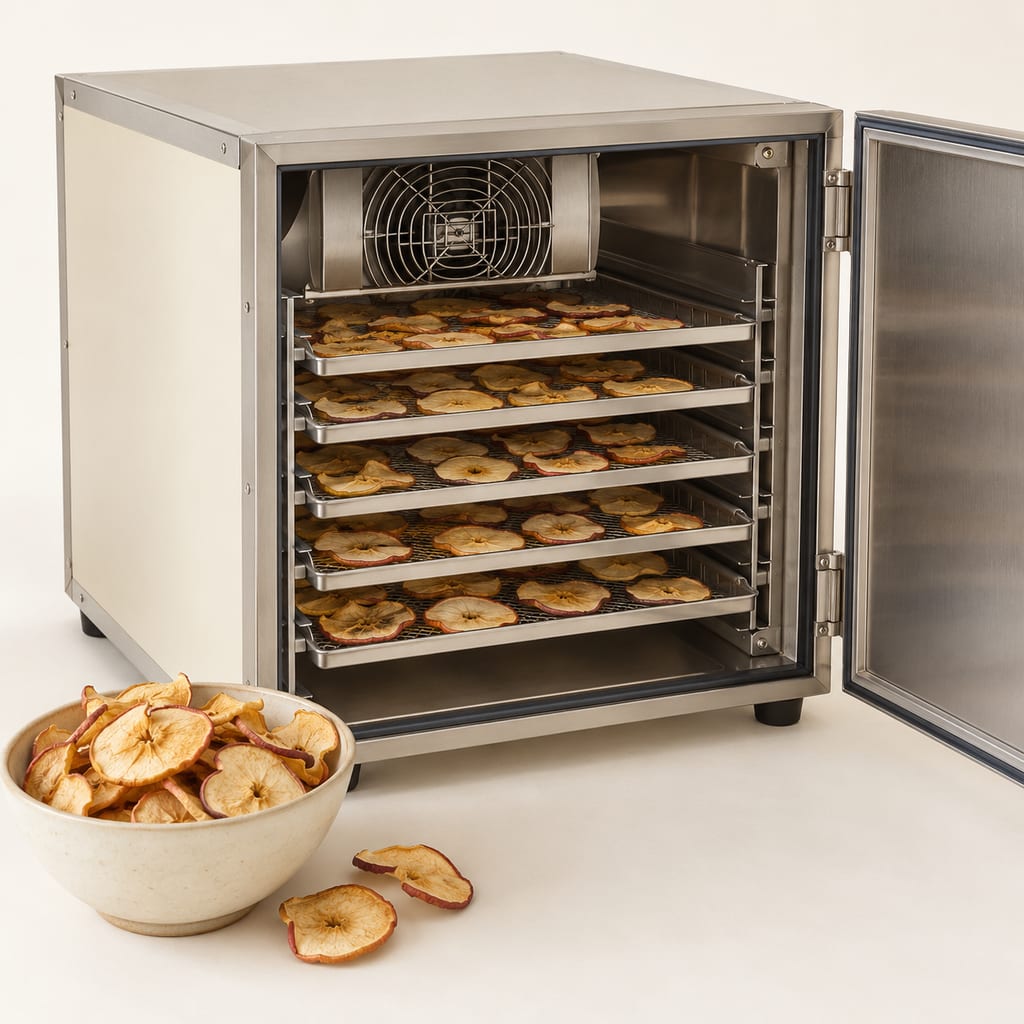
A modular heated tray dryer is a cabinet that holds a stack of removable trays, with a heater and a fan that move warm air across them. Modular means the cabinet can be built up from sections or fitted with a different number of trays. The design is aimed at fruit and vegetable drying, where a heated cabinet with washable trays is the usual form.
Purpose-built food dehydrators have the same basic parts: an enclosed heat source, a fan, vents, a thermostat and washable mesh trays, usually of metal or high-grade plastic. The modular cabinet is the home-built version of that arrangement, so its heater, controls and trays have to be judged against the same requirements.
The fan can move air horizontally across the trays or vertically through them. The guidance on purpose-built dehydrators gives the trade-off: horizontal flow spreads heat and keeps drips away from the base element, while vertical flow can mix flavours between trays and drip onto the element. The duct and inlet layout therefore set both the drying evenness and the heater's exposure to drips.
Uniformity between trays is the question a prototype has to answer. Air that short-circuits past the trays, or a recirculation loop that carries moisture back into the product, makes the top and bottom trays dry at different rates. The sources do not give a tray-to-tray figure, so none is recorded here.
The safety of a modular cabinet rests on the heater's protection. A thermostat is the normal controller, and an independent over-temperature cut-out is the backstop when it fails. The fan's behaviour matters too: if airflow stops, the heater must not keep running. Electrical ratings, enclosure clearances and the protection circuit are left to qualified review, because the sources give no design for them.
Commissioning should start with fruit or vegetable loads, measuring the temperature at each tray level under an empty and a full load. A cabinet that holds its set temperature when empty may overshoot at low loads, so the overshoot test is part of commissioning. The result describes the equipment only. It does not establish that any product is safe to dry.
Purpose-built food dehydrators with enclosed heat, a fan, vents, a thermostat and washable trays are documented by the National Center for Home Food Preservation. The modular cabinet in this record is a design built on those features.
A heater inside a cabinet needs an over-temperature limit independent of its normal controller, because a failed thermostat leaves the chamber unprotected.
Hazard sourceJuice or fat from the product can drip onto the heater when the airflow runs downward.
Hazard sourceIndependent over-temperature protection that cuts the heater
Control sourceHorizontal airflow or a drip tray under the heater
Control sourceCommission the cabinet with fruit or vegetables before it is used for any other product. A chamber that reaches its nominal temperature has not thereby been validated for jerky or meat.
Test the fan-failure response: the heater should not keep running with no airflow.
Purpose-built dehydrators use enclosed elements, a thermostat, a fan and vents. A home-built heated cabinet has to provide the same protections before it is used.
Source →Vertical airflow can drip onto the heating element. Horizontal airflow avoids this, so the duct layout decides whether drips reach the heater.
Source →A heated cabinet that reaches its set temperature when empty may not hold it at full load. Load-dependent temperature mapping is needed before any process claim.
SourceNo source in this record establishes a place.
Soft, spreadable Calabrian pork sausage made with a great deal of red chilli and fatty pork, stuffed into natural casings, sometimes smoked and matured while staying soft.

A way to add independent temperature logging to an existing food dehydrator without changing its built-in controls or protections. It is a monitoring method, not a rewiring plan.

Pleurotus cystidiosus is the abalone mushroom, a cultivated oyster-type fungus with dark brown caps that grows more slowly and is more demanding than other Pleurotus species.

A dark, balanced vinegar from Emilia-Romagna made by combining cooked or concentrated grape must with wine vinegar, then acetifying and refining it in wood under a protected specification.

A living dairy inoculum that starts controlled cream fermentation, developing acidity and aroma before sour cream or cultured butter is finished.

A small electric incubator holds jars at a selected temperature for yogurt and other documented warm food preparations. Controls, capacity and vessel arrangement vary by model.

Adygean salt is a seasoned table salt associated with Adygea and the wider North Caucasian culinary tradition. Salt is blended with garlic and a variable selection of herbs and spices; the exact mix depends on the named style and maker.

The African Caesar-group mushroom, Amanita masasiensis, is a wild ectomycorrhizal species of central and southern African woodlands, eaten locally. The genus contains deadly poisonous species, so identification needs care.
No community contributions have been published for this entry yet.
Sign in to contribute. Published comments and photos are free to read.
National Center for Home Food PreservationMethod · Safety
Food DehydratorsPurpose-built dehydrators have enclosed heat, a fan, vents, a thermostat and washable mesh trays, usually in metal or high-grade plastic.
Horizontal airflow can distribute heat and avoid drips into a base element; vertical flow can mix flavours and drip onto it.
Cited in: What it is; How the airflow decides the result; Protection and commissioning