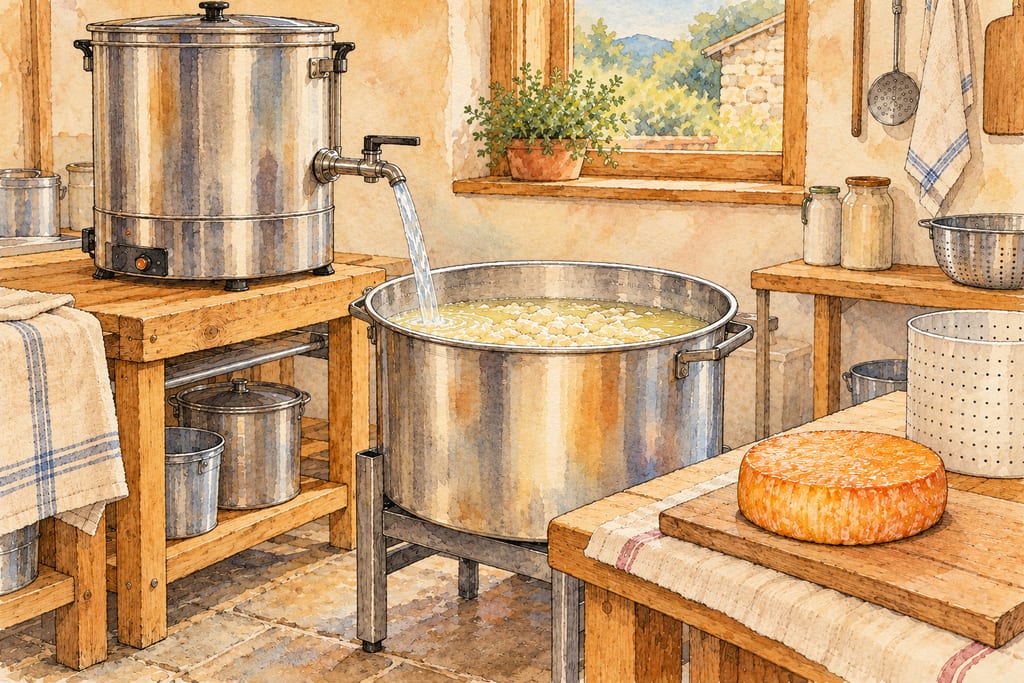
Brewer as a hot-water service station
The brewer holds clean water at a set temperature for washed-curd cheeses and other hot-water jobs, beside a separate cheese pot, instead of heating milk directly.
 FermenteaWhere food goes to change
Built structures · Pits and cavities
Rua kūmara are underground Māori stores for whole kūmara. Research at Pūrākaunui, authorized by Pūrākaunui Block Inc. and Kāti Huirapa Rūnaka ki Puketeraki, documents 15th-century pits without establishing one design.
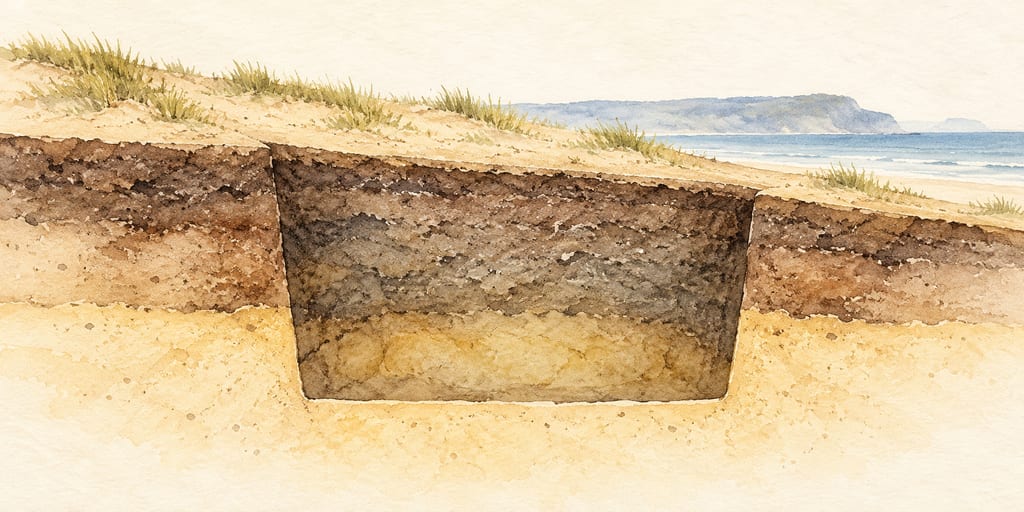
Rua kūmara are underground storage pits used by Māori for whole kūmara. They belong alongside two distinct Māori storage forms: whata, raised platforms, and pātaka, raised storehouses. A rua is an excavated store. Its siting, drainage and internal arrangement matter because stored roots need to remain dry.
Pits were placed on slopes or other free-draining ground. Whole roots were arranged on shelves cut into the inner walls, then checked and rotated. This describes a traditional storage practice, not a modern temperature-controlled cellar or an instruction for storing unrelated crops.
Documented forms include pits dug into a bank and bell-shaped pits. Drainage channels were sometimes added, and larger pits could have pitched roofs supported by poles; smaller pits could be dug in the open or within houses and larger pits. These are documented variations, not one standard shape.
At Pūrākaunui Inlet on the Otago coast of Te Waipounamu, four excavated pits fit a roofed, semi-subterranean quadrangular store form. The recorded group is more than half a metre deep and 2–5 metres long. P3 measures 4.5 by 2.3 metres and P4 measures 3.3 by 2 metres. P1–P3 have evidence of superstructure postholes; the precise roof design and materials are not established.
Secure archaeological deposits from the Pūrākaunui complex were dated to 1430–1460 CE at 95% probability, with starch granules characteristic of kūmara. This date belongs to the evidence at that site, not to the origin of rua kūmara across Aotearoa.
The excavations and later investigations were approved by Māori owners Pūrākaunui Block Inc. and authority Kāti Huirapa Rūnaka ki Puketeraki under archaeological authority 2001/88. This makes the local authority and research context explicit without turning one site into a universal Māori template.
Kūmara beginning to rot could be fermented into kōtero. That is a possible later transformation of stored roots; it does not mean rua kūmara were fermentation pits. The linked plan and profile images show archaeological features and soil sections, not a complete above-ground structure. The cutaway illustration is an evidence-led interpretation; its precise roof form and materials remain uncertain.
Rua kūmara are Māori storage pits for whole kūmara. Archaeological deposits at Pūrākaunui include secure 15th-century evidence; this dates that site context, not the origin of the wider form.
A build is made where it stands: moving it means building it again.
The sources describe rua kūmara within Māori food storage and horticulture; their regional forms and archaeological examples are not identical.
The article records the research as approved by Pūrākaunui Block Inc. and the authority Kāti Huirapa Rūnaka ki Puketeraki. This identifies the study's mana whenua context and does not imply public access to the archaeological site.
The brewer holds clean water at a set temperature for washed-curd cheeses and other hot-water jobs, beside a separate cheese pot, instead of heating milk directly.
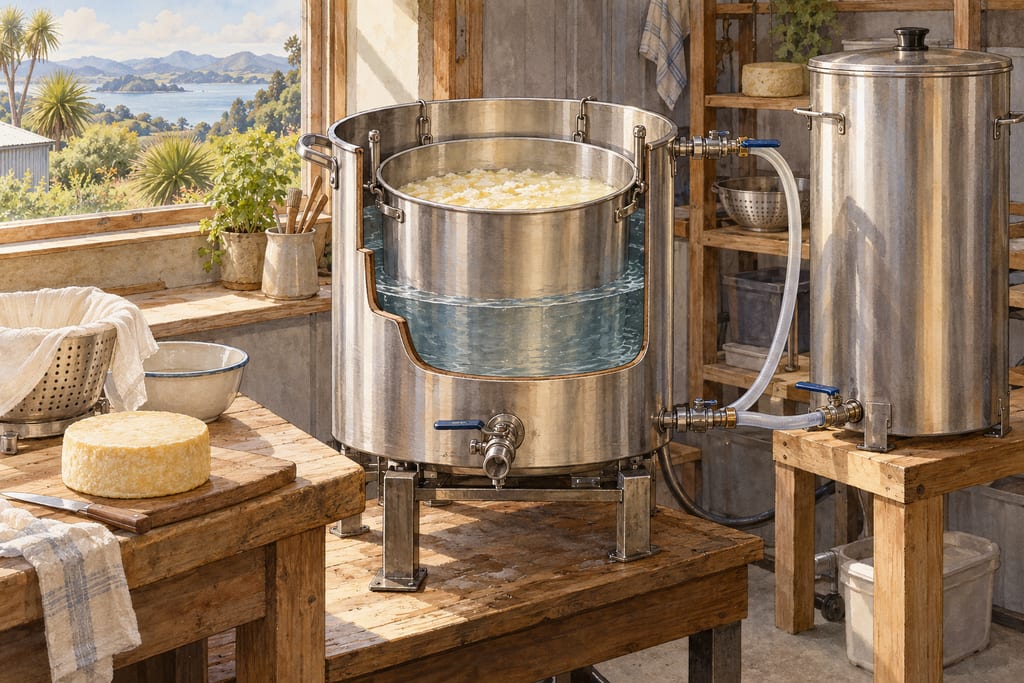
New Zealand home cheesemaker Tony Hamblyn's custom brewery, in which a 50-litre cheese pot hangs in a 70-litre mash tun of circulated hot water; later one tank served purely as hot water.
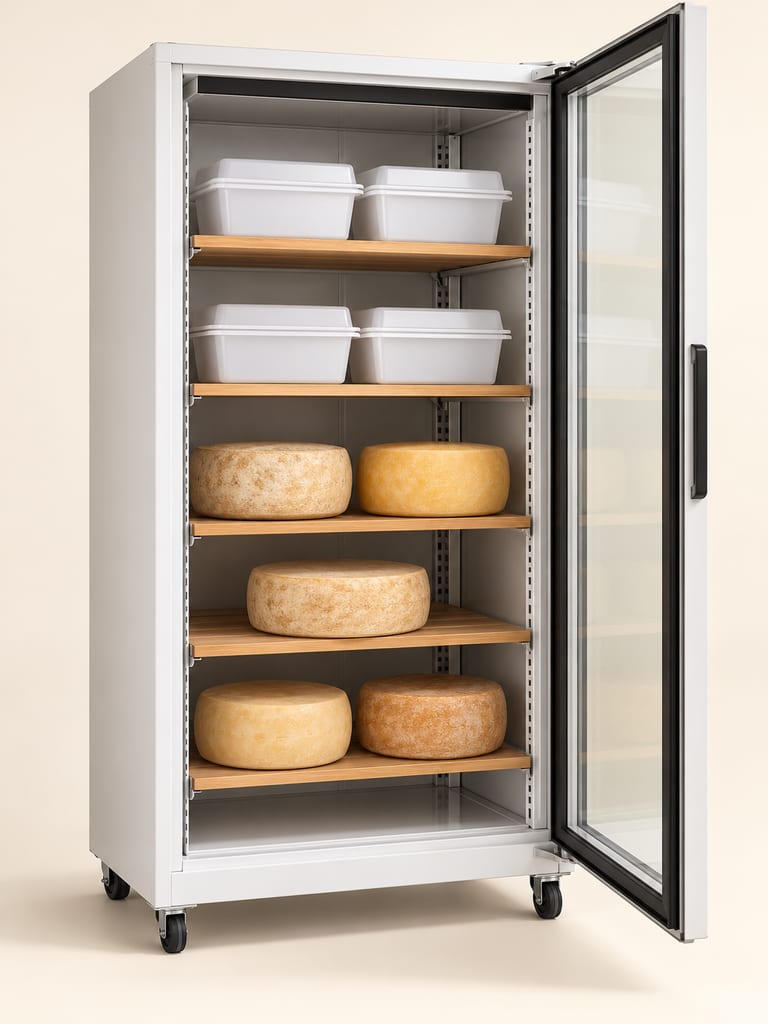
A modern cheese-ripening space made by controlling the temperature of a refrigerator or display cabinet and managing each cheese in its own covered container. It is an appliance conversion, not a natural cave or a traditional structure.
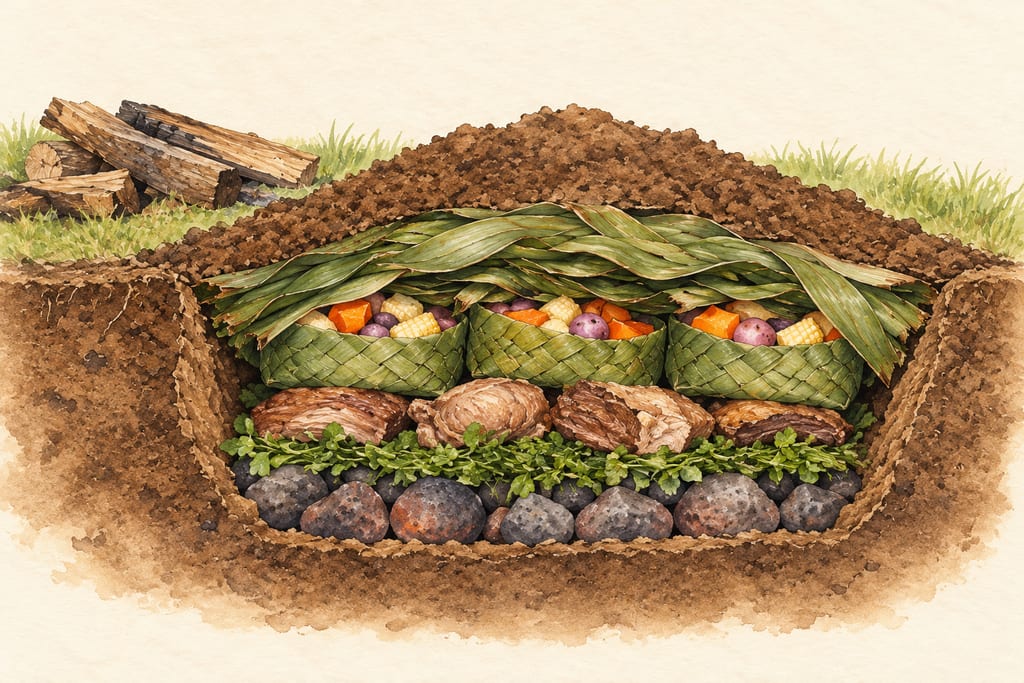
A source-specific account of the shallow earth oven used by a Ngāi Tahu family at Arowhenua Marae, with its hot stones, woven rourou and earth cover.
Māori raised storehouses held preserved food and seed. Heritage New Zealand documents one rare, uncarved Ngāti Hauiti example at Rata; its materials and later relocation are specific to that structure.
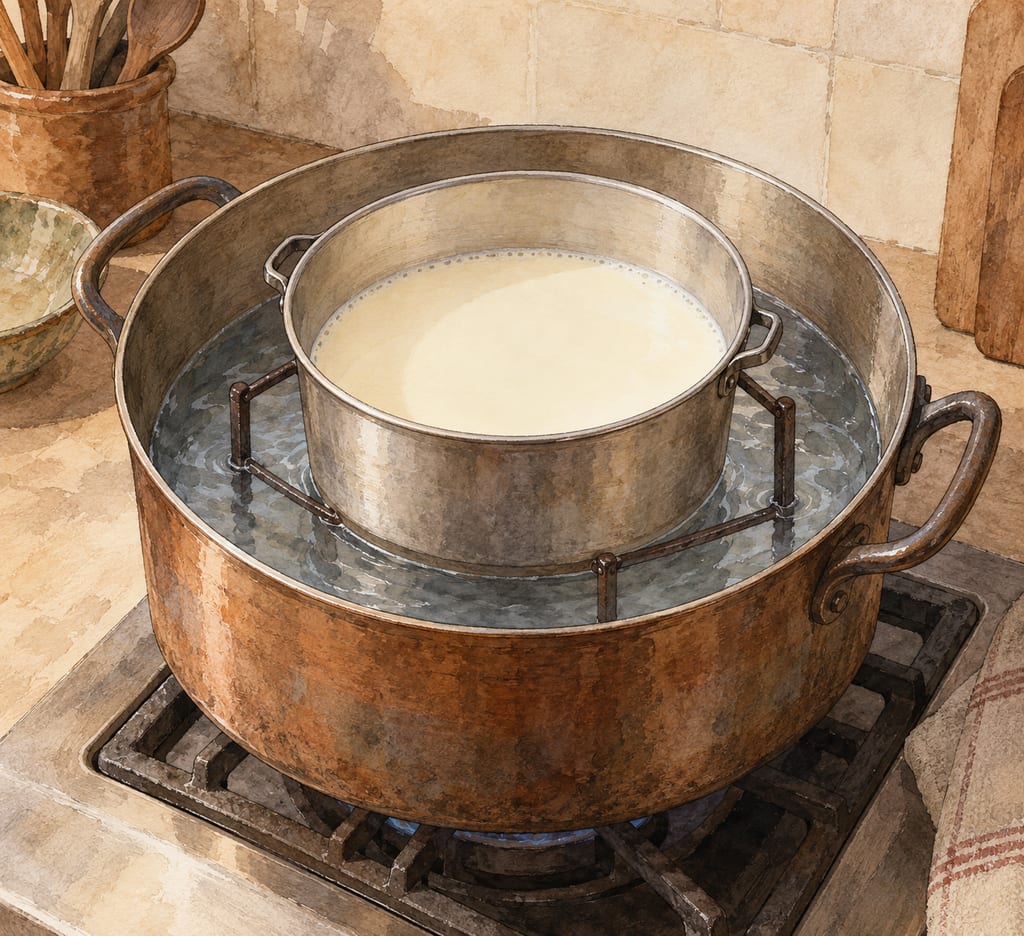
A food pot held at a fixed height inside a larger vessel of controlled hot water: the water distributes heat while the milk or whey inside stays still and away from the heater.
Whata are raised Māori food-storage platforms or stages. Sources describe temporary storage and drying, while recorded forms and terminology vary.
No community contributions have been published for this entry yet.
Sign in to contribute. Published comments and photos are free to read.
Te Ara – the Encyclopedia of New ZealandUse · Form · Culture
Traditional cooking and preserving — Māori foods – kai MāoriTe Ara distinguishes whata platforms, pātaka storehouses and rua kūmara underground storage pits.
The storage account places rua kūmara on slopes or other free-draining places, describes shelves cut into the pit walls, and says whole kūmara were checked and rotated.
Te Ara says kūmara beginning to rot could be fermented into kōtero; this is a later food transformation, not evidence that the storage pit itself is a fermentation vessel.
Cited in: A pit store for kūmara; Pūrākaunui and its research context
Te Ara – the Encyclopedia of New ZealandForm · History
Storage pit designsTe Ara’s text describes bank-cut and bell-shaped pit forms, drainage channels, and pole-supported pitched roofs for some large pits, as well as small pits in open or indoor settings.
The diagram itself is not reused; Te Ara says non-text media are subject to specific conditions and published reproduction may require copyright clearance.
Cited in: Forms vary; the evidence is specific; Pūrākaunui and its research context
PLOS ONEForm · History · Geography · Culture · Materials
Archaeological science meets Māori knowledge to model pre-Columbian sweet potato (Ipomoea batatas) dispersal to Polynesia’s southernmost habitable marginsThe study interprets four Pūrākaunui pits as roofed, semi-subterranean quadrangular rua kūmara; it describes the group as over 0.5 m deep and 2–5 m long, with postholes for P1–P3 at least.
P3 is recorded as 4.5 × 2.3 m and P4 as 3.3 × 2 m; secure deposits with starch granules characteristic of kūmara are dated to 1430–1460 CE at 95% probability.
The authors state that work and later investigations were approved by Māori owners Pūrākaunui Block Inc. and authority Kāti Huirapa Rūnaka ki Puketeraki, under archaeological authority 2001/88.
The article is CC BY 4.0; Fig. 2 and Fig. 3 show an excavation plan/section and excavated pit profiles, not complete reconstructed storehouses.
Cited in: Forms vary; the evidence is specific; Pūrākaunui and its research context