
'Nduja di Spilinga
Soft, spreadable Calabrian pork sausage made with a great deal of red chilli and fatty pork, stuffed into natural casings, sometimes smoked and matured while staying soft.
 FermenteaWhere food goes to change
Equipment · Drying kilns and dryers
A mesh-fronted cupboard, or a stack of food-suitable trays, that dries herbs and leaves in shade out of rain and direct sun. It needs no heater; a low-power fan is an optional add-on.
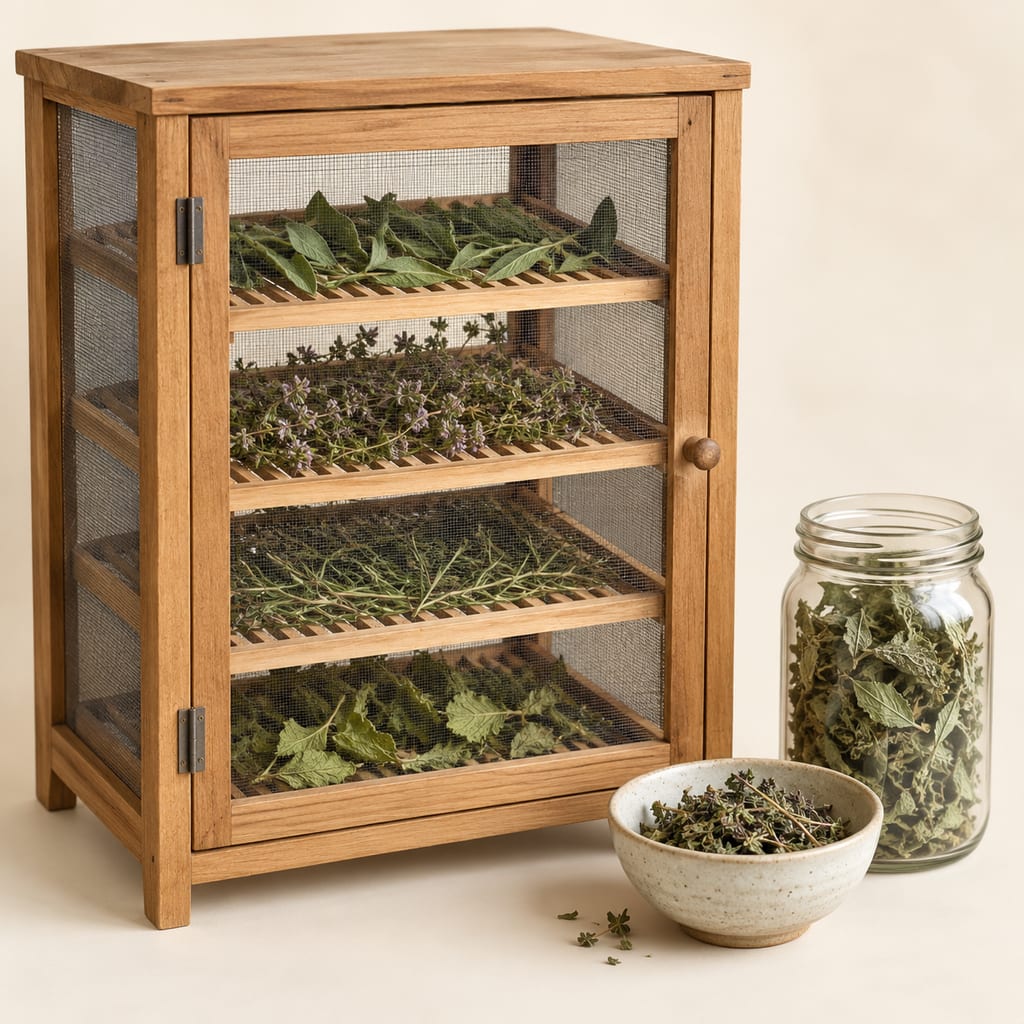
A screened shade drying cabinet is a cupboard with a mesh front, or a stack of food-suitable trays, that sits in shade and lets air move through it. Its purpose is to dry herbs and leaves gently, sheltered from rain and direct sun, without a heater. A low-power extractor can be added to help the airflow when the cabinet is in a still place.
The principle comes from open hanging in shade, which is documented for biltong in South Africa and commonly done in winter for one to two weeks depending on conditions. The screened cabinet keeps that shade and airflow but adds a barrier against insects and weather, which open hanging does not provide.
The mesh is the part of the cabinet that touches the air and the product. The National Center for Home Food Preservation describes food-contact screens for fruit made of stainless steel, Teflon-coated fibreglass or plastic, and advises against galvanized hardware cloth, copper and aluminium. A second protective screen keeps insects out of the food-contact layer. The same guidance is written for fruit; its use for herbs is an extension that the sources do not test.
Screen aperture, frame section and fixing are not given by any source. A prototype should choose a mesh that keeps insects out without slowing the airflow too much, and it should check how easily the mesh cleans.
Shade and airflow dry a product by moving its moisture into the air around it. A cabinet cannot do that when the surrounding air is already saturated. A fan can help the air move, but it cannot make up indefinitely for room humidity that is too high, so the cabinet suits drier days and drier rooms.
Which herbs, mushrooms and leaves need which drying conditions, how much volatile aroma and colour survive, and whether the dried product reabsorbs moisture after drying are not established for this cabinet. A tested process would need measured temperature, humidity and drying time for each product before anyone relies on it.
Hanging biltong in shade is documented in South African practice, commonly in winter over one to two weeks depending on conditions. The screened cupboard builds on that practice but is not recorded as a historical object.
Open shade drying exposes the product to insects. The sources recommend a second protective screen for insect exclusion.
Hazard sourceSome metals in the screen can contaminate food. The sources name galvanized hardware cloth, copper and aluminium as unsuitable for food contact.
Hazard sourceUse a food-contact screen of stainless steel, Teflon-coated fibreglass or food-grade plastic
Control sourceAdd a second protective screen for insect exclusion
Control sourceDo not use this cabinet for meat or fish on the basis of herb drying. The sources advise against outdoor meat drying where heat and humidity cannot be controlled.
Dry herbs fully before storage in sealed containers. Moisture left in the product can reabsorb from humid air afterwards.
A fan cannot make up for room air that is too humid for drying. A cabinet in damp shade will dry slowly whatever its ventilation.
SourceThe sources advise against galvanized hardware cloth, copper and aluminium for food-contact screens.
Source →The sources advise against drying meat outdoors because heat and humidity cannot be controlled.
Source →No source in this record establishes a place.
Soft, spreadable Calabrian pork sausage made with a great deal of red chilli and fatty pork, stuffed into natural casings, sometimes smoked and matured while staying soft.

A way to add independent temperature logging to an existing food dehydrator without changing its built-in controls or protections. It is a monitoring method, not a rewiring plan.

Pleurotus cystidiosus is the abalone mushroom, a cultivated oyster-type fungus with dark brown caps that grows more slowly and is more demanding than other Pleurotus species.

A dark, balanced vinegar from Emilia-Romagna made by combining cooked or concentrated grape must with wine vinegar, then acetifying and refining it in wood under a protected specification.

A living dairy inoculum that starts controlled cream fermentation, developing acidity and aroma before sour cream or cultured butter is finished.

A small electric incubator holds jars at a selected temperature for yogurt and other documented warm food preparations. Controls, capacity and vessel arrangement vary by model.

Adygean salt is a seasoned table salt associated with Adygea and the wider North Caucasian culinary tradition. Salt is blended with garlic and a variable selection of herbs and spices; the exact mix depends on the named style and maker.

The African Caesar-group mushroom, Amanita masasiensis, is a wild ectomycorrhizal species of central and southern African woodlands, eaten locally. The genus contains deadly poisonous species, so identification needs care.
No community contributions have been published for this entry yet.
Sign in to contribute. Published comments and photos are free to read.
National Center for Home Food PreservationMethod · Safety
Sun DryingFood-contact screens for fruit can be stainless steel, Teflon-coated fibreglass or plastic; galvanized hardware cloth, copper and aluminium are advised against.
A second protective screen suggested for insect exclusion.
Outdoor meat drying is advised against because heat and humidity cannot be controlled.
Cited in: Screens and materials; Humidity and what the cabinet cannot do
SciELO South AfricaHistory · Method
Biltong review (Jones et al., 2017)Biltong strips hung outdoors in shade, commonly in winter, for one to two weeks depending on ambient conditions.
Cited in: What it is; Humidity and what the cabinet cannot do