Overview
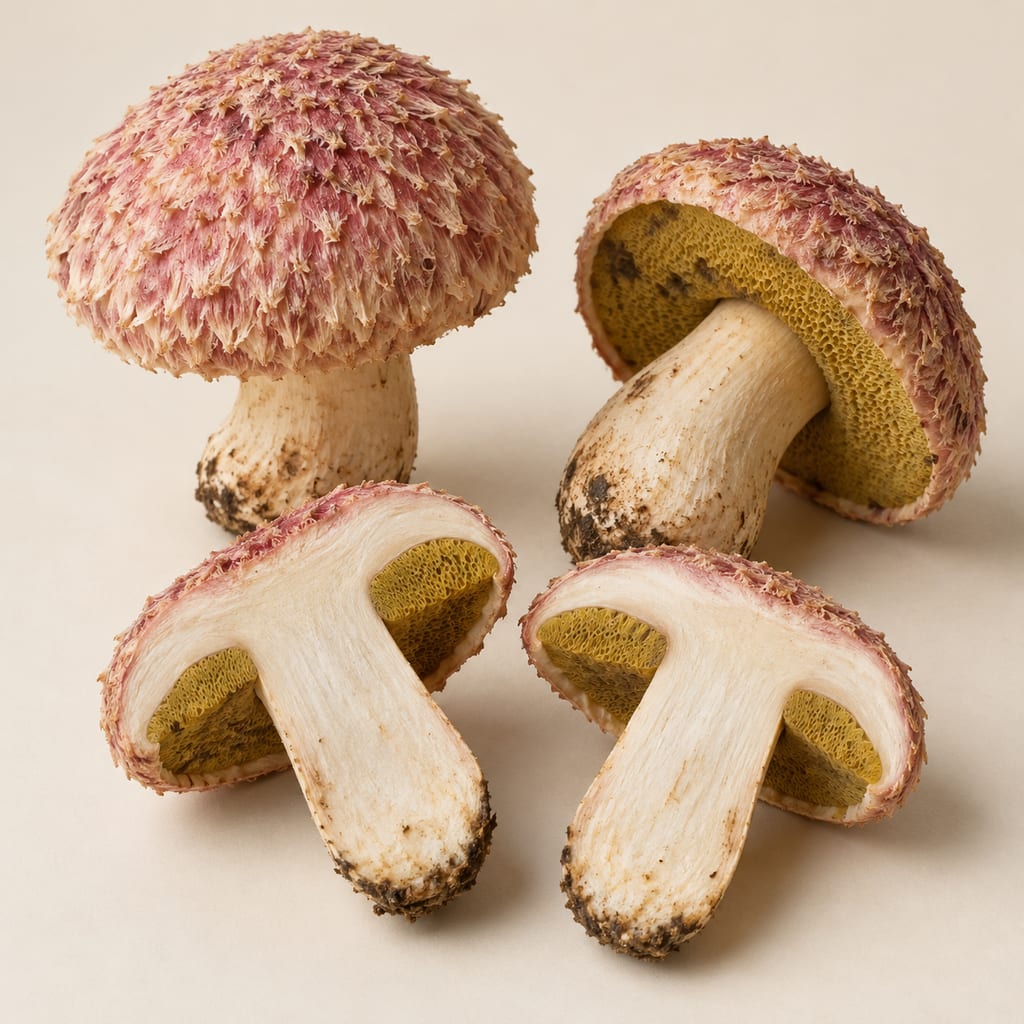
Tylopilus balloui is a bolete, a mushroom with a porous rather than gilled underside, of tropical forests in South America. Its common name in the sources is burnt orange bolete, and the catalogue gives the English label Ballou's bolete. Food use is recorded in Guyana, where the species grows with trees of the genus Dicymbe.
Names and taxonomy
Sources list the species under several names, including Boletus balloui, Gyrodon ballouii, Rubinoboletus balloui and Tylopilus balloui. The catalogue treats the name as a research label. Its identification in the Guyanese survey was morphology-based, and the modern species concept needs checking before any record is taken as settled.
Ecology and distribution
The species is ectomycorrhizal, meaning it grows in partnership with tree roots. The Guyanese records place it in forests dominated by the ectomycorrhizal legume genus Dicymbe. Guyana is the only country the catalogue lists for it.
Food use
The catalogue records that the Ackawaio use the mushroom as food, and that some Patamona later adopted it. The further search did not find independent confirmation of this Guyanese food use.
Taste and edibility
Sources disagree on the species. One describes it as edible and a delicacy for some enthusiasts. Another describes it as generally considered inedible because of its very bitter taste, and recommends against eating it, while noting it is not known to be dangerously poisonous. A third notes that it is good when it is not too bitter, but often it is. The genus Tylopilus is generally bitter-tasting.
Safety
No source read establishes a safe preparation for this species. The catalogue advises that the older identification needs modern species-level review, and that a food-use record does not settle safety. The page gives no edibility verdict.
Places
Guyana
Documented use · Country evidenceFood use reported among the Ackawaio, with later adoption by some Patamona according to the catalogue; the further search did not confirm the Guyanese food use.