
'Nduja di Spilinga
Soft, spreadable Calabrian pork sausage made with a great deal of red chilli and fatty pork, stuffed into natural casings, sometimes smoked and matured while staying soft.
 FermenteaWhere food goes to change
Other
Leccinum vulpinum, the foxy bolete, is a red-brown bolete that grows with Scots pine. Sources describe it as edible, and advise careful identification because it has close relatives.
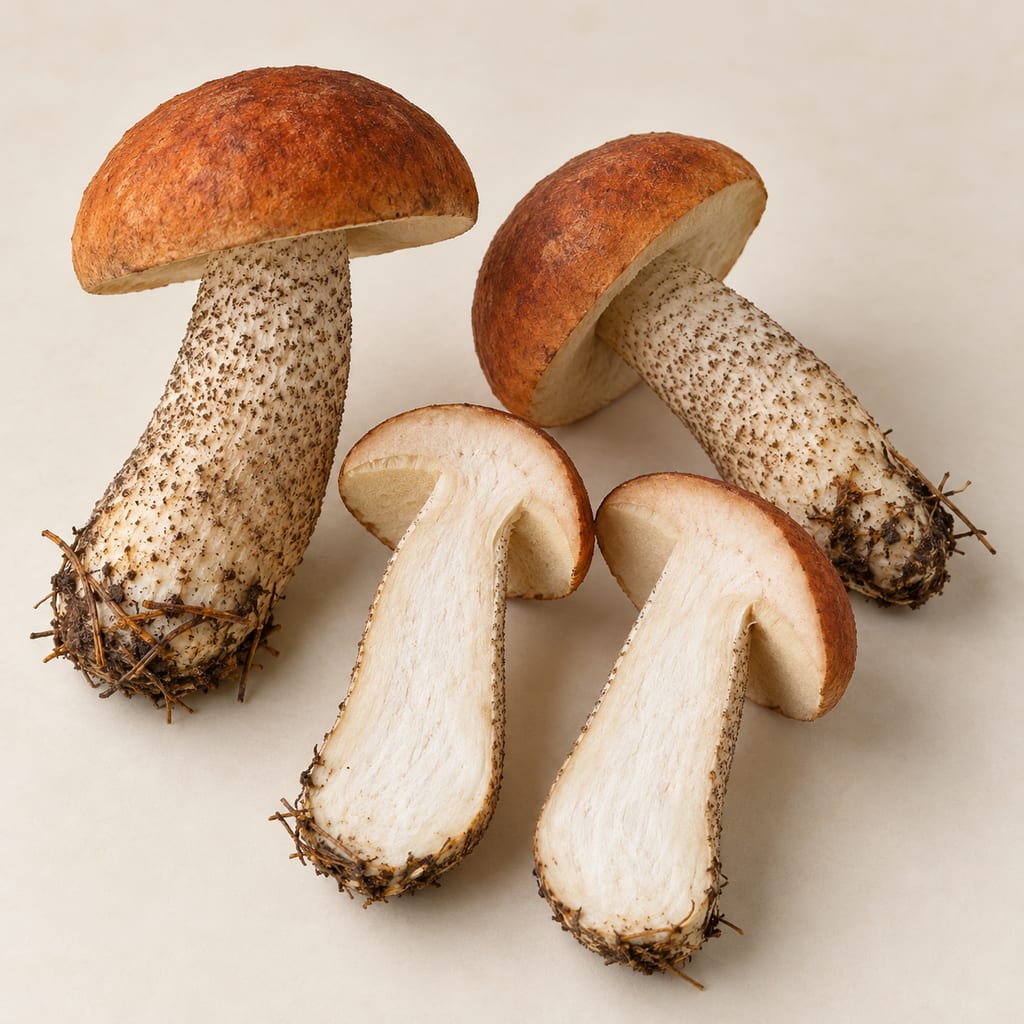
The foxy bolete has a cap of muted fox-red with a cocoa-brown tint, 30 to 90 mm across, which darkens to burnt sienna as it matures. Its stem is pale, 85 to 135 mm long, and covered in scales that darken from white to dark brown with age.
The species was first described from Scotland by Roy Watling in 1961. Its cap colour and conifer association separate it from the orange-capped Leccinum aurantiacum and L. testaceoscabrum complex.
It forms a mycorrhizal partnership with Scots pine, Pinus sylvestris, and grows in dry upland pine woods. Recorded localities include Poland, Portugal, North Macedonia and Montenegro, as well as its Scottish type area.
Finnish guides describe it as common, especially in Lapland, and note that it grows with pine and bearberry.
The flesh is white and usually stays unchanged when cut. When it does colour, the change is slow, first a pale pink or wine tint at the stem apex and later a blue-green at the base.
Sources call it edible, and at least one describes it as to be cooked before eating. Leccinum species are easy to confuse with other orange and scaber-stalked boletes, so identification needs care.
This record is not a guide to identifying wild mushrooms. Confirm any identification with an expert before eating, and cook the fruit bodies thoroughly as the guides advise.
Region-level record. The species is recorded across Europe, with Scotland as its type area.
Soft, spreadable Calabrian pork sausage made with a great deal of red chilli and fatty pork, stuffed into natural casings, sometimes smoked and matured while staying soft.

A way to add independent temperature logging to an existing food dehydrator without changing its built-in controls or protections. It is a monitoring method, not a rewiring plan.

Pleurotus cystidiosus is the abalone mushroom, a cultivated oyster-type fungus with dark brown caps that grows more slowly and is more demanding than other Pleurotus species.

A dark, balanced vinegar from Emilia-Romagna made by combining cooked or concentrated grape must with wine vinegar, then acetifying and refining it in wood under a protected specification.

A living dairy inoculum that starts controlled cream fermentation, developing acidity and aroma before sour cream or cultured butter is finished.

A small electric incubator holds jars at a selected temperature for yogurt and other documented warm food preparations. Controls, capacity and vessel arrangement vary by model.

Adygean salt is a seasoned table salt associated with Adygea and the wider North Caucasian culinary tradition. Salt is blended with garlic and a variable selection of herbs and spices; the exact mix depends on the named style and maker.

The African Caesar-group mushroom, Amanita masasiensis, is a wild ectomycorrhizal species of central and southern African woodlands, eaten locally. The genus contains deadly poisonous species, so identification needs care.
No community contributions have been published for this entry yet.
Sign in to contribute. Published comments and photos are free to read.
WikipediaIdentity · Habitat · History
Leccinum vulpinumCap and stem measurements; Scots pine association; Scottish type; distribution; slow flesh staining; edible
Cited in: What it is; Habitat and distribution; Cutting, eating and look-alikes
Out in the NatureIdentity · Safety · Habitat
How to identify edible boletes in FinlandCommon in Finland, especially Lapland; cook before eating; pine and bearberry habitat
Cited in: Habitat and distribution; Cutting, eating and look-alikes; Safety