
Home equipment crafts
Traditional food crafts with modern home equipment
A slow cooker, a brewing kettle or a dehydrator can take over the hard part of many old food crafts, once you see each appliance as a set of physical functions and give it the right container.
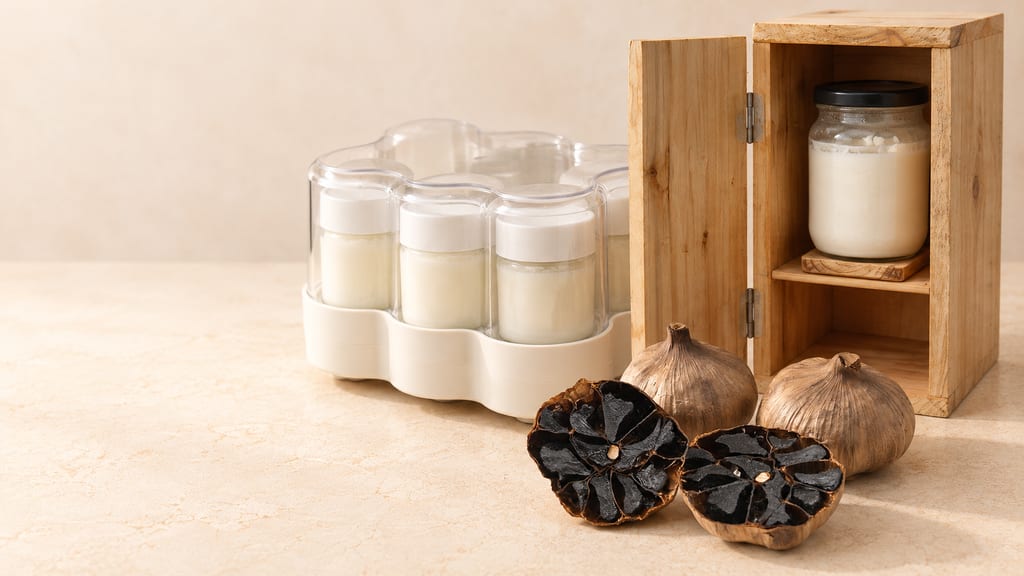
A yoghurt maker, a warm box and black garlic: kitchen equipment is best understood by what it holds steady.
Appliances that were made for something else
Many traditional foods ask for one demanding operation that a household once supplied by hand, by fire or by the weather. Milk has to be warmed slowly and then left completely still. A tray of steamed rice has to stay at body warmth for two days while a mould grows through it. Sesame has to be ground for hours, fruit pulp stirred until it no longer splashes, a skin lifted again and again from hot soy milk, a sheet of purée dried in a week without rain. Modern kitchens already hold machines that do these things well. They were bought for stews, beer, bread or soda, and they rarely say so on the box.
Some cooks have already made the leap, and their accounts are the backbone of this series. Kathy Love, demonstrating for New England Cheesemaking Supply, made quick mozzarella in a slow cooker. She pushed a thermometer probe through the lid, heated the milk on High, lifted the crock out of its base when the milk reached 35 °C so that the rennet could set without more heat, and put it back to warm the cut curds to 41 °C. Tony Hamblyn, a pilot and home cheesemaker in New Zealand, lowered a 50-litre pot into the 70-litre mash tun of his home brewery, rested it on its handles and circulated hot water around it, turning the brewery into a double boiler for cheese. The Nordic Food Lab in Copenhagen kept its koji in an upright refrigerator, switched off and fitted with a heating mat and a probe on a controller, after an earlier insulated box warmed by underfloor heating cable. Excalibur, a dehydrator maker, publishes a yogurt recipe in which every drying tray comes out and capped jars of milk sit in the warm cabinet for nine hours.
None of these uses is what the appliance was sold for, and none turns the appliance into a different machine. Each takes one physical function, gentle heat, still warm air or a steady bath, and puts the food in a container that lets that function reach it in the right way. That idea, and its limits, runs through all twelve articles in this series.
Three kinds of evidence, kept apart
None of the appliance adaptations described here has a published temperature trial. Three kinds of claim are therefore worth keeping apart.
The first is documented use: a manufacturer, a recipe author or an identifiable practitioner shows the appliance doing the job. Kathy Love's slow-cooker mozzarella, Hamblyn's brewery double boiler and Excalibur's jar yogurt are of this kind. A demonstration proves that the arrangement worked for that person, with that machine and that batch. It does not prove that every model behaves the same, and it is not a safety validation.
The second is reasoned adaptation. The food process is documented, and an appliance plainly supplies the physical function the process needs, but nobody has published the exact combination. A pot of milk standing in a slow cooker full of water is an example: water jackets are an old cheesemaking tool, and a slow cooker can heat water, but no one has published the temperature curve.
A manufacturer's manual establishes what its own machine is for and what it does; it does not establish that a food made in it is safe. A temperature printed in a recipe belongs to that recipe, and is never a general schedule for every machine.
Heat, held in water, crockery and air
The heating appliances differ less in how hot they get than in how heat reaches the food.
A slow cooker heats a thick ceramic crock from below and around its sides. The crock stores a great deal of heat, so it warms slowly, evens out the heating, and keeps releasing heat after the power goes off. That is an asset when warmth should fade slowly over hours and a nuisance when a temperature must stop rising at a mark. Its controls are not temperatures. Crock-Pot's booklet for its 3.5-litre SCV400RD prints no figure for High or Low, and reserves Warm for keeping cooked food warm for no more than four hours.
A sous-vide circulator heats and stirs a tank of water to a setpoint. Breville's manual for its HydroPro circulators says the machine is for water only and that food must sit in a bag or container separated from the bath, and gives 90 °C as its highest setting. An all-in-one brewer is a large electric kettle with a controller and often a pump. KegLand's manual for the 35-litre BrewZilla Gen 4 forbids switching on with less than 4 litres in the boiler; Grainfather's G30 manual describes a machine made for small-batch beer brewing, rated at 2,000 W on 220–240 V supplies and 1,600 W on 110–120 V.
A bread proofer warms still air. Brød & Taylor, which makes one, explains that its proofer heats from an aluminium plate in its base, that it only heats and cannot cool, and that a lid on a container or water in its humidity tray raises the food's temperature at the same setting. A multicooker adds pressure and a set of programmes; the 2016 manual for the Instant Pot Duo specifies a yogurt programme that can run as low as 30–34 °C and a Keep Warm function at 63–78 °C.
Each of these is a heat source with its own thermal mass, its own way of delivering heat and its own controls. None of them knows the temperature of the food.
Air, cold, motion and pressure
A dehydrator is a heater and a fan. Moving air carries water vapour away from a wet surface, and evaporation cools that surface, which is why Excalibur says food on its trays usually runs about 11 degrees Celsius cooler than the air. A refrigerator removes heat and, in doing so, dries its air; New England Cheesemaking Supply notes that an ordinary fridge is too cold and too dry for ripening cheese, and that a fridge run by an external thermostat at 11–13 °C makes a workable cave. A freezer grows ice, and ice is a separating tool as well as a preserving one: gelatin freeze-thaw clarification, which Dave Arnold credits to Wylie Dufresne for juices, lets a frozen gel drip a clear liquid as it thaws in the refrigerator.
Motors grind, beat and press. A stand mixer's whisk churns cream until the fat gathers into butter. A blender reduces seeds to paste in minutes; a stone refiner rolls granite over a drum for days. Diamond Custom Machines, which sells the Premier refiner, draws the line between the two kinds of stone machine sharply: wet grinders are designed for short runs, while its refiner has been tested to run continuously for 72 hours. A small screw press such as Piteba's squeezes oil from seed, provided the seed holds about 10 per cent moisture; a steam juicer condenses steam on fruit so that juice runs out without crushing.
Gas pressure is a function too. A home carbonator dissolves carbon dioxide in a drink, and SodaStream warns that most of its machines are designed to fizz water only, with flavour added afterwards. A cream whipper charged with nitrous oxide forces liquid into the pores of herbs and draws it out again when the pressure drops; in Dave Arnold's rapid-infusion method the whole cycle takes about a minute. Neither machine ferments, ages or preserves anything.
Reading the kitchen this way, as heat with thermal mass, still warm air, moving warm air, cold, ice, agitation, particle reduction, pressing, steam and gas pressure, makes it easier to see which machine can take over which stage of a craft, and which cannot.
The insert is often the valuable part
The most useful adaptations are not new machines but new containers inside old ones.
A supported pot inside a water bath is the most widely useful. The outer water spreads heat evenly around the inner pot while the food inside stays still, which separates two needs that conflict in cheesemaking: even heating and an undisturbed rennet set. Hamblyn's pot hung from its handles, so its height stayed fixed as whey was ladled out; a floating bowl rises as it empties and tips when stirred. The bath also caps the temperature of the surface the food touches, since the pot wall cannot be hotter than the water around it.
Several jars in one bath turn a tank into a set of side-by-side trials. Every jar shares one water temperature, so a bath can compare starter cultures, milks, doses or flavourings, but never two incubation temperatures. Breville's rule that food stays out of the bath water is the starting point; the jar, its lid and its fill do the rest.
A wide shallow pan does what a deep vessel cannot. Yuba, the skin of soy milk, forms only at the surface where hot milk meets air, so the area of the pan, not its volume, sets how much skin forms at a time. Kyoto's yuba makers warm soy milk in a framed pot over a hot-water bath, and food scientists form yuba films in pans standing in baths held at 85 °C.
A warm cabinet with a container inside is the fourth arrangement, and the container decides what the food experiences. A capped jar keeps its water, so a dehydrator full of yogurt jars dries nothing. Tempeh pressed into plastic bags pierced every inch gets air without drying out. Koji spread two centimetres deep under a damp cloth can lose the heat its mould produces. The same proofer serves all three only because the containers differ.
Two smaller ideas complete the set. An appliance can serve another vessel without holding the food: Hamblyn's later layout kept one tank purely for hot water, and a brewer could in the same way supply wash water for Gouda or a hot whey bath for halloumi beside a separate cheese pot, an untested but straightforward use. And a plug-in controller can add feedback to equipment that has none, provided the appliance turns itself back on after power returns, the controller is rated for the load, and the probe sits where the measurement means something.
A setpoint is not a temperature
Every appliance in this series reports a number that is not the food's temperature, and every documented method that works around this does so with a probe in the food.
KegLand's BrewZilla manual is candid: its controller reads the liquid near the elements at the bottom of the boiler, which is not the core temperature of the mash, and a second calibrated thermometer shows the real figure. Excalibur calibrates its dehydrator dial to the food rather than the air, so at a 41 °C setting the air can reach 51 °C; a capped jar does not evaporate, so how closely its contents follow that dial is unknown until measured. Brød & Taylor's own yogurt recipe makes the point in a single page: to bring milk to about 38 °C in the second stage, its proofer is set to 30 °C and its Sahara dehydrator to 38 °C. Its black garlic method once told owners of an older proofer to set 39 °C because the base plate then reached 60 °C.
Labels mislead more than numbers. A slow cooker's Low or Warm is a heating level, not a temperature. A rice cooker's keep-warm exists to keep rice hot, and the Instant Pot Duo's Keep Warm range of 63–78 °C sits above the 50–60 °C window in which Marukome holds its amazake. A recipe that says "set the cooker to Warm" says nothing about what the food will reach.
Lag completes the picture. Heat flows into a jar or a pot in proportion to the gap between bath and food, so the food warms quickly at first and ever more slowly as it nears the bath temperature, and an open pot losing heat at its surface settles below it. A large bath or a heavy crock also stores heat it cannot shed quickly; if it overshoots, the food follows. Time any hold from when a probe in the food, or in a representative jar of the same size and fill, reaches the target.
What really becomes faster
Appliances save labour more often than they save time, and the difference matters when a recipe promises speed.
A pressure cooker shortens the cooking of beans: Brød & Taylor gives 50 to 60 minutes of simmering for tempeh beans, or 15 to 20 minutes steamed under pressure. It does nothing for the fermentation that follows, and the British Columbia Centre for Disease Control's guidance for tempeh and natto makers adds a step it cannot skip: once below 60 °C, cooked beans should reach inoculation temperature within two hours, with six hours as the limit, because spore-forming bacteria grow in warm cooked beans.
Controlled warmth makes a culture more reliable in a cold room; it does not make every ferment faster, and more heat can stop it. Koji and tempeh produce their own heat as the mould grows: the Fermentation Culture shop logged soy-sauce koji reaching 39 °C within 14 hours of inoculation, and the Nordic Food Lab notes that the centre of a packed tempeh cake can reach 40–50 °C, above the mould's optimum. A heater-only cabinet cannot answer that. Enzymes have the same ceiling: Marukome holds amazake at 50–60 °C and notes that a mixture held too hot stops turning sweet.
A motor replaces hours of pounding but sets its own particle size, and similar-looking grinders are not interchangeable. More air speeds vinegar: the Nordic Food Lab acidified a wine with an aquarium pump and an airstone in days rather than the months of a still barrel, but the strength of a homemade vinegar remains unknown until measured. Freezing a gel to clarify a stock replaces skimming with a day or two of waiting. A dehydrator frees drying from the weather but does not reproduce sunlight's chemistry: in one study, fermented tapioca starch dried in the sun puffed to 6.97 mL/g on baking, against 3.71 mL/g for the same starch dried in an oven. And a controller with a logger gives fewer manual corrections and a reproducible record, which is valuable, but is not a validated recipe or a shelf life.
Where the equipment stops
Vacuum packing removes air, but the UK Food Standards Agency explains that non-proteolytic Clostridium botulinum can grow and make toxin without oxygen at 3 °C and above, and sets a maximum ten-day shelf life for vacuum-packed chilled foods unless a stated controlling factor applies. A sealed bag is a package, not a preservation step. An electric multicooker is not a pressure canner: the National Center for Home Food Preservation does not support its canning processes in them, because those processes were worked out from temperatures measured inside jars in particular stovetop canners, including the heat delivered while the canner comes up to pressure and cools down. A sealed jar or a pressurised pot is not evidence of a shelf-stable food.
A sour taste is not a vinegar strength; tested pickling recipes call for vinegar of known acidity, usually 5 per cent. Histamine formed in badly chilled fish is not destroyed by cooking or smoking, so no warm vessel can rescue it. Freeze-drying keeps microbes alive rather than killing them, as Utah State University Extension's 2026 guidance stresses. Drying meat is not cooking it: the National Center's jerky method separates drying at 60 °C from a heating step that brings the inside of the meat to 71 °C.
Mature flavour is a matter of time. A refrigerator on a controller can hold a cheese at its ripening temperature but cannot shorten the weeks its cultures and enzymes need. The last article in the series works through each of these boundaries by its mechanism, and for each one says what the appliance still does well.
What a good recipe record holds
An adaptation becomes useful to anyone else only when it is written down well. A recipe that says "use this beer machine" travels badly; one that says "brewing kettle with a supported stainless inner pot and water circulating outside it" can be repeated on another brand. A useful record names the configuration as well as the appliance: model and version, the insert and how it is supported, the working volumes and the depth of the food.
It separates control from setting: the food's target temperature, the bath or cabinet setting used to reach it, where the probe sat, the ramp, when stirring started and stopped, and whether the container was closed, loosely covered, pierced or open. It names the ingredients at the precision that matters, such as milk treatment (Penn State Extension's home cheesemaking guide warns that ultra-pasteurised and UHT milk interfere with curd formation), the culture and its source, the coagulant, the salt by weight. It states the endpoint the recipe actually uses, a pH, a clean break, a set, a spoon test, a dryness, rather than a running time alone, and it keeps hands-on time, unattended holds and cooling apart. It records yield, by-products and loss, storage as the recipe states it, how the result differs from the traditional food, and which batch sizes and models were actually tried.
The first trial of any new arrangement should use water. Fill the inner pot or jars to the planned level, check cold that nothing tips or floats and that water can circulate, then heat and log the appliance display beside a probe in the food vessel. That shows fit, lag and overshoot. It says nothing about how real food heats, whether a culture acidifies or how long the result keeps, and a batch that worked at two litres does not scale to twenty by multiplying.
How the series is organised
A slow cooker as a small dairy follows Kathy Love's mozzarella and asks what a crock can and cannot do for paneer, ricotta, mascarpone, quark and yogurt, including the documented method that makes yogurt from a switched-off cooker's own cooling. Cheese in the brewhouse turns to brewing kettles as water jackets, hot-water tanks and whey cookers, from Hamblyn's build to halloumi, Gouda wash water and brunost. One bath, many small jars explains circulator physics and the documented yogurt, egg, dashi and syrup methods that use it. Rice, koji and malt in a warm hold separates enzyme work from fermentation in amazake, shio koji, sikhye, rice syrup, jiu niang and fermented batters.
Soy milk, tofu and yuba: why the pot's shape matters shows how one batch of soy milk becomes a still gel, a pressed curd or a lifted skin. Cream four ways follows cream through clotting, culturing, churning and clarifying. Fermentation cabinets covers proofers, dehydrators and converted fridges for tempeh, koji, natto, kombucha, sauerkraut, kimchi and cheese. Drying and freeze-drying at home deals with water activity, fruit leathers, hoshiimo, tarhana and what a freeze dryer does.
Mills, presses and extractors at home compares blenders, refiners, wet grinders and oil presses, from tahini to coconut milk, horchata and gari. Fruit extraction and concentration covers steam juicers, fruit butters, fruit pastes, date and maple syrups, freeze-thaw clarification and carbonation. What an appliance cannot reproduce closes the series with sunlight, frost, pits, time and the kill steps no machine supplies.
Related
Discussed in this article
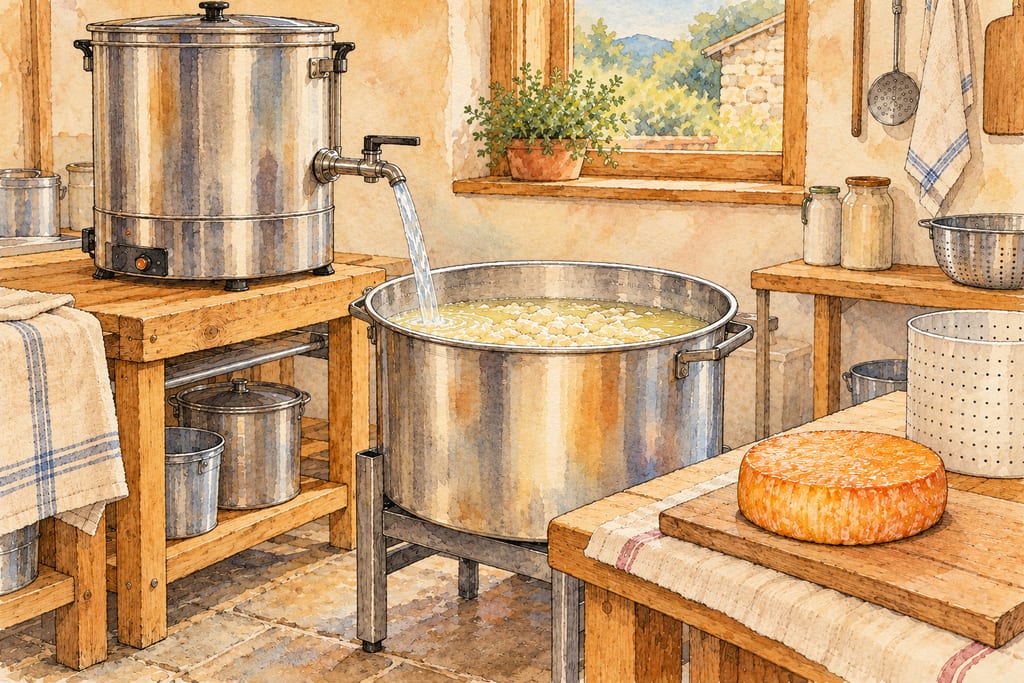
Brewer as a hot-water service station
The brewer holds clean water at a set temperature for washed-curd cheeses and other hot-water jobs, beside a separate cheese pot, instead of heating milk directly.
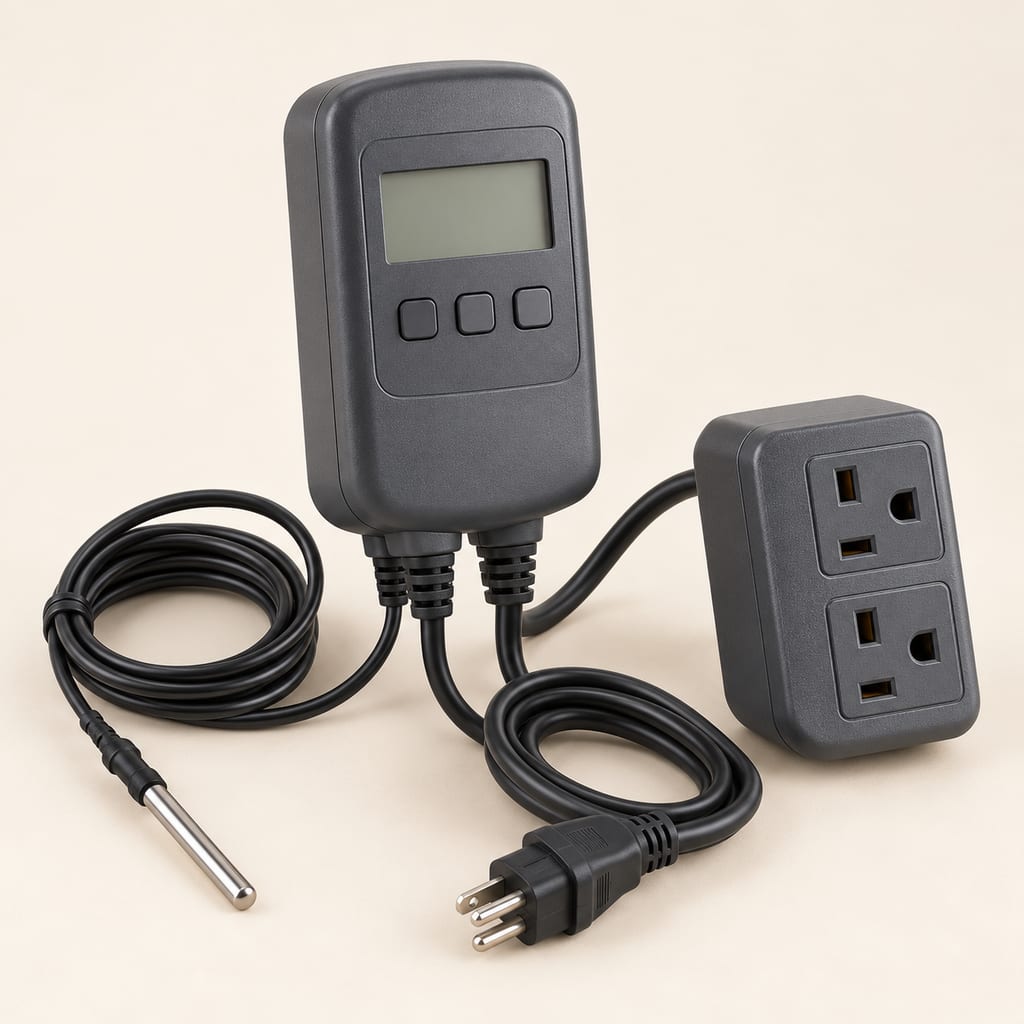
Plug-in temperature controller
A plug-in controller reads a wired probe and switches compatible heating or cooling appliances around a setpoint. It adds feedback; it is not itself a heater, cooler or validated food process.
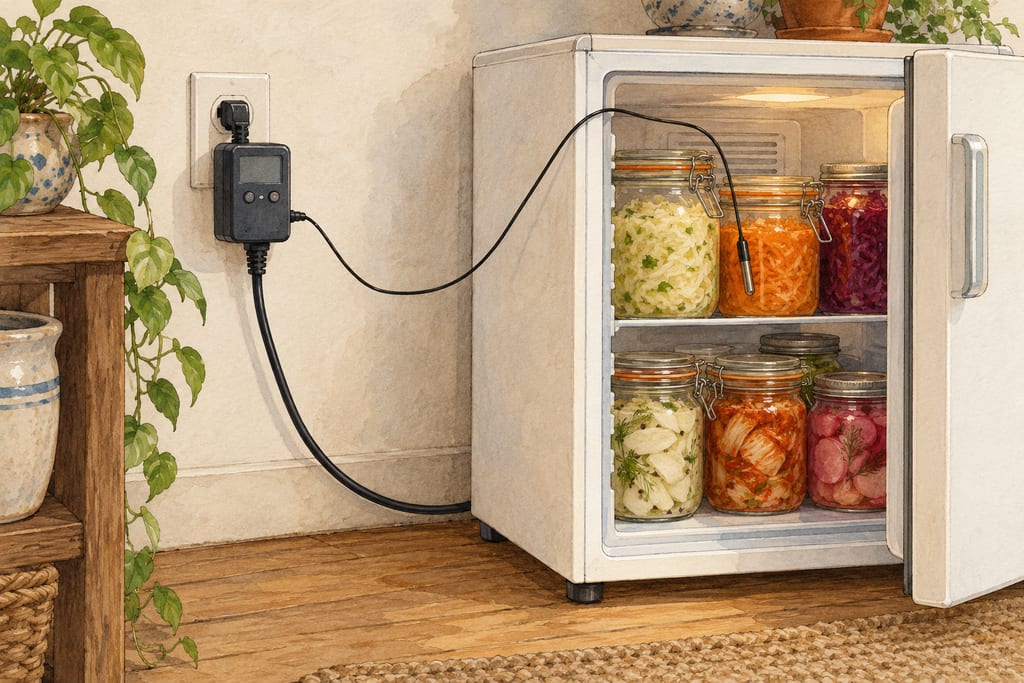
Plug-in temperature controller on an appliance
An appliance plugged into an external controller so a probe, rather than the appliance's own dial, decides when it heats or cools.
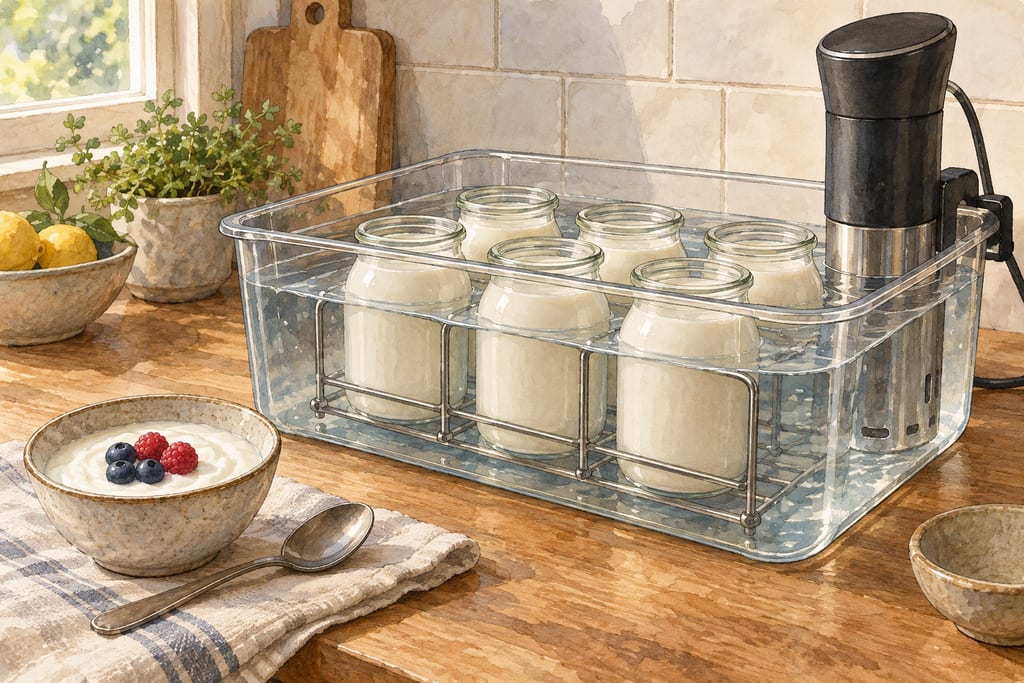
Several jars in one bath
A circulator tank holding a rack of identical jars, so several small batches share one temperature for side-by-side trials of cultures, milks, ratios or flavourings.
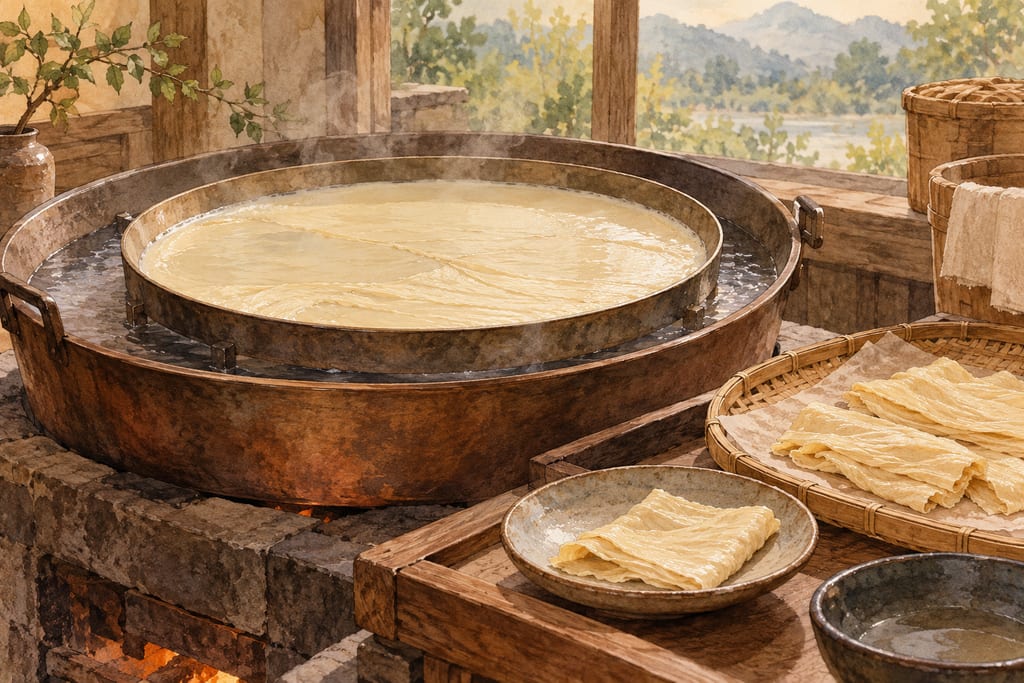
Shallow pan over controlled hot water (yuba pan)
A wide shallow pan of soy milk standing in a controlled hot-water bath, so that the bath heats evenly while the open surface forms film after film of yuba.
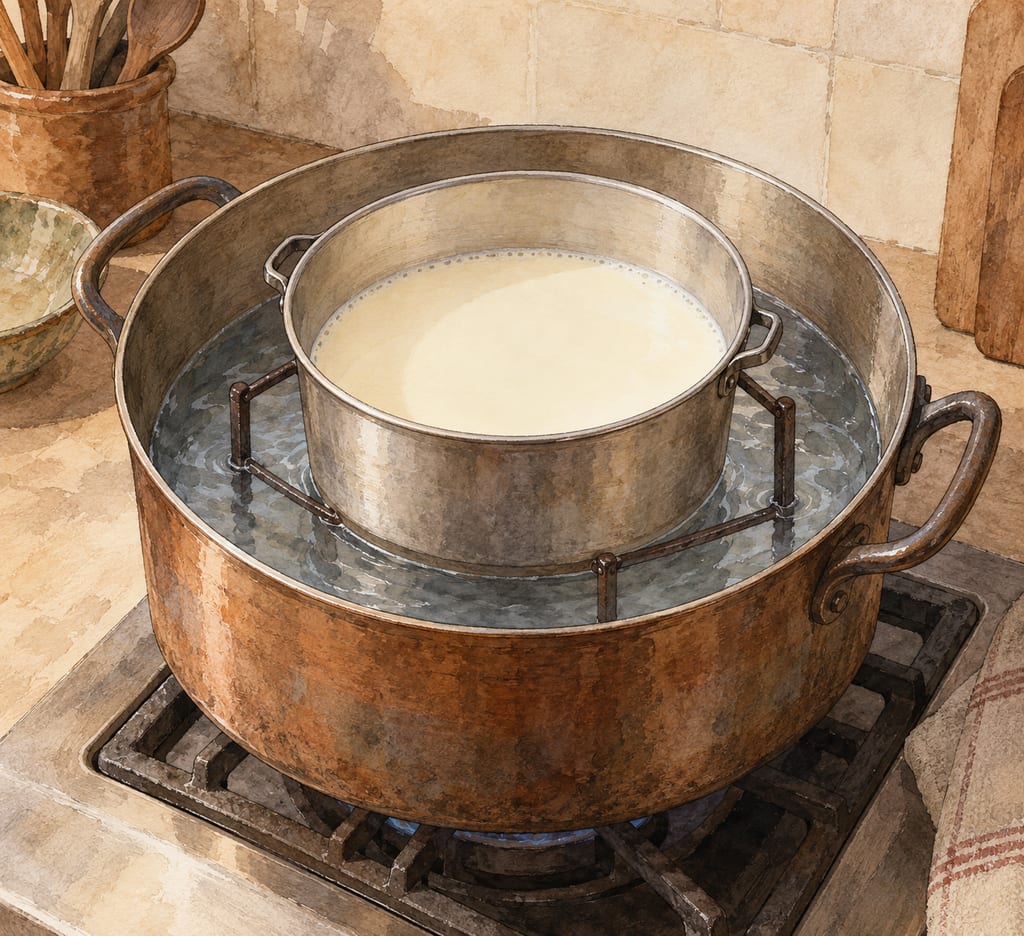
Supported pot inside a water bath
A food pot held at a fixed height inside a larger vessel of controlled hot water: the water distributes heat while the milk or whey inside stays still and away from the heater.
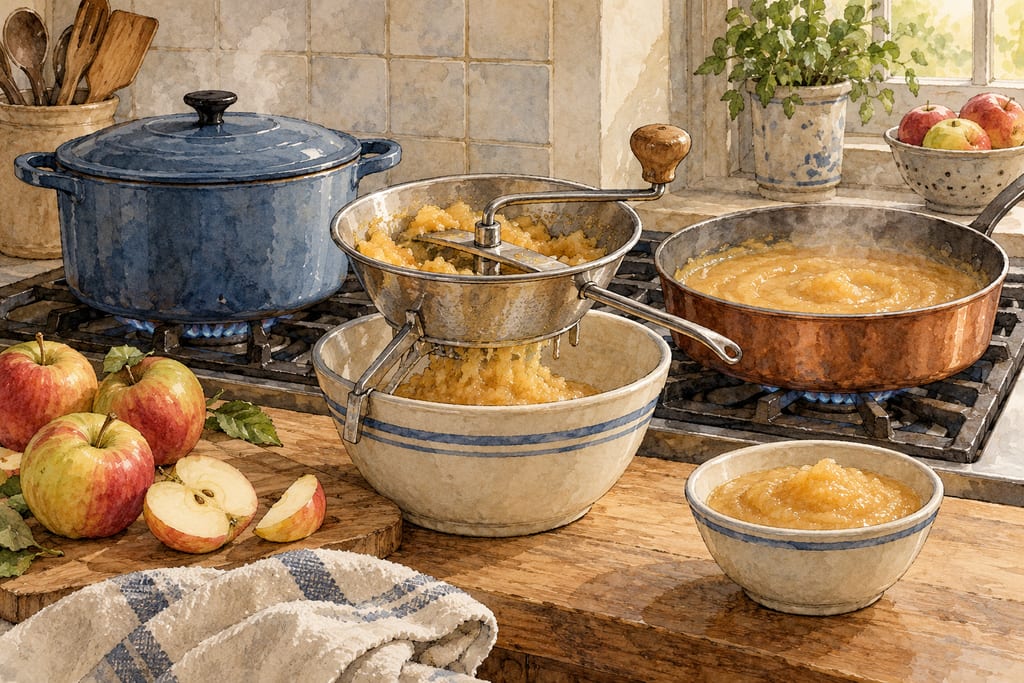
Two appliances sharing a workflow
Each appliance does the stage it is good at: a closed pot to soften, a mill or cloth to separate, an open pan or freezer to concentrate or clarify.
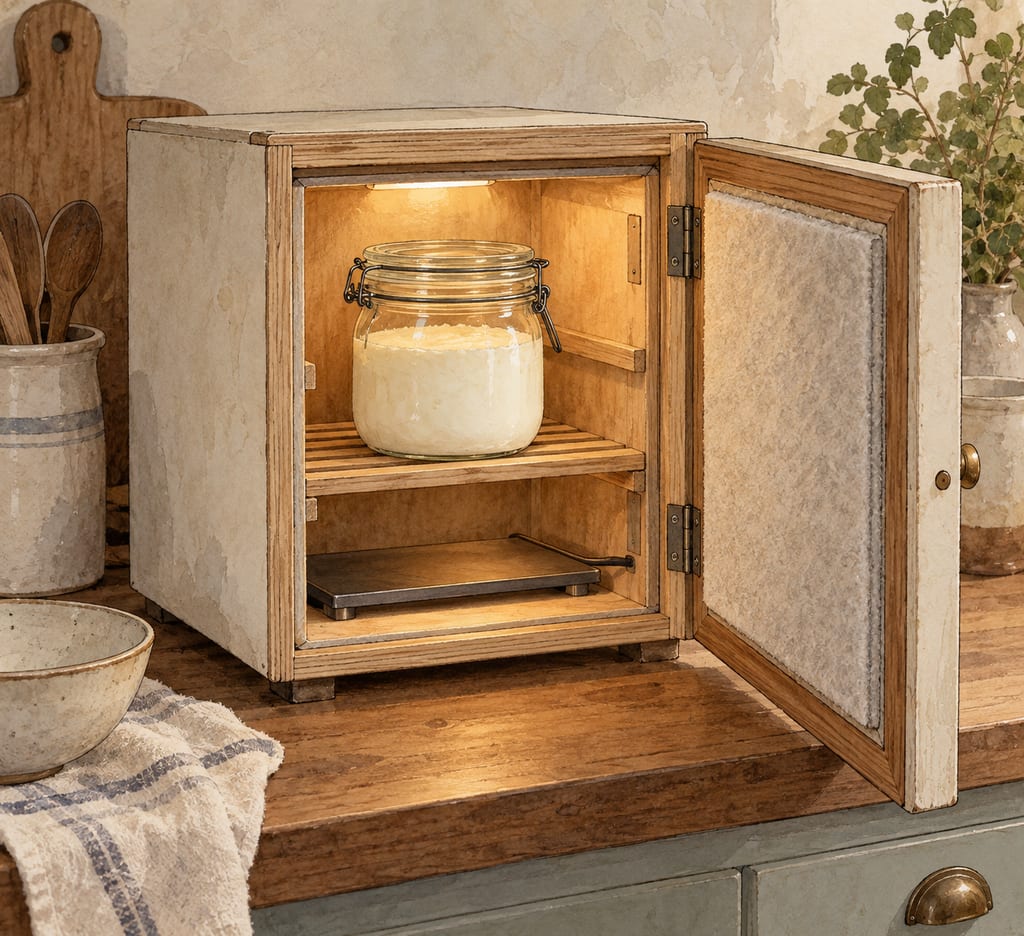
Warm cabinet with an internal food container
Any warm box, proofer, dehydrator cabinet or adapted fridge whose conditions reach the food through a separate container chosen for that culture.
Community
No community contributions have been published for this entry yet.
Share what you made
Sign in to contribute. Published comments and photos are free to read.
Sources
New England Cheesemaking Supply Company
Making Mozzarella in the Slow CookerCited in: Appliances that were made for something else; Three kinds of evidence, kept apart; What a good recipe record holds; How the series is organised
New England Cheesemaking Supply Company (cheesemaking.com)
Tony Hamblyn Cheesemaker in New ZealandCited in: Appliances that were made for something else; Three kinds of evidence, kept apart; The insert is often the valuable part; How the series is organised
Nordic Food Lab
Koji – history and processCited in: Appliances that were made for something else; The insert is often the valuable part
Excalibur Dehydrators (recipe site)
Homemade YogurtCited in: Appliances that were made for something else; The insert is often the valuable part; How the series is organised
Breville (PolyScience)
the HydroPro™ Plus & the HydroPro™ Instruction Book - CSV750/CSV700Cited in: Three kinds of evidence, kept apart; Heat, held in water, crockery and air; The insert is often the valuable part; What a good recipe record holds
Crock-Pot (Newell Brands), UK manuals page
Crock-Pot SCV400RD 3.5L Slow Cooker instruction bookletCited in: Heat, held in water, crockery and air; A setpoint is not a temperature
KegLand Distribution Pty Ltd (copy hosted by The Malt Miller)
BrewZilla 35L - Gen 4 Instruction Manual (Last Updated 30/08/2022), distributor copyCited in: Heat, held in water, crockery and air; A setpoint is not a temperature; What a good recipe record holds
Grainfather
Instructions - G30 (Grainfather G30 instruction manual PDF, 'Grainfather Connect Instructions')Cited in: Heat, held in water, crockery and air
Brød & Taylor
Support (product specifications and FAQ: Folding Proofer & Slow Cooker, Sourdough Home, Sahara Folding Dehydrator)Cited in: Heat, held in water, crockery and air; A setpoint is not a temperature
Instant Pot (manual hosted by Williams-Sonoma)
Programmable Electric Pressure Cooker User Manual, Models IP-DUO60/80 (September 2016)Cited in: Heat, held in water, crockery and air; A setpoint is not a temperature
Excalibur Dehydrator
Intro to DehydratingCited in: Air, cold, motion and pressure; A setpoint is not a temperature
Cooking Issues, the International Culinary Center's Tech 'N Stuff blog, 20 July 2010
Simple Agar Clarification: 1 Year Anniversary, Plus a Rundown of Current Clarification TechniquesCited in: Air, cold, motion and pressure; What really becomes faster
PITEBA
Electric oil press. how to press oil from seeds and nutsCited in: Air, cold, motion and pressure
Oregon State University Extension Service, Home Food Safety and Preservation Program; first video by Utah State University Extension
Steam juicer (Library of Things), with the videos 'How to Use a Steam Juicer' and 'Water Bath Canning: Fruit Syrup'Cited in: Air, cold, motion and pressure
SodaStream UK
can I fizz liquids other than water in my Sodastream?Cited in: Air, cold, motion and pressure
New England Cheesemaking Supply Company (cheesemaking.com)
Tony Hamblyn in New Zealand UpdateCited in: The insert is often the valuable part
Ministry of Agriculture, Forestry and Fisheries (MAFF), Japan
京湯葉(きょうゆば)|にっぽん伝統食図鑑:農林水産省Cited in: The insert is often the valuable part
Foods 15(6):1094 (MDPI), 2026
Microwave Pretreatment of Soybeans Prior to Soaking Enhances Mechanical and Rehydration Properties of YubaCited in: The insert is often the valuable part
Brød & Taylor
How to make TempehCited in: The insert is often the valuable part; What really becomes faster
Fermentation Culture (fermentationculture.eu, LUVI Fermente GmbH, Lenzing, Austria)
What Koji needs to grow and how to provide for its needsCited in: The insert is often the valuable part; What really becomes faster
Marukome Co., Ltd.
糀甘酒の作り方|マルコメの糀甘酒|マルコメCited in: A setpoint is not a temperature; What really becomes faster
BC Centre for Disease Control, Fermented Foods Working Group
Fermented Foods Guidance – Section 3.9 Tempeh (Safety of Fermented Foods, November 2023, updated December 2024)Cited in: What really becomes faster
BC Centre for Disease Control, Fermented Foods Working Group
Fermented Foods Guidance – Section 3.8 NattoCited in: What really becomes faster
Nordic Food Lab
Tempe part 1: traditional fermentation, fungal trials, and regional seedsCited in: What really becomes faster
Nordic Food Lab
Vinegar: From the Orleans Method to Food Lab ExperimentsCited in: What really becomes faster
International Journal of Biological Macromolecules 145:965–973 (2020); DOI 10.1016/j.ijbiomac.2019.09.187; PMID 31614157
Combinatorial effect of fermentation and drying on the relationship between the structure and expansion properties of tapioca starch and potato starchCited in: What really becomes faster; How the series is organised
UK Food Standards Agency, published and last reviewed December 2020 (revision 4; first published July 2008)
The safety and shelf-life of vacuum and modified atmosphere packed chilled foods with respect to non-proteolytic Clostridium botulinumCited in: Where the equipment stops
National Center for Home Food Preservation, University of Georgia, 1 February 2019
Canning in Electric Multi-CookersCited in: Where the equipment stops
National Center for Home Food Preservation
General Information on PicklingCited in: Where the equipment stops
Food Standards Scotland
Chemical hazards in fish (Safe smoked fish tool resources)Cited in: Where the equipment stops
Utah State University Extension
Can I Freeze-Dry That? A Practical Guide to Safe and Effective Freeze-DryingCited in: Where the equipment stops
National Center for Home Food Preservation, University of Georgia (from So Easy to Preserve, 6th ed., 2014)
JerkyCited in: Where the equipment stops
Penn State Extension (The Pennsylvania State University), code ART-4803, 2019; copy hosted by UC Agriculture and Natural Resources
Home CheesemakingCited in: What a good recipe record holds
Cooking Issues, 11 August 2010
Infusion Profusion: Game-Changing Fast-N-Cheap TechniqueCited in: Air, cold, motion and pressure
Gaps
- No published temperature curve exists for any of the appliance adaptations described: milk in a slow cooker on Low or Warm, a pot nested in a commercial all-in-one brewer, jars spread through a home circulator bath, or a koji tray, tempeh bag and jar sharing one cabinet.
- The two-appliance workflows (pressure cooker to tempeh cabinet, blender to yuba pan, brewer to whey pan, proofer to stand mixer, rice cooker to syrup pan, slow cooker to fruit-paste pan) have not been published as complete methods.
Updated 2026-10-27