
Home equipment crafts
Fermentation cabinets: proofers, dehydrators and converted fridges
A proofer, a dehydrator with its trays out or an old fridge on a controller can keep cultures at a steady temperature. Whether it works depends on what sits inside: a lidded jar, a vented bag, a shallow tray or a crock.
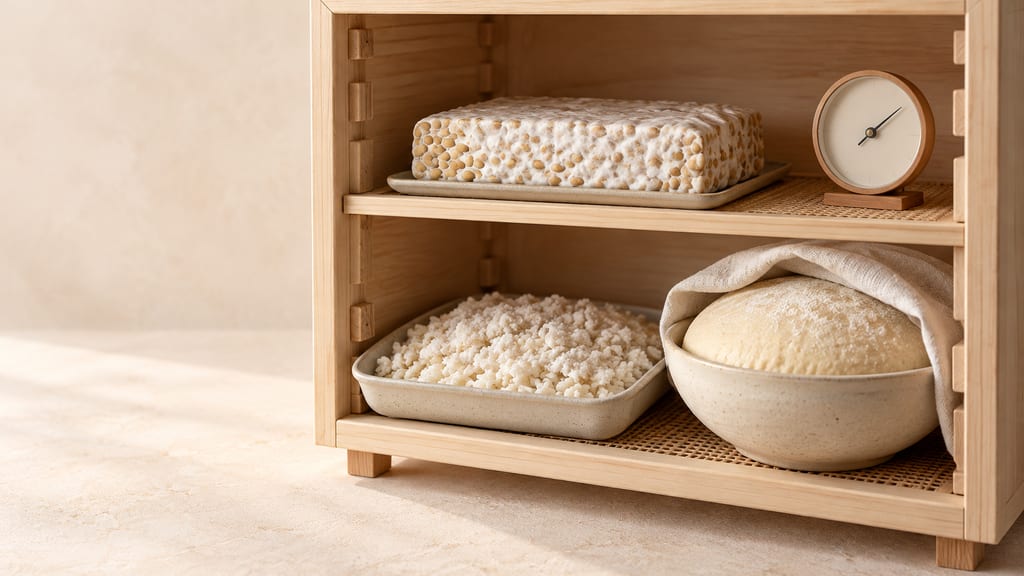
Tempeh, koji and risen dough: the foods a warm, humid fermentation cabinet is built to grow.
A box of air around a separate container
Before cabinets, ferments ran in whatever climate the season gave. Kimchi was made in November or early December and its pots buried, and natto, before it was made in factories, fermented at room temperature in the winter months, as the British Columbia Centre for Disease Control's guidance records. A fermentation cabinet tries to give a home kitchen one dependable climate all year.
The Nordic Food Lab, a small non-profit research kitchen in Denmark, described its first attempt on its blog in December 2011. Many of its ferments wanted 30 to 40 °C, warmer than any Danish summer. The team bought a PID controller from Auber, which switches whatever heater is plugged into it, and laid electric underfloor heating inside an insulated box. Two linked boxes held its garum trials, a solid-state vinegar and barley being moulded for a yellow-pea ferment.
By August 2013 its koji grew in an upright fridge, switched off and fitted with a heating mat and a probe on a PID controller. Josh Evans listed what the chamber had to do: hold 30 °C, keep the air humid, and leave room for air to move.
These are research-kitchen improvisations, history rather than wiring instructions. Their modern relatives are a bread proofer, a dehydrator with its shelves removed, and a fridge on a plug-in controller. In each, the appliance conditions the air around a separate food container, and the container decides what the food experiences: a capped jar keeps its water, a pierced bag lets a mould breathe, a shallow tray under a damp cloth lets grain shed heat without drying.
What the cabinet controls, and what the food does anyway
Still air carries heat poorly. Brød & Taylor's proofer heats mainly by radiation from an aluminium plate in its base, and its thermostat switches the element on the plate's temperature. The air inside warms but does not match the setting, so a thermometer hung in the air says little about the food. The maker lists two things that raise the food's temperature at the same setting: a lid on the container, and water in the humidity tray. In dry mode at settings of 21 to 35 °C, food may sit several degrees below the setpoint.
A lidded jar is a small climate of its own: nothing evaporates, so nothing cools its surface. An open tray of grain is the opposite, losing water to the air and cooled by that evaporation.
Living cultures then add heat. Bernat Guixer and Roberto Flore, writing about tempeh for the Nordic Food Lab in 2015, explain that fungal growth releases considerable heat, that a packed cake passes it outward badly, and that its centre can reach 40–50 °C, above the 37 °C they cite as Rhizopus's optimum. Viktor, who writes for the Austrian koji-spore shop Fermentation Culture, logged soy-sauce koji that reached 39 °C within 14 hours of inoculation and warmed the box around it.
A heater cannot answer that. Brød & Taylor says its proofer only warms: if the room is warmer than the setting, the box cannot be cooler. Self-heating is handled by thinner layers, stirring, a door left ajar, or a cabinet that also cools.
Control lags. Viktor's controller switched the heat on below 30 °C and off above 30.5 °C, with its probe in the middle of the koji, yet each heating spell raised the grain by 3 to 4 °C rather than half a degree, because the grain responds slowly. Where the probe sits, and how the food lags behind it, belong in the recipe.
A dehydrator with its trays out
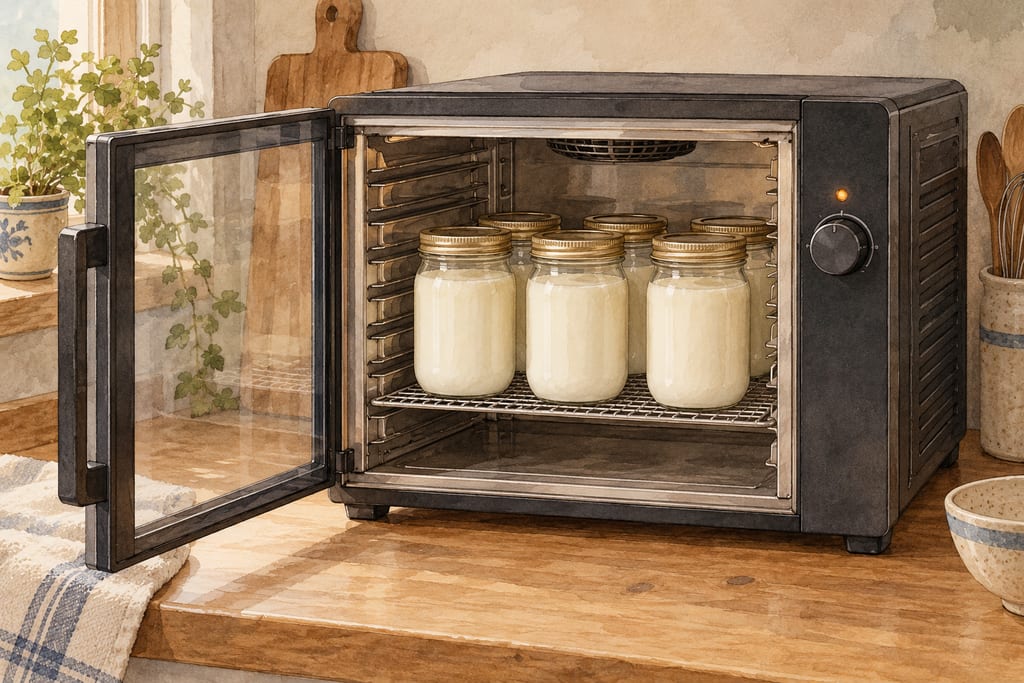
Excalibur, a dehydrator maker, publishes a yogurt recipe that uses its machine as a warm cupboard. Half a gallon of milk is heated to 85 °C, cooled to 46 °C and whisked with 4 tablespoons of live yogurt. The jars are capped, every tray comes out, and the jars stand at a 43 °C setting for 9 hours, undisturbed, before going into the fridge. The lids stop the dehydrator from drying the milk.
Brød & Taylor's classic yogurt shows that a setting cannot be copied between boxes. Its "High-Low" method starts at 49 °C for an hour in both of its appliances. In the proofer the setting then drops to 30 °C, which, the recipe explains, lets the milk drift down to about 38 °C over three hours. In its Sahara dehydrator the second stage is set at 38 °C. One maker and one milk, but two settings for the same intended food temperature.
Excalibur's guide to dehydrating explains its dial. Evaporation keeps wet food about 20 degrees cooler than the air, so the company calibrates the dial to the food: at a 41 °C setting the air can reach 51 °C (41 and 51 °C). A capped jar does not evaporate, so how closely its contents match the dial has to be measured with a probe in a jar.
Range sets limits. The Sahara runs from 30 to 74 °C, so it cannot hold anything below 30 °C, and a dehydrator's fan dries open mould cultures. Viktor's first koji box used a dehydrator only as the heater for a closed cabinet, switched by a controller, with the koji in its own cloth-lined tray. The dehydrator works as a cupboard for lidded jars or a heater for a larger space, not as a drying rack for a living culture. A proposed extension goes one step further: koji or tempeh in a shallow, breathable inner tray inside the dehydrator, covered enough to slow drying but never airtight. That has not been demonstrated; the food temperature, moisture behaviour and maximum load would all need confirming first, and a machine whose lowest setting is 40 °C cannot serve a culture that wants about 30 °C. How yogurt behaves across all these appliances is the subject of the article One bath, many small jars.
Tempeh: a cake that breathes and warms itself
Tempeh is a firm cake of cooked, split soybeans bound by the white threads of a Rhizopus mould. It comes from Java. The BC Centre for Disease Control's guidance, written by a working group for inspectors and food businesses in 2023, notes that the earliest written mention is in a Javanese manuscript of the 1600s, and that tempeh is the one fermented soy food that did not come from China or Japan. The Nordic Food Lab authors add that earlier forms were made from okara, the pulp left from soy milk.
The method explains the cabinet's job. Beans are soaked, split and dehulled so the mould can reach the inside of each half, cooked, then dried on a towel; Brød & Taylor calls a wet bean the commonest reason a batch spoils. Acid goes in: the company adds 2 tablespoons (30 g) of white vinegar to 2 cups (340 g) of dry beans, and the BC guidance asks producers to soak in water acidified to pH 4.6 or lower, but not below 3.5, because Bacillus cereus and other bacteria grow in unacidified beans. Then a teaspoon (3.4 g) of starter is mixed through.
The container does the clever part. The beans are pressed about an inch thick into quart plastic bags pierced every inch with a skewer, giving the mould air without drying the cake. The proofer is set to 31 °C with no water in the tray. After about 12 hours the beans make their own heat, and the company says to check the tempeh itself and turn the proofer down to keep it at 29–32 °C. After 24 to 48 hours the beans are a firm white mass. The BC guidance sets the outer limit: above 42 °C the mould dies and spoilage organisms take over.
Grey or black patches near the holes are spores. Brød & Taylor calls them harmless; the BC guidance links blackening and an ammonia smell to a fermentation that ran too long. Fresh tempeh is perishable: Brød & Taylor suggests a week in the fridge.
Beans other than soy
The BC guidance lists tempeh from other beans, peas, chickpeas, grains and coconut press cake, with a warning. In Indonesia, tempeh made with coconut milk and coconut cake produced bongkrekic acid, a toxin made by the bacterium Burkholderia gladioli, in outbreaks between 1951 and 2013, until public health policy required acidified soaking water and hygienic premises. A new substrate is a new recipe with its own hazards.
The Nordic Food Lab's 2015 trials are the clearest small-scale record for other pulses. Guixer and Flore used brown beans from the Swedish island of Öland. They brought 600 g of dry beans to the boil, cooled the water with ice, soaked them overnight and dehulled them, then cooked them for 12 minutes in water acidified with vinegar to pH 4.8 and cooled them on a towel. Spores went in at the supplier's rate, and the beans went into ziplock bags pierced with holes 0.5–1 mm across about 1 cm apart, no more than 2 cm thick, at 30 °C for 24 to 30 hours. Humidity, they found, largely regulated itself inside the bag.
The culture mattered as much as the bean. Rhizopus oryzae gave solvent-like aromas and a light mycelium; one commercial R. oligosporus turned black around the holes within a day; a culture brought from Indonesia gave the compact white cake an Indonesian colleague judged closest to tempeh at home. The team also made tempeh from wheat and from Danish heritage fava beans and peas. Chickpea, lentil and mixed-pulse tempeh can use the same cabinet, but each new substrate is its own recipe: softness, hulls and surface moisture differ from soybeans, so the cooking and drying have to be worked out for that pulse.
Koji: a damp cloth, a shallow tray and a hand that turns it
Koji is steamed grain or beans overgrown with Aspergillus oryzae, grown for the enzymes the mould makes. Josh Evans's 2013 history for the Nordic Food Lab, built on William Shurtleff and Akiko Aoyagi's history of koji, traces the Chinese equivalent, qu, to a written mention around 300 BCE, and koji in Japan to a provincial record of 725. Using koji in amazake, shio koji and other enzyme holds is the subject of the article Rice, koji and malt in a warm hold; this section is about growing it.
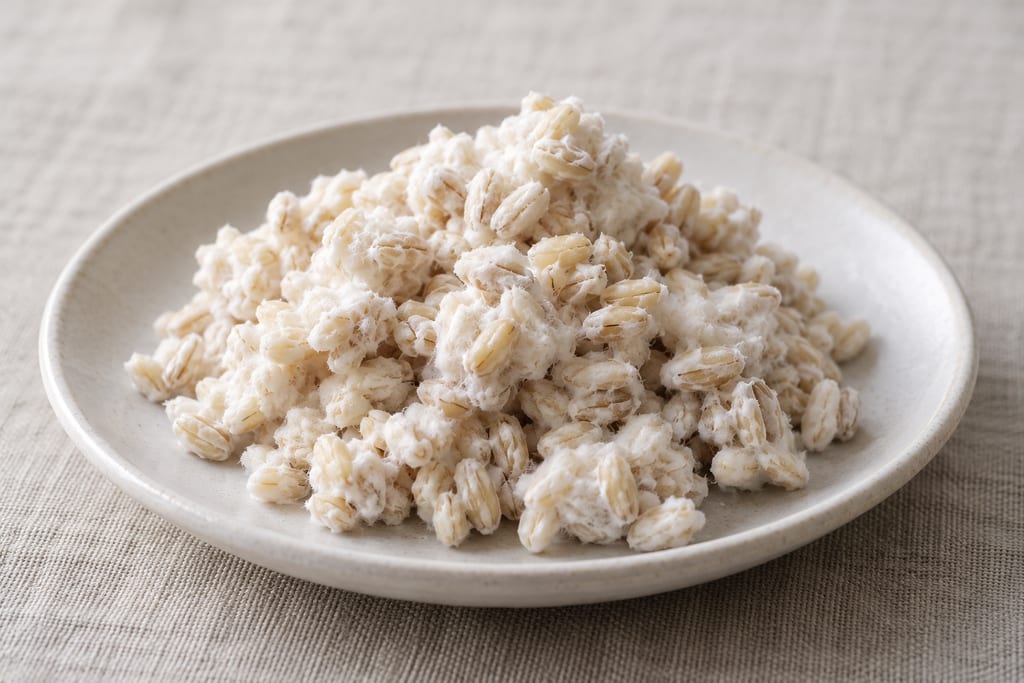
Evans's barley koji is a complete method. A kilogram of pearled barley is soaked overnight and steamed for 90 minutes. Once it cools to 35 °C, about 20 g of powdered spores per kilogram of cooked grain is mixed in. The grain is spread 2 cm deep in a steel tray under a warm, damp, wrung-out cloth and goes into the chamber at 30 °C, probe in the grain on the warmest shelf. At 18 hours it is turned; from then it should stay at 25–30 °C, and the lab treats 38 °C as fatal to the mould. At 24 and 30 hours it is turned into deep furrows, the cloth re-dampened and the door left open a crack against overheating. By about 36 hours the grain is a white cake, roughly 1,450 g from the kilogram of dry barley. Grain that turns sticky and smells of ammonia and sour bananas has overheated, and Bacillus subtilis has taken over.
The BC guidance describes the commercial rhythm: inoculation after cooling to 35 °C, incubation near 30 °C, heat building from about 10 hours, hand-mixing at 16 to 18 and near 26 hours, finished in 42 to 48 hours, and a ceiling of 40 °C, above which enzyme production stops. Humidity starts near 98 % and falls as the koji dries. Two rules matter at home: buy spores from a supplier that can vouch for them, and do not grow the next batch from your own koji, because wild Aspergillus strains can produce aflatoxin.
Viktor's notes add that rice must be steamed, not boiled, because wet grain favours bacteria, and that a wooden tray, or thick cloth on a perforated one, stops water pooling under the grain. He aims for roughly 28–36 °C and about 90 % humidity on the first day.
Humidity without rain: the warm-water reservoir idea
Koji needs humid air without wet grain. One proposal is a stable perforated tray on a rack above a reservoir of temperature-controlled water inside a washable enclosure. If a sous-vide circulator heats the water, its specified water depth is kept and its electrical head and other parts not rated for heat and humidity stay outside the enclosure, as its manual requires. The water would add humidity and thermal mass; the rack would keep the grain off the liquid; a cloth lining could manage free moisture. It is a warm, humid cabinet, not submerged sous vide, built on known warm-box, moisture-management and shallow-tray practice; the exact assembly has not been tried.
The nearest working versions are simpler. Viktor stood a pot of water with an immersion heater inside his koji cabinet, switched with the dehydrator by one controller. He reports that a tray of water over a heating element brings a box to about 70 % humidity, and passes on a reader's suggestion: cover the koji in a deep steel tray with cling film pierced for air, so the tray itself stays humid. Evans's damp cloth does the same job.
The likely problems are clear in advance. Warm humid air condenses on a cooler lid and drips onto the grain. Warm water cannot remove the heat the koji makes, and the mould still needs air exchange. Tempeh hardly needs the extra humidity: it regulates itself in a pierced bag, and the BC guidance gives 75–85 % for tempeh rooms. For tempeh, a simpler dry cabinet is the first comparison. A trial would log the water setting against the grain-centre temperature, where condensation falls, airflow, evaporation and a safe water level over 48 hours, and whether the koji's own heat can be removed at all.
Natto: the warmest of the bean ferments
Natto is soybeans fermented by Bacillus subtilis var. natto, which makes long sticky threads of poly-γ-glutamic acid and a smell of ammonia. The BC guidance explains that natto was once wrapped in rice straw, which carried wild bacteria and absorbed some of the smell; pure cultures replaced it, and the guidance advises against straw fermentation because straw can carry unwanted organisms.
Brød & Taylor's method makes about 150 g from half a cup (3 oz) of dry beans. They soak 12 hours, then cook in a covered stock pot set directly on the proofer's plate in slow-cook mode at 90 °C for 7 to 8 hours, until they break easily between the fingers. Starter dissolved in 2 teaspoons (10 ml) of boiled, cooled water goes onto the still-warm beans. A thin layer goes into each of five or six small glass containers with lids resting loosely on top, and they culture on the rack at 38 °C for 18 to 24 hours, without the water tray, until white filaments show. The natto then rests in the fridge at least overnight, and natto with a strong ammonia smell is discarded.
Commercial natto runs hotter. The BC guidance gives 40–50 °C with high humidity, an internal temperature of 48–52 °C by hour 14, and cooling to 10 °C or below within four hours to limit ammonia. The home figure is a setting calibrated to food in a small jar; the factory figure is a humidity-controlled profile. Neither transfers to another box without a probe in the beans.
Beans before the cabinet: what a pressure cooker changes
A pressure cooker shortens the slowest preparation step. Brød & Taylor offers it for tempeh beans: 50 to 60 minutes of simmering, or 15 to 20 minutes steamed under pressure. Viktor cooks shoyu soybeans for about 15 minutes at full pressure and warns that a fast release splits them to mush. The BC natto guidance describes commercial cooking at 15 to 20 psi for 20 to 30 minutes, to soften the beans and denature proteins that would give off-flavours. Instant Pot's FAQ adds its own limits: foods that expand must not fill the pot past the half line, beans want natural release, and reaching pressure alone can take 10 to 40 minutes or more.
The saving ends when the beans leave the pot. The BC guidance treats cooling as critical for tempeh, natto and koji alike: once below 60 °C, cooked beans should reach inoculation temperature within two hours, with six hours as the limit, because spore-forming bacteria grow in warm cooked beans. The fermentation takes as long as before: a pressure cooker shortens the cooking, not the culture.
Kombucha, vinegar and kefir: liquids that need the right air
Kombucha is sweet tea fermented by yeasts, which make alcohol, and acetic acid bacteria, which need oxygen to turn most of it into acids; hence a cloth cover, not a lid. The National Center for Home Food Preservation at the University of Georgia publishes a recipe backed by a published safety study. The starter liquid must test at pH 4.0 or lower, the tea must be below 35 °C before the culture goes in, and the jar ferments at room temperature, 20–25 °C, for 7 to 10 days. The bottled drink is refrigerated and used within 30 days; airtight bottles can build pressure and burst.
Brød & Taylor runs the same idea in a proofer at 24 °C, arguing that mould becomes likelier as the brew gets colder, which is the case for a cabinet in a cold kitchen. The BC guidance asks producers for a pH below 4.2 but not below 2.5, control of alcohol, and no glazed ceramic vessels, after two people in Australia were poisoned by lead from ceramic brewing pots.
Vinegar is the same oxygen problem. Ben Reade, writing for the Nordic Food Lab in 2012, describes the Orleans method: barrels half full of wine, holes in the ends under muslin, bacteria working at the surface for one to three months. An industrial acetator atomises air into the liquid at 30 °C; the lab acidified a 5 % alcohol wine in four to five days with an aquarium pump and an airstone. Warmth helps, but oxygen is essential. A homemade vinegar's strength is unknown unless measured, and the University of Georgia centre warns against pickling with vinegar of unknown acidity.
Kefir needs less help than people expect. The BC guidance describes milk kefir as grains added at 2 to 10 % (weight of grains to volume of milk), held at 20–25 °C for 18 to 24 hours in a vented container and reaching pH 4.6 within 36 hours at most. Water kefir ferments sweetened water, often with dried figs, at 21–25 °C for two to four days in a closed container that can vent gas. Both run at room temperature, so a cabinet helps only in a cold room. A heating mat under a tray or a belt around a jar, on a controller with its probe in the liquid, is the cheap route proposed for that; it has not been tried.
Sauerkraut and kimchi want a cool cabinet, not a warm one
Cabbage ferments by its own lactic acid bacteria once salt draws out its juice and the leaves stay under brine. The National Center for Home Food Preservation's recipe uses 25 lb of cabbage and three-quarters of a cup of canning salt, packed in 5 lb lots under a plate and weights. It recommends 21–24 °C for three to four weeks; at 16–18 °C it may take five to six; below 16 °C kraut may not ferment, and above 24 °C it may soften. The BC guidance, written for producers, prefers 15–20 °C, with limits at 10 and 25 °C, salt at about 2.25 % of the cabbage's weight, and pH below 4.2 before fresh kraut is packed.
The two disagree on the best temperature, but both put a refrigerator out of range. A two-way cabinet gives kraut a ceiling in a hot kitchen and a floor in a cold one.
Kimchi has its own cooling tradition. UNESCO's 2013 record of kimjang, the shared autumn making of kimchi, describes a year built around it, ending with households choosing the day by watching the weather. The BC guidance describes the old practice of making kimchi in November or early December and burying the pots for winter. Since the 2000s, it adds, South Korean homes have used kimchi refrigerators programmed to ferment at settings such as 15 or 10 °C for two to four days, and studies it cites preferred storage at −1 °C. It quotes a model in which kimchi reaches pH 4.6 in about 2 days at 20 °C, 6 at 10 °C, 15 at 5 °C and 35 at 0 °C (20, 10, 5 and 0 °C), and gives producers a rule: a batch that has not reached pH 4.6 within three days at room temperature, or seven in the cold, is discarded.
Other vegetables follow the same logic. Fermented cucumbers, the BC guidance notes, take three to six weeks at 20–25 °C in vessels that let gas escape. Several small jars in one chamber make a useful comparison series for texture and acidification, each with its own recipe and gas-release arrangement. Every jar keeps its own salt, recipe and vent, and the cabinet's heat does not replace salt and pH controls.
Black garlic: weeks of heat and no microbes
Black garlic is often sold as fermented. Brød & Taylor says plainly that it is not: its colour and its caramel and balsamic notes come from Maillard browning, the reaction behind toast and seared meat, run very slowly. Its method holds whole bulbs at 60 °C for three to four weeks without letting them dry.
Each bulb is wrapped tightly in foil, the bulbs are packed into a metal pot with a snug lid, and the pot stands directly on the proofer's plate in slow-cook mode, rack and water tray removed. After three weeks one bulb is opened; if the cloves are not very dark brown or black, the rest stay about a week more. The company gives three weeks at room temperature, six months in the fridge or a year frozen for the finished cloves.
The method shows how far a setpoint can sit from a temperature. On its original proofer models the company told owners to set 39 °C, because at that setting the aluminium plate reaches 60 °C. When a customer found garlic at only 46 °C after three weeks, the answer was that the pot must sit on the plate itself.
Cheese in a fridge, and a cabinet that can cool as well as heat
Ripening cheese needs cool, steady, humid air. New England Cheesemaking Supply, which began making cheese in 1978, explains in its aging guide that an ordinary refrigerator is too cold and dries the air, so cheese aged there ripens slowly and needs an airtight box. A refrigerator run by an external thermostat at 11–13 °C makes a workable cave, with a shallow pan of water and a sponge to raise humidity.
Its advice on boxes is the useful part. A box should be about 40 % cheese and 60 % air. If condensation drips onto the cheese, the box is too wet and the lid should be left slightly open; water on the lid or floor is wiped off at each turning. Mats keep the cheese raised so its underside breathes, and boxes are opened often to swap ripening gases for fresh air. Cracking in winter calls for 65–75 % humidity; mould-ripened cheese drains at 75–80 %. Boxes separate cheeses with different humidity needs, but they are a separation, not a guarantee against moulds moving between cheeses. The sensible order is temperature control and individual boxes first, whole-cabinet humidification only if the load needs it, and a fridge run warm for cheese is not also used for ordinary groceries. An adjustable wine cooler is a separate candidate whose actual temperature range and humidity behaviour have to be checked for the chosen cheese. Mature cheese flavour is taken up in the articles Cheese in the brewhouse and What an appliance cannot reproduce.
A fridge whose controller can also switch a heater becomes a cabinet that heats and cools, useful where a kitchen crosses a ferment's range during the year. Brød & Taylor sells a small one for starter jars, the Sourdough Home, which holds 5–50 °C by heating or cooling; its proofer cannot cool. For a whole fridge, a controller with separate heating and cooling outputs is the proposed route. INKBIRD's ITC-308 series is one: it has separate heating and cooling outputs, calibration, alarms and compressor-delay protection for refrigeration, and its published specifications differ between regional versions, so the actual model's electrical ratings, probe limits and environmental limits have to be matched. INKBIRD's IHC-200 adds outputs for a humidifier and a dehumidifier switched on relative humidity. The proposed assembly is a washable cabinet, refrigeration if cooling is needed, an enclosed heat source rated for the job, removable trays or ripening boxes, sensors and gentle air movement, built from ready-made enclosed controls rather than exposed mains wiring. Food sits in food-contact containers, never against a heater or a probe of unknown food-contact suitability. Each use needs its own mode: a dry-curing chamber, a humid mould incubator and a cool vegetable cabinet differ in humidity, ventilation and cleaning.
Five checks come first. Unplug the appliance and plug it back in: one that stays off after power returns will not work under a switching controller. Match the controller's rated current to the heater and the fridge, and give a compressor suitable protection. Never bypass an appliance's thermal cut-outs or alter its wiring. Decide where the probe sits, in a box, in a cheese or in the air, because each gives a different number. And use enclosed, ready-made heaters: Viktor reports that the floor-heating wire in his first koji box melted its insulation.
Miso, soy sauce, jang and dawadawa: the long part happens at room temperature
For many cultured pastes the cabinet's job ends with the koji. Marukome, the miso maker, publishes a home recipe from bought rice koji: 300 g of koji, 250 g of soybeans and 120 g of salt for a sweet miso, or 430 g of beans and 155 g of salt for a saltier one. The beans are simmered about six hours and mashed hot; everything is packed without air pockets under film, a drop lid and a 200 g weight, and left at room temperature out of the sun. The BC guidance gives the frame: salt usually 6 to 16 %, maturation from a month to more than a year, slower in cooler rooms, and finished miso at a water activity of 0.85 or below. A stable-temperature cabinet is the proposed modern help, with bought koji sparing the cook the mould stage; the recipe's salt, proportions and maturation stay as written, because extra heat changes miso's flavour, not only its speed.
Soy sauce follows the same two stages. Viktor grows koji on cooked soybeans mixed with roasted, cracked wheat, covers it with a 15 % brine of 176 g of salt to each 1,000 g of water, stirs daily for the first weeks and ages it two to twelve months before pressing. The BC guidance describes commercial mash at 18 % salt or more for six to eight months. A controlled cupboard around the brined mash is a possible modern route, but the starter stage and the brine maturation are separate processes, and the mixing, salt and long ageing remain the substance of the method.
Korean jang shows the limit of any programme. UNESCO's 2024 listing describes soybean paste, soy sauce and chilli paste made and kept by families, each household's different, some soy sauces aged for decades. A controlled meju stage followed by separate brine and ageing vessels, with temperatures logged, is a possible research route; it should not reduce family-specific mixed-culture traditions to a single warm-box programme.
West African dawadawa, also called iru or soumbala, is an alkaline Bacillus ferment of African locust beans, not a low-pH pickle. A pressure cooker could cut the active bean cooking and shallow, controlled incubation could make seasonal conditions reproducible, but the effects of the traditional leaves and containers need explicit validation before any such route is published. In soy-dawadawa, S. Darkwa and colleagues found that Bacillus subtilis made up about half of the Bacillus present, with B. cereus among the rest, and that the profiles resembled locust-bean dawadawa. A soybean cooker and controlled incubation trays make soy-dawadawa an accessible research project, distinct from the Parkia condiment. Red oncom, okara overgrown by the mould Neurospora intermedia in West Java, is described in the article Soy milk, tofu and yuba. A tofu or soy-milk maker supplies fresh okara for it, and controlled tray incubation is the obvious cabinet job, but it needs a suitable Neurospora food culture and a documented process, never whatever mould lands on the okara.
Related
Discussed in this article
Barley koji
Steamed pearled barley grown into a white koji cake with Aspergillus oryzae over about 36 hours in a 30 °C chamber, turned three times under a damp cloth.
Bread proofer or insulated fermentation box
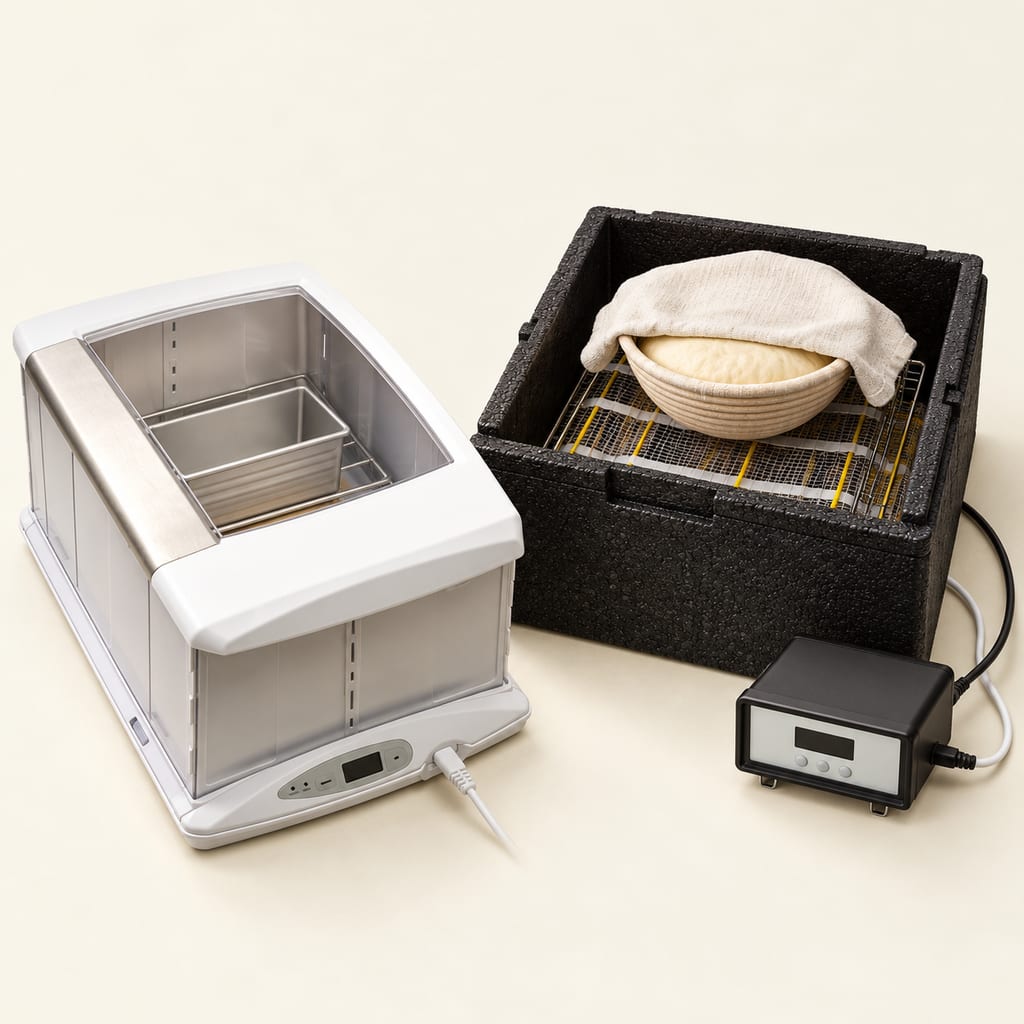
A bread proofer creates a warm, sheltered place for dough to rise. Purpose-built countertop proofers and insulated boxes with separately controlled heat are different designs; neither sets one temperature or proofing time for every dough.
Dehydrator as a jar incubator
A dehydrator with its trays removed or shelves rearranged, holding capped jars of cultured milk at a low setting so the machine warms but does not dry.
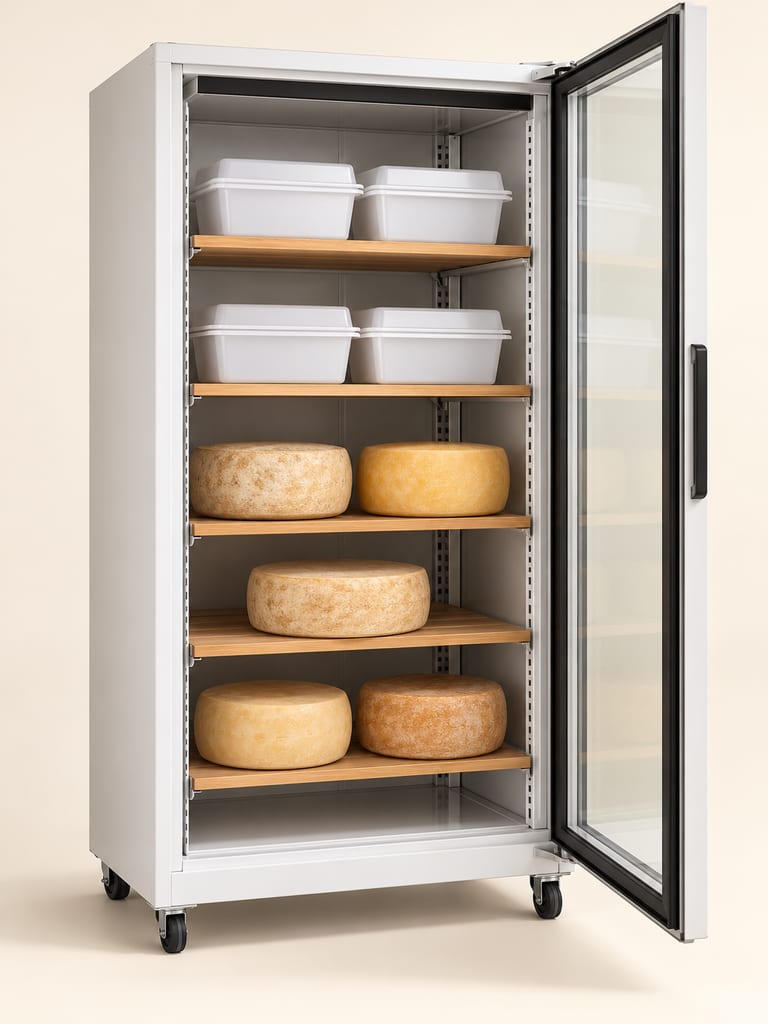
Fridge cheese cave with individual ripening boxes
A modern cheese-ripening space made by controlling the temperature of a refrigerator or display cabinet and managing each cheese in its own covered container. It is an appliance conversion, not a natural cave or a traditional structure.
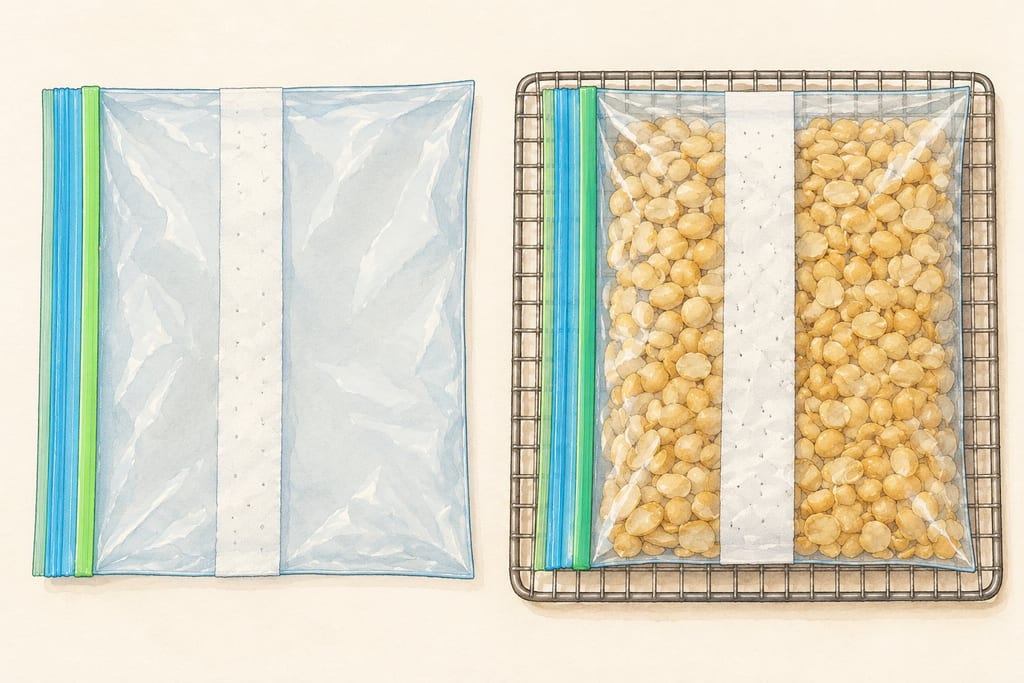
Perforated tempeh bags or ventilated containers
Perforated plastic bags and covered trays hold tempeh in a thin shape while admitting air; they are modern packaging options, distinct from the documented leaf wrapper.
Proofer as a multifunction culture station
A heat-only proofer used in turn for tempeh bags, natto jars, kombucha, yogurt and black garlic, each with its own container, rack and water-tray setting.
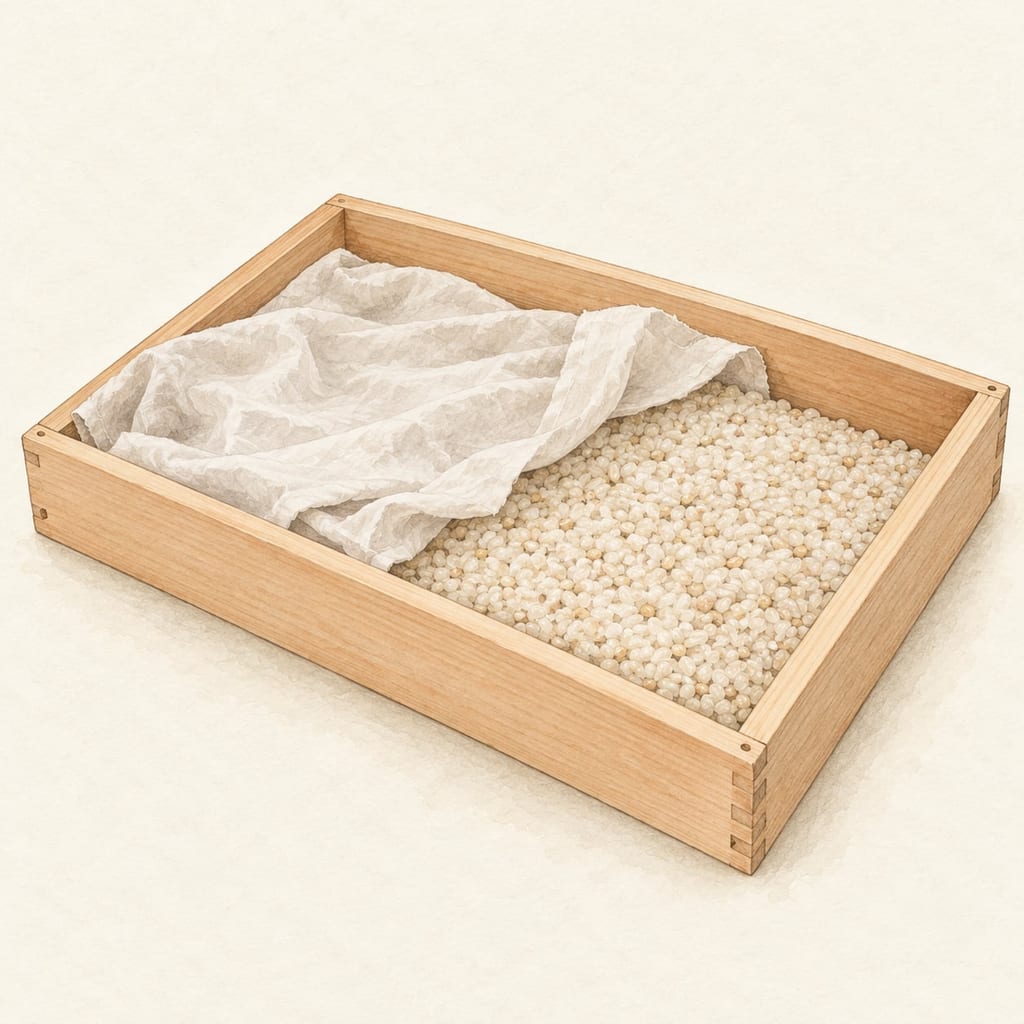
Shallow breathable koji tray
A koji-buta is a shallow wooden tray for spreading grain as it grows into koji. Japanese sources document a traditional form, while modern methods also use cloth-lined or steel trays; size and construction vary.
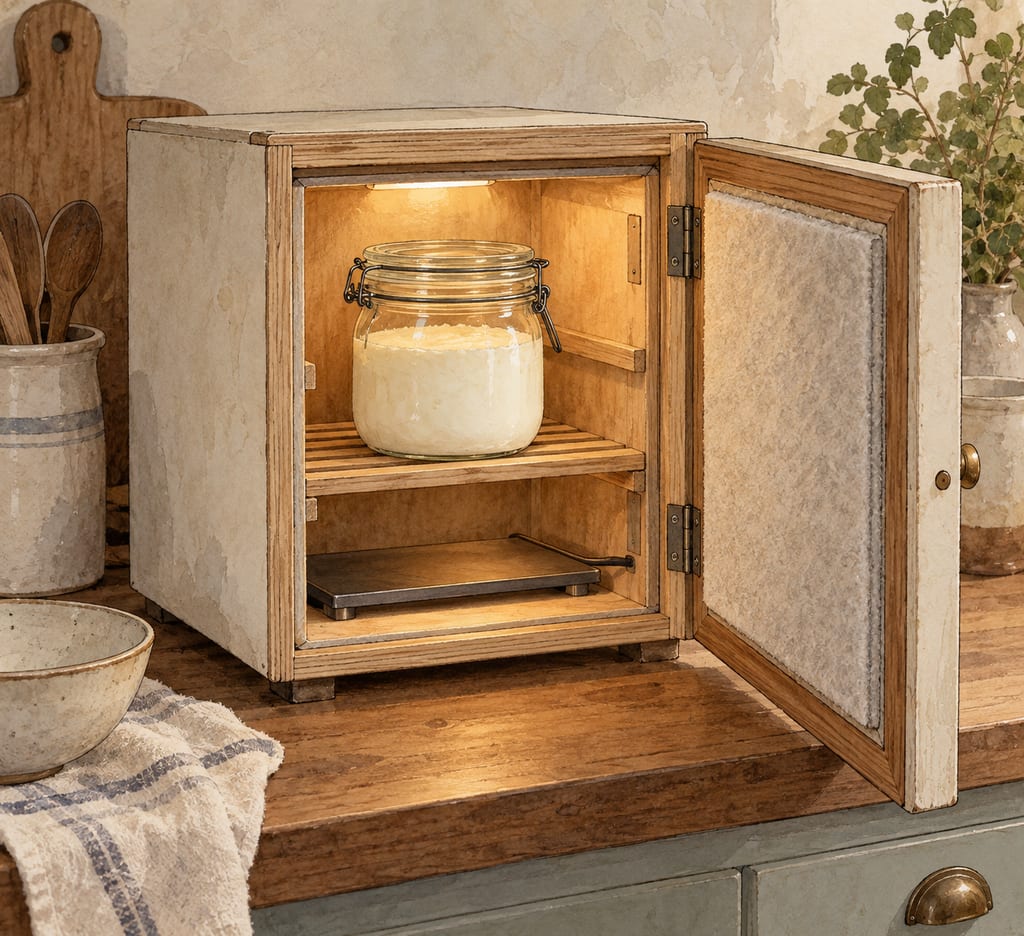
Warm cabinet with an internal food container
Any warm box, proofer, dehydrator cabinet or adapted fridge whose conditions reach the food through a separate container chosen for that culture.
Community
No community contributions have been published for this entry yet.
Share what you made
Sign in to contribute. Published comments and photos are free to read.
Sources
BC Centre for Disease Control, Fermented Foods Working Group
Fermented Foods Guideline – Section 3.3 KimchiCited in: A box of air around a separate container; Sauerkraut and kimchi want a cool cabinet, not a warm one
BC Centre for Disease Control, Fermented Foods Working Group
Fermented Foods Guidance – Section 3.8 NattoCited in: A box of air around a separate container; Natto: the warmest of the bean ferments; Beans before the cabinet: what a pressure cooker changes
Nordic Food Lab
Koji – history and processCited in: A box of air around a separate container; Koji: a damp cloth, a shallow tray and a hand that turns it; Humidity without rain: the warm-water reservoir idea
Brød & Taylor
Support (product specifications and FAQ: Folding Proofer & Slow Cooker, Sourdough Home, Sahara Folding Dehydrator)Cited in: What the cabinet controls, and what the food does anyway; A dehydrator with its trays out; Cheese in a fridge, and a cabinet that can cool as well as heat
Nordic Food Lab
Tempe part 1: traditional fermentation, fungal trials, and regional seedsCited in: What the cabinet controls, and what the food does anyway; Tempeh: a cake that breathes and warms itself; Beans other than soy; Humidity without rain: the warm-water reservoir idea
Fermentation Culture (fermentationculture.eu, LUVI Fermente GmbH, Lenzing, Austria)
What Koji needs to grow and how to provide for its needsCited in: What the cabinet controls, and what the food does anyway; A dehydrator with its trays out; Koji: a damp cloth, a shallow tray and a hand that turns it; Humidity without rain: the warm-water reservoir idea; Beans before the cabinet: what a pressure cooker changes; Cheese in a fridge, and a cabinet that can cool as well as heat
BC Centre for Disease Control, Fermented Foods Working Group
Fermented Foods Guidance – Section 3.9 Tempeh (Safety of Fermented Foods, November 2023, updated December 2024)Cited in: Tempeh: a cake that breathes and warms itself; Beans other than soy; Humidity without rain: the warm-water reservoir idea; Beans before the cabinet: what a pressure cooker changes
Brød & Taylor
How to make TempehCited in: Tempeh: a cake that breathes and warms itself; Beans before the cabinet: what a pressure cooker changes
BC Centre for Disease Control, Fermented Foods Working Group
Fermented Foods Guideline – Section 3.10 Koji and MisoCited in: Koji: a damp cloth, a shallow tray and a hand that turns it; Miso, soy sauce, jang and dawadawa: the long part happens at room temperature
Instant Pot
Frequently Asked QuestionsCited in: Beans before the cabinet: what a pressure cooker changes
National Center for Home Food Preservation (University of Georgia)
Kombucha TeaCited in: Kombucha, vinegar and kefir: liquids that need the right air
Brød & Taylor
How to Brew and Bottle KombuchaCited in: Kombucha, vinegar and kefir: liquids that need the right air
BC Centre for Disease Control, Fermented Foods Working Group
Fermented Foods Guideline – Section 3.11 Kombucha and JunCited in: Kombucha, vinegar and kefir: liquids that need the right air
Nordic Food Lab
Vinegar: From the Orleans Method to Food Lab ExperimentsCited in: Kombucha, vinegar and kefir: liquids that need the right air
National Center for Home Food Preservation
General Information on PicklingCited in: Kombucha, vinegar and kefir: liquids that need the right air
BC Centre for Disease Control, Fermented Foods Working Group
Fermented Foods Guidance – Section 3.12 KefirCited in: Kombucha, vinegar and kefir: liquids that need the right air
National Center for Home Food Preservation (adapted from USDA Complete Guide to Home Canning, Agriculture Information Bulletin No. 539)
SauerkrautCited in: Sauerkraut and kimchi want a cool cabinet, not a warm one
BC Centre for Disease Control, Fermented Foods Working Group
Fermented Foods Guideline – Section 3.2 SauerkrautCited in: Sauerkraut and kimchi want a cool cabinet, not a warm one
UNESCO Intangible Cultural Heritage
Kimjang, making and sharing kimchi in the Republic of KoreaCited in: Sauerkraut and kimchi want a cool cabinet, not a warm one
BC Centre for Disease Control, Fermented Foods Working Group
Fermented Foods Guidance – Section 3.1 Fermented VegetablesCited in: Sauerkraut and kimchi want a cool cabinet, not a warm one
Brød & Taylor
Black Garlic: How to Make it at HomeCited in: Black garlic: weeks of heat and no microbes
New England Cheesemaking Supply Company
Aging Cheese FAQCited in: Cheese in a fridge, and a cabinet that can cool as well as heat
INKBIRD
Temperature Controller ITC-308 (product page)Cited in: Cheese in a fridge, and a cabinet that can cool as well as heat
INKBIRD
Digital Humidity Controller IHC-200 Series (product page)Cited in: Cheese in a fridge, and a cabinet that can cool as well as heat
Marukome Co., Ltd.
味噌を手作りしてみよう! (Let's make miso by hand)Cited in: Miso, soy sauce, jang and dawadawa: the long part happens at room temperature
Fermentation Culture (fermentationculture.eu, LUVI Fermente GmbH)
How to make Soy SauceCited in: Miso, soy sauce, jang and dawadawa: the long part happens at room temperature
UNESCO Intangible Cultural Heritage
Knowledge, beliefs and practices related to jang making in the Republic of KoreaCited in: Miso, soy sauce, jang and dawadawa: the long part happens at room temperature
International Journal of Food Microbiology (UGSpace repository record, University of Ghana)
Effect of boiling and roasting on the fermentation of soybeans into dawadawa (soy-dawadawa)Cited in: Miso, soy sauce, jang and dawadawa: the long part happens at room temperature
Journal of Food Processing and Preservation
Incubation and fermentation of African locust beans (Parkia biglobosa) in production of 'dawadawa' (Journal of Food Processing and Preservation 31: 227–239, 2007)Cited in: Miso, soy sauce, jang and dawadawa: the long part happens at room temperature
Ecology of Food and Nutrition
African locust bean (Parkia species) and its west African fermented food product, dawadawa (Ecology of Food and Nutrition 9: 123–132, 1980)Cited in: Miso, soy sauce, jang and dawadawa: the long part happens at room temperature
Nature Microbiology (open access, PMC11445060)
Neurospora intermedia from a traditional fermented food enables waste-to-food conversion (Nature Microbiology 9: 2666–2683, 2024)Cited in: Miso, soy sauce, jang and dawadawa: the long part happens at room temperature
Gaps
- No temperature log exists for a capped jar, a tempeh bag and a koji tray sharing one cabinet.
- The warm-water reservoir under a dry koji tray has not been built or measured.
- No test exists of a seedling heat mat or brewing heat belt under kombucha, vinegar or kefir.
- No household methods are published for meju, doenjang, ganjang, dawadawa, soy-dawadawa or red oncom.
- No tested home method exists for chickpea or lentil tempeh.
- Home and institutional guidance disagree on the best sauerkraut temperature (70–75 °F versus 15–20 °C).
Updated 2026-10-27