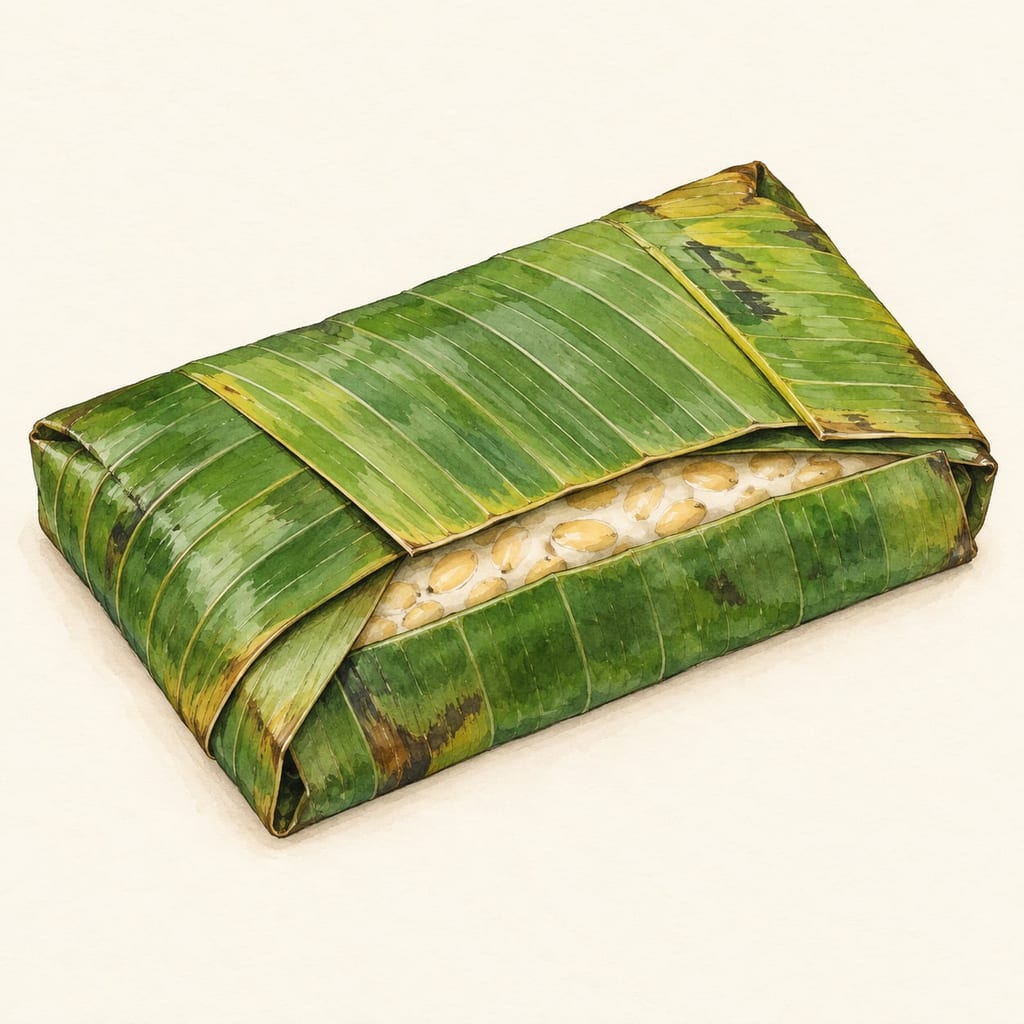
Tempe leaf packet
A broad banana leaf folded around beans forms the flat packet in which tempeh ferments. It shapes the cake while allowing air exchange; Indonesian producers also use plastic wraps.
 FermenteaWhere food goes to change
Equipment · Bags, sacks and casings
perforated tempeh pouch · tempeh bag · vented tempeh tray
Perforated plastic bags and covered trays hold tempeh in a thin shape while admitting air; they are modern packaging options, distinct from the documented leaf wrapper.
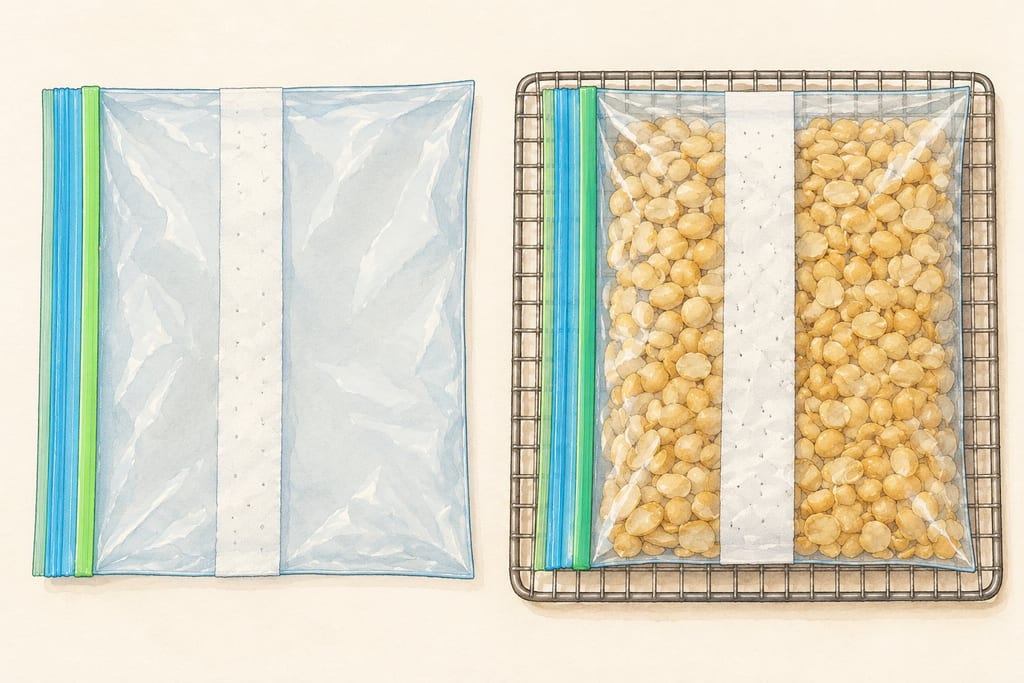
Tempe is associated with Indonesia, but the perforated plastic pouch documented here is a modern packaging option, not an established traditional vessel. BC Centre for Disease Control guidance contrasts current perforated polyethylene pouches and plastic-covered trays with traditional wrapping in leaves or scored banana peels, and says those plant wraps need contamination controls. The separate Tempe leaf packet entry describes that documented leaf form; it should not be conflated with a plastic bag.
Nordic Food Lab's 2015 protocol is one dated account of a zip-seal bag with air holes. It does not identify an inventor or first use, and no source here locates the bag form's geographic origin. The sources support use of modern packaging with tempe, an Indonesian food, without claiming that plastic bags are part of its historic equipment.
A perforated tempeh bag is a flexible plastic pouch used to hold beans in a shallow package while allowing air exchange. The bag gives the contents a flat shape; it is not the fermenting agent and does not by itself control the process. Nordic Food Lab's 2015 protocol describes zip-seal bags with holes about 0.5–1 mm wide, spaced roughly 1 cm apart, and limits the filled layer to 2 cm. These are that experiment's parameters, not a standard for every bag.
Brød & Taylor describes a different method: beans are pressed into 1-quart plastic bags in an approximately 1-inch layer, with vents pierced about 1 inch apart using a skewer. BC Centre for Disease Control guidance also describes perforated plastic over wooden, plastic, or stainless-steel containers. A tray cover is a different arrangement from a self-supporting bag. The published designs differ in hole size, spacing, and package thickness, and no source specifies a universal tray shape or fastening.
The sources place tempe in Indonesian food tradition, but they do not show where perforated plastic bags or vented trays originated. The visible examples come from a Nordic Food Lab protocol, a maker's method, and public-health guidance; these document present-day use, not a unique regional design. Geography for the plastic package itself is therefore unestablished.
BC Centre for Disease Control guidance says containers should drain so beans are not held in standing water, and that packaging should permit adequate oxygen without too much. These are relevant limits of the container, not a validation of any one recipe. The cited sources do not establish a universal plastic grade, food-contact certification, reuse practice, bag size, or tray geometry. The only specific tool named for making vents in the cited maker method is a skewer.
Tempe is an Indonesian food with traditional leaf-wrapped forms, but this page concerns modern perforated plastic bags and covered containers. Nordic Food Lab published a zip-bag protocol in 2015; BC Centre for Disease Control guidance later describes perforated polyethylene pouches and plastic covers over containers. Neither source dates the invention or first use of this equipment.
This entry describes packaging and does not validate a tempeh fermentation process.
The two written bag patterns are examples, not a universal perforation specification.
Source →BCCDC guidance says containers should drain and soybeans should not stand in water.
Source →The sources do not establish a standard tray shape, reusable life, or food-contact certification.
Source →Tempeh is associated with Indonesia, but the sources do not establish a geographic origin for perforated plastic bags or trays. Modern methods are documented in a Nordic Food Lab protocol and public-health guidance.
A broad banana leaf folded around beans forms the flat packet in which tempeh ferments. It shapes the cake while allowing air exchange; Indonesian producers also use plastic wraps.
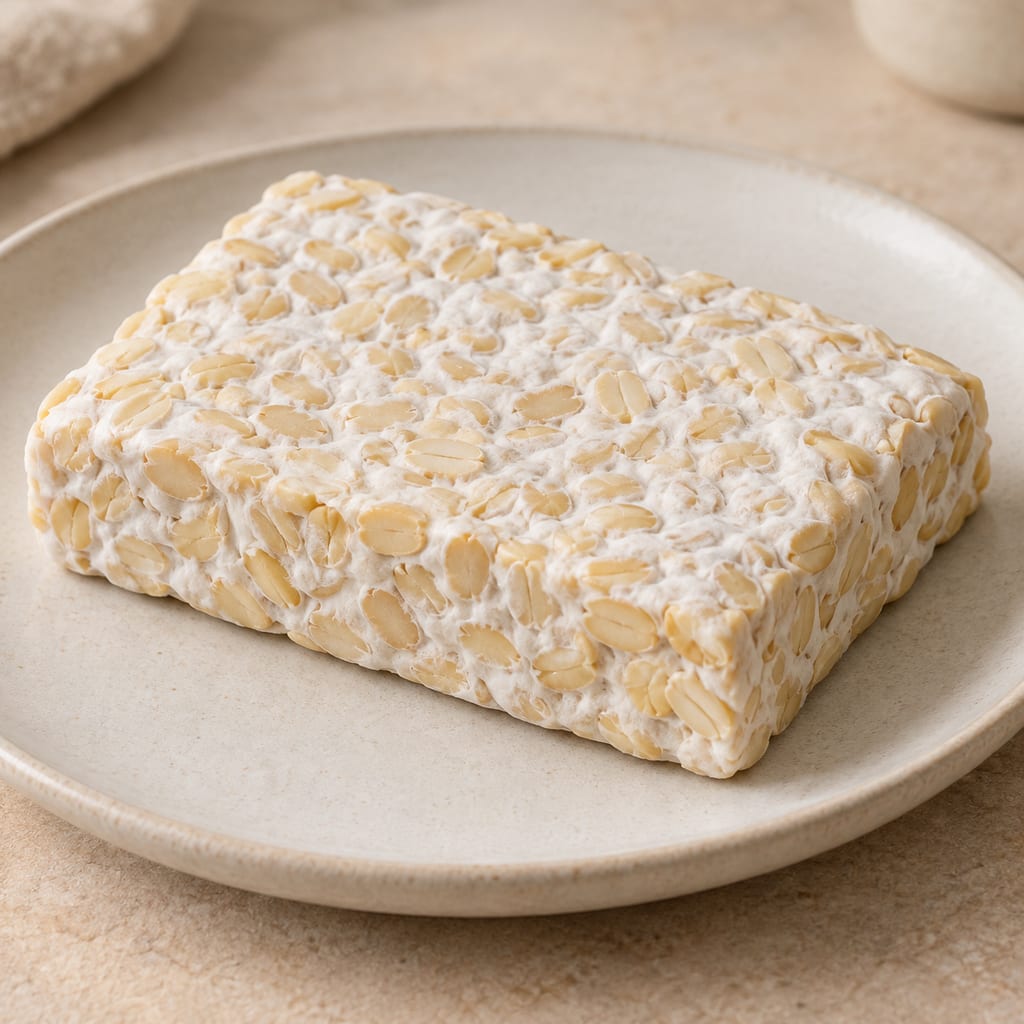
A two-cup soybean batch uses one Cultures for Health tempeh starter packet and vinegar. The supplier describes dehulling, a thin vented layer, controlled early incubation and attention to self-heating; it is not a validated home process.
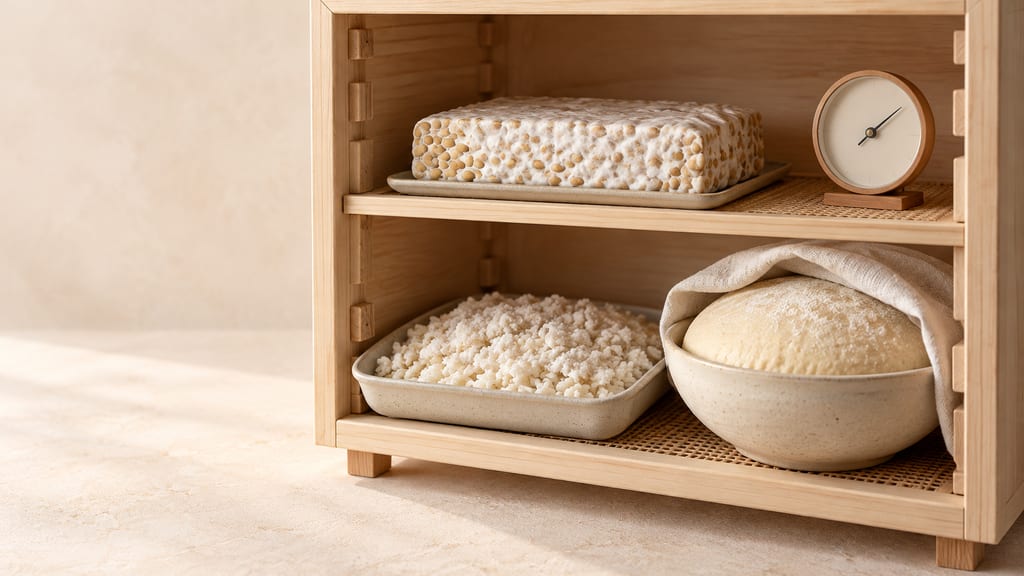
A proofer, a dehydrator with its trays out or an old fridge on a controller can keep cultures at a steady temperature. Whether it works depends on what sits inside: a lidded jar, a vented bag, a shallow tray or a crock.

Soft, spreadable Calabrian pork sausage made with a great deal of red chilli and fatty pork, stuffed into natural casings, sometimes smoked and matured while staying soft.

A way to add independent temperature logging to an existing food dehydrator without changing its built-in controls or protections. It is a monitoring method, not a rewiring plan.

Pleurotus cystidiosus is the abalone mushroom, a cultivated oyster-type fungus with dark brown caps that grows more slowly and is more demanding than other Pleurotus species.

A dark, balanced vinegar from Emilia-Romagna made by combining cooked or concentrated grape must with wine vinegar, then acetifying and refining it in wood under a protected specification.

A living dairy inoculum that starts controlled cream fermentation, developing acidity and aroma before sour cream or cultured butter is finished.

A small electric incubator holds jars at a selected temperature for yogurt and other documented warm food preparations. Controls, capacity and vessel arrangement vary by model.

Adygean salt is a seasoned table salt associated with Adygea and the wider North Caucasian culinary tradition. Salt is blended with garlic and a variable selection of herbs and spices; the exact mix depends on the named style and maker.

The African Caesar-group mushroom, Amanita masasiensis, is a wild ectomycorrhizal species of central and southern African woodlands, eaten locally. The genus contains deadly poisonous species, so identification needs care.
No community contributions have been published for this entry yet.
Sign in to contribute. Published comments and photos are free to read.
Nordic Food LabMethod · Equipment · Geography · History
Tempe part 1: traditional fermentation, fungal trials, and regional seedsDescribes tempe as an Indonesian food and reports the authors' 2015 protocol using perforated zip-seal bags.
Its bag protocol describes holes about 0.5–1 mm in diameter and approximately 1 cm apart, with filled package thickness no more than 2 cm; these are that protocol's parameters, not a universal standard.
The source does not identify who invented this bag form or when it was first used.
Cited in: Traditional leaf wrapping and modern bags; How the bag or tray holds tempeh; Geography, drainage and limits
Brød & Taylor UKMethod · Equipment · Current use
How to make TempehThe maker's method uses two 1-quart plastic bags and a bean layer about 1 inch thick, with skewer-made air vents at 1-inch intervals.
Those dimensions describe this particular maker method and differ from Nordic Food Lab's bag protocol; they do not establish one standard.
Cited in: How the bag or tray holds tempeh; Geography, drainage and limits
BC Centre for Disease ControlPackaging · Drainage · Oxygen · Safety · Traditional alternative
Safety of fermented foods: Tempeh (Section 3.9)BC public-health guidance describes common perforated polyethylene pouches and perforated plastic over wooden, plastic, or stainless-steel containers.
It says packaging should permit enough oxygen without excessive oxygen, and containers should drain so beans are not held in standing water.
It describes traditional leaf wrapping or scored banana-peel covers separately and says these should not be used without contamination controls.
Cited in: Traditional leaf wrapping and modern bags; How the bag or tray holds tempeh; Geography, drainage and limits
Wikimedia CommonsVisual reference · Equipment form
Tempeh Bag (8681516823).jpgInspected photograph shows an empty clear-blue zip bag with a narrow vertical strip of pinholes; the paring knife is for scale, not part of the equipment.
Wikimedia CommonsVisual reference · Method
Tempeh, Pre Fermentation (8681519365).jpgInspected photograph shows loose dehulled soybean halves inside a clear bag with a visible strip of pinholes on a wire rack, before fermentation; it does not show a finished cake.