Overview
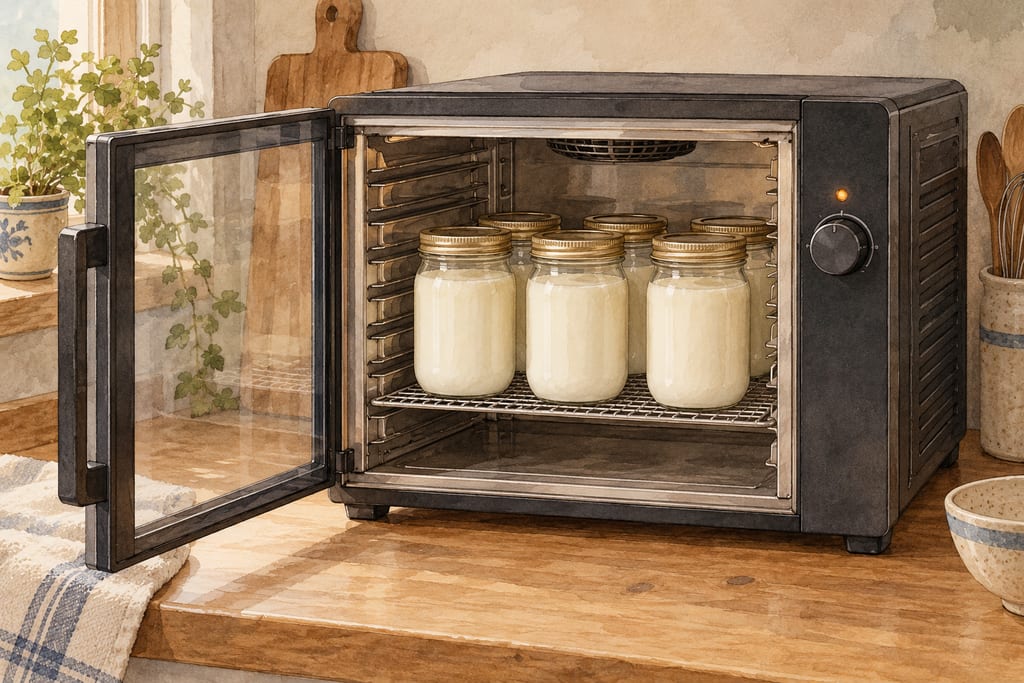
A food dehydrator has a heater and a fan that keep a warm, moving airflow. Used as a warm cupboard, it holds capped jars of milk at a low setting. The jar lids stop evaporation, so the machine warms the milk without drying it.
Excalibur's yogurt method removes every tray and holds capped jars at 110 °F for 9 hours. Brød & Taylor's Sahara runs its High-Low yogurt at 120 °F for an hour and then at 100 °F for 3 hours, with its shelves arranged for jars.
Sources for this section
How it works
A capped jar does not lose water, so the dehydrator's food-calibrated dial does not show the temperature of the milk. A probe in one jar does.
Sources for this section
Measuring
Measure the temperature inside one representative jar, and the set and acidity of the yogurt.
Sources for this section
Limits
The minimum setting rules out cooler cultures. The Sahara's minimum is 85 °F (30 °C).
Open mould cultures would be dried by the fan, so this set-up suits capped jars only.
The interior height limits the jar size.
Sources for this section
Evidence
Documented: both yogurt methods are the manufacturers' own published recipes. Using the dehydrator for other ferments is not documented.
Sources for this section
History
Both yogurt methods are current manufacturer recipes. The dehydrator's dial is calibrated for food drying, not for the milk, and the sources do not date the use of a dehydrator as an incubator.
Site
SettingA kitchen counter: a food dehydrator with its trays removed or its shelves spaced for jars, holding capped jars of cultured milk.
ClimateA warm, still space inside the dehydrator's heater and fan; the heater runs at a low setting so the machine warms but does not dry.
NotesNo source gives the internal dimensions of the models named.
A build is made where it stands: moving it means building it again.
How it is built
Risks and precautions · Standard risk
Milk left warm after incubationThe Excalibur method ends with a move to the refrigerator after incubation, which the card records as the safety step.
Hazard source
Move the yogurt to the refrigerator after incubation.
Control source
Set the heater to its lowest setting and check the jar temperature with a probe; the dial does not read the milk.
Materials
- 1 Food dehydrator — Trays removed (Excalibur yogurt method) or shelves spaced for jars (Brød & Taylor Sahara).
- Glass jars with lids — Capped, so the jar does not evaporate.
- 1 Thermometer probe — In one representative jar, to read the milk.
- Remove every tray (Excalibur) or space the shelves for jars (Sahara).
- Stand capped glass jars of inoculated milk on the base or a shelf.
- Set the heater to a low setting. Excalibur holds 110 °F for 9 hours. Brød & Taylor's Sahara runs 120 °F for 1 hour, then 100 °F for 3 hours.
- Read the temperature inside one representative jar with a probe. The dial is not a reading of the milk.
- After incubation, move the yogurt to the refrigerator (Excalibur).
Places
Documented for international use, with no single place of origin assigned.