
'Nduja di Spilinga
Soft, spreadable Calabrian pork sausage made with a great deal of red chilli and fatty pork, stuffed into natural casings, sometimes smoked and matured while staying soft.
 FermenteaWhere food goes to change
Modern adaptation
pressure-steamed soybeans · pressure-cooked soybeans for tempeh
Soaked soybeans softened under pressure in a multicooker instead of simmered for an hour or more, then drained, dried and cooled quickly before inoculation.
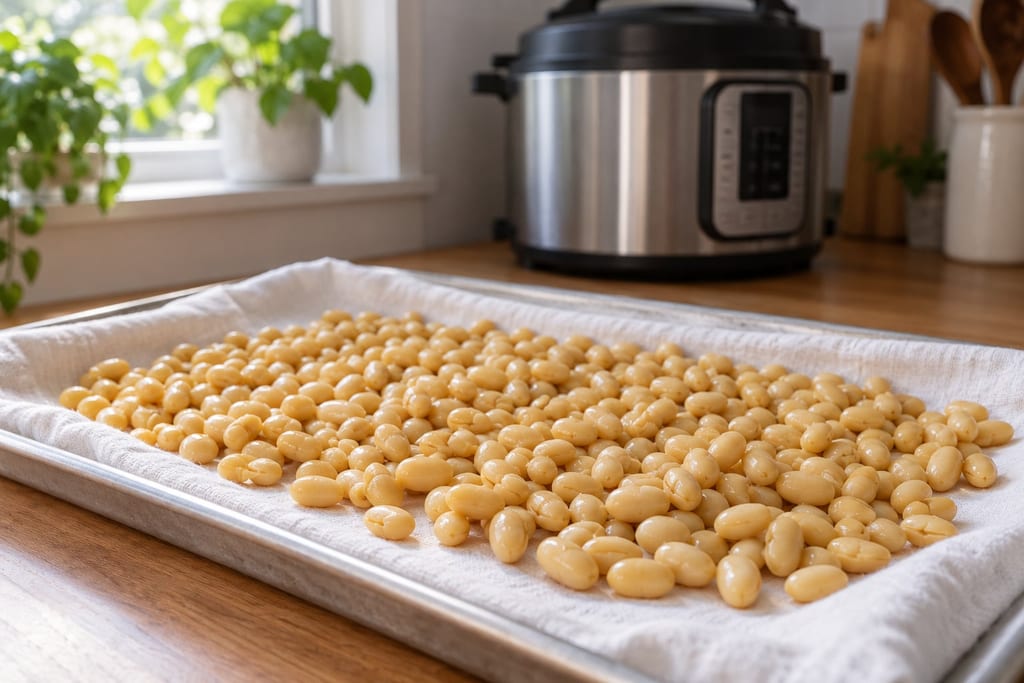
Tempeh, natto, koji and many miso and shoyu makers start from cooked soybeans. The cooking softens the seed so that a mould or bacterium can colonise its surface or its interior, and it drives off raw-bean compounds that would otherwise be eaten in the finished food. Long simmering is the old method. Pressure cooking reaches the same softness in a fraction of the time because water held above its normal boiling point penetrates the seed faster.
The beans are then drained and dried on a towel so that the surface is not wet when the culture is added. The cooling is the step that matters most for safety. Beans that cool slowly give spore-forming bacteria time to grow, so the guidance treats the time between the cooker and inoculation as a control point.
The tempeh guide gives 15 to 20 minutes of pressure-steaming for tempeh beans, against the 50 to 60 minutes of simmering it replaces. A fermentation maker cooks shoyu soybeans for about 15 minutes at full pressure and releases the pressure slowly. The commercial natto process described in the BCCDC guidance runs at 15 to 20 psi for 20 to 30 minutes, which is a factory setting and does not transfer to a home cooker.
These times are for soybeans on a pressure cooker. The sources do not give times for other beans, for pulses that swell differently, or for the bean mass used in miso. Applying these times to those foods is an untested adaptation, and the cook must judge the softness of the beans by touch before using them.
The fill line is the first control. Beans expand as they cook, so the cooker is filled no higher than its half line. The release is the second. Natural release is the route the cooker maker gives for beans, because a fast release can split the beans and can splatter starchy foods. Pressure takes 10 to 40 minutes or more to build, and that time is not part of the cooking time.
A pressure cooker is not a pressure canner. This step prepares beans for an immediate culture and does not preserve them. Beans that are held warm or cool slowly, or that wait before inoculation, fall outside the guidance above.
Pressure cooking of soybeans is a modern appliance step. It is a shortcut to the simmering used before the fermentation, and no earlier history is recorded for this step.
Scaling: source batch only
The BCCDC guidance treats cooling of cooked beans as a critical control point for tempeh, natto and koji.
Hazard sourceExpanding beans above the fill line can overflow or block the valve; the model's manual governs the release.
Hazard sourceCool the beans to inoculation temperature
Control sourceFill limit for expanding foods
Control sourceA pressure cooker is not a pressure canner. This step prepares beans for immediate fermentation only and is not a preservation process.
A modern appliance practice described in maker and food-safety guidance, with no single place of origin.
Soft, spreadable Calabrian pork sausage made with a great deal of red chilli and fatty pork, stuffed into natural casings, sometimes smoked and matured while staying soft.

A way to add independent temperature logging to an existing food dehydrator without changing its built-in controls or protections. It is a monitoring method, not a rewiring plan.

Pleurotus cystidiosus is the abalone mushroom, a cultivated oyster-type fungus with dark brown caps that grows more slowly and is more demanding than other Pleurotus species.

A dark, balanced vinegar from Emilia-Romagna made by combining cooked or concentrated grape must with wine vinegar, then acetifying and refining it in wood under a protected specification.

A living dairy inoculum that starts controlled cream fermentation, developing acidity and aroma before sour cream or cultured butter is finished.

A small electric incubator holds jars at a selected temperature for yogurt and other documented warm food preparations. Controls, capacity and vessel arrangement vary by model.

Adygean salt is a seasoned table salt associated with Adygea and the wider North Caucasian culinary tradition. Salt is blended with garlic and a variable selection of herbs and spices; the exact mix depends on the named style and maker.

The African Caesar-group mushroom, Amanita masasiensis, is a wild ectomycorrhizal species of central and southern African woodlands, eaten locally. The genus contains deadly poisonous species, so identification needs care.
No community contributions have been published for this entry yet.
Sign in to contribute. Published comments and photos are free to read.
Brød & TaylorMethod
How to make TempehPressure-steaming for 15 to 20 minutes against 50 to 60 minutes of simmering
Dry the beans on a towel
Cited in: Why beans are cooked before a culture; The documented times, and where they stop
Fermentation CultureMethod
How to make Soy SauceAbout 15 minutes at full pressure
Slow release
Cited in: The documented times, and where they stop
Instant PotEquipment · Safety
Frequently Asked QuestionsHalf-line fill for expanding foods
Natural release for beans
10 to 40 minutes to reach pressure
Cited in: Using the appliance safely
BC Centre for Disease Control, Fermented Foods Working GroupSafety
Fermented Foods Guidance, Section 3.9 TempehCooling within two hours below 60 °C, six-hour limit
Cited in: Why beans are cooked before a culture; Using the appliance safely
BC Centre for Disease Control, Fermented Foods Working GroupMethod
Fermented Foods Guidance, Section 3.8 NattoCommercial pressure-cooking at 15 to 20 psi for 20 to 30 minutes
Cited in: The documented times, and where they stop