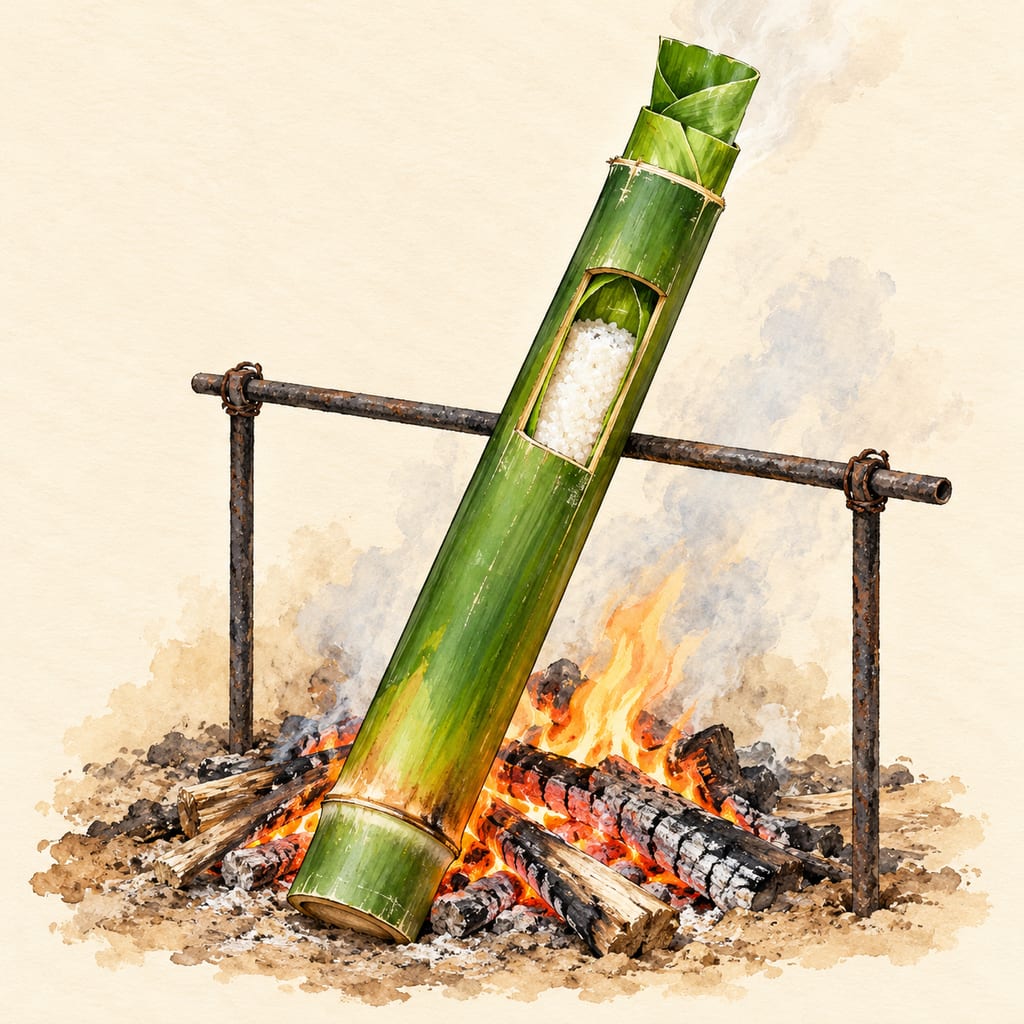
Bamboo cooking tube
A bamboo internode can serve as the cooking vessel itself: its natural node closes one end while the open end holds food, often with a leaf lining or plug. Regional preparations differ in filling, fire arrangement and handling.
 FermenteaWhere food goes to change
Equipment · Baskets, trays and beds
In the Battambang dried-banana craft, thin banana slices are laid on bamboo frames and set in the sun. The supports hold the overlapping slices off the ground while air and sunlight dry them into flexible sheets.
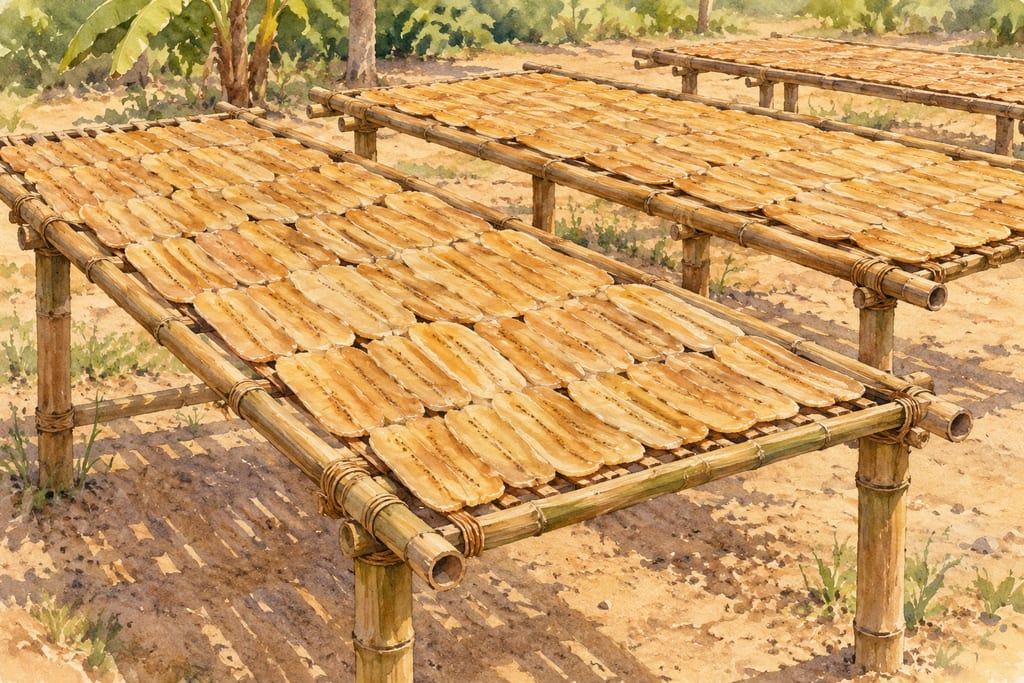
The bamboo supports in the Battambang dried-banana craft are simple frames that hold fruit slices while they dry in the sun. A field report describes families north of Battambang placing very thin banana slices on bamboo frames, with adjacent pieces slightly overlapping. The frame supplies a broad, raised surface for the slices; the account does not publish a universal pattern or dimensions.
The photographs show trays or flat frames carrying rows of banana slices, as well as the dried sheets after they have been taken off. Bamboo is the material identified by the written account. It would go beyond the evidence to specify a fixed weave, a particular bamboo species, an exact slat spacing, or a standard way of binding the corners. Those construction details are left open rather than filled in from a generic drying rack.
The support is best understood as part of a small household craft setting, not as a specialized machine. Makers slice and arrange the fruit by hand, then set the frames out in sunlight, as the field report records. The frame keeps the slices together as they dry; its role is to support and expose them, while the sun and weather do the drying.
The field account describes small sweet bananas cut lengthwise into very thin slices. Makers lay the pieces on the bamboo frames with slight overlap, then put the supports in the sun. The report says drying often lasts a full day, producing a pliable result with a toffee-like consistency. That is a description of the observed craft, not a guaranteed duration for every fruit, thickness or weather condition.
After drying, the sheets are peeled from the bamboo, folded and packed for sale. The frame is therefore a temporary work surface rather than part of the food. It is not a fermentation vessel, and it does not contribute a separately documented flavoring or curing ingredient. The matched recipe record describes the dried banana sheets; this equipment page documents the traditional bamboo support used in that preparation.
A Cambodian Agricultural Research and Development Institute country report supplies broader context, noting that dried banana is one of several processed forms eaten in Cambodia alongside fresh, boiled, fried and cake preparations. It does not describe the Battambang support itself, so the specific bamboo-frame claim remains anchored to the firsthand field report.
The authors describe families in rural areas north of Battambang who had been perfecting the craft for generations. Their account was published in 2017 and updated in 2024, but it does not provide a year or century when bamboo supports first entered the process. The dated article is evidence of a living practice, not proof of an ancient origin.
This equipment record is tied to the locality named by that account. It does not suggest that every Cambodian dried-banana maker uses the same frame or that bamboo supports are unique to this region. The support shown here is the form documented for this particular household craft: bamboo frames set out to carry overlapping slices in the sun.
The source identifies no exact frame dimensions, repairs, service life, cleaning schedule or carrying capacity. Those details can differ with local materials and the maker's own frame. The record therefore describes the material and use that the source supports, while leaving unmeasured design details unspecified.
A firsthand field account published in 2017 describes families north of Battambang who had practiced the dried-banana craft for generations. The account gives no dated origin for the supports or the craft, so no ancient start date is assigned.
The photographic account shows the frame in one Battambang-area craft; its exact construction, dimensions and load are not stated. Weather determines whether sun drying can proceed, and the report does not establish a fixed drying time for every batch.
Source →The account places household workshops in rural areas just north of Battambang; it does not establish that this is the only Cambodian use of bamboo drying supports.
A bamboo internode can serve as the cooking vessel itself: its natural node closes one end while the open end holds food, often with a leaf lining or plug. Regional preparations differ in filling, fire arrangement and handling.

Soft, spreadable Calabrian pork sausage made with a great deal of red chilli and fatty pork, stuffed into natural casings, sometimes smoked and matured while staying soft.

A way to add independent temperature logging to an existing food dehydrator without changing its built-in controls or protections. It is a monitoring method, not a rewiring plan.

Pleurotus cystidiosus is the abalone mushroom, a cultivated oyster-type fungus with dark brown caps that grows more slowly and is more demanding than other Pleurotus species.

A dark, balanced vinegar from Emilia-Romagna made by combining cooked or concentrated grape must with wine vinegar, then acetifying and refining it in wood under a protected specification.

A living dairy inoculum that starts controlled cream fermentation, developing acidity and aroma before sour cream or cultured butter is finished.

A small electric incubator holds jars at a selected temperature for yogurt and other documented warm food preparations. Controls, capacity and vessel arrangement vary by model.

Adygean salt is a seasoned table salt associated with Adygea and the wider North Caucasian culinary tradition. Salt is blended with garlic and a variable selection of herbs and spices; the exact mix depends on the named style and maker.

The African Caesar-group mushroom, Amanita masasiensis, is a wild ectomycorrhizal species of central and southern African woodlands, eaten locally. The genus contains deadly poisonous species, so identification needs care.
No community contributions have been published for this entry yet.
Sign in to contribute. Published comments and photos are free to read.
Best regards from farConstruction · Method · Geography · Image · History
Traditional crafts of Cambodia (6/7): dried banana sheets, BattambangReports household workshops north of Battambang where families slice small sweet bananas thinly, place the overlapping slices on bamboo frames, and set them in the sun, often for a full day.
Describes the resulting pliable/toffee-like sheets and shows the drying arrangement and finished product in photographs; no origin date for the equipment is supplied.
Cited in: A bamboo surface for thin slices; From fresh banana to pliable sheets; A living local craft, with an open history
Cambodian Agricultural Research and Development InstituteContext
Status of Banana Research and Development in CambodiaThe Cambodia country report notes that banana is consumed fresh and also processed in dried, boiled, fried and cake forms; it provides national context rather than details of this support frame.
Cited in: From fresh banana to pliable sheets