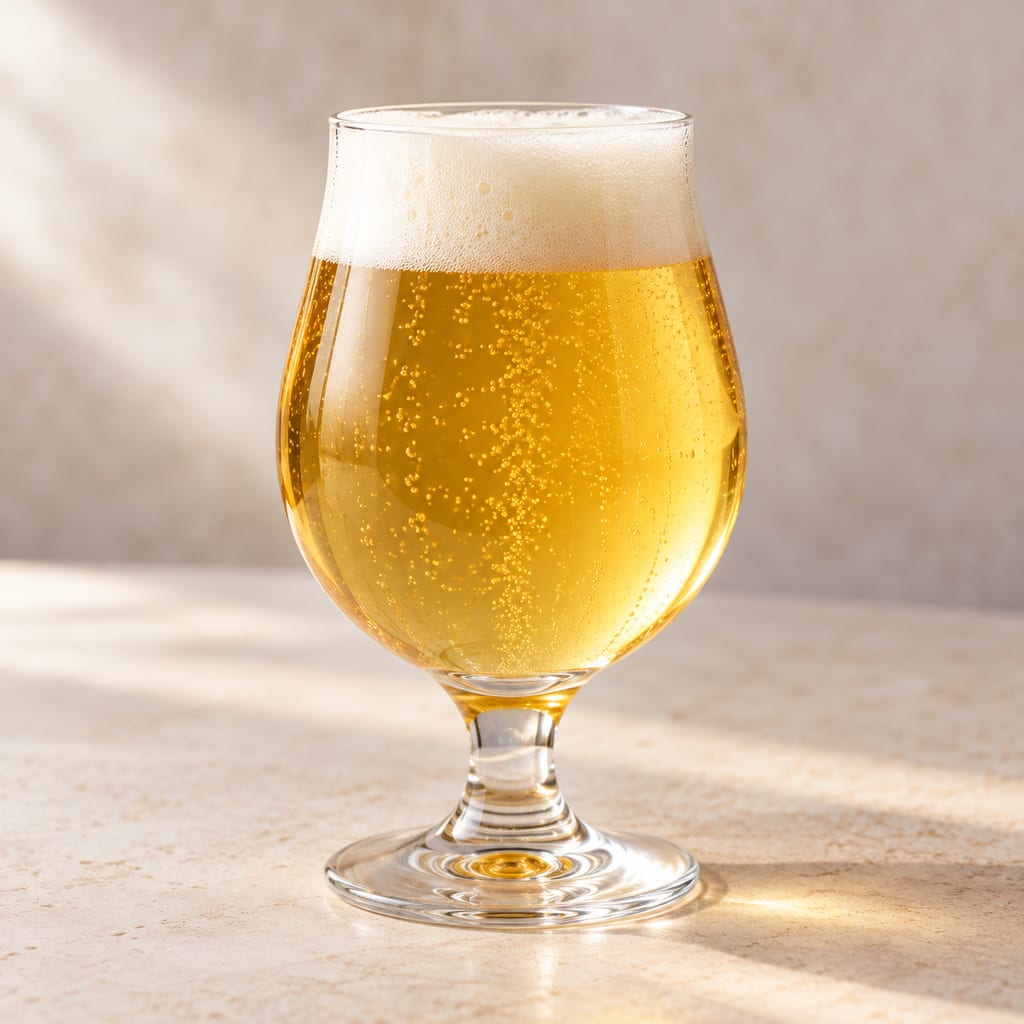
Monk’s Ration Trappist-style single
A pale Belgian-style ale with Pilsner and aromatic malts, cane sugar and Saaz hops, fermented under loose foil before an airlock is fitted.
 FermenteaWhere food goes to change
Equipment · Bags, sacks and casings
A reusable fabric filter bag holds crushed malt inside a brew kettle during the mash, then lifts out to separate grain from wort.
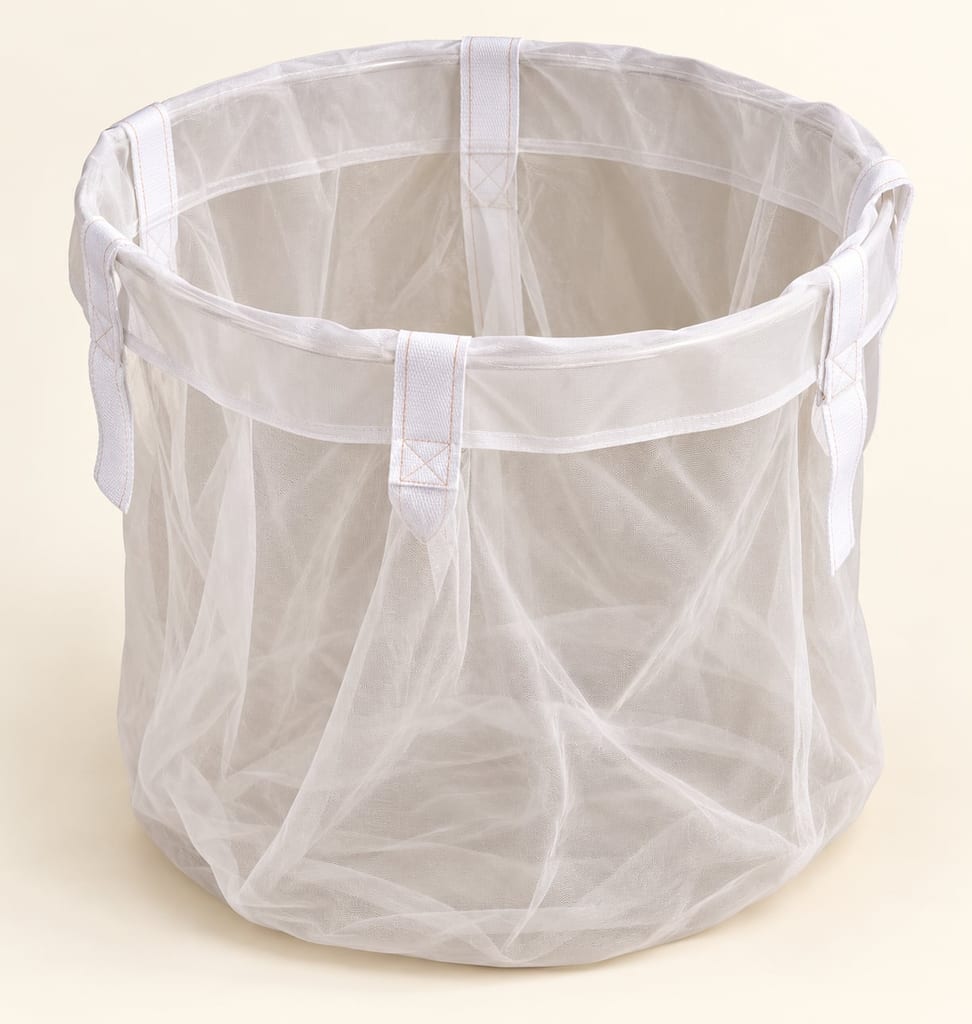
A brew-in-a-bag mash bag is a large fabric filter that sits inside the kettle used for an all-grain beer mash. Crushed malt is held in the bag while hot strike water circulates through it. The fabric lets wort drain while retaining most of the grain. Once the mash is finished, the brewer lifts the grain-filled bag away, leaving the wort in the kettle for boiling. The bag is equipment for the mash and lautering stages; it is not the kettle, a fermentation vessel, or the complete beer-brewing system.
In the simplest single-vessel, no-sparge version, the same kettle holds the full mash volume and later the wort boil. The American Homebrewers Association also describes BIAB variations that add a sparge, in which the bag is rinsed or dunked in more hot water. Those options change water volumes and sometimes require a second vessel; they do not change what the bag is. The full-volume method in Fermentea's Monk’s Ration recipe is an example of the bag's role, without naming a brand or model.
There is no single standard construction. The AHA guide describes voile as widely used by homebrewers and says that bags can be made from curtain or bulk fabric. Premade examples have sewn rims, reinforced seams, lifting loops, straps, drawstrings or other ways of holding the opening at the kettle rim. One manufacturer identifies its bag as polyester; another lists a polyester-mesh product with reinforced nylon seams. These are documented choices, not proof that all BIAB bags share one fibre or seam design.
Mesh opening matters because wort must pass through while the bag retains grain. The AHA notes that a coarse bag can let more grain sediment into the boil and that a very fine bag may impede the passage of wort sugars. Retail products illustrate the range rather than define a standard: Craft a Brew lists 63-micrometre mesh for its product, while Craft Hardware sells a 200-micrometre version and advises against pumping through that particular bag. Neither figure is a universal target. A bag should be chosen for its kettle, grain bill and intended drainage or recirculation setup.
The bag works by physical separation. It is not a mash basket: a rigid basket is built for a particular kettle or appliance, while the bag is flexible fabric that must be supported at the kettle rim or by its sewn tabs. Nor is it a mash tun, where a false bottom or other filter supports the grain bed and wort is run off separately. The main advantage of the bag is that it can replace that separate mash vessel and later be lifted out of the same kettle.
The bag must match the kettle. The AHA guide says it should fit around the kettle's circumference without resting on the bottom, both to retain grain and to avoid scorching. The Brew Bag's instructions for its own product call for a loose fit with the top overhanging the kettle rim by two to four inches. The exact fit and fastening method depend on the bag design; a bungee, drawstring, sewn loops or rim clips are not interchangeable requirements.
For a full-volume mash, the kettle must hold the strike water and grain together, with enough additional room for the planned pre-boil volume. The AHA recommends a kettle of at least ten gallons for its example five-gallon batch, assuming a 7–7.5 gallon pre-boil volume, and notes that higher-gravity beers may need more space. This is a kettle recommendation tied to its stated example, not a capacity rating for the bag or a rule for every batch. No common bag capacity or dimensions are established across products.
The bag should also clear the heat source during use. The AHA says some brewers insert it after heating the water to reduce the chance of scorching. The Brew Bag maker says its polyester bag must not touch the kettle bottom while its flame is on and warns that the material is not fireproof. That advice is specific to the maker's product; a different material may carry different instructions. A bag being sold for brewing does not make its fabric flameproof or suitable for every kettle configuration.
After mashing, the brewer lifts the bag so wort drains back to the kettle. A bag with sewn loops can be lifted by hand or attached to a support; larger wet grain bills make the load heavier. One maker suggests using suitable support in the brewing space and cautions against putting uneven pressure on the kettle. A community photograph of a very large BIAB rig shows a hoist lifting a filled bag, but that image documents one unusual scale and is not a typical household setup.
Drainage advice differs. The AHA's guide says to let its example bag drip and does not recommend squeezing. The Brew Bag's manufacturer demonstrates squeezing its own product as an option. The evidence does not establish one handling rule for every bag and batch. A brewer should follow the exact bag instructions and recipe process, with a stable kettle and support that can carry the wet load.
A BIAB bag can also be used in a kettle with a sparge or with additional equipment such as a pump. These are modified setups. The Craft Hardware seller warns that its 200-micrometre bag is not suitable for pumped recirculation and recommends a coarser product from its range for that purpose. This is a useful example of how a particular mesh can limit a setup, not proof that all bags or pumps behave alike.
Premade bags are sold by homebrew shops, and the AHA guide also describes homebrewers sewing their own from curtain or bulk fabric. A purchased bag should match the kettle's internal size and have material and heat instructions for its intended use. A DIY bag needs fabric that is suitable for the job; the AHA's description of voile as widely used does not certify every textile sold under that name. The intended use is hot wort and grain, so the source of the material and the bag's construction matter.
Care instructions also differ by product. The Brew Bag says its mash-use bag can be shaken out and rinsed thoroughly on both sides, then hung to dry. It advises handwashing after the bag is used for hop additions, because hop oils remain. These instructions concern that manufacturer's sewn bag. The AHA guide's mash procedure says not to squeeze its example bag; another manufacturer's directions demonstrate optional squeezing. Rinse, cleaning agents and drying should therefore follow the product's own guidance rather than an assumed rule for all fabrics.
Contemporary product pages show bags sold across North American, New Zealand and German/EU home-brewing markets, alongside DIY approaches described by the AHA. That supports treating the modern bag as internationally available without claiming a single country invented it. Brewshop's historical account suggests an Australian origin for BIAB, but also says the exact history is difficult to trace; the sources gathered here do not establish an origin date for this equipment form.
Current American Homebrewers Association and manufacturer documentation describe reusable and DIY bags for BIAB. The sources gathered here do not establish a definitive inventor or first date for this bag form.
The AHA recommends a bag fit that does not rest on the kettle bottom to avoid scorching. The Brew Bag manufacturer warns that its product is not fireproof and says it must not contact the kettle bottom while a flame is on.
Hazard sourceThe Brew Bag manufacturer warns that its waterlogged bag becomes heavy during lifting and advises using support available in the brewing space; the captured wort is hot.
Hazard sourceUse the exact bag's manufacturer instructions, size it to the kettle, and keep it clear of the kettle bottom or active burner when the material instructions require it.
Control sourcePlan a supported lift for the wet bag and keep the hot wort draining back into a stable kettle.
Control sourceMaterial and heat limits vary by product; do not assume an unmarked fabric bag is food-suitable or flameproof.
A bag's fit, material and mesh determine whether it retains grain and drains wort; the AHA notes that mesh that is too coarse leaves grain particles while a very fine bag can hold back wort sugars. No single mesh specification applies to every brewing system.
Source →The Brew Bag says its own polyester bag must not touch the kettle bottom while flame is on and is not fireproof. This is a product-specific limit, not a rating for every BIAB bag.
Source →Craft Hardware says its 200-micrometre bag is unsuitable for pumped wort recirculation and recommends its 400-micrometre bag for recirculating systems; this applies to its own product range.
Source →The inspected sources do not establish a specific place of origin or a representative place of use for this equipment category. Manufacturer-specific examples do not establish the geography of the broader type.
A pale Belgian-style ale with Pilsner and aromatic malts, cane sugar and Saaz hops, fermented under loose foil before an airlock is fitted.

Soft, spreadable Calabrian pork sausage made with a great deal of red chilli and fatty pork, stuffed into natural casings, sometimes smoked and matured while staying soft.

A way to add independent temperature logging to an existing food dehydrator without changing its built-in controls or protections. It is a monitoring method, not a rewiring plan.

Pleurotus cystidiosus is the abalone mushroom, a cultivated oyster-type fungus with dark brown caps that grows more slowly and is more demanding than other Pleurotus species.

A dark, balanced vinegar from Emilia-Romagna made by combining cooked or concentrated grape must with wine vinegar, then acetifying and refining it in wood under a protected specification.

A living dairy inoculum that starts controlled cream fermentation, developing acidity and aroma before sour cream or cultured butter is finished.

A small electric incubator holds jars at a selected temperature for yogurt and other documented warm food preparations. Controls, capacity and vessel arrangement vary by model.

Adygean salt is a seasoned table salt associated with Adygea and the wider North Caucasian culinary tradition. Salt is blended with garlic and a variable selection of herbs and spices; the exact mix depends on the named style and maker.

The African Caesar-group mushroom, Amanita masasiensis, is a wild ectomycorrhizal species of central and southern African woodlands, eaten locally. The genus contains deadly poisonous species, so identification needs care.
No community contributions have been published for this entry yet.
Sign in to contribute. Published comments and photos are free to read.
American Homebrewers AssociationMethod · Equipment · Limits · Safety
Brew in a Bag (BIAB)A one-kettle bag holds crushed malt for mashing; removing and draining it frees wort for the boil.
No-sparge BIAB differs from sparged variations.
The bag should fit the kettle without resting on the bottom; mesh must retain grain and allow wort to drain.
Voile is described as widely used for DIY BIAB bags; a 10-gallon kettle is recommended only for the guide's example five-gallon batch.
The guide says let the bag drip and does not recommend squeezing; sparging is an optional variant.
Cited in: A filter that fits the kettle; Mesh, fabric and construction vary; Fit and kettle size set the limits; Lifting separates the grain from wort; Buying, making and cleaning a bag
The Brew BagConstruction · Fit · Care · Limits · Safety
Instructions for How to Use The Brew BagThis maker specifies polyester for its product.
Its fitting guidance calls for a loose fit and 2–4 inches of kettle overhang.
Its instructions say to shake/rinse the bag and to handwash after hop use.
It states its product is not fireproof and says it must not touch the kettle bottom while flame is on.
It says a wet grain bag becomes heavy when lifted.
Cited in: A filter that fits the kettle; Fit and kettle size set the limits; Lifting separates the grain from wort; Buying, making and cleaning a bag
American Homebrewers AssociationEquipment · Comparison · Limits
Homebrew EquipmentThe BIAB bag fits the brew pot without resting on the bottom and contains most grain sediment.
The page distinguishes BIAB bag use from mash-tun and sparge-pot equipment in batch-sparge brewing.
Craft a BrewManufacture · Product example
Reusable Brew Bag — BIABOne product page specifies polyester mesh, reinforced nylon seams and four lifting straps.
The page lists 63-micrometre mesh, fit up to a 19-inch kettle diameter, and a 230°F (110°C) rating for that product only.
Cited in: Mesh, fabric and construction vary; Buying, making and cleaning a bag
Craft HardwareManufacture · Product example · Limits
BIAB Brew Bag 200 µmOne product is a 200-micrometre hobby-brewing bag with several kettle size options.
The seller warns that its 200-micrometre bag is unsuitable for pumped recirculation and recommends a 400-micrometre product for that setup.
Cited in: Mesh, fabric and construction vary; Lifting separates the grain from wort; Buying, making and cleaning a bag
BrewshopMethod · Equipment · Photograph
Back to Basics: Brew in a BagThe article describes a bag holding crushed grains in a kettle during the mash, followed by lifting and draining.
One photograph shows a mesh bag during mashing.
The article speculates about the technique's origins; no definitive origin claim is used.
Cited in: Buying, making and cleaning a bag
Homebrewing.comPhotograph
BIAB Kettle ClipsPhoto reference shows a white grain bag clipped to the rim of a stainless kettle with a probe at the rim; no technical claims are taken.
HomebrewTalk community forumPhotograph
145 Gallon BIAB, yes 145 gallon!Photo reference shows a scaled-up grain bag suspended over a large kettle; it is not evidence that this scale is typical.
Cited in: Lifting separates the grain from wort