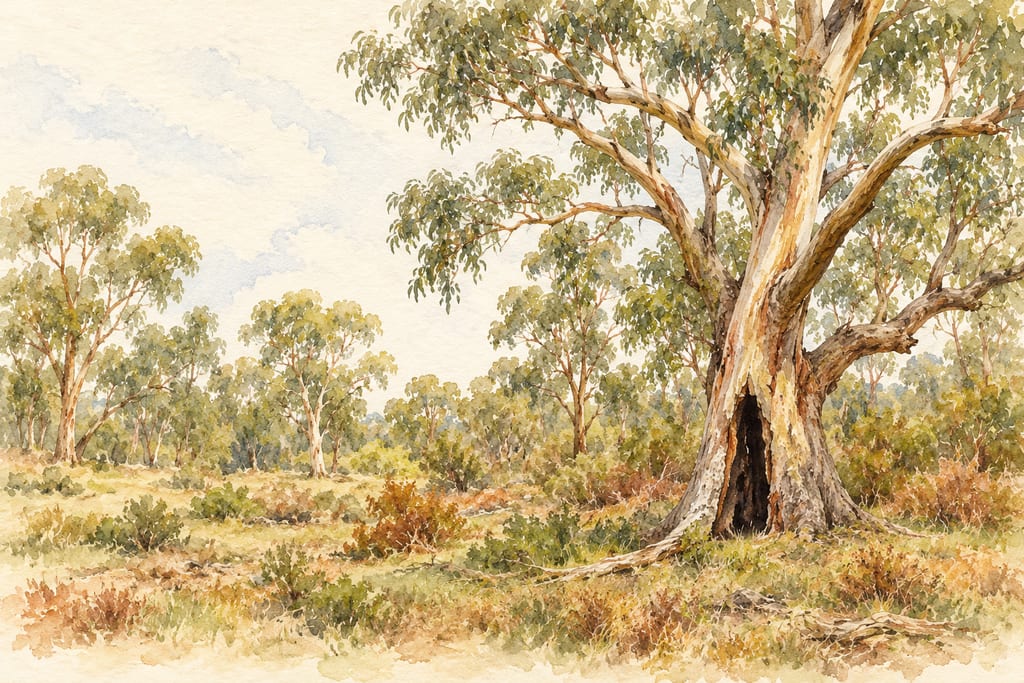
Gunditjmara eel-smoking tree
Gunditj Mirring describes hollowed Manna Gum and Red Gum trees used by Gunditjmara people to smoke eels and fish. At Kurtonitj, an identified smoking tree stands within the wider Budj Bim cultural landscape.
 FermenteaWhere food goes to change
Place · Floors, basins and masonry tanks
Budj Bim eel traps · Gunditjmara eel-holding systems
The Budj Bim system is a set of channels, weirs and holding ponds cut into a basalt lava flow in south-western Victoria, used by the Gunditjmara people to trap, hold and harvest eels.
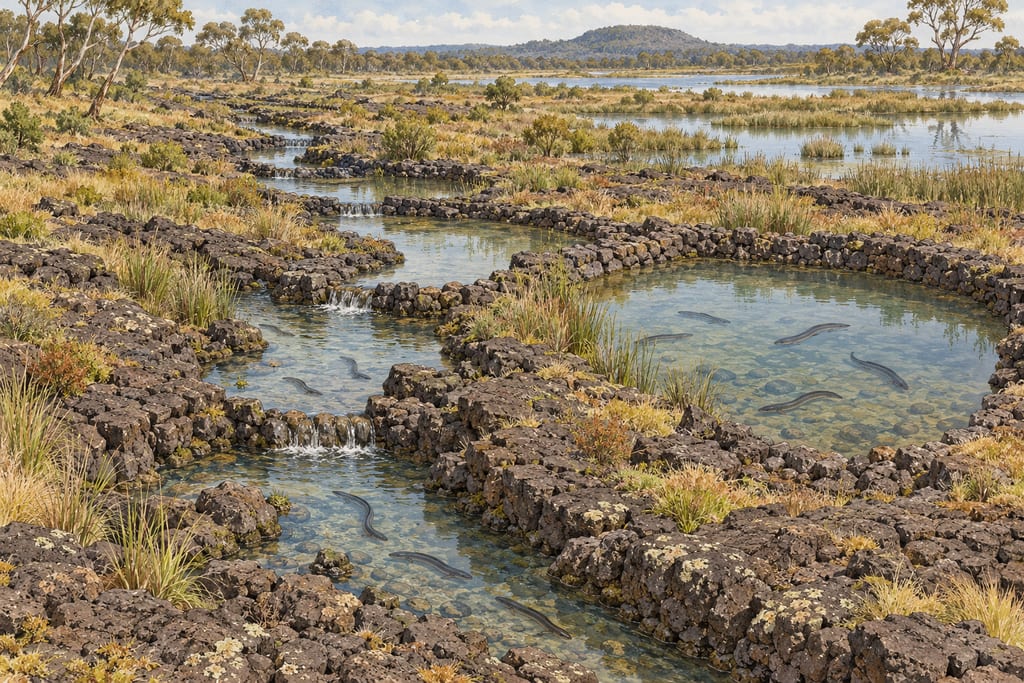
The Budj Bim system is a built landscape of eel-holding and eel-trapping works, cut and built into a basalt lava flow in south-western Victoria. The structures include stone channels, weirs and holding and growing ponds. The Gunditjmara people constructed them, and the sources describe them as engineered to trap, store and harvest short-finned eels.
It is a build, not a vessel. Its channels and ponds are part of the ground they were cut into, and moving the system would mean building it again.
The channels carry water through the lava flow, and the weirs across them guide eels into a place where they can be caught. The holding and growing ponds keep eels alive until they are needed, so the system is a living food reserve rather than a store of dead fish.
The woven eel baskets are placed in the weirs. They were made of river reed and spear grass and regulated the eels by weight and size, so that mature eels could be taken and smaller ones kept or released. The source does not give the exact dimensions of the works.
The source dates the first construction to at least 6,600 years ago. Its wording is a minimum age, so no calendar year is given. Many of the systems are still in use today.
The system is recorded in the UNESCO World Heritage listing for the Budj Bim Cultural Landscape. The listing describes it as a cultural landscape rather than a single structure.
The sources give no dimensions for the channels or ponds beyond the statement that some channels are hundreds of metres long, and no water-flow or stocking figures. They do not describe the stone-working method in detail, so the steps on this page follow the sources' general account and no more.
The source states that Gunditjmara people first constructed these aquaculture systems at least 6,600 years ago and that many of them are still in use.
Placed on the Budj Bim lava flow of the dormant Budj Bim volcano. The source gives no more precise locality than the lava flow.
Gunditj Mirring describes hollowed Manna Gum and Red Gum trees used by Gunditjmara people to smoke eels and fish. At Kurtonitj, an identified smoking tree stands within the wider Budj Bim cultural landscape.

At North Abydos in Egypt, a fixed early Dynastic brewery comprised parallel semi-subterranean installations with rows of ceramic mash vats; excavation reports revise their number, scale and estimated batch capacity.

Ají amarillo is the orange-yellow Peruvian chilli cultivar group of Capsicum baccatum, used to colour and season huancaína sauce and ají de gallina. Published heat estimates do not establish one range for the named cultivar.

Toasted almonds are whole sweet almond kernels dry-roasted until golden to brown. Heat replaces their marzipan note with a roasted, nutty one; they thicken and flavour romesco.

Kodiak salmon, halibut and cod cut as seg'aq and hung on an initaq rack to become tamuuq, with kac'amaasaq and kupcuunaq named as different results.

Aniseed is the dried ripe fruit of Pimpinella anisum, an aromatic Apiaceae spice commonly called a seed. It adds a sweet, warm aroma to breads such as Moroccan krachel and South African mosbolletjies, and is distinct from star anise.

A fixed Late Chalcolithic installation in Areni-1 cave combined a shallow clay pressing basin with a large jar set into the cave floor and storage vessels nearby.

Ripe avocado flesh is the soft, buttery, fat-rich pulp of Persea americana, eaten raw. It is low in acid, so it is a fresh ingredient that needs care in chilled dishes.

A portable dome and pan used over a hearth, with embers on the lid and heat from below. Regional peka and saç forms share this principle while differing in materials, pan shape and how the food is cooked.
No community contributions have been published for this entry yet.
Sign in to contribute. Published comments and photos are free to read.
Parks VictoriaMethod · History
UNESCO World Heritage listing for Budj Bim Cultural Landscape (Parks Victoria)Structures dug out of basalt lava flow from the dormant Budj Bim volcano: weirs, holding and growing ponds, and stone channels, some hundreds of metres long.
Gunditjmara people crafted long eel baskets of river reeds and spear grass to regulate and trap eels by weight and size.
At least 6,600 years ago the systems were first constructed; many are still in use.
Cited in: What it is; How the parts work; Age and continuity; Limits of the record
National Museum of AustraliaHistory
Budj Bim Cultural Landscape (National Museum of Australia)Gunditjmara eel-holding systems at Budj Bim are a major Australian example of living storage.