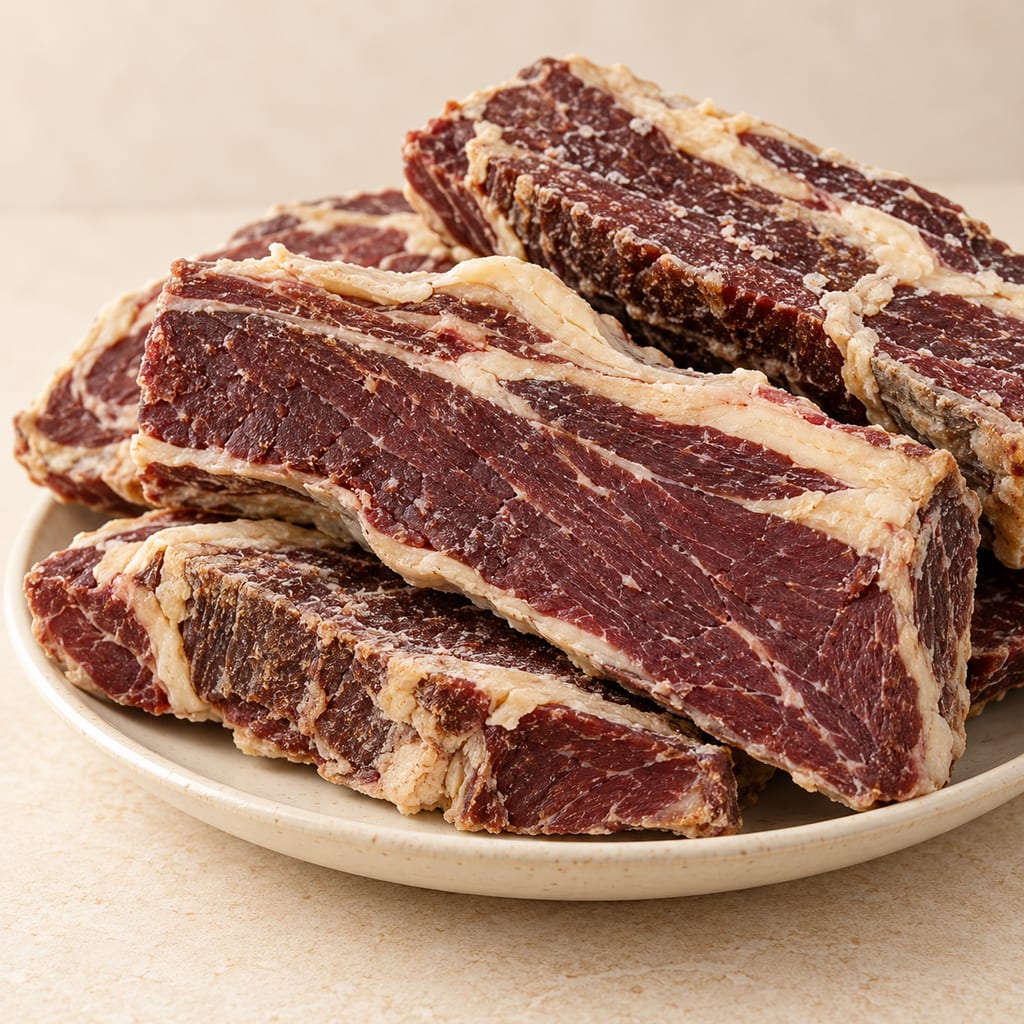
Charque
Beef salted heavily and dried into a strongly preserved ingredient that is desalted before it is cooked in stews; a Brazilian form of salt-dried meat that keeps far longer than the lightly salted carne-de-sol.
 FermenteaWhere food goes to change
Built structures · Terraces, platforms and stands
Varales · Charque rails
Open wooden rails in a sunny, ventilated yard, on which salted beef sheets for charque are hung in the air and sun. The rails are a Latin American premises arrangement that the FAO describes in its meat-processing guidelines.
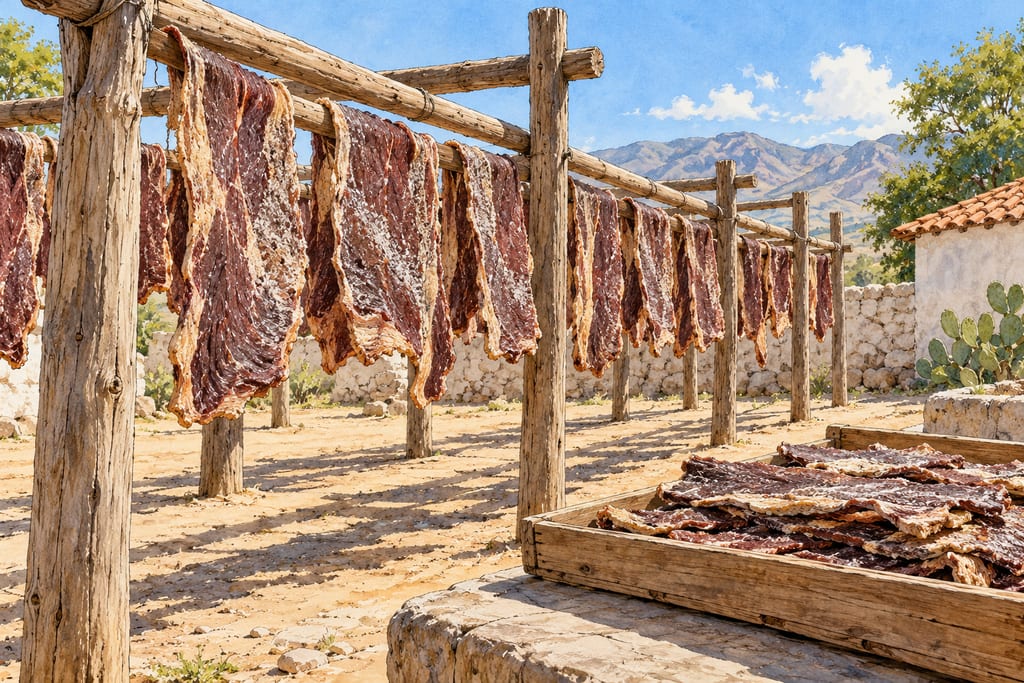
Charque is salted beef dried in the air. In the premises the FAO describes, the drying happens on open wooden rails that run in one direction across a sunny yard. The salted sheets are hung over the rails, so the sun and the air reach both faces. The arrangement is simple: nothing encloses the product, and nothing directs the air except the open yard itself.
The FAO guidelines separate this open drying from carne-de-sol, which is dried in a ventilated covered space with netting against insects and birds. The two products need different equipment, and the guidelines keep them apart in the plant flow.
The FAO figures give the rails their working clearances. At least 0.80 metres lies between runs so a hand-pulled trolley can pass, and the upper and lower rails sit 0.70 metres apart so the meat pieces stay separate. These are minimum clearances, not a full layout. The guideline does not give the rail length, post height, bracing or joinery.
A second design from a 2023 Argentine thesis shows a different tray-type structure. Its tray is a metre square, its tube is 20 by 10 millimetres and its mesh is 20 millimetres. That is a student design, and it is recorded here only as a contrast. It does not describe the traditional rails.
The rails are an apparatus record. They say nothing about drying times, product temperature, salt levels or the safety of the finished meat. The sources do not give them as a validated process, and a builder who copies the spacing would still need to work out the timber sections, posts and fixings for a local site.
Anyone adapting the rails should measure their own drying outcomes and treat the food-safety controls as a separate matter.
The FAO guidelines of 2007 describe open charque drying on hung rails in salted-meat premises. A 2023 thesis from the Universidad Nacional de Cuyo documents a different tray-type arrangement, which is a separate student design and is not treated here as a traditional pattern.
A build is made where it stands: moving it means building it again.
Use task-specific protection when measuring, sawing and fixing the timber. This is a general workshop precaution, not a source instruction.
The FAO guidelines describe salted-meat premises in Latin America. They name no single country for the rails, so none is recorded here.
Beef salted heavily and dried into a strongly preserved ingredient that is desalted before it is cooked in stews; a Brazilian form of salt-dried meat that keeps far longer than the lightly salted carne-de-sol.

Soft, spreadable Calabrian pork sausage made with a great deal of red chilli and fatty pork, stuffed into natural casings, sometimes smoked and matured while staying soft.

A way to add independent temperature logging to an existing food dehydrator without changing its built-in controls or protections. It is a monitoring method, not a rewiring plan.

Pleurotus cystidiosus is the abalone mushroom, a cultivated oyster-type fungus with dark brown caps that grows more slowly and is more demanding than other Pleurotus species.

A dark, balanced vinegar from Emilia-Romagna made by combining cooked or concentrated grape must with wine vinegar, then acetifying and refining it in wood under a protected specification.

A living dairy inoculum that starts controlled cream fermentation, developing acidity and aroma before sour cream or cultured butter is finished.

A small electric incubator holds jars at a selected temperature for yogurt and other documented warm food preparations. Controls, capacity and vessel arrangement vary by model.

Adygean salt is a seasoned table salt associated with Adygea and the wider North Caucasian culinary tradition. Salt is blended with garlic and a variable selection of herbs and spices; the exact mix depends on the named style and maker.

The African Caesar-group mushroom, Amanita masasiensis, is a wild ectomycorrhizal species of central and southern African woodlands, eaten locally. The genus contains deadly poisonous species, so identification needs care.
No community contributions have been published for this entry yet.
Sign in to contribute. Published comments and photos are free to read.
FAOEquipment · Method · History
Guidelines for slaughtering, meat cutting and further processing, section 3Charque is dried in the open on hung salted sheets of meat (mantas) over wooden rails in direct sunlight; carne-de-sol is dried in a ventilated covered space with netting.
The rails are aligned north to south, with at least 0.80 m between runs and upper and lower rails 0.70 m apart.
The site should be sunny, naturally ventilated and away from pollution, with animals excluded.
Cited in: Rails for hanging meat in the sun; Spacing and access; What the rails do not show
Universidad Nacional de CuyoEquipment
Tesis de grado (Ramón Guajardo, 2023), figures 3.6 and 3.7A student design shows a tray-type structure with a 1 m square tray, 20 × 10 mm tubular section, 20 mm mesh and rails about 0.5 m high. These belong to that design only.
Cited in: Spacing and access