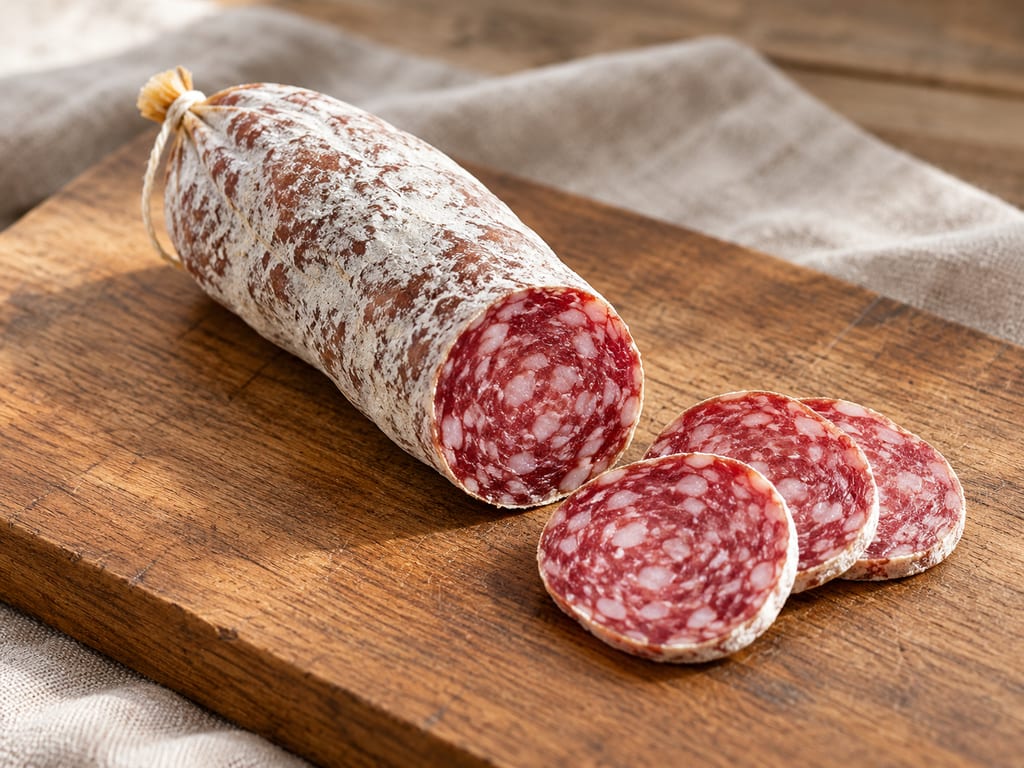
Cacciatore salami
Small Italian hunter-style salami of lean pork, firm fat, salt, pepper and garlic, mildly acidified and dry-matured; protected as Salamini Italiani alla Cacciatora DOP.
 FermenteaWhere food goes to change
Equipment · All-in-one appliances
dry-aging cabinet · curing cabinet
A powered cabinet regulates conditions around food during drying or maturation. Modern models range from small dry-aging cabinets to larger systems; their settings are product-specific, not universal process instructions.
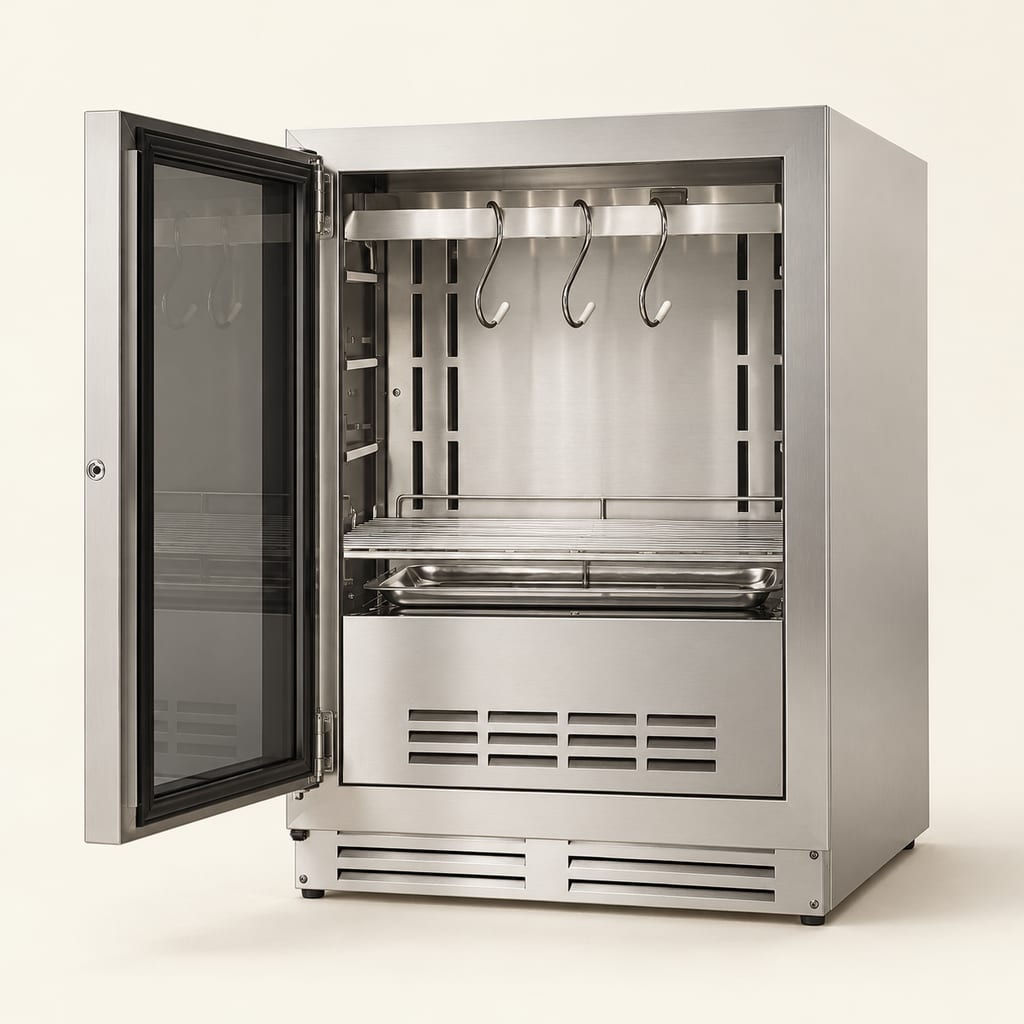
A controlled drying cabinet encloses food while managing some combination of temperature, humidity and air movement. In modern commercial equipment it can be a self-contained, powered cabinet rather than an open rack or a purpose-built curing room. This entry uses a documented undercounter dry-aging unit as a concrete example; cabinets differ in size, refrigeration, humidification and control.
HENDI's SKU 221426 is listed as a 98-litre undercounter cabinet measuring 595 × 620 × 830 mm. Its page describes a stainless-steel body and interior, a two-layer tinted tempered-glass door, a manual distilled-water container, forced cooling, adjustable humidity, a hanging rod and hooks, a shelf and a collection tray. The published temperature range is 1–25°C and the humidity range 60–85%. These figures describe this model only. The same page currently marks it as last stock and unavailable for online orders.
Drying removes water from a food to the surrounding air. Temperature affects the pace of moisture movement, while humidity and airflow influence how readily the surface can release it. A surface that dries too quickly may harden while the interior remains wetter; too little movement can leave moisture lingering around the product. The balance depends on the food, its shape, load and curing method.
A 2019 Fagor catalogue presents dry-aging cabinets for meat, salami and cheese, but distinguishes equipment ranges and intended products. A cabinet is a controlled environment, not a universal recipe. The controls make repeatable conditions possible; they do not decide which conditions or endpoints are appropriate for a given food.
The equipment has documented applications in meat maturation and charcuterie, with some commercial ranges also designed for cheese. The sources show both cabinet-sized units and larger rooms; those are not interchangeable objects, and a room built into a site belongs in the separate category of builds. A cabinet can be moved as a manufactured appliance.
Temperature, humidity and airflow settings must come from the method for the particular food, not from the cabinet's maximum range or a setting copied from a different product. Manufacturer pages do not establish a validated drying schedule for every food. HENDI says its model requires manual replenishment of distilled water and provides a low-water notification; its page does not supply a general cleaning, calibration or maintenance schedule. The listed SKU is also marked last stock, so availability should be checked before treating it as an obtainable model.
The HENDI example's stated temperature and humidity ranges are model specifications, not a universal food-drying schedule.
Source →A cabinet's setpoints cannot be transferred across products without a product-specific method; airflow, load and humidity interact during charcuterie drying.
Source →HENDI and Fagor pages document manufacturer offerings but do not state the manufacturing origin or establish the complete geographic reach of this equipment category.
Small Italian hunter-style salami of lean pork, firm fat, salt, pepper and garlic, mildly acidified and dry-matured; protected as Salamini Italiani alla Cacciatora DOP.

Soft, spreadable Calabrian pork sausage made with a great deal of red chilli and fatty pork, stuffed into natural casings, sometimes smoked and matured while staying soft.

A way to add independent temperature logging to an existing food dehydrator without changing its built-in controls or protections. It is a monitoring method, not a rewiring plan.

Pleurotus cystidiosus is the abalone mushroom, a cultivated oyster-type fungus with dark brown caps that grows more slowly and is more demanding than other Pleurotus species.

A dark, balanced vinegar from Emilia-Romagna made by combining cooked or concentrated grape must with wine vinegar, then acetifying and refining it in wood under a protected specification.

A living dairy inoculum that starts controlled cream fermentation, developing acidity and aroma before sour cream or cultured butter is finished.

A small electric incubator holds jars at a selected temperature for yogurt and other documented warm food preparations. Controls, capacity and vessel arrangement vary by model.

Adygean salt is a seasoned table salt associated with Adygea and the wider North Caucasian culinary tradition. Salt is blended with garlic and a variable selection of herbs and spices; the exact mix depends on the named style and maker.

The African Caesar-group mushroom, Amanita masasiensis, is a wild ectomycorrhizal species of central and southern African woodlands, eaten locally. The genus contains deadly poisonous species, so identification needs care.
No community contributions have been published for this entry yet.
Sign in to contribute. Published comments and photos are free to read.
HENDIForm · Materials · Dimensions · Capacity · Power · Use
Undercounter dry aging cabinet, SKU 221426HENDI describes an electric undercounter cabinet with forced cooling, adjustable humidity, a hanging rod and hooks, a shelf and collection tray.
The documented model has 98 L usable volume, dimensions 595 × 620 × 830 mm, a 1–25°C range, a 60–85% humidity range, and 220–240 V / 170 W electrical specifications.
The manufacturer's page labels SKU 221426 as last stock and says it is not currently available for online orders.
Cited in: A compact controlled environment; Use and limits
Fagor IndustrialHistory · Use · Form
Distribution: Wine cellars and dry-aging cabinetsThe 2019 catalogue describes cabinet systems for dry-aging meat, salami and cheese under controlled cold, humidity and ventilation conditions.
Its MA model family uses humidification for meat, salami and cheese, while MD models are described for meat maturation; the ranges differ, so no single schedule applies to all products.
Cited in: Why air, humidity and temperature belong together; Use and limits
Tempus FoodsHow it works · Limits
Controlled DryingThe producer identifies temperature, humidity and airflow as interacting conditions in charcuterie maturation.
It describes too-fast surface drying as case hardening and explains that excessive or insufficient airflow changes moisture removal; its numerical conditions are specific to its own products and are not copied as general settings.
Cited in: Why air, humidity and temperature belong together; Use and limits