
Acadian boucanière
A Cap-Pelé boucanière is an Acadian herring-smoking building. The documented Willie Niles example is a one-storey wood-frame structure with a ridge smoke vent and interior bays for hanging fish-bearing cannes.
 FermenteaWhere food goes to change
Built structures · Pits and cavities
Curanto en hoyo · curanto al hoyo · hoyo de curanto
The Chiloé curanto en hoyo is a fixed outdoor cooking pit heated with stones and covered with nalca leaves and earth or turf. It is distinct from curanto cooked in a pot; ingredients and layer order vary by household and occasion.
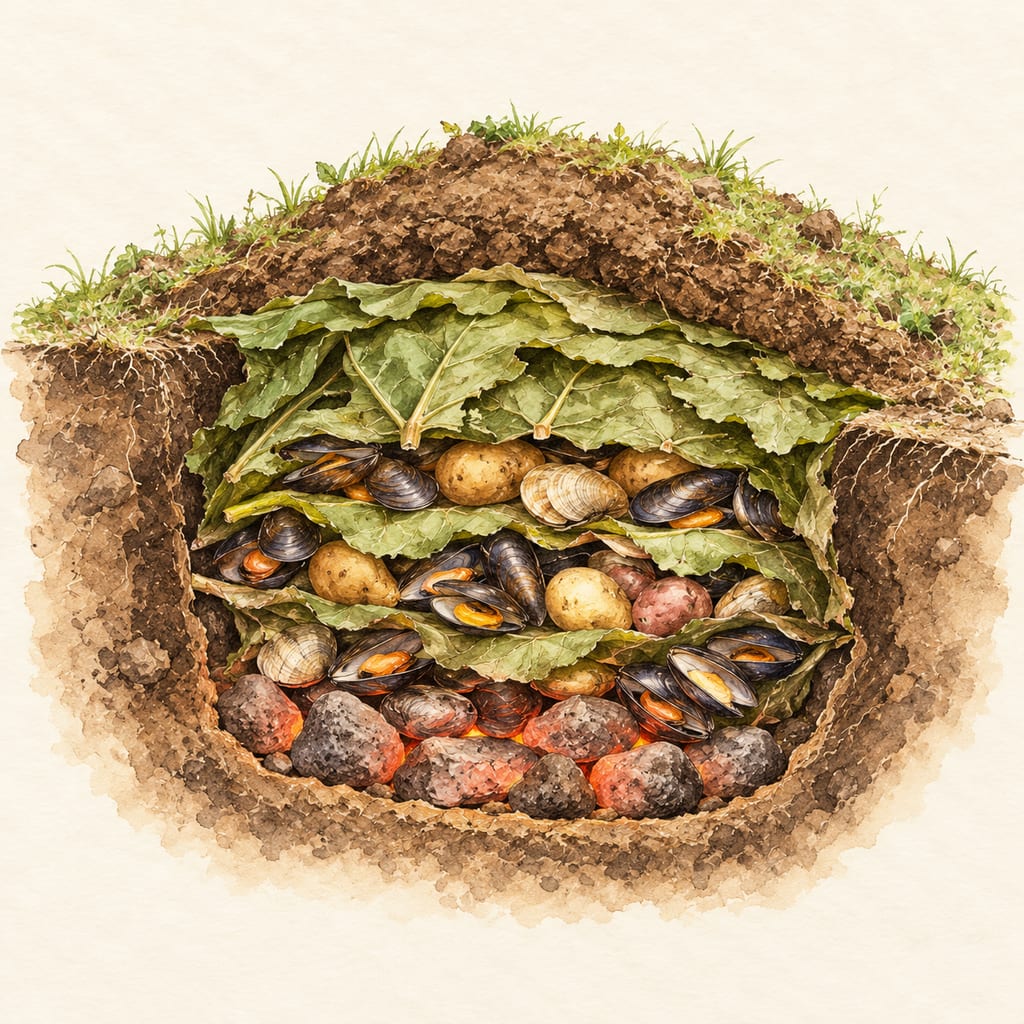
Curanto en hoyo names the pit-cooked form of curanto in Chiloé. The build is a cavity dug at the cooking site, heated with stones and firewood, then loaded in layers and closed with leaves and earth or turf. It is not a pot buried in a hole: the heated stones, leaves and soil work together inside the ground opening, and no separate cooking vessel is required.
The Chilean agricultural heritage programme SIPAM Chiloé describes the dish as a gathering around a hole with hot stones, seafood, meat, potatoes, milcaos and chapaleles under nalca leaves. It places this preparation within Chiloé's food culture. The fixed pit belongs to that account; curanto made in a pot is a different form.
Cavada's 1914 description begins with firewood and large stones in a hole. Once the stones have heated, foods are laid over them. His sequence places shellfish first, then potatoes, peas and beans, with a layer of nalca or pangue leaves and further foods above. The text describes a layer of plant cover and turf to close the top. This provides a dated written example, not a fixed recipe or mandatory sequence.
Current descriptions retain the essentials of hot stones, layers and a leafy cover but show that the contents can differ. SIPAM includes shellfish, meats, potatoes, chapaleles and milcaos. A 2018 family memoir from Puerto Montt describes the work of gathering large pangue leaves and stones, digging the hole, and preparing potato foods before the meal was assembled outdoors. The sources document variation across time and households.
The stones are heated in the pit before the food is assembled. The cover then confines heat and moisture around the layers; leaves separate ingredients and help keep the contents covered. SIPAM describes steam cooking beneath nalca leaves. Cavada describes turf above the leafy layers, while other modern accounts also use soil or turf. The sources support a covered earth-pit system, not a standardized wall, liner or chimney.
A 2024 report from Universidad Austral de Chile says people test curanto stones to judge whether they will withstand high temperatures without breaking. It records this practice as knowledge that travels with stones used over many curantos. The report gives no laboratory test or engineering standard, so the page records the purpose of the practice without inventing a technical test.
The pit was also a setting for collective work. In a family memoir published in El menú de Chile, the author recalls Sunday and holiday curantos outdoors at Piedra Azul, Chinquihue, Isla Tenglo and near Maullín. Family members gathered leaves and stones, dug the hole, prepared milcaos and chapaleles, and later shared the cooked foods. Those named places document one family’s practice rather than a complete map of curanto use.
Universidad Austral de Chile discusses curantos in the archaeological heritage of Chiloé and Llanquihue as linked with subsistence, socialization and repeated communal shellfish gathering. The university account connects present-day practice with archaeological contexts while recognizing the specific territories in the study. It does not establish that every ancient pit contained the modern mixture of foods, so this entry keeps the archaeological account separate from the detailed 1914 and contemporary descriptions.
Curanto cooked in a pot is explicitly described as a variation of the pit form in the family memoir, but it no longer needs the ground installation. The related recipe link points to curanto en hoyo as the dish cooked with this build; the link to a moist earth oven marks a broad structural comparison, not identity of ingredients or cultural history.
A 1914 source gives a pit about one metre across or sized as needed. That measurement is not a modern plan. The sources do not specify a universal depth, safe soil profile, stone species, amount of fuel, exact layer order, temperature or cook time. The illustration is therefore an interpretive cutaway of the documented relationships—ground cavity, loose heated stones, leaves, food and cover—not a measured reconstruction or a construction specification.
Francisco J. Cavada's 1914 account describes a pit heated with firewood and stones, layered foods and a covering of leaves and turf. Current Chilean agricultural heritage guidance documents curanto al hoyo in Chiloé. A university archaeological heritage publication relates current curantos to archaeological cooking contexts while distinguishing the evidence of past sites from the details of any one present-day practice.
A build is made where it stands: moving it means building it again.
A University Austral account reports that Chiloé cooks test stones before use to check whether they can tolerate high heat without breaking. This record does not supply a validated modern test or safe construction specification.
The entry concerns the pit-cooked form documented in Chiloé; it does not claim that every preparation or modern pot-cooked version uses this installation.
These are places recalled by one family in a published memoir, not an exhaustive distribution map.
A Cap-Pelé boucanière is an Acadian herring-smoking building. The documented Willie Niles example is a one-storey wood-frame structure with a ridge smoke vent and interior bays for hanging fish-bearing cannes.

Achcharu is a family of Sri Lankan vinegar pickles made with mixed vegetables or seasonal fruit and a piquant spice dressing. This version is a quick, refrigerated, non-fermented mixed-vegetable pickle.

The acocote is a long, hollowed and dried gourd used to draw aguamiel from a mature maguey. It is a harvesting tool: the sap is transferred to a separate vessel before it ferments into pulque.

Adrak murabba preserves young ginger in sugar syrup, a sweet South Asian preparation recorded in Indian cookery and food-processing sources.

Parkia biglobosa seeds are fermented into regional West African seasonings, including nététou, iru, dawadawa and soumbala. The yellow fruit pulp is a separate food, and names and methods vary by place.

Japanese reddish-brown vinegar from sake lees matured about three years, turned to vinegar by acetic bacteria; the vinegar of Handa and Edomae sushi rice.

A refined common-wheat flour blended for a broad range of baking; its protein and behavior vary with wheat, milling and market.

The almond mushroom, Agaricus subrufescens, was cultivated in eastern North America in the 1800s, lost its market, and returned as a cultivated mushroom from Brazil, where it is grown under several names.
No community contributions have been published for this entry yet.
Sign in to contribute. Published comments and photos are free to read.
SIPAM Chiloé; Chilean Ministry of AgricultureMethod · Geography · Materials · Modern use
Gastronomía ChilotaDescribes Chiloé curanto as an outdoor hole with hot stones, layered seafood, meat, potatoes, chapaletes and milcaos, covered with nalca leaves and cooked with steam.
Contrasts the pit method with cocimiento chilote cooked in a pot and situates these foods in Chiloé's cultural and culinary setting.
Cited in: The pit is the cooking structure; How the cavity is loaded; Heat, leaves and earth; A distinct build, not a universal plan
Francisco J. Cavada; Ediciones Museo Regional de Ancud (1914; 2016 reprint)Method · Materials · History · Geography
Chiloé y los chilotesThe 1914 account describes firewood and stones heating in a hole, with shellfish, potatoes, peas and beans and then other foods layered above.
It describes nalca or pangue leaves and turf as covers, and gives a roughly one-metre pit diameter as one historical description while allowing size to vary.
Cited in: How the cavity is loaded; Heat, leaves and earth; A distinct build, not a universal plan
Universidad Austral de ChileHistory · Geography · Heritage
Equipo UACh publica libro sobre “Arqueología de Llanquihue y Chiloé”The university describes curanto as cooking food from sea and land with hot stones and discusses archaeological contexts in Llanquihue and Chiloé.
It describes curanto as a means of subsistence and socialization, reports repeated communal shellfish gathering at coastal sites, and notes that stones are tested for heat resistance before use.
The article reports similarities between archaeological contexts and current practice but does not establish that every archaeological pit had the same ingredients or arrangement as a modern curanto.
Cited in: Heat, leaves and earth; Chiloé place and community
Ministerio de las Culturas, las Artes y el Patrimonio de ChileMethod · Geography · Social use
El menú de Chile: reconocimiento a las cocinas patrimonialesA family memoir recalls outdoor curanto al hoyo on Sundays and holidays at Piedra Azul, Chinquihue, Isla Tenglo and near Maullín, describing the collection of leaves, selection of stones, digging the pit, preparing milcaos and chapaleles, and serving the cooked layers.
The memoir distinguishes curanto in a pot as a variation of curanto al hoyo and describes the family's 1940–1970 practices; these details are one family account.
Cited in: How the cavity is loaded; Chiloé place and community; A distinct build, not a universal plan
Wikimedia Commons; photograph by Fabiola CárcamoImage reference
Curanto al Hoyo, Chiloé.JPGPhotograph shows an open Chiloé curanto pit with leaf lining and layered shellfish and other foods; licensed CC BY-SA 3.0.
Wikimedia Commons; photograph by Lin linaoImage reference
Fuego para curanto-2.jpgPhotograph shows fire heating stones for curanto in Chiloé; licensed CC BY-SA 3.0.